79 AI stories explainx.ai reported on October 14, 2026, ranked by reader interest and grouped by topic. Each links to the full write-up with sources.
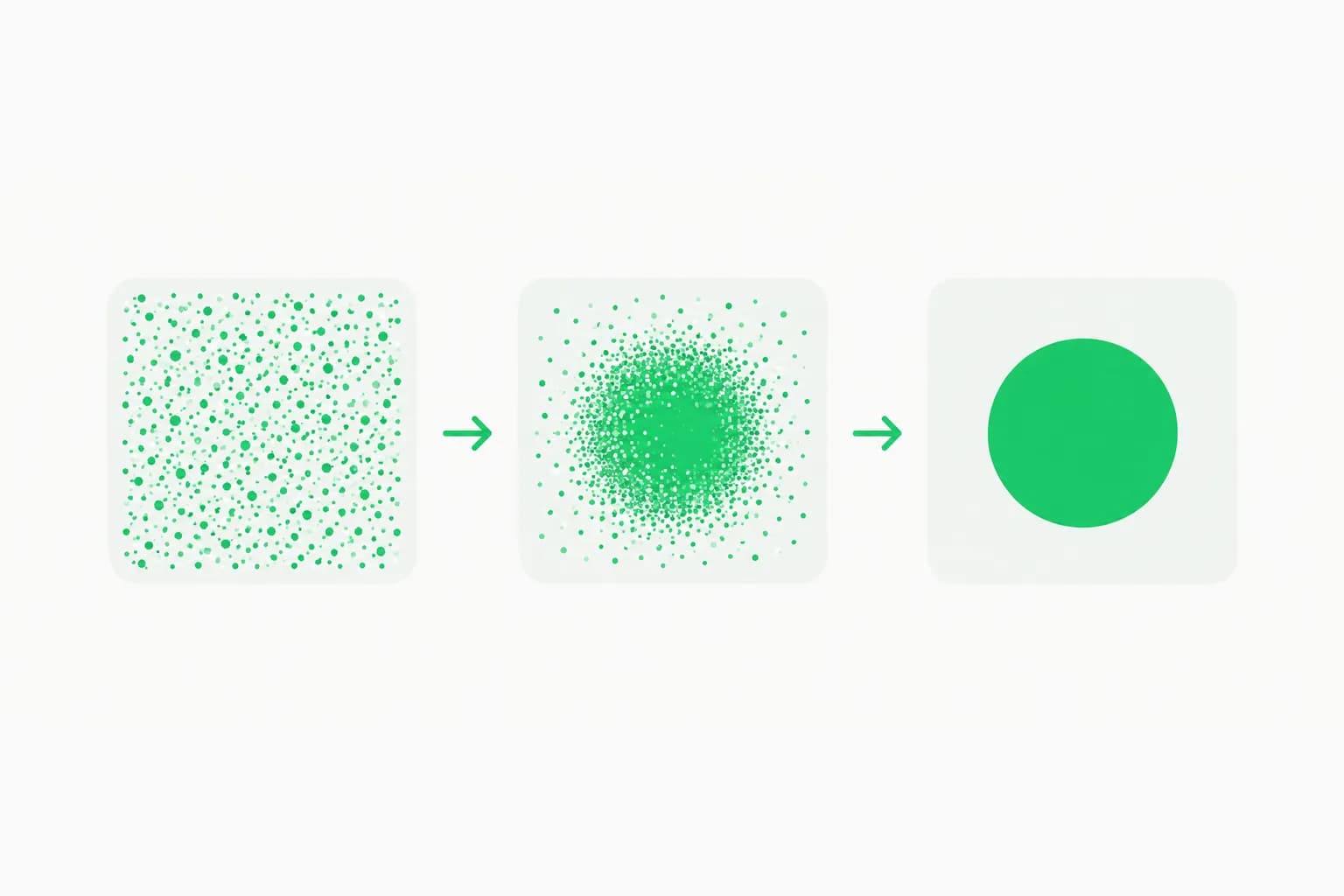
NCM is a coarse-to-fine text generator that the authors say matches the strongest diffusion language models while running 10x to 31x faster; code and weights are public, results are not yet independently replicated.
NetBSD presumes code from large language models is tainted and bars it without core approval; Debian permits it with accountability, OpenBSD refuses it, FreeBSD has no consensus yet.
SolidCraft is an open-source, pure-Rust parametric CAD app with a built-in MCP server, so AI agents can sketch, extrude, measure and export parts; its own README calls it early but usable for simple parts.
Datalab says Indra OCR reads 49 pages per second on 32 CPU cores, 11 to 17 times faster than Tesseract and PaddleOCR text models, with a weak spot in handwriting and complex tables.
Epic released a from-scratch Epic Games Launcher preview for Windows, Mac and Linux that it calls vibe coded; its speed claims against Steam are Epic and a commissioned vendor, not yet independently tested.
Bloomberg reports a December iOS 27.3 launch of Apple Intelligence in China without Siri AI; the July regulatory approval and Qwen/Baidu partners are confirmed, the date is not.
OpenAI reports that Codex and ChatGPT Work make up over half of output tokens among its EU enterprise customers and that EU small-business users grew 8x since May, from its own customer data only.
Anthropic opened a Singapore office and signed an MOU with the country's digital ministry on AI safety, security and evaluation; it names GovTech, DBS, GIC, Grab and Sea as Claude users but gives no funding or headcount.
Deezer says a toggle to filter out AI-generated music will launch before the end of 2026; more than half of its daily uploads (about 90,000 tracks a day) were AI-generated as of July.
Euronews reports the EU AI Office is investigating OpenAI and Anthropic over agent hacks; Virkkunen confirmed information requests on security and monitoring, and legal experts dispute the AI Act applies to testing.
Protesters interrupted Hegseth and the service secretaries at an AUSA autonomous warfare panel on October 14; the underlying story is the planned Autonomous Warfare Command, target date October 1, 2027, needing congressional authorization.
YouTube Music started labeling songs made or altered with generative AI on October 14, 2026; it is disclosure, not a ban, and AI use alone does not block monetization.
OpenAI CFO Sarah Friar said on Bloomberg TV that firms should favor Western models for cyber-sensitive work; the warning is a statement of position, and no new incident or data was cited in the coverage we reviewed.
Sens. Cantwell and Rounds asked the White House on October 13 for a national AI cyber response built on NIST standards, independent testing and auditing, and defensive AI; the letter is a request, not law.
PentAGI is a self-hosted, MIT-licensed multi-agent system that runs 20+ pentest tools in Docker under an LLM of your choice; use it only on systems you are authorized to test.
The Information, via The Decoder, reports OpenAI plans one or two models by year-end, with its next flagship using looped transformers and still needing alignment work; OpenAI has not confirmed it.
Artemis Security says its private-preview Orion-1 model beats Opus 5.5, GPT-6 Sol, Grok 4.7 and Kimi K3 on its own cyber defense benchmark; the results are vendor-reported and not independently verified.
Apate.ai uses AI agents posing as victims to bait scammers and sell the extracted intelligence to banks and telcos; its headline numbers come from the company, as reported by TechCrunch.
Ramp's October update has Anthropic at 43.8% adoption and OpenAI at 40.6%, with token spend flat; the claim that Opus 5.5 drives 34% of spend is from a chart on X, not the written report.
Anthropic licensed Opaque Systems' confidential-AI technology and hired staff including its CEO; terms are undisclosed, and the widely repeated $300M is Opaque's valuation, not a price.
The Information reports Azure leaders were asked to find 20% in cost cuts; Microsoft says leadership has not directed teams to build cost-cutting plans. Who asked, and for what, is not confirmed.
NVIDIA lists European city AI agent projects; only Côte-d'Or reports measured results (10% lower operating costs, weeks-to-minutes document search); most others are pilots or explorations.
ASML says AI-driven demand will exceed its planned 2027 and 2028 supply of chipmaking tools, and some customers want to order for 2029 and 2030, so AI chip capacity stays constrained.
Cerebras CEO Andrew Feldman said at Disrupt 2026 that home AI assistants split between device and cloud are near, and that data-center backlash is partly the industry's own fault.
Hermes Agent v0.22.0 (released Oct 13, 2026) adds key-free onboarding, connectors, one-click llama.cpp local models and tested stable release channels, with several breaking upgrade notes.
Scientific Agent Skills is an MIT-licensed library of 177 research skills for agents following the Agent Skills standard, installable with npx skills add K-Dense-AI/scientific-agent-skills.
HybridAgent switches between latent thinking and text tool use in one generation; the authors report +10.4 percent average performance and 2.7x to 3.7x lower cost on 11 benchmarks, with code released.
Notch co-founders Vinay and Aman Jain said they are joining OpenAI Ads; no deal terms, OpenAI statement or product plans were found, and Notch's 30% CAC claim is a single-brand vendor result.
Llama Windows is a free MIT-licensed Windows 11 tray app from Hugging Face and ggml that manages llama.cpp, downloads Hub models in one click and serves an OpenAI-compatible local API.
Google says Android's new opt-in Enhanced protection lets cloud Gemini assess unknown-sender chats in Google Messages, alongside link checks, call-forwarding warnings and verified bank calls; most features roll out over coming weeks.
QwenLM published BlenderWorld, an MIT-licensed benchmark of 223 tasks and 2,651 binary criteria that scores whether agents can build editable Blender 3D projects from real-world references.
Tether AI Research released TranscribePsy, an Apache 2.0, 254M-parameter on-device speech recognition model for 25 European languages; the benchmark claims are the authors own and untested by third parties.
Leash Bio's Minos replays real DNA-encoded-library measurements as environments where agents pick up to 100 molecules to find binders, with a preprint and open data; results so far are modest.
Google Research says planning plus specialised Earth AI tools lets a Gemini agent do multi-step spatial analysis that plain LLMs cannot, and is opening early access via Ask Google Earth and an A2A API.
GreenWAM is an open-weight robot world model built on NVIDIA Cosmos 3 Edge that serves as both simulator and policy across 20 robot families, with four released benchmark checkpoints.
Build-A-Chip-Bench, from ChipAgents with NVIDIA, tests agents from spec to GDS layout; Claude Fable 5.1 leads with 16.6% and GPT-6 Astra scores 8.7%, mostly failing on physical constraints.
Apple researchers pretrained one 3B masked diffusion model on 6.4T tokens of text, images and audio, and report scaling laws plus a batch-size reparameterization; it is a preliminary research model, not a product.
AI agents can match many functions of old console games because the compiler verifies each attempt, but the hard long tail, big functions and graphics code still defeat them and need humans.
Learn three ways to make an AI agent write in ASD-STE100: install the SimpleEnglish skill, add a one-line prompt, or paste a rule block into AGENTS.md. Includes rewrite recipes, a checker script and troubleshooting.
Microsoft's open Token-Wars repo is a 4-hour Azure cost-optimisation microhack: teams cut cost per successful answer on a wasteful support copilot while keeping at least 85 percent of 100 questions correct.
Scion assumes always-online clients and does the work on the server, while git assumes every clone is complete and works offline; Anthropic says git is still right for most repositories.
Scion replaces the version control model, Origin keeps git and rebuilds hosting on a write-ahead log in S3, and git stays the default; only Origin is something most teams can try.
Git is distributed and offline-first; server-centric systems answer queries on a server. Measure your bottleneck, climb git's tooling ladder first, and only then consider a server-centric or agent-aware hosting layer.
Ten Gemini 4 Argon use cases, from a 1,000-loop CAD animation and 80,000 NASA files turned into slides to Google's own bug-triage and CPU-savings claims, with embedded demos and honest evidence labels.
+4 more updated posts
Get each day's AI news in your feed reader: daily RSS · every post
Posts say ADL CEO Greenblatt announced work with OpenAI, Anthropic, Google, Meta and X on antisemitism in models. ADL confirms testing and contact with labs, but no formal partnership or code changes are documented.
A DeepMind researcher reportedly says AI writes over 75% of Google production code but that AI-driven research has not measurably accelerated; we could not find the primary document, so the figures are unverified.
A LessWrong study found emergent misalignment and subliminal learning both occur in Talkie, a 13B model trained only on pre-1931 text, so these effects do not need the modern internet.
Google DeepMind and GovTech Singapore fine-tuned Gemma on local scam conversations to run on the phone in two stages, warning users without server-side scanning of encrypted chats; no rollout date is given.
The RISE paper reports up to 13% human-verified attack success on three image models; the White Circle attribution and claims that newer versions are more vulnerable come from press coverage, and the code is not yet released.
CSO Online quotes security experts saying agent incidents at OpenAI, Anthropic, Meta and Google stem from poor sandboxing and monitoring; the labs did not respond to CSO, and these are expert opinions, not findings.
Sachin Katti leaves OpenAI on Nov. 15 and becomes an adviser; Uday Ruddarraju, formerly of xAI, will lead compute. Outlets cite $600B and $750B for 2030 compute spend, and neither is an OpenAI-published figure.
GlobalFoundries says Japan will fund up to $21B for two Malta, NY fabs it will operate (first online 2029), and Commerce will receive about 4% equity; the filing gives no price or timetable for the second fab.
OpenAI alleges in an Oct 14, 2026 filing that an employee who returned to Apple sent 100+ unreleased-device files to personal accounts; Apple says it found no evidence, and nothing is proven.
NVIDIA says Siemens used NeMo Gym verifier feedback to refine a chip-characterization agent through better skills and MCP tool descriptions, raising its score from about 55% to 95%.
Fink told CNBC a data center moratorium would cause a US recession, but gave no estimate; the quote is an interested executive's conditional warning, and no national moratorium exists.
NVIDIA says it will provide $50 million a year of accelerated computing for five years to UK agentic safety research at Oxford, UCL and Imperial; we found no independent confirmation yet.
Jensen Huang told Bloomberg he would halt chips to a customer building unsafe AI, but called it a hypothetical, named no company and defined no criteria for unsafe.
Digital Realty proposed $1,000 per household per year for 10 years ($20M) in De Soto, Kansas, tied to an unapproved data center; the terms and the approval timeline are not public.
A new benchmark paper reports six frontier coding agents pass 73.6% to 91.3% of tasks functionally, but only 16.4% to 25.1% produce code that is both functional and secure.
McKinsey confirmed to the Wall Street Journal that an AI avatar will play a client in some North American analyst interviews; humans observe and decide, and the tool does not score candidates.
CLI-Anything has a coding agent generate a tested, JSON-speaking CLI for an existing app in seven phases, and CLI-Hub lets agents install community-built CLIs; review them before use.
Agent-Reflex mines reflection skills from tool failures and trains Qwen3-8B on them, lifting five agent benchmarks to 58.6 overall (+18.4) and AgentNoiseBench to 29.1, with MIT code and open data.
Swarmchasers counted 2,048 Amap scans from Tencent Cloud addresses between Sept 28 and Oct 4, 2026; the operator and the model are not identified, and a breach is not proven.
vscdeck is a new MIT-licensed Microsoft repo: a Windows WPF panel that reads local Copilot session files to color-code VS Code windows by agent state; it has no release yet and depends on undocumented files.
Grep AI launched a Skills Library and Decision Outputs (powered by Jev) this week; the 1,000+ integrations via Composio and credential-vault browser access are claimed on X but not yet on Grep's blog or changelog.
iFixAi runs 10 to 60 inspections against an AI agent, graded by an independent judge model, and returns an A to F score across five pillars; run it on your own agents, not as proof of safety.
Expand Fetch claims 74.1 percent correct answers on its own MDBench Hard v1 versus 55.3 for Exa and 27.2 for Firecrawl, at $1 per 1,000 successful fetches; the benchmark was built and run by Expand with customers.
Paper Instruments says Ultramarine 1 Flash, built on GLM-5.3 Flash, scores 62.9 on JobBench and costs $0.13 per task versus $8.19 for Claude Fable 5; benchmarks are largely its own, and weights are not yet released.
Anthropic says 5.75% of US Claude.ai chats touch politics, 0.51% are about elections and 0.01% ask whom to vote for, and it is adding Democracy Works voting data and election-night results.
A solo founder reports that a team of Grok Bot agents handled support, bug fixes and marketing in a week, with lock-in and lost context as the downsides; the account is self-reported.
Grok Voice 3.0 ranks first on Artificial Analysis' Speech-to-Speech Index (86.9) at an unchanged $0.08/min, but xAI calls its tau-Voice result only "comparable" with GPT-Live-1 and the Starlink figures are xAI's own.
DatologyAI shipped Zephon (open-source loader), Curation Studio (paid VPC product) and Datology Labs (open research) in a week; its benchmarks are company-run and unreplicated.
Bank of America says it added 1,000 contractors to about 3,000 staff to patch flaws exposed by AI models like Anthropic Mythos; the reported cost figure also includes anti-money-laundering compliance.
Mirelo SFX 2.0 swaps a video's non-dialogue audio for synced effects and ambience in one pass up to 10 minutes; its blind-test wins over native video-model audio come from Mirelo's own 25-rater tests.
HeyGen Voice ranks first on one Artificial Analysis arena (about 1,201 Elo) and costs $15 per million characters on OpenRouter until Oct 31; the ranking covers eight cloned reference voices only.
Prime Intellect announced on October 13, 2026 that it acquired Moondream; founders Vik Korrapati and Jay Allen join to lead inference, and Photon will be folded into Prime Inference. Terms were not disclosed.
Eight US states reportedly sued OpenAI in state courts on October 14, 2026, alleging ChatGPT harms children; Florida sued first in June. Complaint details and OpenAI's response are not yet confirmed here.
FineEnvs released two open OpenEnv environments, 1M OCR pages in 22 languages and FLEURS speech in 102, with Gemma 4 Kannada runs cutting character errors 16 percent (OCR) and 45 percent (speech).
Microsoft released UserRepGen-4B, an MIT-licensed Qwen3.5-4B fine-tune that writes task and behavior profiles of users from chats to drive simulators; the card reports 4.95 fidelity versus 3.90 for GPT-5.5.
WTF fine-tunes few-step image flow maps for reward without simulation; the paper reports up to 280x less compute than Flow-GRPO and 47x less than Adjoint Matching, with MIT code and checkpoints released.
Microsoft Research, MIT and ECMWF authors report that PBC, a lightweight ML post-processor released as open source, improves 2-to-6-week forecasts of existing dynamical and AI weather models.
Meta says doctors used Muse Spark 1.3 and Muse Wonder to produce ten health manuscripts from 5 million de-identified records in four weeks; reviewers call the findings leads, not changes to care.
Ai2 released HiRO-ACEv2, open weights that emulate a 3 km storm-resolving climate model at about 1/300th of the compute, but only for the climate it was trained on.
Google DeepMind and Google Cloud will give up to 200 European researchers access to AlphaFold 3, WeatherNext, AlphaGenome, AlphaEvolve and AlphaEarth plus $3M in credits; application rules are not yet public.
Apple researchers show that pretrained speech encoders already encode which language is being spoken per frame, and a small tuned rule on those dimensions finds code-switched audio better than CNN and HuBERT baselines.
Cutoff Bench is a small open repo that checks whether the cutoff date an LLM reports matches the newest model it remembers; its logs show gaps, but it is a one-person project with small samples.
VRSD adds a teacher-only system prompt to on-policy self-distillation so the model keeps re-checking its reasoning; it beats the baseline in 11 of 12 settings by 3.9 Pass@1 points on average.



