




A NeurIPS 2026 spotlight paper offers a cheaper way to teach image generators what people prefer. WTF, short for Wasserstein-Tilted Flow Maps, fine-tunes few-step image models for reward without simulating long generation rollouts. The paper, arXiv 2609.27033 by Abbas Mammadov, Jerry Y. Huang, Justin Lin and colleagues at Oxford and Carnegie Mellon, reports reaching the peak reward of two strong baselines with up to 280x and 47x less training compute.
You may have seen a different number. Social posts summarizing the work said "50 to 100x faster." The paper's figure is larger and more specific, and the difference is a useful lesson in reading speedup claims. The authors have also released MIT-licensed code and checkpoints, so the result is testable. This is a research article for builders who post-train generators, in the same family as our coverage of Apple's four-step normalizing trajectory image models.
TL;DR: questions and answers
| Question | Answer |
|---|---|
| What is it? | A reward fine-tuning method for flow-map image models |
| Who made it? | Oxford and Carnegie Mellon (Abbas Mammadov and Jerry Huang lead; Yee Whye Teh and Nicholas Boffi are the last-listed authors) |
| Venue | NeurIPS 2026 spotlight |
| Headline claim | Up to 280x less compute than Flow-GRPO, 47x less than Adjoint Matching |
| "50 to 100x" in social posts? | A looser summary; the paper reports different multiples per baseline |
| Is code released? | Yes, MIT, plus six checkpoints (8.3 GB) |
| Training cost | About 6 hours on 8 H100s (text-to-image), about 3 hours (ImageNet-256) |
| Reward used | HPSv2, a learned human-preference score |
What problem does WTF solve?
Reward fine-tuning updates a pre-trained generator so its samples score higher under a reward, such as a human-preference model, while staying close to the original. The catch, per the project page, is that rewards are defined only for complete samples, so each update needs rollouts from the current model.
The standard recipe frames this as sampling from a KL-regularized reward tilt: reweight the base model's distribution by the exponential of the reward. The page notes two weaknesses. The tilt can only reweight mass the base model already has, and its pathwise form is tractable for diffusions, so existing methods convert a deterministic flow into a diffusion, fine-tune it with many-step stochastic rollouts, then convert it back. That conversion cannot exploit flow maps, models that jump between any two times of the generation process in one network evaluation. If that sounds like consistency models, it is related, and it is why few-step generators are fast.
How does WTF work in plain language?
WTF swaps the KL penalty for a transport cost built from the pre-trained model's own dynamics: how much steering the original flow needs to move a sample to a new endpoint. Instead of reweighting a whole distribution, each starting noise sample is moved to the endpoint with the best trade-off between reward and steering effort.
The authors show this is equivalent to a deterministic optimal control problem, where you learn a small correction to the model's drift with a quadratic penalty on its size. A pre-trained flow map then lets them estimate the value gradient with two network evaluations, with an unbiased single-sample Monte Carlo estimate, no learned critic and no rollout simulation. Training regresses the flow map onto that gradient and keeps it consistent through self-distillation. The output is itself a fine-tuned flow map that works from one to many sampling steps, with no extra distillation step.
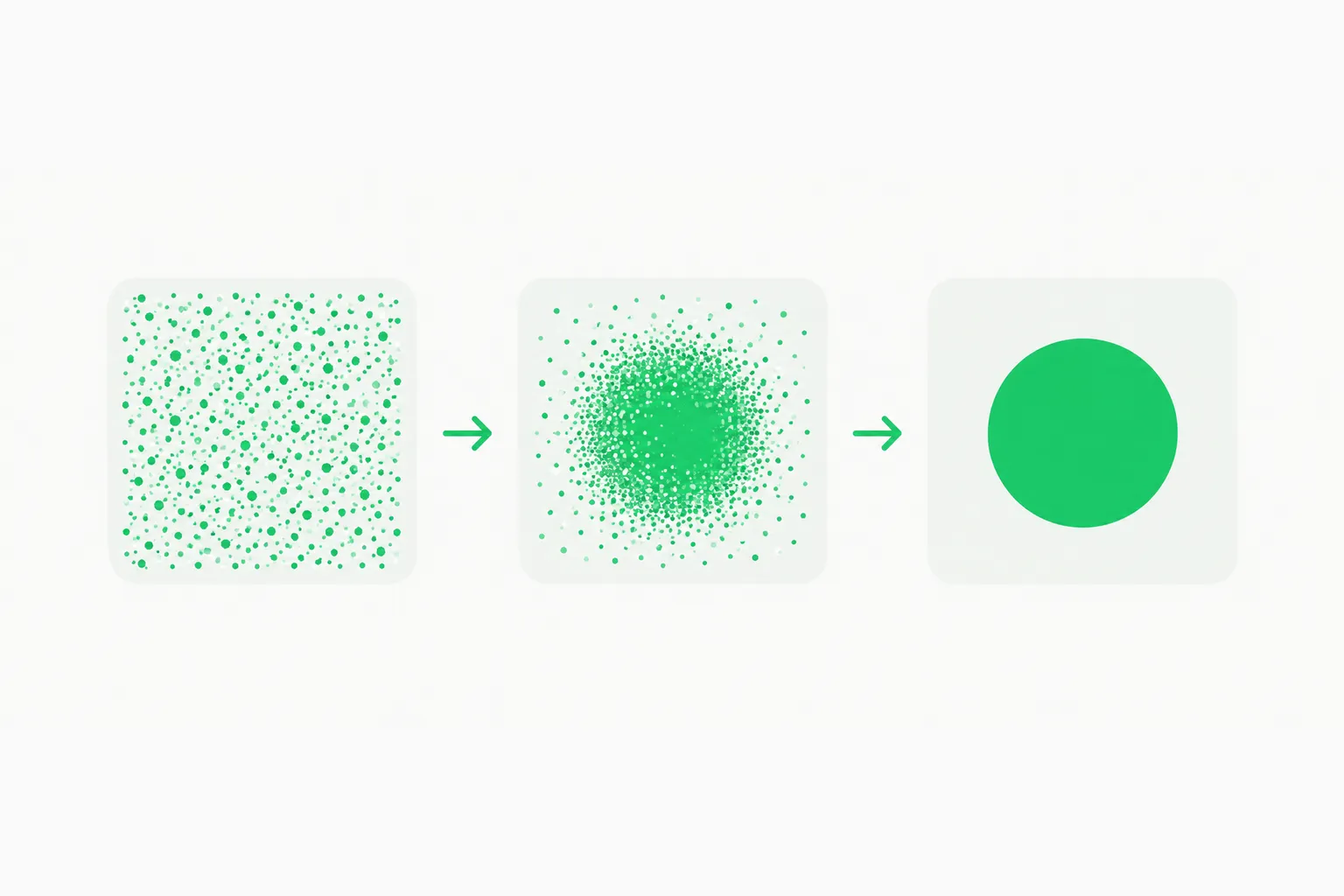 Speckles resolving into a clean shape in three panels, illustrating few-step image generation from noise with a flow map
What do the results say?
From the repository's tables (values reported in the paper; WTF's own run, not independently reproduced).
Text-to-image (TiM-T2I with a rank-16 LoRA, HPSv2 reward, about 48 GPU-hours on one 8xH100 node for every method):
| Method | Steps | HPSv2 | PickScore | ImageReward |
|---|---|---|---|---|
| Base model | 4 | 0.255 | 21.06 | 0.665 |
| Base model | 50 | 0.274 | 21.58 | 0.997 |
| Flow-GRPO | 50 | 0.303 | 22.06 | 1.210 |
| Adjoint Matching | 50 | 0.357 | 22.75 | 1.380 |
| WTF | 1 | 0.347 | 22.31 | 1.069 |
| WTF | 4 | 0.401 | 22.97 | 1.383 |
| WTF | 50 | 0.398 | 22.87 | 1.416 |
Reading it carefully: a single WTF checkpoint at 4 steps beats the base model at 50 steps and both baselines on HPSv2, and roughly matches Adjoint Matching on ImageReward. At one step it falls just short of Adjoint Matching's HPSv2. Diversity is lower than the base model, as expected after reward tuning: the repository's diversity columns show WTF at 4 steps (0.250 DreamSim) between Adjoint Matching (0.210) and the base model at 4 steps (0.426).
ImageNet-256 (DMF XL/2): WTF at 1 step reaches HPSv2 0.319 and at 250 steps 0.330, against the base model's 0.214 and 0.218. It trails a baseline called VFM on PickScore and ImageReward at one step (20.91 and 0.860 for VFM versus 20.24 and 0.612), while leading on HPSv2 (0.307 for VFM). So the picture is mixed, not a clean sweep.
Where does 280x come from?
The project page says that on text-to-image, WTF "reaches the peak rewards of Flow-GRPO and Adjoint Matching with up to 280x and 47x less training compute, respectively." This is measured on a reward-versus-cumulative-compute curve at 50 evaluation steps: the span from where WTF first matches a baseline's peak to where that baseline gets there. The "up to" matters. It is a best-case comparison at a particular reward level, and the curves have standard-error bands.
The widely shared "50 to 100x" figure came from author posts describing the approach as roughly that much faster than current state of the art. It is not wrong in spirit, but it is not the number in the paper. When you see a multiple, ask: against which baseline, at what reward, measured as compute or wall-clock time, and with what budget. Here the repository adds that Adjoint Matching and Flow-GRPO checkpoints are not released, so you cannot rerun those baselines against WTF from the release alone.
How to try it
The repository is MIT-licensed and includes training, evaluation and a reproduction checklist. The Hugging Face repo wasserstein-tilted-flow-maps/WTF holds six checkpoints (8.3 GB): the main text-to-image LoRA, two ablation checkpoints and three ImageNet seeds.
huggingface-cli download wasserstein-tilted-flow-maps/WTF --include "*.pt" --local-dir checkpoints
python eval.py t2i/configs/wtf_t2i.yaml --ckpt checkpoints/wtf_t2i_step1460.pt --nfe 4 --gpus 1
python eval.py imagenet/configs/wtf_imagenet.yaml --ckpt checkpoints/wtf_imagenet_seed0_step12500.pt --nfe 1
Requirements from the README: Python 3.11, CUDA 12.1, PyTorch 2.5.1. You need the base models: TiM-T2I (Apache-2.0) uses Gemma-3-1B-it as a text encoder, a gated model you must accept the license for, and the ImageNet model is Decoupled MeanFlow XL/2 (MIT). Training is python run.py t2i/configs/wtf_t2i.yaml (about 6 hours on 8 H100s) or the ImageNet config (about 3 hours). ImageNet training is data-free, using noise and random class labels.
What are the caveats?
- Narrow setting. The experiments cover two benchmarks and one reward family (HPSv2 for training, with PickScore and ImageReward for evaluation). Results on other generators, rewards or text, video or robotics are not shown.
- Reward over-optimization. Fine-tuning toward a learned scorer can overfit it. This is a known failure mode, discussed in our post on on-policy distillation collapse and reward hacking. Higher scores do not guarantee images people prefer, and the numbers we reviewed include no human study.
- Approximation. The image experiments use a Euclidean reward gradient that omits the flow-map Jacobian, with an ablation reported in the paper.
- Needs flow maps. WTF requires a pre-trained flow map, which most hosted image APIs are not. For application builders, this is a method to watch, not a switch to flip.
- Early traction. The repository had one star and no forks at publication. That says nothing about quality, but there is no community replication yet.
Why it matters for people building with AI
Post-training is where the cost of generative models is shifting, as we covered in open-source RL-as-a-service stacks and a worked example of training a 4B model with RL. If a fine-tuning method needs two network evaluations per gradient instead of long rollouts, small teams can align image models on a single node in hours, which is the claim to test. The paper's broader argument, that fast samplers like flow maps are infrastructure for efficient post-training and that the KL formulation is one choice among many, is worth following even if you never touch an image model.
If you want to verify it, run the evaluation commands on the released checkpoints, then retrain with the default config and compare against the expected values in the reproduction file. Do the same with a different reward model to see how much of the gain transfers.
What we could not verify
We read the paper abstract, project page, repository and checkpoint card, but did not run the code or reproduce any number. The compute-saving figures come from the authors' own curves, and the Flow-GRPO and Adjoint Matching baselines were not released, so we could not check those runs. We also did not review the full paper's proofs. We will update this post if independent replications appear.
Details reflect the authors' public materials as of October 14, 2026.
Related reading
- Apple's four-step normalizing trajectory image models
- On-policy distillation collapse and reward hacking
- Open-source RL-as-a-service post-training stacks
- Training a 4B model with RL for Postgres query optimization
- Fine-tuning LLMs: the complete guide
- DatologyAI launch week
- Official: arXiv paper, project page, code