



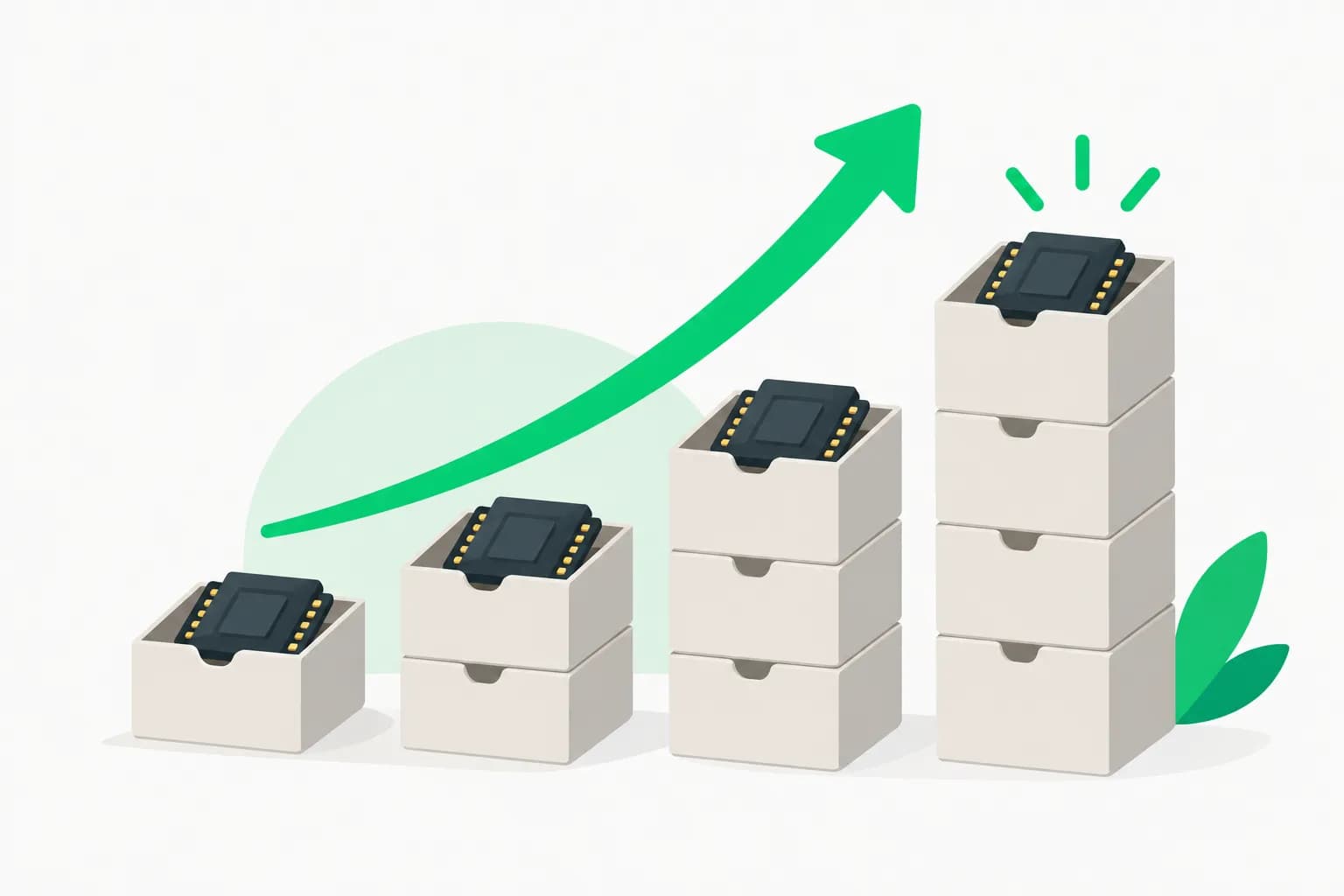
ASML, the Dutch company that makes the lithography machines every leading-edge AI chip depends on, said on October 14, 2026 that AI demand is now larger than what it can build. In its Q3 2026 results release, the company wrote that "our supply as currently planned for both 2027 and 2028 will not fully meet the demand of our customers," and that some customers are now interested in placing orders for 2029 and even 2030.
That is a statement about the deepest bottleneck in the AI buildout. GPUs, custom accelerators and HBM stacks all start on wafers patterned by ASML tools. When the toolmaker says it is sold out two years ahead, the constraint on AI compute is not only power, packaging or memory. It is also the machines that print the chips.
TL;DR: what ASML reported
| Question | Answer (from ASML's release) |
|---|---|
| Q3 2026 net sales | €11.7 billion (€11,662 million), a record for the company per its CEO |
| Gross margin | 57.5%, above guidance |
| Net income | €5.0 billion (€4,960 million), versus €2.9 billion in Q2 |
| New systems sold | 113 in Q3, versus 86 in Q2 |
| Installed Base Management sales | €3.3 billion, above guidance, on productivity-upgrade demand |
| Q4 2026 guidance | Net sales €14.2 to €15.2 billion, gross margin around 57% |
| Full-year 2026 guidance | Net sales €44 to €45 billion, gross margin around 56% |
| Supply versus demand | 2027 and 2028 supply "will not fully meet" customer demand |
| Orders for later years | Some customers are interested in ordering for 2029 and even 2030 |
| Capacity plan | Investigating more 2028 capacity beyond the 30% increase previously communicated |
What exactly did the CEO say?
The quotes below come from the CEO statement in the release, attributed to ASML President and CEO Christophe Fouquet. They are the primary source for the story.
On demand: customers "continue to increase their short- and medium-term equipment demand forecasts with us, driven primarily by their views on the size and duration of AI-related investments."
On the horizon: "in light of their demand visibility, some customers are expressing an interest in placing orders with us for 2029 and even 2030."
On supply: with an order book momentum that "continues to increase quarter on quarter this year," ASML "now expect[s] that our supply as currently planned for both 2027 and 2028 will not fully meet the demand of our customers."
On the response: ASML is "investigating ways to increase capacity for 2028 beyond the 30% increase we previously communicated," while continuing to provide wafer capacity "through our productivity upgrade portfolio."
Two details matter for reading this correctly. First, interest in 2029 and 2030 orders is not the same as orders. ASML's own forward-looking statement warns of the risk that "customer interest in orders in future years" may not turn into actual orders. Second, ASML no longer publishes quarterly net bookings, so there is no booking number to check this against. The evidence is management commentary and the revenue trend.
How does this follow from July?
In July, ASML's Q2 2026 results, summarized in the Q2 press release, raised the 2026 outlook and set out the capacity plan: increase 2026 low-NA EUV and DUV immersion capacity by 30% in 2027, and investigate a further 30% in 2028. Management then described EUV as close to fully booked for 2027 with a substantial number of orders already in for 2028.
Three months later the message hardened. Q2 sales were €9.3 billion; Q3 reached €11.7 billion; Q4 is guided at €14.2 to €15.2 billion. Net income rose from €2.9 billion to €5.0 billion in one quarter. A 30% capacity increase that looked generous in July is now described as not enough for 2028. Earlier in September, a JPMorgan note cited by Reuters said ASML was examining ways to build more than 110 EUV tools in 2028, with assembly speed rather than the supply chain as the limiter. That is analyst reporting, not an ASML commitment, so treat the number as a signal and not a target.
Why a lithography shortage matters for AI
Every generation of AI accelerator is a bet on a leading-edge process node, and every node needs more EUV exposures per wafer than the last. HBM, the memory stacked next to the GPU, is built on DRAM lines that are also adding EUV layers. So the same few machines serve TSMC's accelerator wafers, Samsung and SK Hynix's memory, and Intel's foundry ambitions.
When ASML can only ship so many tools per year, the downstream limits are straightforward:
- Chipmakers cannot add wafer starts faster than tool deliveries plus installation time.
- AI labs that sign multi-year compute deals are competing for the same slice of wafer supply.
- Used and upgraded tools, which ASML sells through its installed-base business, become a way to squeeze more output from existing fabs. That business posted €3.3 billion in Q3.
This is the supply-side counterpart to the memory crunch we covered in Stanford's history of DRAM, HBM and NAND prices and the lead-time problems in the AI server MLCC shortage.
Where does this fit with the rest of the AI chip chain?
 Illustration of a calendar filled with chip slots, representing scarce chip-tool capacity in 2027 and 2028
The chain has several choke points, and each has been in the news in recent months:
| Layer | Recent explainx.ai coverage | Constraint |
|---|---|---|
| Lithography tools | This post | Supply short of demand for 2027 and 2028 |
| Foundry and packaging | TSMC record, GlobalFoundries interposers and GB300 packaging at TSMC Arizona and Amkor | Advanced packaging capacity |
| HBM | Samsung's HBM4 yield | Yield and qualification |
| Custom silicon | Microsoft Maia 300 and Meta's Iris MTIA | Hyperscalers want their own chips, on the same fabs |
The ASML message ties these together. The labs and hyperscalers announcing gigawatt-scale plans are all drawing on one upstream pool of tool capacity.
What this means for what you build or pay
This is a finance-adjacent story, so here is the practitioner consequence plainly.
- Do not plan around cheap compute arriving soon. A tool shortage through 2028 means new fab capacity, and so new accelerator supply, ramps slowly. Price declines per token are more likely to come from efficiency (better models, quantization, inference engines) than from a glut of chips.
- Expect efficiency to stay a first-class feature. Labs that can serve more tokens per chip hold a structural cost advantage while wafers are scarce. That is why inference-efficiency claims, such as the tokens-per-megawatt figures on custom chips, keep appearing in launch posts.
- Reserved capacity gets more valuable. If you run production workloads on a cloud GPU, long commitments and multi-provider fallbacks matter more in a supply-constrained market.
- Local hardware prices can follow. Memory and accelerator scarcity feeds consumer and workstation pricing as well, which is relevant if you are budgeting for local AI.
What the release does not tell us
It is worth being clear about the limits of the evidence:
- ASML did not give the size of the 2029 and 2030 interest, the customers involved, or a unit count. It said "some customers."
- It did not say how much of the 2027 and 2028 gap exists, only that planned supply will not fully meet demand.
- The further 2028 capacity increase is being investigated, not promised.
- ASML's release contains the usual caution that export controls, trade restrictions, order cancellations or delays could change the outlook.
- Demand is described as driven by customers' views on AI investment. If AI spending slows, forward interest can evaporate; ASML's own risk language says so.
How would you check the claim yourself? Read the CEO statement in the original release, compare Q2 and Q3 figures in the table (net sales, systems sold, margin), and watch the Q4 and full-year results in January 2027, when ASML will publish its annual backlog figure.
Context: why ASML has this position
ASML is the only company that makes extreme ultraviolet (EUV) lithography systems, the tools that print the smallest features on advanced logic and memory chips. Its deep ultraviolet (DUV) immersion tools cover the layers below that. Because TSMC, Samsung, SK Hynix, Micron and Intel all buy from the same supplier, ASML's capacity plan works as a rough ceiling on how fast the entire industry can expand. The company's cycle time for building an EUV system, which press reports in July said ASML's CFO wants to cut from around 22 weeks to 15 to 16 weeks (a target, not an achieved result), is one of the levers it is pulling.
That also explains why a 2029 or 2030 order request is notable. Lithography tools take years to plan, build and install, and fabs themselves take years to construct. A customer asking about orders three or four years ahead is signalling that it believes AI demand will last through the lifetime of the fab it is planning.
What to watch next
- ASML's Q3 investor call on October 14 at 09:00 US Eastern, where management is likely to say more about the 2028 capacity investigation.
- TSMC, Samsung and SK Hynix capex statements in their own results: do they confirm tool orders into 2029?
- Export-control changes, which can move China-related tool revenue in either direction.
- Whether the further 2028 capacity increase is formally committed. The language today is "investigating."
If you use AI agents in procurement or infrastructure planning, remember that numbers in earnings summaries are easy to garble. For agent workflows that touch real systems, AgentBeam is the agent security platform from the explainx.ai team that stops AI agents before they take dangerous actions.
Related reading
- Stanford memory prices history: DRAM, HBM, NAND
- AI server MLCC shortage and 16-month lead times
- AI chip supply chain: TSMC record, Samsung, GlobalFoundries
- Nvidia GB300, TSMC Arizona and Amkor packaging
- Samsung HBM4 yield ahead of schedule
- Microsoft Maia 300 inference chip
- Meta Iris MTIA chip and 14 GW compute
Figures are from ASML's October 14, 2026 press release and are accurate as of the publication date. Forward-looking statements are ASML's and may change.