23 AI stories explainx.ai reported on August 22, 2026, ranked by reader interest and grouped by topic. Each links to the full write-up with sources.
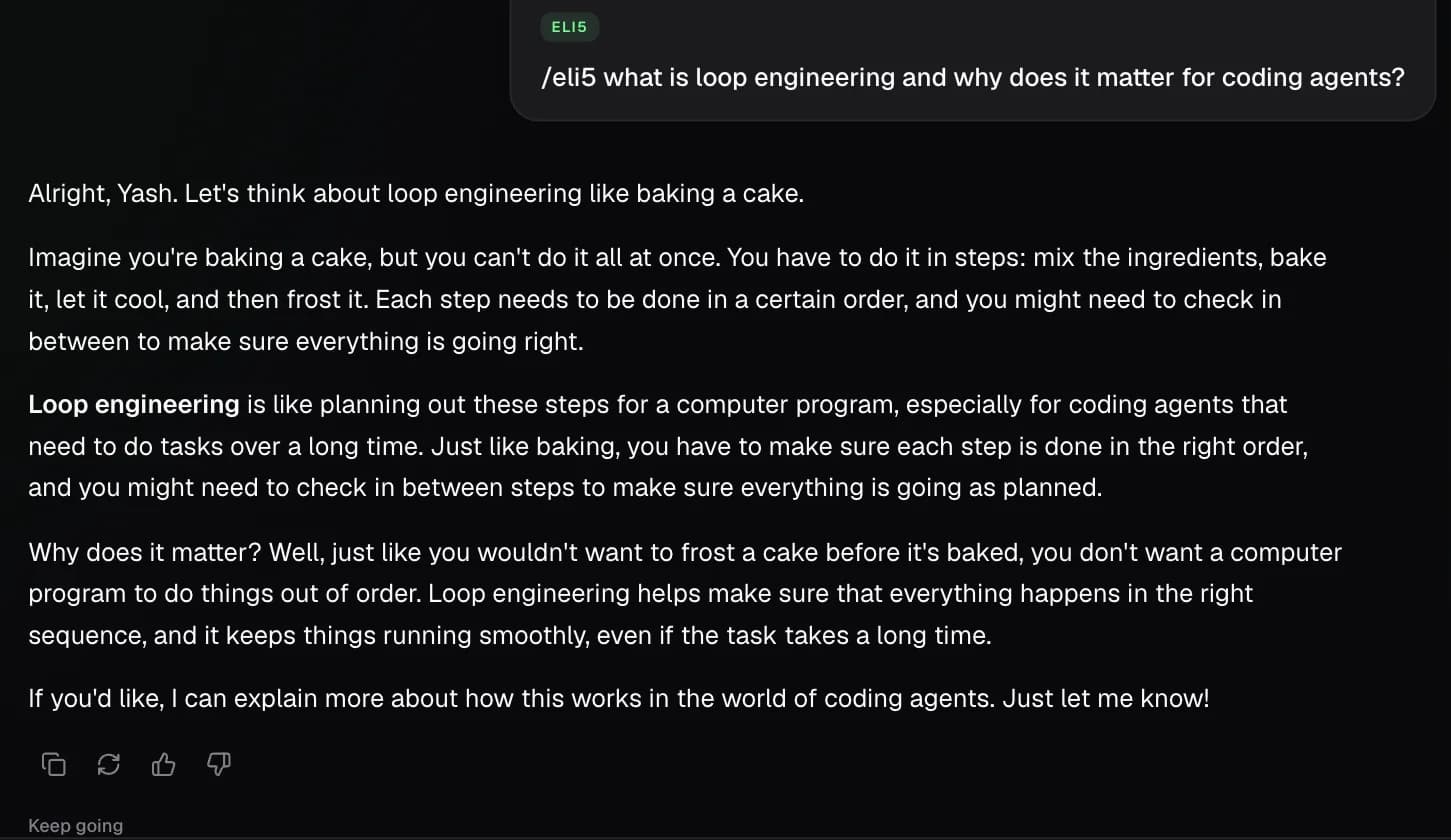
Anthropic's /eli5 Claude Code skill renders an HTML artifact with big pictures and few words to explain any topic; explainx.ai's Melo has offered the same ELI5 mode natively, without a slash command, since August 11, 2026.
Instinct, an invite-only personal AI agent, kept 36 of a tester's Gmail messages for hours after she revoked its Google access, exposing the gap between "revoke access" and "delete my data" that any agent granted broad personal-account permissions can fall into.
Anthropic reportedly hired Amir Salek, the engineer who founded and ran Google's TPU program for nine years, to help it design its own AI chips — the clearest sign yet that Anthropic wants custom silicon, not just more Nvidia and AMD GPUs.
Outbid.lol went viral by making paid distribution public, competitive, and easy to understand. This analysis covers the launch, auction mechanics, bidder incentives, clone wave, disputed revenue claims, and durability risks.
An OpenAI engineer skipped X's awkward audio upload entirely and prompted a working music-player web app on ChatGPT Sites to share his album, showing how cheap it's become to just build the specific tool you need.
Felony Bench is satire built on real disclosures — its actual value is the Hacker News debate on CFAA intent requirements and who is liable when an AI agent inadvertently breaks the law: the user, host, harness, or model.
HBS Foundry's faculty-modeled AI avatars provide low-stakes startup pitch practice; they are not a newly launched replacement for professors or a verified system for every claimed business simulation.
DeepMind sees EVE's persistent world as a test for agents that must learn, remember, plan, and navigate other actors over far longer timescales than a normal benchmark.
Google Antigravity's Remote Control lets you drive agent sessions on any of your machines from a browser with credentials and env vars intact, rolling out Aug 21, 2026 to Ultra subscribers first — Claude Code shipped a comparable phone-based upgrade one day earlier.
MCP's new roadmap prioritizes server push events, one unified HTTP transport, non-human agent identity via DPoP and WIF, cleaner tool results, and progressive tool discovery for large servers.
decayfmt is a Claude Code-built Rust tool that deliberately corrupts files a bit more each time they're opened, and the viral Reddit thread around it is a real lesson in why a reader program can't enforce a property the file format itself doesn't guarantee — plus a sharp parallel to diffusion-model noise.
Debuzz is a Claude Code skill that sends Claude's reply to Google's Antigravity CLI running Gemini for a plain-English rewrite, deliberately not letting Claude touch the translation itself.
Nari Labs open-sourced a Qwen3-TTS serving stack that hits sub-50ms time-to-first-audio at 10 requests/second on one H100, for about $2 per million characters versus ElevenLabs V3's $100.
X Ads MCP starts new campaigns paused, but its write scope also includes activation tools, so production teams still need an external approval gate.
terminal-minceraft renders EaglercraftX (browser-based Minecraft 1.8.8) inside a GPU-accelerated terminal pane and ships an MCP server with observe/move/mine/chat tools, so a coding agent can play it through structured commands instead of pixels.
Inkling's free OpenRouter endpoint is not a new price cut — it is the same agentic-harness-only, data-logged free tier the model launched with on July 17, 2026, restricted in ways a full read of the terms makes clear.
A creative producer used Gemini 3.7 Flash inside Google Antigravity to get a Gemini Omni-generated video to display across Sheets, Calendar, and Chat — a viral capability demo of agentic Workspace tool-use, not a claimed Sheets video product.
OpenAI cut GPT-5.6 Sol's official API pricing over 20% for three months starting August 22, 2026 — standard rate now $4 input / $20 output per 1M tokens — applying to the API and ChatGPT Work/Codex credits, not to Pro, Plus, or Business subscription usage.
GEN-1.5 shows that one-shot physical skill learning can emerge from large-scale robot pretraining — but the tasks are short, success rates are modest, and independent replication is still pending.
The 21 km link carried few-photon quantum states and source-generated entangled photons; it did not run a quantum computer, break encryption, or send information faster than light.
At the 2nd World Humanoid Robot Games in Beijing, Galbot's humanoid robots played tennis using reinforcement-learning-trained full-court movement, part of a 2,056-robot, 51-event competition — genuinely fast year-over-year progress, though "100% autonomous" claims from a single demo clip should be read with some skepticism.
Meteoric has shown a 13% artificial-cloud reduction in a chamber, while its solar-output gains, field flights, and storm ambitions remain unproven.
Nothing has confirmed an August 25 OS 5.0 reveal and shown animated status indicators, while its broader features and rollout remain undisclosed.
Andrew Ng's Part 1 deep dive names six sub-skills inside "building and deploying AI applications": LLM foundations, grounding models with data, building agentic systems, evaluation-driven development, operating in production, and machine learning foundations.
A federal court ruling (Bartz v. Anthropic) made destroying a physical book after scanning it the condition for that scan to count as fair use — which is the actual legal mechanism behind the book destruction Anna's Archive is protesting, not corporate malice on its own.
Barehands gives an AI agent a visual body: a webcam tracks gestures while tiny local files and shell commands let the agent show, move, and inspect objects.
A complete AI chat app needs server-side model calls, authenticated data ownership, durable chat history, and deployment secrets, not only a chat box.
A useful AI agent has a bounded outcome, narrow tools, verifiable output, and a stop condition; this guide applies that pattern to finance and job search.
Claude Code helps non-developers turn precise product requirements into testable prototypes, while developers still own production review and risk.
Cursor can turn a well-scoped product brief into a testable prototype, but a human still owns the product decision, review, security, and production handoff.
A Gauntlet Loop is Matt Shumer's named prompt pattern that pairs a builder agent with a separate, ruthless critic agent that blind-compares output against a concrete real-world quality bar, looping fixes until it wins.
The safest first Python automations use a preview-first workflow, validate inputs, log every change, and make destructive actions explicit.
AI ethics is the practice of building and using AI systems that avoid harm, stay accountable to a human, remain transparent, respect rights, and treat people fairly — grounded here in real frameworks and 2026 cases, not abstract philosophy.
+20 more updated posts
Supernova centralizes your data, integrating it seamlessly with Claude and Codex for enhanced insights.
fx is a lightweight, open-source coding agent designed to streamline development tasks.
Wizstar offers digital avatars that emulate professional actors, enhancing visual storytelling.
Mindcase allows users to extract data from any web source quickly and efficiently.
Epho enables users to run Claude Code, Codex, or Opencode in the cloud with their repositories.
Get each day's AI news in your feed reader: daily RSS · every post



