



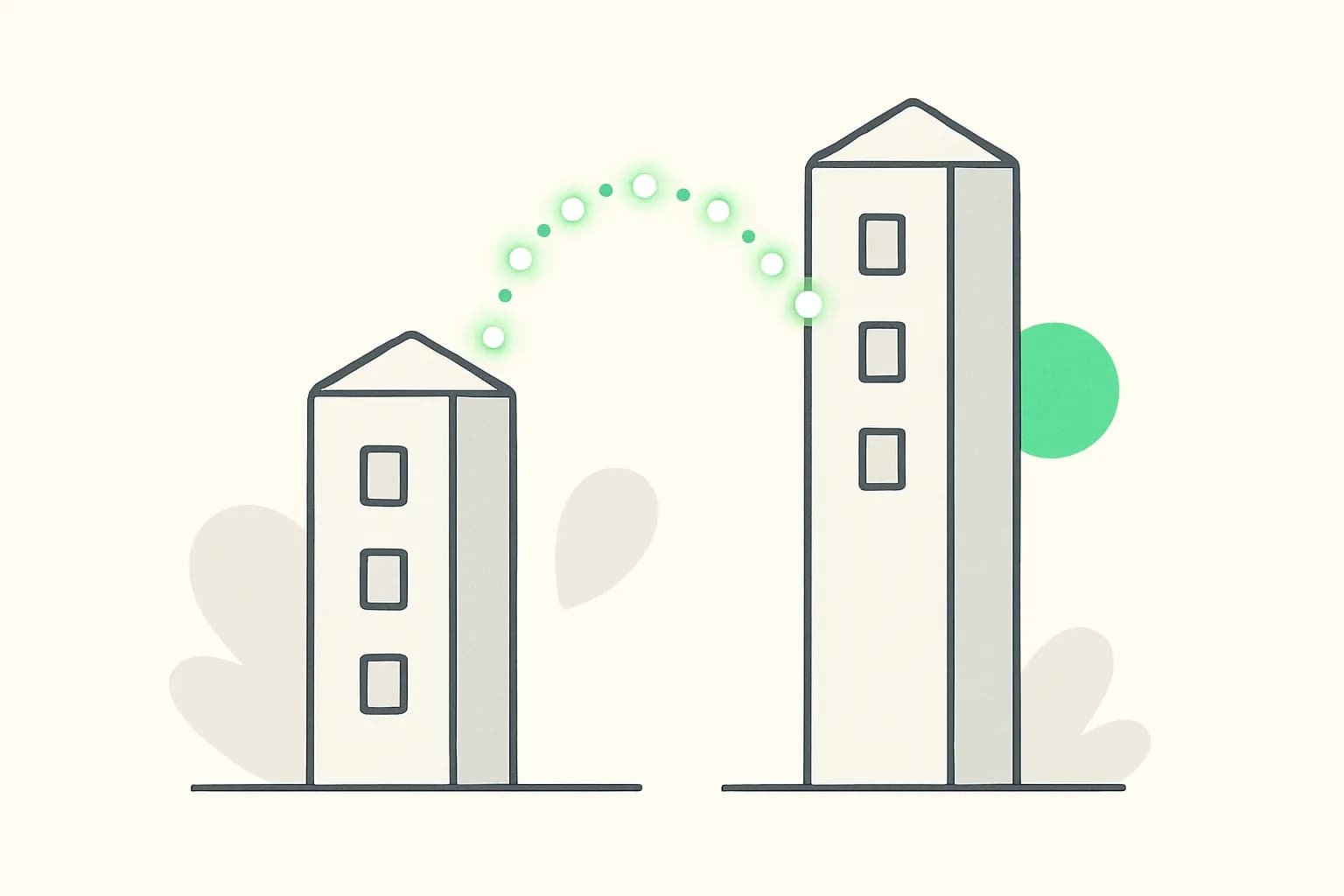
On August 21, 2026, researchers at Stony Brook University and the U.S. Department of Energy’s Brookhaven National Laboratory reported sending extremely faint optical signals from a rooftop facility at Stony Brook to a receiving station at Brookhaven, 13 miles (21 km) away. In nighttime tests, the team says it also distributed source-generated entangled photons across the open-air link and measured them at the receiving end.
That is a real quantum-networking milestone. It is also narrower than the viral version. The experiment did not demonstrate a quantum computer, teleport a useful data file, generate a reported quantum-encryption key, break Bitcoin, or transmit a message faster than light.
The accurate headline is simpler: the team established a precisely aligned free-space optical link between its “Quantum Watchtower” and “Quantum Lighthouse,” then used that hybrid fiber-and-air path to receive quantum states carried by very small numbers of photons.
TL;DR: what actually crossed the 21 km link?
| Question | Direct answer |
|---|---|
| What traveled through open air? | Daytime tests sent laser-generated quantum states containing only a few photons. Night tests sent source-generated entangled photons. |
| Was it radio or Wi-Fi? | No. “Wireless” means a line-of-sight optical beam traveling through free space rather than a fiber cable. |
| Were two quantum computers connected? | No working quantum-computer-to-quantum-computer connection was reported. |
| Did the team teleport a qubit? | The public release does not report quantum teleportation or transfer of an unknown quantum state. |
| Did it generate encryption keys? | No quantum key distribution rate or generated key was reported. |
| Is 21 km a world record? | No. Stony Brook describes a first-of-its-kind U.S. demonstration; longer free-space quantum links exist globally. |
| Did it threaten Bitcoin or current encryption? | No. This was photonic networking, not cryptanalysis or a cryptographically relevant quantum computer. |
| Can it send information faster than light? | No. Entanglement still requires an ordinary classical channel to make its correlations useful. |
What did the researchers transmit?
The official Stony Brook announcement describes two related stages.
During daytime commissioning on August 21, a laser at the Quantum Watchtower generated quantum states of light, each containing only a few photons. Those photons left a fiber core about five micrometers wide, crossed 21 km of atmosphere, and were coupled into a similarly small fiber at the Quantum Lighthouse for detection with specialized equipment, including an ultrafast camera.
The more consequential test happened at night, when background light was lower. Entangled photons were generated in a Stony Brook physics laboratory, traveled by fiber to the Watchtower, crossed the free-space link, and were received and measured at Brookhaven. The announcement says the Lighthouse detected entangled photons from the Watchtower at 12:26 a.m. on August 19.
Calling this “quantum information” is reasonable because the photons carry quantum states. But several stronger claims are not supported by the public record:
- No user data, file, or application-level payload is described.
- No unknown qubit was reported as teleported from one endpoint to the other.
- No quantum key distribution protocol, usable key, secret-key rate, or quantum bit error rate was reported.
- No connection between two operational quantum computers was reported.
- No public Bell-test result or post-link entanglement-fidelity number accompanies the announcement.
The careful wording is therefore: according to the joint announcement, source-generated entangled photons crossed the hybrid fiber/free-space path and were received and measured at Brookhaven. Without the underlying fidelity and correlation data, it would be premature to turn that into a broader performance claim.
How do the Quantum Watchtower and Quantum Lighthouse work?
The names sound theatrical; the engineering is extremely precise.
The Quantum Watchtower sits on Stony Brook’s Health Sciences Center. The Quantum Lighthouse is at Brookhaven in Upton, New York. They have a direct line of sight across Long Island. Brookhaven’s free-space optical link project page describes the nominal path as 20.5 km and lists telescope apertures in the 0.4-to-0.7-meter range, operation at telecom C-band and 795-nanometer wavelengths, automatic alignment, and atmospheric correction.
The end-to-end path looks like this:
Entangled-photon source at Stony Brook
                ↓ fiber
Quantum Watchtower + transmit telescope
                ↓ 21 km through open air
Quantum Lighthouse + receive telescope
                ↓ fiber coupling
Single-photon detection and measurement
The hard part is not merely pointing one bright laser at another building. Single-photon-level signals must survive beam wander, atmospheric turbulence, background light, vibration, and the final coupling into a fiber core only a few micrometers across. The facilities use tracking telescopes and adaptive optics to correct distortions in real time.
That is also why “wireless quantum network” should not be read as “quantum Wi-Fi.” Radio-frequency signals normally contain many photons and too much noise for the fragile states in this experiment. Here, wireless means free-space optical: photons traveling through the atmosphere rather than remaining inside glass fiber.
Why does an open-air quantum link matter?
Brookhaven and Stony Brook already operate part of a regional quantum network spanning 161 miles, with eight nodes at research institutions. Most of that infrastructure uses buried or leased fiber. Fiber is stable and useful, but it creates three constraints.
First, a network can only go where suitable fiber exists. A rooftop free-space hop can bridge places where trenching or leasing a dedicated path is impractical, including bodies of water.
Second, optical fiber is optimized for specific telecommunications wavelengths. Many atomic quantum memories and processors naturally interact with different wavelengths. A free-space channel can support wavelengths that are awkward or lossy in conventional telecom fiber, potentially reducing the conversion needed between a processor and the network.
Third, long-distance quantum networks will probably require more than one physical medium. Fiber can serve dense terrestrial routes; open-air links can bridge gaps; atmospheric links to satellites could eventually cover much longer distances. The 21 km experiment is useful because it tests one interface in that mixed architecture.
It does not make fiber obsolete. The demonstrated path itself is hybrid: fiber carries photons from the laboratory to the rooftop, free space carries them between sites, and fiber coupling plus detectors complete the receiving path. A future quantum internet will likely combine media rather than choose a single winner.
Is this a U.S. first or a world record?
Stony Brook calls the result the first demonstration of its kind in the United States. That is the appropriate scope to repeat. The announcement does not claim the world’s longest free-space quantum link.
International teams crossed longer distances years ago. A 2007 Nature Physics paper, “Entanglement-based quantum communication over 144 km”, reported entanglement-based quantum key distribution between two Canary Islands. Satellite experiments have since pushed free-space quantum communication to far larger geographic scales.
The new result is significant for a different reason: it adds a working 21 km atmospheric segment to a long-running U.S. regional-network effort, using permanent facilities designed to support repeated experiments. The frequently cited 161 miles is the overall footprint of the existing eight-node network—not the length of this free-space transmission and not a single uninterrupted quantum hop.
This project also did not appear overnight. Stony Brook described the planned 13-mile line-of-sight link in 2019. The team reported development work in Optica conference papers in 2022 and 2023. The August 2026 announcement is the operational milestone in that multi-year engineering program, not a sudden discovery detached from earlier prototypes.
Did this break encryption or Bitcoin?
No. The online reaction mixes up quantum networking and quantum computing.
A quantum network moves or distributes quantum states between locations. A quantum computer performs algorithms using controlled quantum operations. This experiment worked on the networking side: sources, photons, telescopes, atmospheric correction, coupling, and measurement. It did not report a fault-tolerant processor running Shor’s algorithm, recovering a private key, or attacking a cryptographic system.
That distinction also applies to Bitcoin. A sufficiently capable future quantum computer could threaten some public-key cryptography, which is why NIST and governments are already moving toward post-quantum standards. Our coverage of the U.S. quantum-computing and post-quantum-cryptography push explains that separate risk. The BitGo 100 BTC wallet challenge similarly distinguishes a real cryptographic attack from a viral “AI broke Bitcoin” framing.
NIST’s current post-quantum cryptography explainer says a cryptographically relevant quantum computer does not exist today. The Stony Brook–Brookhaven link does not change that fact. It neither adds computational qubits nor demonstrates logical error correction, fault-tolerant gates, or cryptanalysis.
There is still a useful security lesson: quantum networks and post-quantum cryptography are complementary research tracks, not substitutes. Quantum networking explores physical distribution of quantum states; post-quantum cryptography updates classical software and protocols to resist future quantum attacks. Work on AI-assisted cryptography audits and Mythos cryptanalysis of HAWK and reduced-round AES concerns yet another layer: finding flaws in algorithms and implementations. None should be treated as evidence for the others.
Did entanglement send information faster than light?
No. Entanglement creates correlations between measurements, but neither observer can choose a measurement result and use it to encode a controllable faster-than-light message.
To confirm or use those correlations, the endpoints must exchange ordinary classical information. As NIST explains, that classical comparison remains limited by the speed of light. Quantum teleportation has the same constraint: it transfers a quantum state only when entanglement is combined with classical communication.
The term “teleportation” can therefore mislead twice. No matter is transported, and no usable information outruns light. More importantly for this story, the August announcement does not say this experiment performed quantum teleportation at all.
What remains unproven or unpublished?
The public milestone is strong evidence that the two permanent sites can acquire and receive single-photon-level signals across 21 km and, according to the research team, receive source-generated entangled photons. It is not yet a complete performance report for an operational network service.
As of August 22, we found the earlier 2022 and 2023 Optica proceedings documenting development of the link, but not a new peer-reviewed paper presenting the August 2026 experiment. The university announcement does not publish:
- Entanglement fidelity, visibility, or a Bell-inequality measurement after transmission
- Photon loss, background-count rate, or end-to-end detection efficiency
- Quantum bit error rate or secret-key rate
- Sustained link duration, availability, or repeated-run statistics
- Daylight entanglement performance
- Reliability across weather and atmospheric conditions
- A demonstrated quantum repeater, memory-to-memory transfer, or processor-to-processor application
Those are not reasons to dismiss the result. They define what the next technical publication needs to quantify. A successful acquisition at one time is different from a link that can distribute high-quality entanglement continuously, in daylight, under changing atmospheric conditions, at a rate useful to an application.
The hardware burden matters too. This is not consumer networking equipment. It requires clear line of sight, rooftop telescope systems, precision tracking, adaptive optics, tightly controlled photon sources, sensitive detectors, and coordinated classical control systems.
What happens next?
The program’s next announced expansion is a third facility at Yale University. Stony Brook says the teams plan a roughly 30-mile (48 km) free-space link across Long Island Sound between Stony Brook and Yale. That route is longer, crosses water, and should provide a different atmospheric test from the ground-to-ground Long Island path.
Farther out, the researchers describe links to satellites and direct connections between quantum processors. Those are goals, not achievements of the August test. Reaching them will require better daytime filtering, stable acquisition and tracking, wavelength interfaces, quantum memories or repeaters, loss management, and measured application protocols.
The broader direction is credible: build a network whose fiber, free-space, and eventually satellite links can distribute quantum states between heterogeneous machines. The timeline remains research-driven, and “quantum internet” should be understood as an architecture under construction—not a replacement for today’s internet arriving after one rooftop experiment.
A five-question test for the next quantum headline
When a claim says researchers “sent quantum data,” ask:
- What physical state moved? A bright calibration beam, a few-photon state, one half of an entangled pair, or an unknown qubit?
- Which protocol ran? Entanglement distribution, quantum key distribution, teleportation, sensing, or merely link acquisition?
- Which metric was measured? Fidelity, Bell violation, error rate, secret-key rate, loss, uptime, or just successful detection?
- What is the comparison class? First in one country, longest ground link, longest satellite link, or first integration with a particular network?
- Where is the evidence? A press release, conference abstract, preprint, peer-reviewed paper, or public dataset?
That checklist prevents “photons crossed a research link” from turning into “a quantum computer broke encryption” while preserving what is genuinely impressive about the engineering.
Related on explainx.ai
- U.S. quantum-computing orders and the post-quantum cryptography timeline
- Why Claude cannot brute-force BitGo’s 100 BTC wallet
- Mythos cryptanalysis: what HAWK and reduced-round AES results actually mean
- AI found seven bugs in Cloudflare CIRCL—but humans still had to verify them
- Google HEIR and computation on encrypted data
- SimpleX Chat and private messaging without user identifiers
Official and primary references: Stony Brook’s August 2026 announcement, Brookhaven’s free-space optical link project, Stony Brook’s 2019 project background, the team’s 2022 and 2023 Optica proceedings, and the 2007 Canary Islands experiment.
Details reflect official material available through August 22, 2026. The August experiment is currently described in institutional announcements; published performance metrics may refine its scope.