



An internal Anthropic habit — /eli5 <topic> — went viral this week for doing something explainx.ai's Melo has shipped as a standing UI mode since August 11.
On August 22, 2026, Thariq, who works on Claude Code at Anthropic, posted that a skill people at Anthropic have been using a lot recently is /eli5 <what you want explained> — described as "explain like I'm someone who knows nothing about this topic, using a HTML artifact with big pictures and few words." The post crossed 262K views in hours and split the replies into two camps: people who found it genuinely useful for onboarding into unfamiliar code, and people who read it as a workaround for a verbosity problem Claude Code shouldn't have in the first place.
explainx.ai's read: it's a good idea, badly timed to look novel — Melo, explainx.ai's learning copilot, has had an ELI5 mode built directly into its interface since before this tweet existed. See Introducing Melo for the full mode lineup.
TL;DR — what people are asking
| Question | Answer |
|---|---|
| What is it? | An unofficial Claude Code skill that renders explainers as a visual HTML artifact |
| Is it official Anthropic tooling? | Not yet — Thariq says they're debating turning it into a plugin |
| How do I install it? | claude plugin marketplace add anthropics/claude-plugins-community then claude plugin install eli5@claude-community |
| What's it good for? | Explainers, understanding a tradeoff, or diving into an incident before the deep dive |
| Main complaint | Forced analogies read worse than "explain simply, keep the precision" |
| The deeper critique | It's paying tokens twice — once to be verbose, once to undo it |
| Does explainx.ai have this already? | Yes — Melo's ELI5 mode, live since August 11, 2026, no slash command needed |
| Does "like I'm five" mean baby words? | No — remove hidden prerequisites, preserve the real mechanism, then give the learner something to do |
Update — August 24: ELI5 is a design constraint, not baby talk
Tim Harford's August 20 essay, "Explain it to me like I'm ten," sharpens the most important criticism of ELI5 prompts: simplification is useful when it changes the expert's design process, not when it merely swaps technical words for childish ones. Randall Munroe's Up Goer Five is memorable because it explains the Saturn V with only the 1,000 most common English words. It is also, as Harford notes, sometimes harder to decode than a normal explanation. A small vocabulary is not the same thing as a clear mental model.
The productive constraint is closer to this: assume the learner is intelligent, but does not yet share your prerequisites. That forces an expert—or an AI tutor—to restore the missing scaffold: what problem the idea solves, which parts cause which effects, and what the reader needs to notice first. It also pushes against the expertise curse: after using a concept for years, it becomes difficult to remember which steps once required explanation.
Harford connects that constraint to inclusive design. A dropped kerb is essential for a wheelchair user and useful to someone pushing a pram; a lever handle designed for a weak grip also helps a person carrying coffee. The lesson is not that accessibility only matters when everyone benefits. It is that designing for a sharper version of a common difficulty often exposes friction that the default design hid.
That gives ELI5 output a better quality test than word length:
| Test | Weak simplification | Useful simplification |
|---|---|---|
| Accuracy | Replaces the mechanism with a cute metaphor | Keeps the mechanism, defines only the prerequisites |
| Structure | Shortens every sentence equally | Reveals the causal scaffold and removes side paths |
| Respect | Talks down to the learner | Assumes intelligence without assuming prior context |
| Next step | Ends when the answer sounds easy | Hands the learner a recall, explanation, or construction task |
The final row is where explanation becomes learning. A clear answer can create the feeling of understanding without proving that the learner can retrieve, reconstruct, or apply the idea. Melo's learning loop makes those stages explicit: use ELI5 to expose the scaffold, Quiz to retrieve it without the answer visible, Explain Back to rebuild it in the learner's own words, and Interact to manipulate a working representation. The first mode lowers the entry cost; the later modes produce evidence that the concept actually stuck.
That is also why the best ELI5 prompt is not “use only simple words.” A better instruction is: explain this to an intelligent beginner, preserve the mechanism, define the minimum prerequisites, and end with one thing they should be able to predict or do.
What the /eli5 skill actually does
The prompt behind it is short and specific: explain a topic as if the reader knows nothing about it, and answer as an HTML artifact rather than plain chat text — favoring large visuals and minimal copy over paragraphs. That output format is the whole point. A wall of markdown with a "simply put" caveat at the top is not the same experience as a rendered page built around one or two big illustrations and a handful of short labels.
Thariq's own examples show it used as a pre-step, not a replacement for real work:
/eli5 how does this module work— before making changes to unfamiliar code/eli5 why did we make this tradeoff— before re-litigating or extending a decision/eli5 what caused this incident— before reading the full postmortem
That framing matters. None of the three examples are "instead of the technical answer" — they're a fast, visual on-ramp before the technical answer, which is closer to how a senior engineer might sketch a whiteboard diagram before pulling up the actual diff.
Install — copy-paste sequence
Inside Claude Code:
claude plugin marketplace add anthropics/claude-plugins-community
claude plugin install eli5@claude-community
It ships through anthropics/claude-plugins-community, a community-facing marketplace rather than a first-party, pre-installed plugin — Thariq was explicit in a follow-up post that the team is still "debating whether to make it an official plugin." Once installed, invoke it in any conversation with /eli5 <topic>.
The community split: useful tool vs. papering over verbosity
The replies to Thariq's post fell into two clear camps.
The "this is genuinely useful" camp pointed to explainers and diving into unfamiliar problems as the strongest use case — Shubham Saboo called it straightforwardly useful, and Thariq's own framing ("meeting me where I am") positions it as a comprehension aid, not a crutch.
The skeptical camp raised two separate objections worth keeping apart:
| Critic | The complaint |
|---|---|
| Adrian (@1adrianpierce) | Forced analogies produce worse explanations — his example: Claude describing an API call as "a car, and you are driving to your friend's house (database)." He gets better results just asking Claude to "explain this to me as simply as possible without losing technical precision." |
| Keen (@0xkeeny) | The skill is "a refund request with extra steps" — you pay tokens to generate Claude's normally-verbose answer, then pay tokens again to have a second pass strip the verbosity back out. His argument: fix the default output style, and nobody needs /eli5. |
Thariq's reply to Keen conceded the underlying point without abandoning the skill: "we are working on reducing verbosity, but I think this is useful for explainers and understanding concepts before diving into a problem." That's a reasonable split — a leaner default output style and a dedicated ELI5 mode aren't mutually exclusive, they solve different moments in a session.
Adrian's complaint is really about prompt quality, not the concept — a skill instructing the model to reach for a forced metaphor will sometimes produce a worse explanation than a direct "stay simple, stay precise" instruction. That's a tuning problem the community plugin can fix; it's not an argument against visual, simplified explainers as a category.
Where explainx.ai already ships this — Melo's ELI5 mode
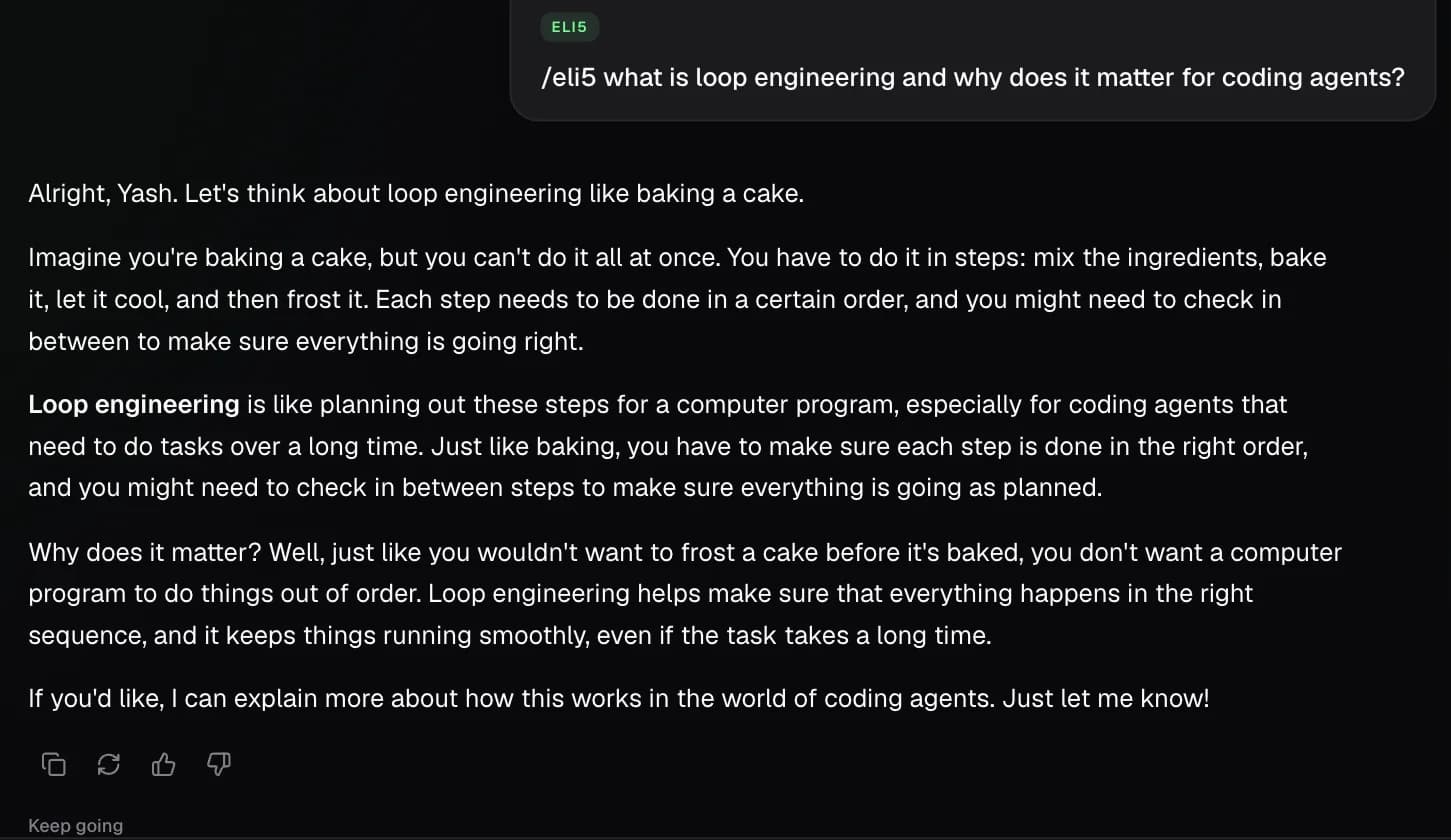
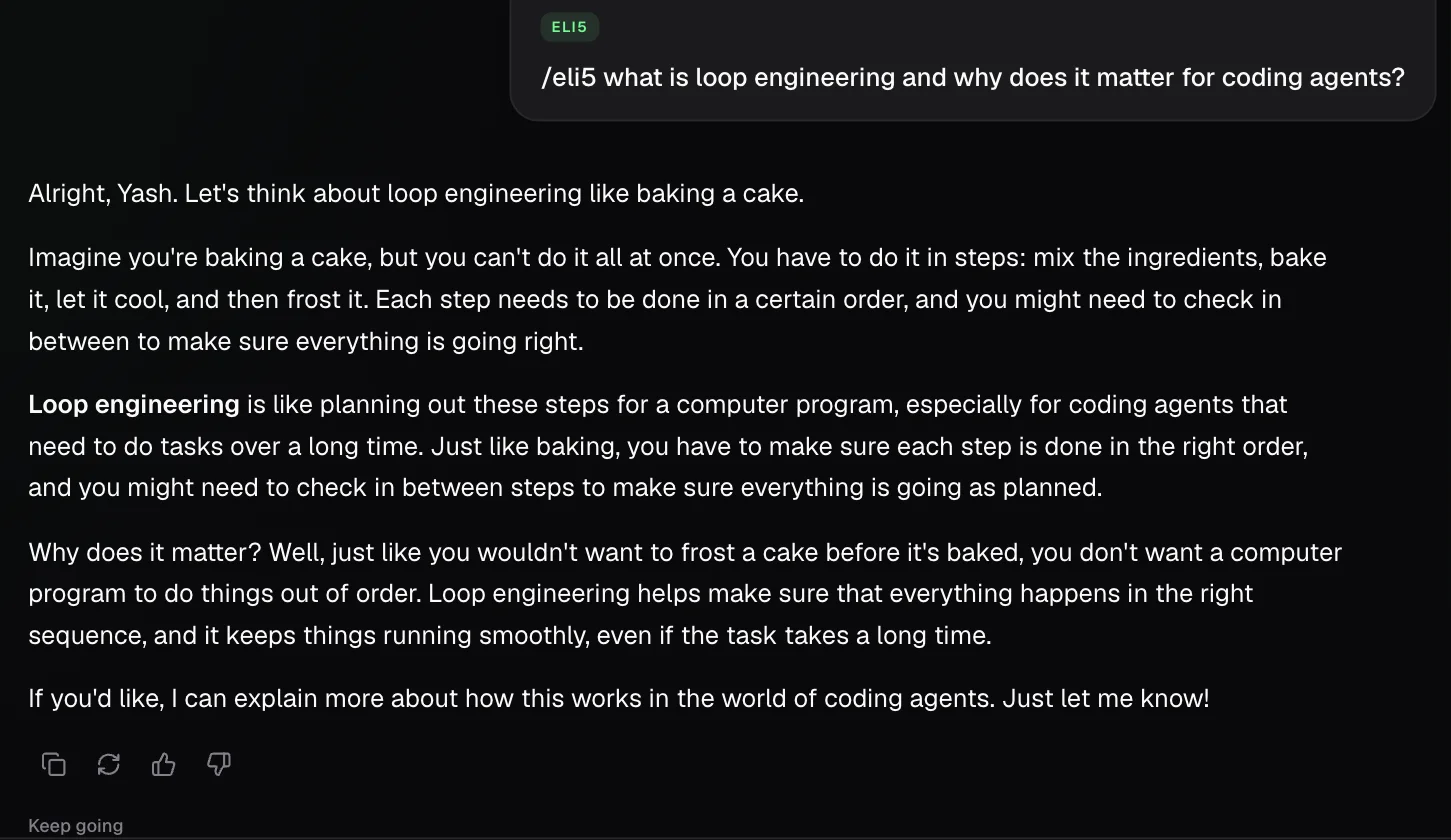 Melo answering an ELI5 question about loop engineering with a baking analogy, personalized by name, with copy, regenerate and feedback buttons below
This is where the tweet gets interesting for explainx.ai readers specifically: Melo, explainx.ai's AI learning copilot, has shipped an ELI5 mode as one of its eight standing modes since it launched in beta on August 11, 2026 — eleven days before Thariq's post. See Introducing Melo for the full breakdown.
The difference isn't the idea — plain-language, analogy-first explanation is an old pedagogical instinct, not a novel prompt. The difference is where it lives:
| /eli5 Claude Code skill | Melo's ELI5 mode | |
|---|---|---|
| How you invoke it | Type /eli5 <topic> every time | Click a mode tab, or type / — persists per conversation |
| Where it runs | Inside a coding session, on your codebase | Inside /dashboard/melo, pathways, skill pages, workshops |
| Install step | claude plugin marketplace add + claude plugin install | None — built in, free to start |
| Output format | An ad-hoc HTML artifact per invocation | A generative UI response, matched to the concept, inside the conversation |
| What happens after the explainer | Nothing — the skill's job ends there | You can switch to Quiz, Explain Back, or Flashcards on the same concept |
That last row is the real product difference. /eli5 is a single-shot output format — a nicer wrapper around one answer. Melo's ELI5 mode is one stop on a pedagogy pipeline: get the plain-language version, then immediately test whether it stuck with Quiz mode, or prove you actually understood it by teaching it back in Explain Back mode (Melo's Feynman-technique mode). See Melo's generative UI for how those in-conversation visuals actually get built, and Melo /interact for the mode that goes a step further — a live, sandboxed simulation instead of a static illustration.
This is explainx.ai's broader thesis: an AI-native learning experience shouldn't require memorizing which slash command produces which teaching style. It should already know, based on what mode you're in and what you're trying to do.
Honest limitations
- Not an official Anthropic plugin (yet) — it ships through a community marketplace, and Thariq's own post frames the "should this be official" question as unresolved.
- Quality depends on the underlying model's restraint — Adrian's complaint is real: a model reaching for a strained analogy can make a concept harder to follow, not easier. The skill is only as good as the prompt behind it.
- Doesn't fix the root cause it's compensating for — Keen's "refund request" framing is fair. If Claude's default output were leaner, a dedicated simplification pass would be less necessary. Anthropic has said this is a separate, ongoing effort.
- Single-shot, not a learning loop — one HTML artifact, then the conversation moves on. There's no built-in follow-up quiz or retrieval check the way a dedicated learning product would pair with an explainer.
Summary
Anthropic's /eli5 skill is a small, well-liked internal habit that turned into a viral install — a slash command that renders any topic as a simplified, visual HTML artifact instead of dense prose. It's genuinely useful as a pre-step before a deep dive, and the community pushback (forced analogies, paying tokens twice) is really an argument for tightening Claude's default verbosity, not against simplified explainers as a format. explainx.ai's Melo has already built the same instinct into its product as a standing ELI5 mode — no install, no slash command, and with a full pedagogy pipeline (Quiz, Explain Back, Flashcards) sitting right next to it rather than ending at the explainer.
Related on explainx.ai
- Introducing Melo: The AI Learning Copilot Built Into explainx.ai
- How Melo Teaches With Generative UI
- Melo Can Now Build a Live Simulation for Anything You Ask
- Claudish-to-English: The Claude Code Plugin That Rewrites AI Jargon
- Vomit: A Local LLM Hook That Rewrites Claude 5's Claudish Output
- Top 25 Claude Plugins in 2026
- Claude Code Commands: Complete Reference Guide
Sources: Thariq's original post · anthropics/claude-plugins-community
Skill availability, install commands, and view counts reflect Thariq's post and the community marketplace as of August 22, 2026. Verify current install steps against the marketplace README before adding it to a shared team config.