



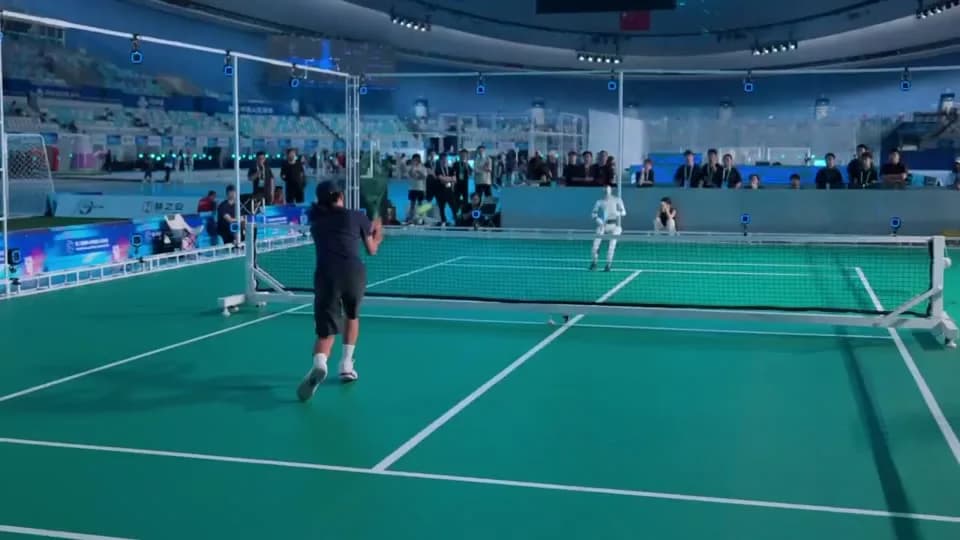
2,056 humanoid robots, 16 countries, 51 events — and the clip everyone shared was a robot trying to play tennis.
The 2nd World Humanoid Robot Games opened this week at Beijing's Ice Ribbon venue, spanning events from athletics and gymnastics to football and table tennis. The clip that broke out of the robotics-enthusiast bubble and into general virality was Galbot's tennis-playing humanoids — full-court rallies, described by organizers as trained via reinforcement learning and running with no human remote control.
explainx.ai's read: this is a genuinely fast pace of visible progress in humanoid robotics — but a single viral clip claiming "100% autonomous" is a marketing framing, not an independently verified benchmark, and it's worth treating it that way.
TL;DR
| Question | Answer |
|---|---|
| What is it? | The 2nd World Humanoid Robot Games, Beijing, at the Ice Ribbon venue |
| Scale | 2,056 robots, 16 countries, 51 events |
| The viral moment | Galbot's humanoid robots playing full-court tennis |
| Autonomy claim | Organizers say "100% autonomous, no human remote control" — unverified beyond the clip |
| Is this WRC Beijing? | No — that's a separate event; don't confuse the two |
| Practitioner relevance | Low direct relevance — it's a hardware/robotics showcase, not a builder tool |
What actually happened
The Games are explicitly a competition, not a research demo — 51 events across athletics, football, gymnastics, table tennis, and tennis, run over multiple days with robots representing teams from 16 countries. Tennis was one of the newer, more dynamically-demanding additions, requiring a humanoid to track a moving ball, cover a full court, and swing with enough precision to keep a rally going — a materially harder whole-body-coordination problem than a scripted walking or dancing demo.
Galbot's entry drew the most attention, reportedly using reinforcement learning to train full-court movement patterns. The World Humanoid Robot Games' own account pushed back on viewers who read the clip as pure comedy (a robot losing balance and running out of its lane is inherently funny on video), arguing the real story is the year-over-year pace: robots at the 1st Games were, in the organizers' own description, "slow and ponderous" — this year's field includes robots attempting live tennis rallies.
The skepticism worth keeping
A few things are worth separating out before taking "100% autonomous, no human remote control" at face value:
- A competition clip is a highlight, not a sample size. Robotics demos — humanoid or otherwise — are typically the best take out of many attempts, edited for the moment that worked. That's not unique to robotics (any product demo does this), but it means a single viral clip tells you almost nothing about failure rate or reliability.
- "Autonomous" is doing a lot of work in one sentence. It can mean anything from genuinely independent, real-time decision-making under a general policy, to a robot executing a pre-planned trajectory for a specific, rehearsed sequence with a person out of frame. Without seeing the failure clips, the training setup, or independent verification, it's reasonable to treat the framing as a marketing claim rather than a settled fact.
- Glitches and crashes are normal, and the organizers know it. The event's own account directly addressed clips of robots crashing or losing balance, framing them as expected friction in a genuinely hard, still-maturing task rather than evidence the whole effort is fake — a fair point, but also a reminder that "robots can play tennis now" and "robots reliably play tennis" are different claims.
Not the same event as WRC Beijing
Worth flagging explicitly: the World Humanoid Robot Games is a separate event from the World Robot Conference (WRC), also held in Beijing and also a venue for humanoid robot announcements — explainx.ai covered Xynova's Prima1 dexterous hand heading to WRC earlier this month. Same city, overlapping robotics-showcase energy, different events — don't conflate the two when searching for coverage.
Why this is mostly spectacle for AI builders — and the one thread that isn't
To be direct about it: this is a robotics and hardware story, not a model release, a tool, or a technique most explainx.ai readers will use this week. It's genuinely fun to watch and a real signal of how fast whole-body humanoid locomotion is progressing, but it doesn't change what you build or pay for AI products the way a model launch or a pricing change does.
The one transferable thread is the underlying method, not the tennis match itself: reinforcement learning for dynamic whole-body control is the same broad family of technique used in the humanoid deployments explainx.ai has covered for warehouse and light-industrial work — see Figure's robots reaching deployment milestones and why robotics still isn't "solved" despite the hype for the more grounded, less spectacle-driven version of the same underlying training problem: getting a robot's policy to transfer from simulation to a body that has real mass, real friction, and real consequences for falling over.
Summary
The 2nd World Humanoid Robot Games in Beijing put 2,056 robots from 16 countries through 51 events, and Galbot's tennis-playing humanoids were the clip that traveled furthest — genuinely fast visible progress on a hard, dynamic, whole-body-coordination task, paired with an "100% autonomous" claim that's worth treating as marketing framing until it's independently verified. Fun to watch, low direct relevance for most AI builders, and a useful reminder that a viral demo clip and a reliable, production capability are two different things — the same caution worth applying to any single-clip claim, robotic or otherwise.
Related on explainx.ai
- The 400m humanoid champion's running form, in slow motion
- World Humanoid Robot Games: Complete Guide to History, 2026 Results, and What's Next
- China's "Lightning" Robot Hit 14.5 m/s and Beat Usain Bolt's 100m Record — the sprint record from the same games
- China Opens Its First School for Robots
- Xynova Prima1: A Direct-Drive Robot Hand Headed to WRC Beijing
- Unitree's Humanoid Robot Jump/Run Claim, Fact-Checked
- Figure's Robots Outnumber Humans Milestone
- Why Robotics Still Isn't Solved
- What Are World Models? AI Starchild-1 Odyssey Complete Guide
Sources: World Humanoid Robot Games official account · Galbot · widely circulated social coverage of the 2nd World Humanoid Robot Games, Beijing, August 2026.
Autonomy claims, robot counts, and event details reflect public coverage of the 2nd World Humanoid Robot Games as of August 22, 2026, and have not been independently verified beyond the circulating video and organizer statements.