



SoduWork is a self-hosted hub where coding agents finish work only after someone signs off on evidence, not when the model stops typing. The mdiri-ai/SoduWork repository describes itself as an AI-native engine for teams and agents: multi-harness, multi-agent, and self-hosted. GitHub listed about 2,431 stars when explainx.ai checked on November 18, 2026.
The pitch is governance for harnesses you may already run. Instead of three subscriptions and three chat logs, SoduWork puts requests, plugins, and review in one Hub so Pi can implement, OpenCode can review on a different model, and a human accepts or sends work back.
TL;DR
| Question | Answer (per SoduWork README, Nov 2026) |
|---|---|
| What ships? | Hub, admin console, desktop client, optional cloud runners |
| Harness count | Nine named adapters plus ACP catalog entries |
| Done means | Requester sign-off after AI review checks criteria |
| Local start | sh start.sh --desktop after clone |
| Team deploy | python3 ops/self-host/deploy.py up with PostgreSQL |
| Status | Public beta; evaluate before production |
Why another agent platform?
Individual developers already get fast output from Claude Code, Codex, or OpenCode. The README argues the missing layer is trust and reuse: time saved generating text returns as time spent verifying it, and good workflows die in private threads.
SoduWork targets four pains it lists in prose:
| Pain | SoduWork response |
|---|---|
| Fast output, slow trust | Acceptance criteria before work; separate AI review; human sign-off |
| Methods trapped in chat | Plugins versioned and granted to people or teams |
| Many AI tools, no standard | One workbench; switch harness mid-conversation |
| Handoffs re-explain context | Issues carry history, files, and audit trail |
That is adjacent to Tencent LoopForge, which chains CLIs through SOP nodes and Docker sandboxes, and Agent Autoloop, which watches GitHub with approval cards. SoduWork leans toward issue tracking plus plugin catalog rather than only CI delivery.
Teams already wrestling with parallel Claude and Codex tabs sometimes adopt a git-backed queue or Worktrunk worktrees before they adopt a Hub. SoduWork tries to sit one layer above that: shared issues, grants, and review so the same acceptance bar applies whether the assignee is you, a contractor, or an agent process on a cloud runner.
How a request flows from chat to sign-off
The README’s workflow diagram is explicit: raise a request, let AI refine acceptance criteria, assign yourself or a colleague or an agent, run work with a team plugin, run AI review (assignee confirms), requester signs off, then optionally save the method as a plugin for the next person.
That separation matters for builders shipping agent skills or MCP tools. The Hub is the single source of truth for issues, approvals, and evidence; harnesses are interchangeable executors.
Levels of multi-agent behavior, again per README:
| Level | Who moves work |
|---|---|
| Sequential steps | Plugin workflow nodes |
| Human and agent | Colleague’s agent delivers; requester signs off |
| Parallel issues | Hub schedules different agents on different issues |
Agents do not autonomously delegate to other agents unless the plugin workflow or a person assigns the next step—an intentional guard against runaway chains.
Which harnesses plug in?
SoduWork treats a harness as the runtime that drives tools, not the model weights. Nine are documented:
| Harness | Models | Connection |
|---|---|---|
| Pi | SoduWork model catalog | Built in |
| OpenCode | Catalog models | Native adapter |
| DeepSeek Harness | Catalog or your DeepSeek key | ACP, on-demand install |
| Qwen Code | Catalog | ACP |
| Kimi Code | Catalog | ACP |
| Codex Harness | Catalog | ACP |
| Codex | Its own OpenAI account | Native adapter |
Programs that speak the Agent Client Protocol (ACP) can be added through a catalog declaration—similar in spirit to CLI-Anything’s agent-native wrapping, but here the Hub owns permissions and audit.
Switching harnesses mid-conversation keeps history and the working folder, which is harder when each CLI is a separate terminal tab.
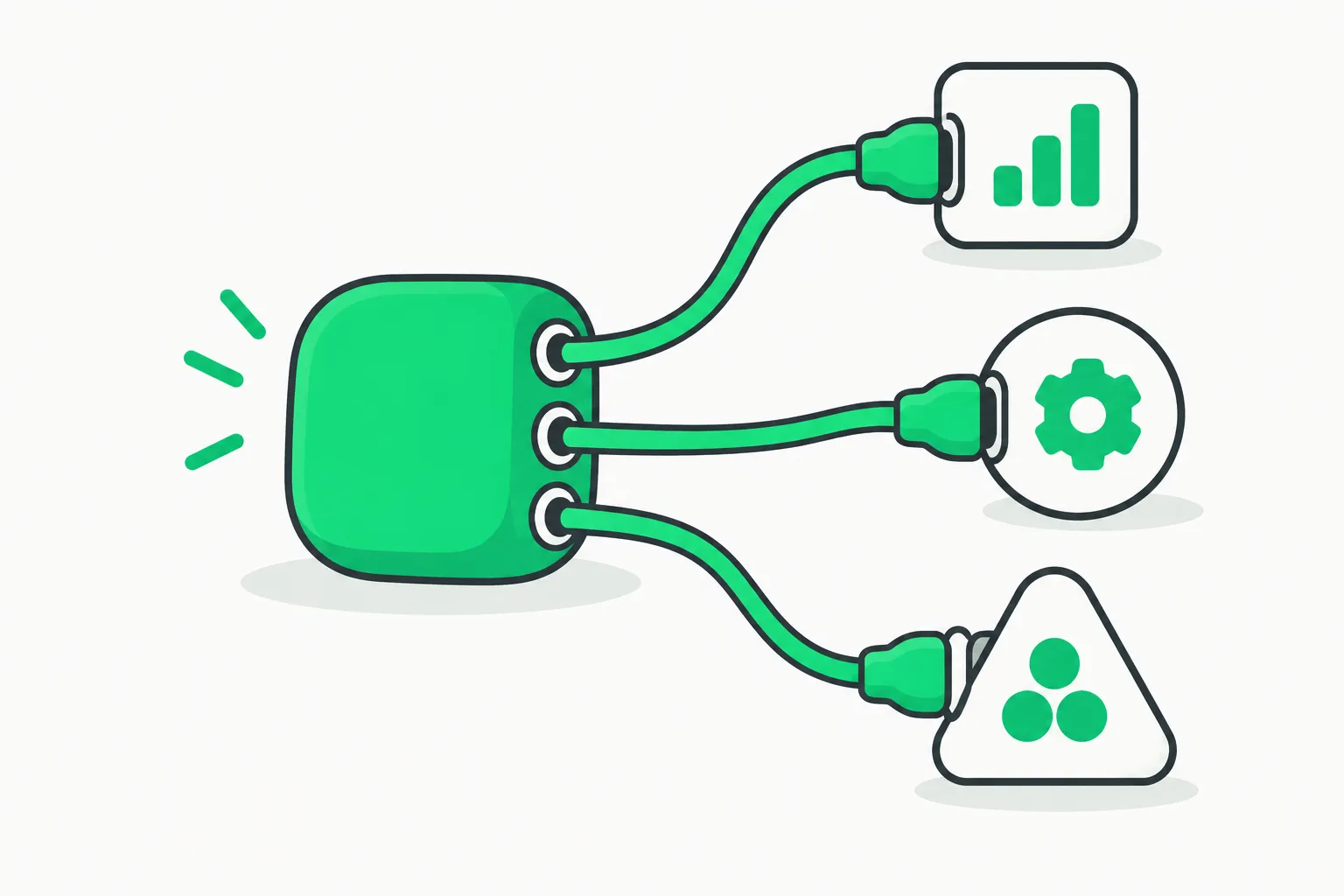 Hub with cables into distinct tool nodes, matching multiple harness adapters on one workspace
Plugins versus skills and agents
The README includes a comparison table between skills, standalone agents, SoduWork plugins, and SoduWork apps:
| Capability | Skill doc | Typical agent | SoduWork plugin |
|---|---|---|---|
| Step-by-step process | No | Partial | Yes |
| Harness choice | No | Partial | Yes |
| Criteria + AI review + sign-off | No | Partial | Yes |
| Versioning and grants | Partial | Partial | Yes |
A plugin can be as simple as a weekly brief workflow: draft node on Pi, review node on Qwen that blocks claims without sources, then publish. The JSON example in the README uses ai and ai_review node types with explicit dependsOn edges—closer to a miniature LangGraph-style graph than a single prompt file.
Teams can keep plugins private or submit them for review, publish, and scoped grants—the enterprise pattern CowAgent and Octop chase from different angles.
 Market-stall motif for team plugin catalog with grants and versioning
Install paths: desktop, Docker, demo
From source (solo or team lab):
Requirements on the README: Python 3.12+, Node.js 22.19+, Git. After clone:
sh start.sh --desktop
First boot installs dependencies, starts Hub and admin console, prompts for a 12–128 character admin password, and opens the desktop client. The README stresses that saving an API key in the admin UI does not create a selectable chat model—you must add the provider’s exact model ID under Capabilities → Model catalog.
Docker team deploy:
python3 ops/self-host/deploy.py up
python3 ops/self-host/deploy.py credentials
That brings up Hub, admin console, and PostgreSQL on one server; production use expects HTTPS in front.
Hosted demo: Releases ship Windows .exe, macOS .dmg, and Linux packages. Point Connection at https://service.soduwork.ai only for evaluation—the README forbids real business data on the demo Hub.
 Rounded server rack beside a building, illustrating on-prem agent hub deployment
Data, telemetry, and runner security
Self-hosters should read the Where does my data go? section carefully. When you run your own Hub, issues and chat live on your database. Model calls still go to whichever provider you configure, using short-lived credentials per run.
The README also documents operational traffic to the selected Hub: device auth, usage accounting (conversation IDs, token counters, timestamps), and client update checks every six hours for installed builds. Source launches skip installer update polling. There is no toggle documented to disable Hub accounting or update checks on installed clients—if you want zero calls to MDiRi’s hosted service, you aim the client at your Hub only.
Runners connect over WebSocket with deduplicated dispatch IDs and subprocess isolation per harness, but the FAQ states runners are not a general-purpose sandbox—actual isolation depends on the harness and your host hardening. Pair that with external sandbox guides for coding agents when exposure matters.
How SoduWork compares to alternatives
The README’s comparison matrix places SoduWork against low-code agent builders, coding harnesses alone, multi-agent orchestrators, and AI office assistants. The recurring claim: it does not replace Codex or Claude Code—it runs them with issue state, review, and plugin governance.
| Category | Typical gap | SoduWork emphasis |
|---|---|---|
| Low-code builders | Canvas wiring | Save a real task as a versioned plugin |
| Coding harness only | No team sign-off | Issues + independent review harness |
| Orchestrators | Agent-to-agent autonomy | People set checkpoints |
| Office AI | History trapped per user | Published plugin catalog |
For a coding-only orchestration without plugin marketplace framing, compare LoopForge’s SOP engine and Microsoft’s agent spend analytics at Ignite for the enterprise FinOps side.
Licensing, competitors, and when to wait
SoduWork is not a model provider. You bring API keys for whichever catalog models you enable, similar to OpenRouter-style routing except the router is your issue assignee field plus plugin workflow. If you only need a single harness on one laptop, starting with Pi or Codex alone remains simpler—SoduWork pays off when two people or two harnesses must agree on the same definition of done.
The README compares itself to low-code agent builders (canvas wiring), raw coding harnesses (no sign-off), multi-agent orchestrators (agent-to-agent autonomy), and AI office assistants (history locked per user). None of those rows claim SoduWork wins on every axis; the bet is governance plus reuse on top of harnesses you already like.
For regulated teams, the audit record—who asked, who ran which plugin, which model, who approved—is the feature that survives a security review better than “we pasted logs into Slack.” Pair Hub grants with MCP tool allow lists so agents cannot silently attach new connectors mid-run.
Roadmap and community
The README roadmap (November 2026) marks cloud runner (Personal Agent) support as shipped, with plugin SDKs, runner sandbox management, and web/mobile clients in progress. Community links point to Discord and GitHub issues.
What to try this week
- Self-host with SQLite via
start.shand run one request end-to-end: criteria, Pi implementation, second harness review, sign-off. - Publish a tiny plugin from a chat you already trust—weekly summary, ticket triage, or doc refresh—and grant it only to your user first.
- Point Connection at your Hub on installed clients so update and accounting traffic stays on infrastructure you control.
- Read runner limits before attaching a cloud runner with sensitive repositories—match harness choice to Agent Client Protocol hardening you already use locally.
Related reading
- Tencent LoopForge SOP orchestration
- Agent Autoloop background hub
- CLI-Anything: agent-native CLIs
- External sandboxes for coding agents
- What are agent skills?
- CowAgent harness comparison
Facts follow the SoduWork README and GitHub API star counts as of November 18, 2026.