



Qwen Code is Alibaba's open-source terminal coding agent — a multi-interface harness for Qwen and third-party models that listed roughly 30,583 GitHub stars when we fetched it on November 16, 2026. The QwenLM/qwen-code README markets Skills, SubAgents, MCP, sandboxing, and Agent Teams in one package you can install with a curl script, npm, or Homebrew.
This post is a practitioner guide to what shipped in the repo, how auth and daemon mode work, and how it sits next to Claude Code, OpenCode, and our Qwen4 commit verification coverage.
TL;DR
| Question | Answer (from README, Nov 16, 2026) |
|---|---|
| License | Apache-2.0 framework; Qwen models have their own terms |
| Install | curl script, npm install -g @qwen-code/qwen-code, or Homebrew |
| Default auth | /auth — Qwen subscription or API keys for other providers |
| Interfaces | Terminal, Desktop app, qwen serve Web UI, IDE plugins, IM channels |
| Differentiator | Multi-provider routing, daemon HTTP+SSE, experimental Agent Arena |
| Stars | ~30.6k on GitHub when fetched for this post |
Why Qwen Code is trending now
GitHub's trend feed flagged +1,469 stars in a week — unusually fast for a mature agent repo. Three forces explain the spike for builders:
- Qwen 1.0 Preview messaging merges Qoder and Qwen Code capabilities in one open release narrative on the README banner.
- Agent harness features — Auto-Memory, Dynamic Workflows, Agent Teams, and Goals with verifiers — match what teams want from Google Stitch Skills-style extensibility without a closed IDE.
- Qwen4 anticipation — commits in this repo already adjust token limits for
qwen4*ids (claimed vs verified), while Qwen4 Max API posts cover hosted models separately.
HN discussion on an older thread (item 44653981) is thin — commenter TXTOS said CLI coding agents make sense but reported multi-turn semantic drift in their own tests. Treat that as one person's experience, not a benchmark.
Installation paths
 A terminal window with a single green cursor block — where Qwen Code runs after curl, npm, or Homebrew install
The README lists three first-class installs:
Standalone script (Linux/macOS):
curl -fsSL https://qwen-code-assets.oss-cn-hangzhou.aliyuncs.com/installation/install-qwen-standalone.sh | bash
npm (Node 22+):
npm install -g @qwen-code/qwen-code@latest
Homebrew:
brew install qwen-code
Restart the terminal after the shell installer so PATH updates apply. On Windows, the README points to a PowerShell irm one-liner.
If you already run OpenCode with Qwen previews, compare update channels: Qwen Code ships its own release cadence on GitHub, not Anthropic's desktop bundle.
Quick start and authentication
From your project directory:
cd /path/to/your-project
qwen
Inside the session, run /auth and choose Qwen Account with Subscription (Plus or Pro) or paste third-party API keys.
The README's first prompt suggestion — explain this repository and show me where to start — is the same onboarding pattern Plannotator assumes: agents need repo maps before edits.
Official docs live at qwenlm.github.io/qwen-code-docs.
Capabilities that matter for daily coding
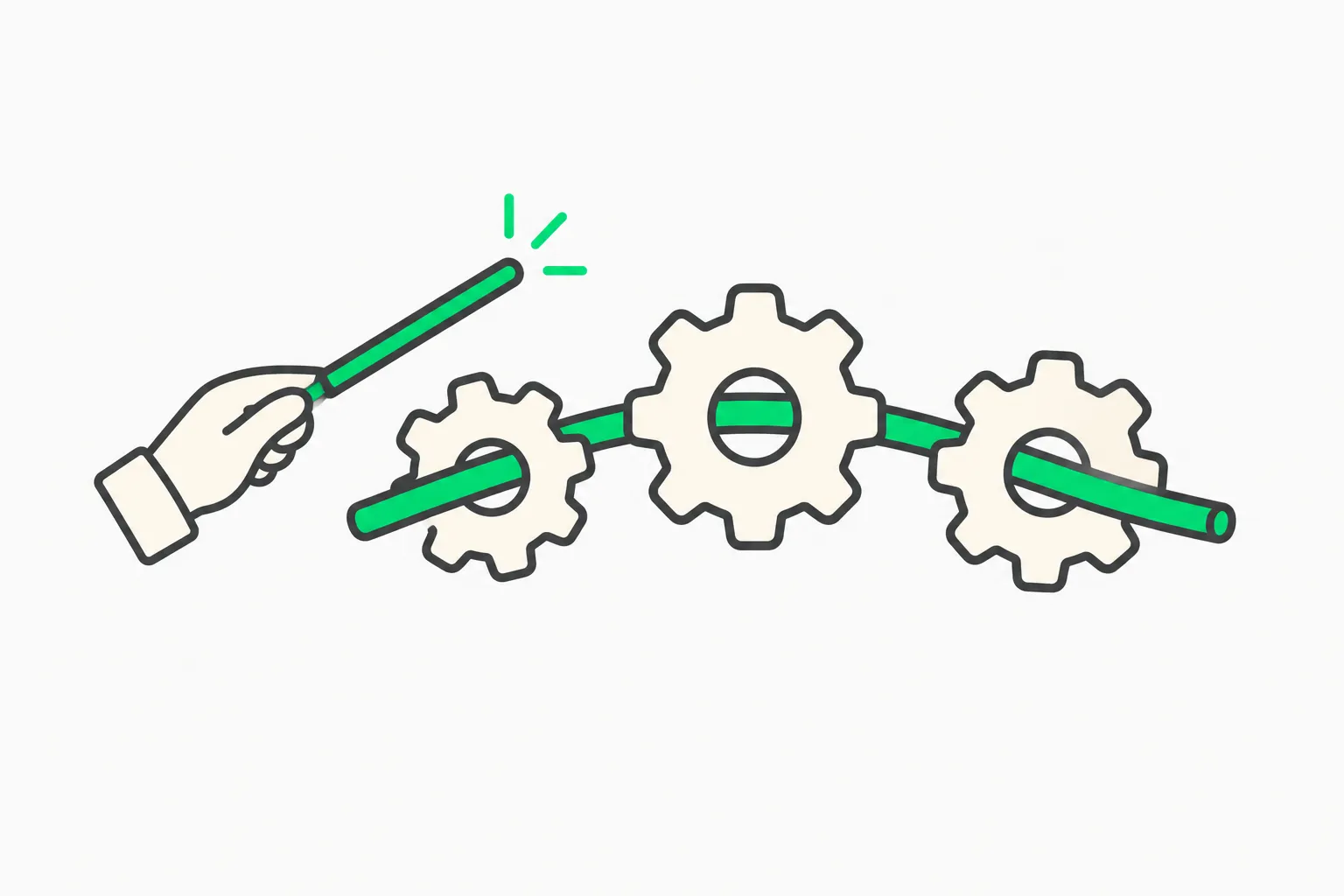 A green baton directing cream gears along a shaft — SubAgents, Agent Teams, and MCP tools Qwen Code wires together
Agentic core
- SubAgents — delegated tasks with isolated context (foreground or background).
- Agent Teams (experimental) — shared task lists and teammate messaging.
- Agent Arena (experimental) — same prompt across models in Git worktrees, merge the winner.
- Dynamic Workflows (opt-in) — model-authored JavaScript orchestration.
- Goals —
/goalruns until an independent verifier accepts within a token budget.
These sit in the same design space as Claude Code subagents and cinecode film skills, but Qwen Code keeps the harness open and provider-swappable.
Memory, skills, and sessions
- Auto-Memory — persistent notes across sessions plus QWEN.md / AGENTS.md loading.
- Skills —
/review,/batch,/bugfix, with/learnand optional auto-skill generation. - Session management —
/resumeand browsing archived chats.
Pair with replica-style skills thinking: skills are only as safe as the tools they invoke.
Multimodal and channels
- Voice input and Qwen Live (experimental) in the Web Shell.
- Image generation via built-in
image_genwhen configured. - Chat integrations — Telegram, DingTalk, WeChat, Feishu, QQ Bot, Email, GitHub — via
qwen channel start.
That channel list is broader than M365 Copilot remote execution risks surface area; lock down webhooks if you expose an agent to IM.
Extensibility
- Hooks at tool-call boundaries.
- MCP for external tools — same ecosystem as Stitch Skills MCP.
- LSP integration (experimental) — go-to-definition and diagnostics inside the agent loop.
- Sandbox and worktrees — confine execution or isolate risky refactors.
Daemon mode and the security footgun
For teams wiring CI or internal dashboards, Qwen Code supports qwen serve:
qwen serve --open
Default bind: http://127.0.0.1:4170. Background management uses qwen daemon start|status|logs|stop.
The README is explicit: default daemon mode has no bearer auth — any local process with network access gets code execution. On shared machines, set QWEN_SERVER_TOKEN and --require-auth.
That warning matches lessons from M365 Copilot remote execution CVEs: unauthenticated local APIs become code execution for any process on the host. Do not expose port 4170 beyond loopback without tokens.
SDK examples exist for TypeScript, Python, and Java; Python uses qwen_code_sdk.query with path_to_qwen_executable.
Qwen Code vs Claude Code vs OpenCode
| Axis | Qwen Code | Claude Code | OpenCode |
|---|---|---|---|
| Open source | Yes (Apache-2.0) | No | Yes |
| Default models | Qwen + swappable | Claude family | Multi-provider |
| Daemon / HTTP API | Built-in experimental | Different surface | Varies by fork |
| Origin | Forked Gemini CLI 0.8.2, independent since 0.1 | Anthropic product | Community harness |
Choose Qwen Code when you want Alibaba model tuning, Asian IM channels, or self-hosted daemon control. Choose Claude Code when your org standardizes on Anthropic billing and Computer Use. Choose OpenCode when you want a minimal community harness without Qwen's feature sprawl.
See also frontier model comparison tables for model quality — harness choice does not replace evaluating the model behind it.
SWE-bench and evaluation claims
The README publishes SWE-bench Verified averages of 76.40%–77.80% across seven Qwen Code versions using Qwen 3.7 Max, with 500 tasks and three trials each.
That is vendor methodology. Before you switch CI from another agent:
- Re-run on your repository's language mix.
- Compare cost per merged PR, not headline pass rate.
- Read Sakana's multi-agent self-supervision post as a reminder that agent gains can be narrow-benchmark specific.
How Qwen Code relates to Qwen4 hosting
Our Qwen4 Max launch and preview token plan posts cover hosted APIs. Qwen Code is the local client that may route to those ids once your account exposes them.
The October Qwen4 token-limit commit proves engineers prepared the CLI for 1M contexts — not that your key already has 1M.
Practical checklist before you adopt
- Run
qwenon a scratch repo with/authand a read-only task. - Enable sandbox for untrusted code paths; compare with Claude desktop Linux telemetry issues lessons on local agents.
- Document daemon auth if you use
qwen servein a team environment. - Pin versions in CI — the README says the project dogfoods rapid self-iteration via its own agents.
- Track export rules if you connect to China-region endpoints while building for U.S. customers — orthogonal to coding, but tied to Pax Silica supply politics.
Troubleshooting installs and upgrades
The README acknowledges rapid iteration — the project uses its own agents to file issues and run tests. That means main can move daily.
| Symptom | Likely fix |
|---|---|
qwen: command not found after curl install | Restart shell; confirm install script PATH hints |
| npm global permission errors | Use a version manager or npx @qwen-code/qwen-code without -g |
Auth loops on /auth | Confirm subscription tier or API key scope on Qwen Cloud |
| Daemon unreachable from IDE | Check bind address; default is loopback only |
| Wrong model context | Verify model id spelling; Qwen4 ids need recent CLI for 1M defaults |
If you pin versions in CI, record qwen --version in build logs the same way you pin Baseten inference guides pin server images.
Plan mode, approval modes, and YOLO
Qwen Code exposes Plan Mode (read-only planning), per-call confirmation, Auto Mode (classifier-driven), and YOLO (minimal prompts). The README places them beside sandbox and Git worktree isolation — the same safety stack Claude bughunter skills assume when agents touch production repos.
Teams migrating from Claude Code plan mode should run one side-by-side session: same bugfix ticket, one terminal each, compare diff size and revert cost. Qwen's Agent Arena experimental mode automates that comparison in worktrees if you enable it.
Chat channels and enterprise boundaries
IM integrations (Telegram, DingTalk, WeChat, Feishu, QQ Bot, Email, GitHub) turn Qwen Code into a shared bot. That is powerful for on-call scripts and dangerous for unauthenticated command injection.
Minimum controls:
- Run channel workers on dedicated VMs with daemon auth enabled.
- Map each chat to a single repository root; never point a public group at
/. - Log
/resumesession ids for audit — parallel to M365 Copilot CVE lessons.
Computer Use and browser automation
The README links Computer Use via native MCP tools and Node REPL + SDK paths compatible with other harnesses. If you enable browser control, segregate credentials the same way you would for Connect MyFitnessPal MCP — health tokens and production cookies do not belong in agent profiles.
Licensing and upstream history
Qwen Code's acknowledgment section states it began from Google Gemini CLI v0.8.2 and stopped upstream sync at v0.1. Lawyers reviewing compliance should read both Apache-2.0 terms on GitHub and Qwen model licenses attached to hosted endpoints — the harness being open does not make every weight download redistributable.
Why star growth may continue
GitHub's +1,469 weekly stars sit beside Alibaba Qwen4 Max launches and Tencent Hy4 open-weight plans — teams want one CLI that rides multiple Asian frontier models without waiting for Western IDE releases.
Install commands and star counts reflect the QwenLM/qwen-code README fetched November 16, 2026.