



Hugging Face moved Hub language-model routing to OpenRouter on November 16, 2026, replacing its custom Inference Providers router with OpenRouter live provider selection. The official announcement says each request can land on one of 80+ inference hosts, with automatic failover when a provider rate-limits or errors, while your application code and Hugging Face token stay the same.
If you have been asking whether Hugging Face is like OpenRouter, the partnership clarifies the split: Hugging Face remains the model catalog, datasets, and token; OpenRouter is the switching fabric that picks who actually runs the forward pass.
TL;DR for builders
| Question | Answer |
|---|---|
| What changed? | Inference Providers for chat LMs now use OpenRouter, not HF custom routing. |
| What stays the same? | API entrypoints on the Hub, HF auth, and support for OpenAI and Anthropic message formats. |
| Why now? | Open-weight models dominate OpenRouter growth; HF cites 71.7% open-weight token share by Sept 2026. |
| What should I try first? | Pick a model on the Hub, use the agent setup guide for your harness, watch Metrics after traffic shifts. |
What Hugging Face and OpenRouter each contribute
Every major open-weight release already lands on the Hugging Face Hub. The hard part for practitioners is not finding weights; it is picking a host, tracking price moves, and surviving rate limits when a small provider melts under load.
OpenRouter built its business on measurement: its provider routing docs say requests route by each provider's measured price, throughput, latency, and reliability, with retry elsewhere when fallbacks are allowed. Hugging Face is plugging that engine into Inference Providers so the Hub UI, model widgets, and serverless calls inherit the same logic.
The post also stresses one identity layer: your Hugging Face token still unlocks Storage Buckets, Jobs, Inference Endpoints, and monthly credits on paid plans. Routing change is not a second billing account for the integrated path described November 16.
Open-weight economics on OpenRouter
Hugging Face publishes a chart on open-weight share climbing on OpenRouter through 2026. The narrative matches what we saw in Asia-dominated OpenRouter token share reporting earlier in the year.
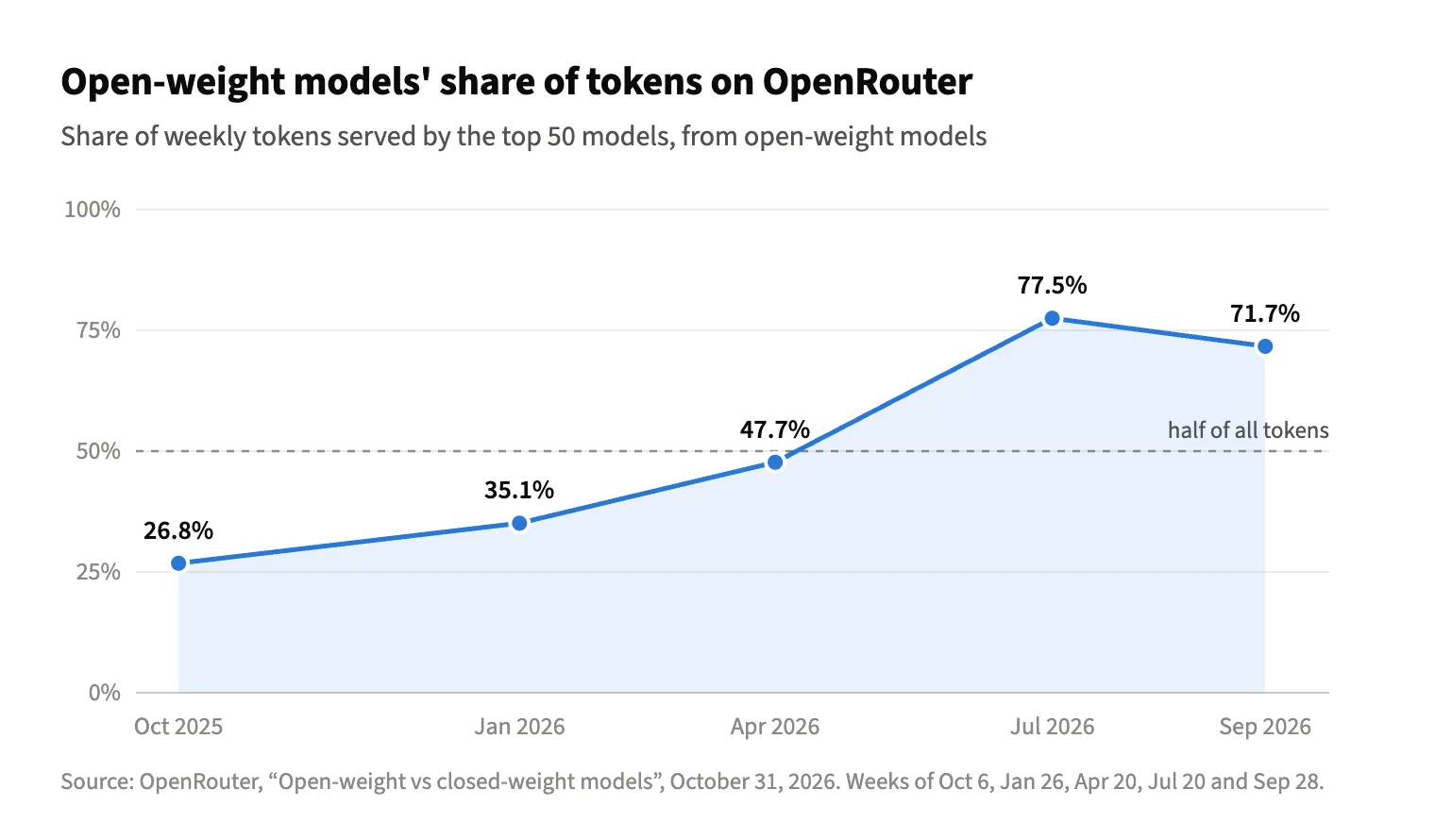 Open-weight models growing share of tokens served on OpenRouter in 2026
Image: Hugging Face
On average token price, the announcement cites OpenRouter October 2026 figures:
- Open-weight: about $0.28 per million input tokens and $1.62 per million output tokens.
- Closed models: about $1.27 input and $6.36 output.
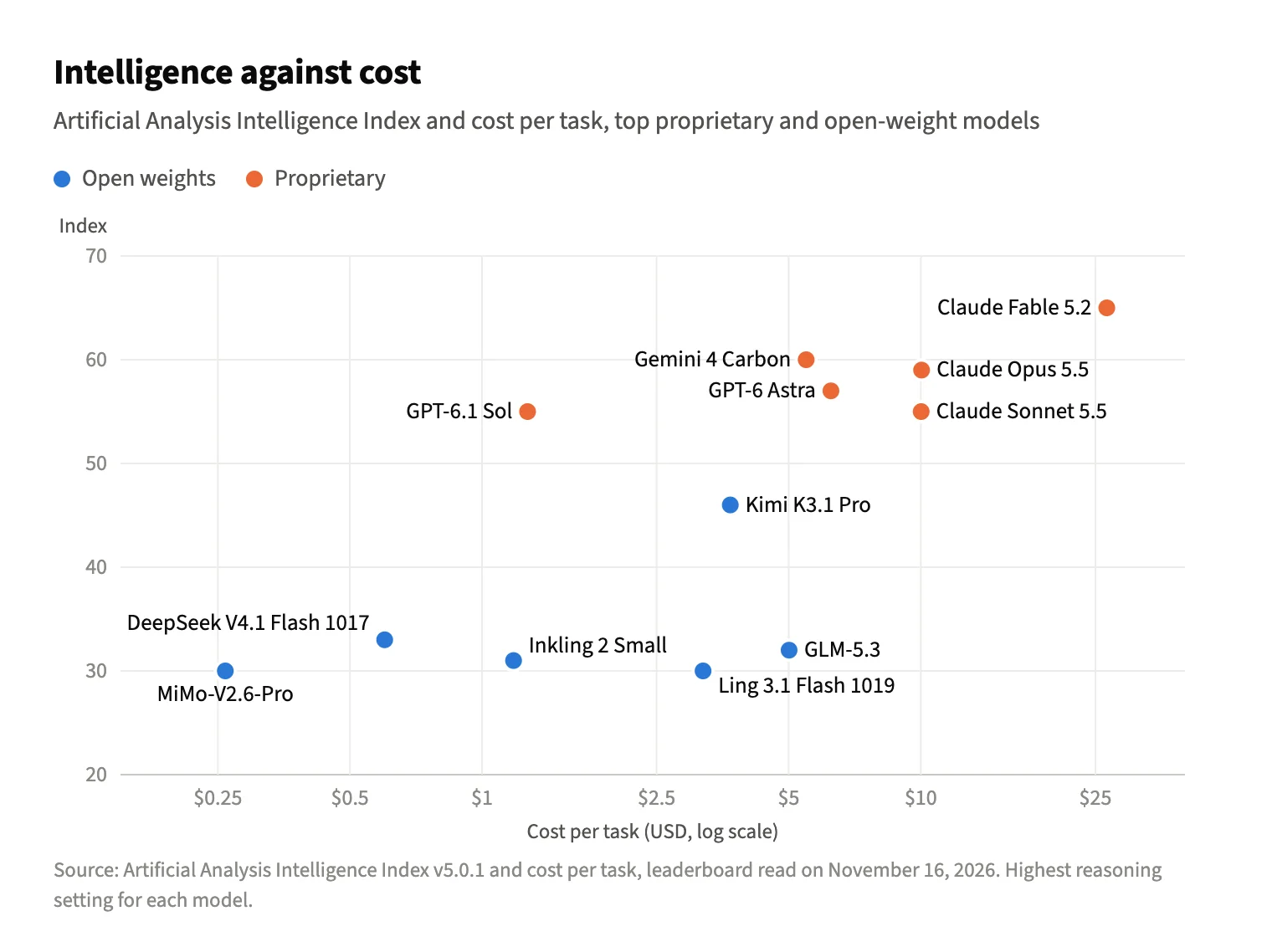 Artificial Analysis intelligence index versus cost per task for open-weight and proprietary models
Image: Hugging Face
Quality trade-offs remain. Hugging Face repeats an Artificial Analysis Intelligence Index comparison: Kimi K3.1 Pro at 46 versus Claude Fable 5.2 at 65, with roughly one-seventh the cost per task in their table ($3.68 vs $26.54). That is vendor-cited benchmark math, not explainx.ai independent testing, but it states why teams route easy workloads to open weights.
This week DeepSeek V4.1 Flash led OpenRouter rankings at 59.2 trillion tokens, per the post, aligning with our open-weight license and Hy4 flash price story coverage on Chinese flash models competing on cost.
Routing behavior and controls
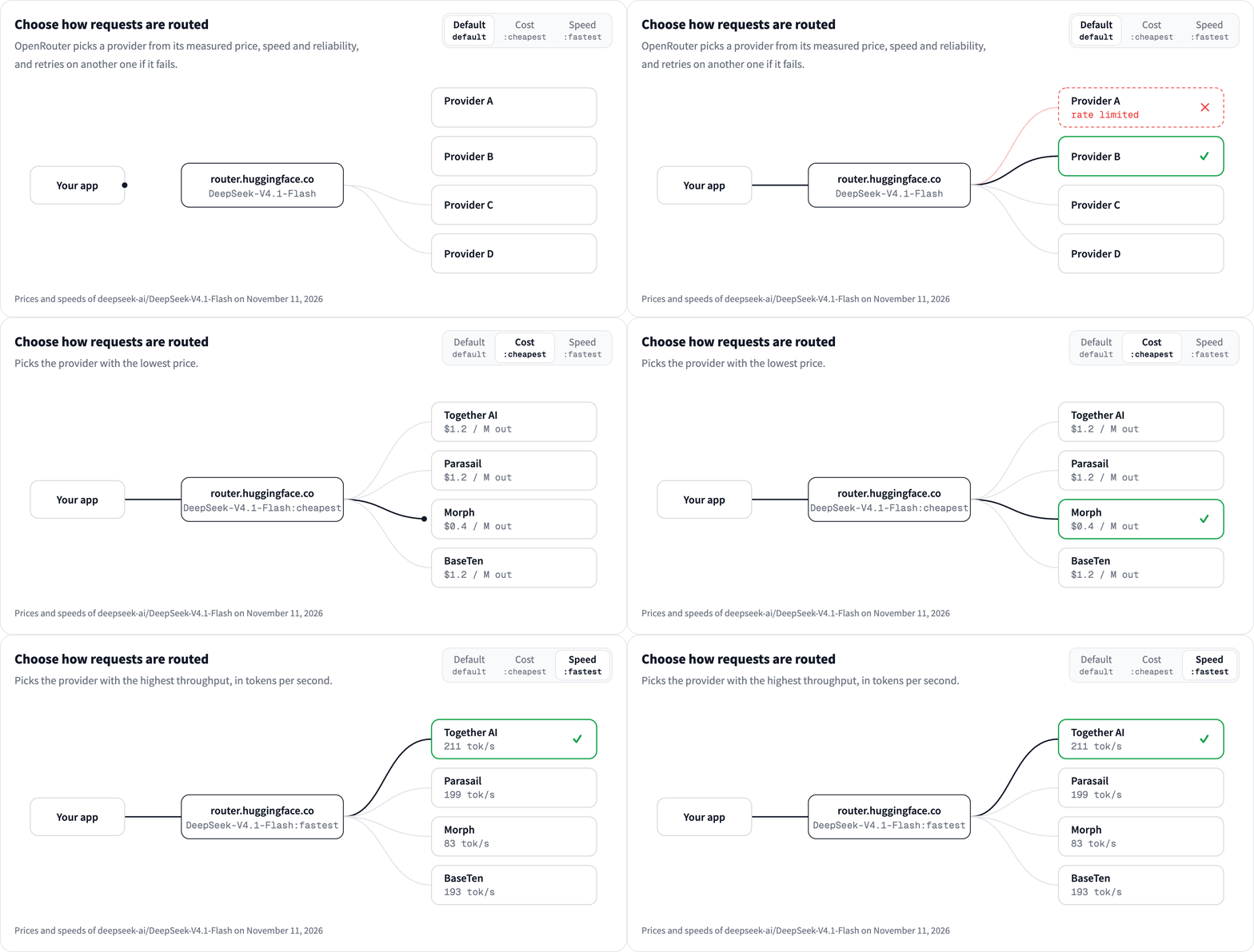 OpenRouter default routing retries and cheapest or fastest profile selection
Image: Hugging Face
OpenRouter exposes directives such as default, :cheapest, and :fastest routing profiles in the announcement assets. Default tries a measured provider, then fails over when the first returns rate limits or errors, an operational detail that matters for agent loops that issue dozens of calls per task.
Hugging Face documents per-provider toggles in Inference Providers settings so teams can block hosts for compliance or quality reasons. If you already standardized on one host for audit logs, use toggles instead of assuming the router always picks the same backend.
Compare this design to OpenRouter default routing quality claims we audited earlier: the Hub integration makes those behaviors default for casual Hub users, not only power users hitting openrouter.ai directly.
Coding agents and API compatibility
The November 16 post is explicitly agent-facing. It ships setup guides for:
- Claude Code
- Codex
- OpenCode
- Pi
- Hermes Agent
Each guide is meant to be copied into an agent prompt or pasted as config. That matches how Google Stitch skills and Claude bughunter skills lowered friction: the platform publishes opinionated harness wiring, not only REST docs.
API shape support is the other headline. Chat Completions, Responses, and Anthropic Messages formats work across providers behind the router, which reduces forked client code when you A/B test Qwen, DeepSeek, or Llama class models against a closed baseline.
How this fits the NVIDIA acquisition thread
Readers following NVIDIA proposed Hugging Face acquisition reporting may wonder if OpenRouter partnership signals a different control story. Operationally, routing openness favors multi-vendor inference, while an acquisition narrative centers distribution and enterprise bundling.
For day-to-day engineering, treat November 16 as product shipping: easier Hub-to-production paths for open weights. Deal politics belong in the acquisition post, not in your latency dashboards.
Migration steps if you already use Inference Providers
- Re-run smoke tests on critical models; provider backends may shift even when slugs stay fixed.
- Open Metrics tabs on model pages after deploy; the post highlights playground and metrics GIFs for watching throughput.
- Set provider toggles before production cutover if you must exclude jurisdictions or hosts.
- Compare bills for a week against pre-November routing; open-weight share growth can lower cost if you accept benchmark gaps.
- Pair with vLLM vs SGLang self-host guide when traffic outgrows serverless economics.
What changes for Claude Code and Codex users
The announcement's setup guides matter because most builders no longer hand-write curl against raw REST. They paste Hub snippets into Claude Code, Codex, or Pi and let agents maintain dependencies. When routing moves to OpenRouter, the agent still talks to Hugging Face endpoints, but the backend host may change between calls.
That has three consequences:
- Latency variance increases when failover kicks in; agent timeouts written for a single slow host may need slack.
- Tool budgets swing when a cheap provider succeeds versus when default routing retries twice.
- Compliance logs must record which provider served each call if you operate in regulated industries; use Hub metrics and provider toggles rather than assuming a static data processor list.
If you already installed Claude bughunter skills or Google Stitch skills, rerun a smoke test on your top three open models after November 16. Routing changes have caused surprise 429 storms in other multi-host setups, as we documented in OpenRouter routing quality claims.
Open weights versus closed models on the same token
Hugging Face emphasizes that open-weight traffic on OpenRouter grew more than 60-fold weekly while closed models grew roughly tenfold in the same window, per the blog. That asymmetry explains why the Hub, historically a weights museum, now optimizes for inference routing: most new commits are API-only releases or gated weights where the economic action is hosted tokens, not downloads.
Teams migrating from closed APIs should run a two-week shadow route: send a slice of production prompts through Hub inference and compare cost, refusal behavior, and tool-call reliability against your incumbent. Our Vals Pro-China model study shows how hosting provider can shift safety posture even when weights are identical.
FAQ for searchers comparing Hugging Face and OpenRouter
Is Hugging Face like OpenRouter? After November 16, for Inference Providers chat models, Hugging Face uses OpenRouter as the router layer while keeping identity, billing integration, and model pages on the Hub. OpenRouter still operates its own direct API for users who start on openrouter.ai.
Do I need both accounts? The integrated announcement path uses a Hugging Face token. Teams with existing OpenRouter keys for non-Hub models can keep them for routes outside this integration.
Will my fine-tuned adapter break? Adapters attached to Hub repos should keep the same model IDs; what changes is which vendor GPU runs the forward pass. Re-validate LoRA deployments if a provider pins a different base revision.
Limits and honest caveats
- Closed frontier tasks still win on hardest benchmarks in Hugging Face own cited table; routing does not change model brains.
- OpenRouter statistics in the post come from OpenRouter; we did not recompute token shares independently this run.
- Dedicated Endpoints and on-prem GGUF paths are unchanged; this news targets shared Inference Providers.
- Enterprise compliance may still require private endpoints despite convenient Hub routing.
When to stay on dedicated Endpoints instead
Hugging Face keeps Inference Endpoints for teams that need fixed hardware, private networking, and predictable data residency. The OpenRouter switch targets shared Inference Providers where multi-tenant efficiency beats single-tenant control.
Choose dedicated endpoints when:
- Your contract names one subprocessors list and failover across 80 hosts is unacceptable.
- You run long-context batch jobs where cold starts on rotating providers destroy SLA math.
- You rely on custom containers or pinned revisions that not every OpenRouter partner ships yet.
Choose routed Hub inference when:
- You prototype many open models per week and want price-aware switching without writing your own router.
- You teach workshops and want students on one HF token (see our workshops directory for live agent classes).
- You benchmark Asian flash models like Hy4 against DeepSeek with minimal glue code.
Related reading
- Open-weight model licenses explained
- Transformers GGUF parity with llama.cpp
- OpenRouter 10 quadrillion token claim, verified math
- Sarvam Token Factory migration from OpenRouter
- Baseten efficient frontier inference guide
- NVIDIA and Hugging Face acquisition context
Routing details are accurate as of the Hugging Face blog post dated November 16, 2026. Provider lists and prices change continuously on OpenRouter.