



Update (July 9, 2026 — GPT-Live): OpenAI launched GPT-Live for ChatGPT Voice — full-duplex consumer layer. This post covers the Realtime API developer stack.
On May 7, 2026, OpenAI announced a major leap in voice AI: GPT-Realtime-2, the company's most intelligent voice model yet, bringing GPT-5-class reasoning to voice agents. Alongside it, OpenAI released GPT-Realtime-Translate (real-time translation across 70+ input and 13 output languages) and GPT-Realtime-Whisper (streaming transcription for live captions and notes).
 OpenAI's new voice models transform voice agents into real-time collaborators
OpenAI's GPT-Realtime-2, GPT-Realtime-Translate, and GPT-Realtime-Whisper are now available in the Realtime API.
These three models are now available in the Realtime API, transforming voice interfaces from simple question-answering systems into real-time collaborators that can listen, reason, take action, handle interruptions, and keep conversations flowing naturally.
This article covers what makes GPT-Realtime-2 a breakthrough, how it compares to GPT-Realtime-1.5, the capabilities of all three models, pricing, use cases, and what developers and product teams should know when building production voice agents in 2026.
TL;DR
| Topic | Takeaway |
|---|---|
| GPT-Realtime-2 | OpenAI's flagship voice model with GPT-5-class reasoning; 128K context window (4× larger than 1.5); handles interruptions, tool calls, multi-turn dialogue |
| Performance Gains | 96.6% on Big Bench Audio (vs 81.4%); 48.5% instruction-following (vs 34.7%); 95% adversarial call success (vs 69%) |
| GPT-Realtime-Translate | Live translation from 70+ input languages → 13 output languages; preserves meaning with regional accents and domain vocabulary |
| GPT-Realtime-Whisper | Streaming speech-to-text with low latency; ideal for live captions, meeting notes, and real-time transcription |
| Pricing | RT-2: $32/1M input tokens, $64/1M output; Translate: $0.034/min; Whisper: $0.017/min |
| Use Cases | Customer support, education, tutoring, multilingual commerce, live events, meeting transcription, voice commands |
What Makes GPT-Realtime-2 a Breakthrough
GPT-5-Class Reasoning in Voice
For the first time, OpenAI brings reasoning capabilities from their most advanced text models directly into a speech-to-speech voice model. This means voice agents can:
- Solve complex problems as conversations unfold
- Call tools and APIs based on voice instructions
- Handle interruptions without losing context or dropping the conversation
- Think harder when needed using configurable reasoning levels
Voice agents are no longer just responders—they're real-time collaborators.
Context Window: 32K → 128K Tokens
GPT-Realtime-2 has a 128K token context window, which is 4× larger than GPT-Realtime-1.5's 32K window. This allows:
- Longer conversations without losing earlier context
- Multi-session continuity for complex support or tutoring scenarios
- More reference material in system prompts for domain-specific applications
For context: 128K tokens is roughly 96,000 words or ~200 pages of text—plenty for extended voice interactions.
Performance Improvements: GPT-Realtime-1.5 → GPT-Realtime-2
OpenAI published benchmark comparisons showing significant gains across key metrics:
Benchmark Comparison
| Metric | GPT-Realtime-1.5 | GPT-Realtime-2 (high) | GPT-Realtime-2 (xhigh) | Improvement |
|---|---|---|---|---|
| Big Bench Audio (reasoning) | 81.4% | 96.6% | - | +15.2 points |
| Audio MultiChallenge (instruction-following) | 34.7% | - | 48.5% | +13.8 points |
| Adversarial Call Success | 69% | - | 95% | +26 points |
| Context Window | 32K tokens | 128K tokens | 128K tokens | 4× increase |
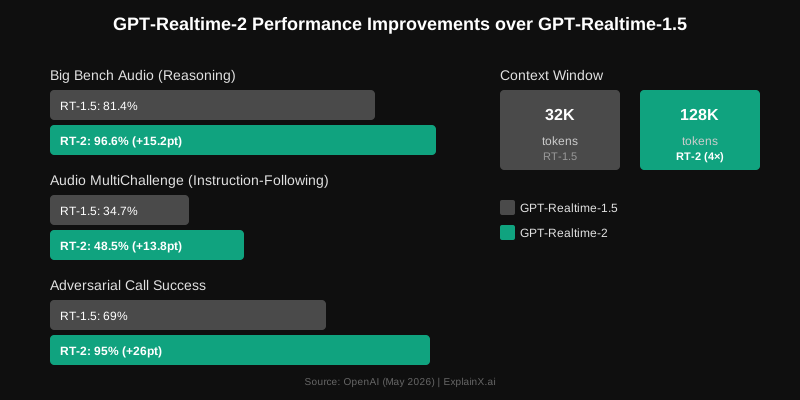 Performance comparison between GPT-Realtime-1.5 and GPT-Realtime-2
Visual comparison showing significant improvements across all key metrics. Source: OpenAI (May 2026)
Key Insight: The +26 point jump in adversarial call success is particularly important for customer support scenarios where users may be frustrated, use unclear language, or intentionally test the system.
Reasoning Levels: Tuning Cost vs Quality
GPT-Realtime-2 introduces five configurable reasoning levels, allowing developers to optimize for latency, cost, and quality based on use case:
| Level | When to Use | Trade-off |
|---|---|---|
| Minimal | Simple acknowledgments, greetings | Lowest cost/latency |
| Low | Straightforward Q&A, basic navigation | Very fast responses |
| Medium | Standard conversational turns | Balanced cost/quality |
| High | General conversation (recommended default) | Good reasoning without major latency |
| Xhigh | Complex branching logic, multi-tool flows, adversarial inputs | Higher latency and cost |
OpenAI's recommendation: Use high as the default for most production applications; reserve xhigh for scenarios requiring deep reasoning or handling difficult edge cases.
GPT-Realtime-Translate: Breaking Down Language Barriers
Overview
GPT-Realtime-Translate is a live simultaneous translation model that works while streaming—translating speech as the speaker talks, across 70+ input languages into 13 output languages.
Key Capabilities
1. Real-Time Translation Translates speech while the person is speaking, not after they finish—critical for natural conversations and live events.
2. Context Preservation Handles:
- Regional pronunciations and accents
- Domain-specific vocabulary (medical, legal, technical)
- Context switches mid-conversation
- Idiomatic expressions that don't translate literally
3. Meaning Over Literal Translation Focuses on preserving intent and meaning rather than word-for-word translation—resulting in more natural output.
Use Cases
- Cross-border e-commerce: Customer support in buyer's native language
- Global events: Real-time translation for webinars, conferences, workshops
- Multilingual customer service: Single agent team serving global customers
- Education: Language learning, international classrooms, overseas tutoring
- Healthcare: Doctor-patient communication across language barriers
Pricing
$0.034 per minute of translated audio.
GPT-Realtime-Whisper: Streaming Transcription
Overview
GPT-Realtime-Whisper is OpenAI's streaming speech-to-text model optimized for low latency. Unlike the batch Whisper API, which processes complete audio files for maximum accuracy, GPT-Realtime-Whisper transcribes as words are spoken.
How It Differs from Batch Whisper
| Feature | Batch Whisper API | GPT-Realtime-Whisper |
|---|---|---|
| Mode | Post-recording processing | Streaming transcription |
| Latency | Processes complete files | Real-time output |
| Accuracy | Optimized for accuracy | Optimized for latency |
| Use Case | Podcasts, video transcripts | Live captions, meeting notes |
| Pricing | Per audio minute processed | $0.017/min streaming |
Use Cases
1. Live Captions
- Accessibility for video calls, webinars, live streams
- Real-time subtitles for events and presentations
2. Meeting Transcription
- Automated note-taking during calls and meetings
- Searchable transcripts generated in real-time
3. Classroom Transcripts
- Lecture notes for students
- Accessibility support for hearing-impaired students
4. Voice Commands
- Real-time transcription for voice-controlled applications
- Dictation for medical, legal, and creative professionals
5. Customer Support Logging
- Real-time transcription of support calls
- Compliance and quality monitoring
Pricing
$0.017 per minute of transcribed audio—exactly half the cost of GPT-Realtime-Translate.
Pricing Breakdown
GPT-Realtime-2
| Component | Cost | Notes |
|---|---|---|
| Audio Input | $32 per 1M tokens | Standard audio input processing |
| Cached Input | $0.40 per 1M tokens | 98.75% discount for cached prompts |
| Audio Output | $64 per 1M tokens | Generated speech responses |
Prompt caching is critical for cost optimization—system prompts, context, and reference material can be cached at $0.40 per 1M tokens instead of $32.
GPT-Realtime-Translate
- $0.034 per minute of translated audio
- Flat rate regardless of language pair or complexity
GPT-Realtime-Whisper
- $0.017 per minute of transcribed audio
- Half the cost of translation, same streaming latency benefits
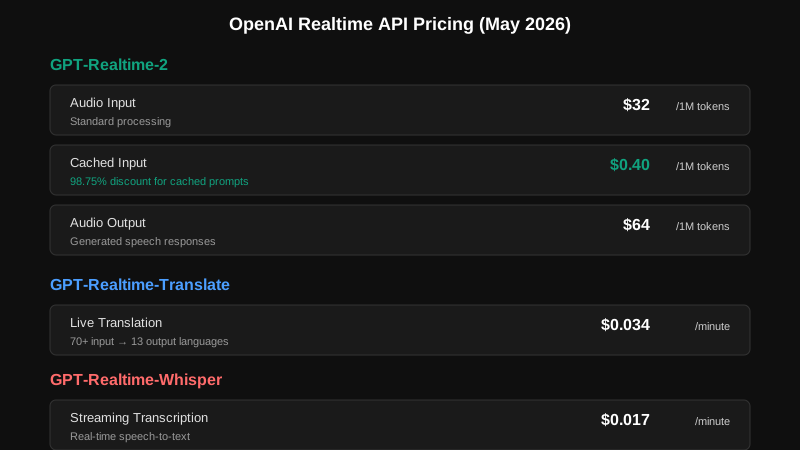 Pricing breakdown for all three OpenAI Realtime API models
Complete pricing structure for GPT-Realtime-2, GPT-Realtime-Translate, and GPT-Realtime-Whisper. Note the 98.75% discount for cached inputs.
Cost Comparison Example
10-minute customer support call:
- RT-2 reasoning + voice: ~$2-5 depending on complexity and caching
- RT-Translate: $0.34
- RT-Whisper transcription: $0.17
Hybrid approach (transcribe with Whisper → reason with text models → respond with RT-2) can optimize costs for workflows where streaming voice isn't critical throughout.
Technical Specifications
GPT-Realtime-2
- Model Type: Speech-to-speech end-to-end
- Context Window: 128K tokens
- Reasoning Levels: Minimal, Low, Medium, High, Xhigh
- Tool Calling: Native support for function/API calls
- Interruption Handling: Built-in support for user interruptions
- Multi-Turn Dialogue: Maintains context across conversation turns
GPT-Realtime-Translate
- Input Languages: 70+
- Output Languages: 13
- Mode: Simultaneous streaming translation
- Latency: Real-time (translates while speaking)
GPT-Realtime-Whisper
- Input: Streaming audio
- Output: Streaming text transcription
- Optimization: Low-latency over post-hoc accuracy
- Format: Standard text output (can be fed to other models)
Production Use Cases
1. Customer Support Escalation
Problem: Level 1 support handles simple queries; complex issues require human escalation.
Solution: GPT-Realtime-2 with high reasoning handles nuanced questions, tool calls (checking order status, processing refunds), and multi-step troubleshooting without human handoff.
Benefits:
- 95% adversarial call success means it handles frustrated customers well
- 128K context retains full conversation history
- Tool calling integrates with CRM, order systems, knowledge bases
2. Multilingual E-Commerce Support
Problem: Serving global customers requires multilingual support teams or fragmented regional systems.
Solution: Single agent team uses GPT-Realtime-Translate to serve customers in their native language; backend support agents work in their native language.
Benefits:
- 70+ input languages covers most global markets
- $0.034/min is cheaper than hiring multilingual specialists
- Regional pronunciation handling improves accuracy
3. Live Event Translation
Problem: International conferences, webinars, and workshops need simultaneous interpretation—expensive and limited by interpreter availability.
Solution: GPT-Realtime-Translate provides real-time translation for live streams, video calls, and in-person events.
Benefits:
- Streaming translation keeps pace with speakers
- Context preservation handles technical vocabulary
- Scalable to unlimited attendees without per-interpreter costs
4. Educational Tutoring
Problem: Personalized tutoring is expensive and hard to scale; students need patient, adaptive instruction.
Solution: GPT-Realtime-2 with high reasoning acts as 1:1 tutor—explaining concepts, answering questions, adapting to student's pace.
Benefits:
- GPT-5-class reasoning handles complex explanations
- Interruption handling lets students ask clarifying questions naturally
- 128K context retains lesson history across sessions
5. Meeting Transcription and Summarization
Problem: Manual note-taking during meetings is distracting; post-meeting transcription delays action items.
Solution: GPT-Realtime-Whisper transcribes meetings in real-time; pair with text models for instant summaries and action items.
Benefits:
- $0.017/min is cheaper than human transcription
- Real-time output means notes available instantly
- Searchable transcripts improve team knowledge management
Trade-offs and Limitations
Cloud-Only Requirement
All three models run in OpenAI's cloud—not suitable for:
- Projects with strict data residency requirements
- On-premise deployments
- Offline or air-gapped environments
Mitigation: For sensitive use cases, consider OpenAI's enterprise tier with enhanced data controls or self-hosted alternatives (though reasoning quality will differ).
Cost Unpredictability
Challenge: Voice interactions are harder to estimate than text:
- Idle silences still consume context
- Response looping (model talks, user talks, model talks) can spike costs
- xhigh reasoning has higher per-token costs
Mitigation:
- Use high reasoning as default; reserve xhigh for specific turns
- Implement session timeouts and idle detection
- Monitor usage in staging before production rollout
- Leverage prompt caching (98.75% discount) for system prompts
Output Variation
Challenge: Switching from GPT-Realtime-1.5 to 2.0 may change:
- Response phrasing and tone
- Tool-calling behavior
- Handling of edge cases
Mitigation:
- Re-validate prompts and system instructions for RT-2
- Run A/B tests comparing RT-1.5 and RT-2 on production traffic
- Update KPIs and benchmarks based on new capabilities
Translation Language Coverage
Limitation: Only 13 output languages (vs 70+ input languages).
Implication: You can listen in 70+ languages but respond in only 13—fine for customer support (respond in user's language) but limiting for multilingual content creation.
How to Get Started
Step 1: API Access
GPT-Realtime-2, GPT-Realtime-Translate, and GPT-Realtime-Whisper are available now in the Realtime API.
Sign up: OpenAI Platform
Step 2: Choose Your Model
- GPT-Realtime-2: Production voice agents with reasoning
- GPT-Realtime-Translate: Real-time translation
- GPT-Realtime-Whisper: Streaming transcription
Tip: You can combine models—e.g., Whisper for transcription → text model for reasoning → RT-2 for voice output.
Step 3: Configure Reasoning Level
Start with high reasoning for general use; test xhigh for complex scenarios.
Step 4: Leverage Prompt Caching
System prompts, context, and reference material should be cached to get 98.75% cost savings on repeated tokens.
Step 5: Monitor Usage and Optimize
- Track cost per conversation
- Measure latency at different reasoning levels
- Monitor adversarial call success and edge-case handling
- A/B test RT-2 vs RT-1.5 on production traffic
Comparison: GPT-Realtime-2 vs Competitors
OpenAI GPT-Realtime-2 vs Anthropic Claude Voice
| Feature | GPT-Realtime-2 | Claude Voice (hypothetical) |
|---|---|---|
| Reasoning | GPT-5-class reasoning | Claude Opus 4.7-class reasoning |
| Context Window | 128K tokens | Likely 200K+ (Claude's strength) |
| Pricing | $32/$64 per 1M tokens | TBD (Claude typically competitive) |
| Tool Calling | Native support | Native support (strong in Claude) |
| Latency | Optimized for real-time | TBD |
As of May 8, 2026, Anthropic has not announced a competing voice model—GPT-Realtime-2 is the frontier.
OpenAI vs Google Gemini Live
Google Gemini Live (voice mode in Gemini) offers:
- Voice interaction with Gemini models
- Multimodal input (voice + images)
- Interruption handling
GPT-Realtime-2 advantages:
- Dedicated voice models (not repurposed text models)
- Configurable reasoning levels for cost/quality optimization
- Separate translation and transcription models for specialized use cases
The Future of Voice AI
Voice Agents as Real-Time Collaborators
OpenAI's announcement signals a paradigm shift:
Old: Voice assistants as reactive responders—answer questions, set timers, play music.
New: Voice agents as proactive collaborators—solve complex problems, take action, adapt to interruptions, work across languages.
What This Enables
1. Truly Useful Customer Support Not just "I'm sorry you're having trouble"—actual troubleshooting, order management, and resolution.
2. Personalized Education at Scale 1:1 tutoring with reasoning capabilities that adapt to each student's level and pace.
3. Global Business Without Language Barriers Small businesses can serve global customers without hiring multilingual teams.
4. Accessible Meetings and Events Real-time transcription and translation make content accessible to everyone, regardless of language or hearing ability.
What's Next
Expected Evolution:
- Longer context windows (256K+, 1M+)
- More output languages for translation
- Multimodal voice (voice + vision + tool use)
- On-premise deployment for enterprises with data residency requirements
- Fine-tuning for domain-specific voice agents
Bottom Line: Voice Agents Just Got Smarter
OpenAI's GPT-Realtime-2, GPT-Realtime-Translate, and GPT-Realtime-Whisper represent the most significant leap in voice AI since the original Realtime API launch.
Key Takeaways:
- GPT-5-class reasoning is now available in voice—agents can solve complex problems as conversations unfold
- 128K context window enables much longer, more contextual interactions
- 95% adversarial call success means production-ready customer support
- Real-time translation across 70+ languages breaks down global communication barriers
- Streaming transcription at $0.017/min makes real-time captions and notes accessible
- Configurable reasoning levels let developers optimize cost vs quality
Who Should Care:
- Customer support teams: Reduce escalations, handle complex queries autonomously
- Education platforms: Scale personalized tutoring without hiring armies of teachers
- Global businesses: Serve international customers in their native language
- Event organizers: Provide real-time translation and captions for accessibility
- Developers: Build the next generation of voice-native applications
OpenAI has stated: "We know you're eager for voice updates in ChatGPT. Stay tuned, we're cooking."
The Realtime API release is the infrastructure layer—expect consumer-facing voice improvements in ChatGPT soon.
Related Reading
- ElevenLabs Reception: an AI receptionist for small businesses — a packaged product built on the same real-time voice problem, and what its launch thread left unanswered
For more on AI agents, model capabilities, and production AI systems:
- Hugging Face speech-to-speech — open-source, self-hosted Realtime-compatible alternative
- GPT-Realtime-2.1-mini: reasoning at mini pricing (July 2026)
- What Are Agent Skills: Complete Guide
- AI Benchmarks in 2026: The Complete Guide
- Claude Opus 4.7 Models Guide
- What Are LLM Tokens
- LLM Context Window Explained
- Grok Voice Think Fast 2.0 — Speech-to-Speech API (July 2026) — xAI STS vs Realtime; Aug 5 alias cutover
- xAI Grok Voice Agent Builder — no-code phone agents at $0.05/min
Disclosure: This post is editorial analysis based on OpenAI's May 7, 2026 announcement, community developer forum posts, and third-party technical coverage. Benchmark numbers and pricing are accurate as of May 8, 2026 but may change. For production deployments, consult OpenAI's official documentation and pricing pages.
Update — July 7, 2026: OpenAI shipped GPT-Realtime-2.1-mini — reasoning and tool use in the mini lineup at the same cost as GPT-Realtime-mini, plus ≥25% lower p95 latency across Realtime voice models via improved caching. Flagship GPT-Realtime-2.1 remains the choice for maximum reasoning depth ($32/$64 per 1M audio tokens).
Update — July 2, 2026: xAI launched Voice Agent Builder — a no-code Grok Voice platform with telephony and MCP at $0.05/min, quoting 67.3% on τ-voice Bench vs 35.3% for GPT Realtime 1.5 in xAI's table.
Sources
- OpenAI — Advancing voice intelligence with new models in the API
- OpenAI Developer Community — New Realtime Voice Models in the API
- TechCrunch — OpenAI launches new voice intelligence features in its API
- Oflight Inc. — OpenAI GPT-Realtime-2 and the Three New Voice Models
- Neowin — OpenAI unveils trio of realtime audio models to power next-gen voice agents
Update — October 5, 2026: Related Anthropic privacy news: Claude voice data training opt-in.