




Mistral AI released Voxtral 3 on Tuesday, October 20, 2026: a family of speech-to-text and text-to-speech models plus a voice agent SDK that runs listening, reasoning, tool calling and speaking as one streaming pipeline. Mistral says the transcription models cover 50+ languages, the 4B-parameter Mini transcriber costs $0.0035 per minute, and its new speech model costs $13 per million characters, which it says is less than comparable models from OpenAI TTS-1, Deepgram, ElevenLabs Flash and Gemini Flash.
Voice is the most crowded corner of agent building this month. In the last few days alone we covered ElevenLabs' Eleven Realtime models, and earlier OpenAI's GPT-Live-1 in the API and Grok Voice 3.0. Mistral's angle is different: a modular stack you can host in the EU or on your own hardware. Everything below comes from Mistral's launch post, and the benchmark figures are Mistral's own unless we say otherwise.
TL;DR: the questions builders ask first
| Question | Short answer |
|---|---|
| What shipped? | Small and Mini Transcribe 3, Realtime Transcribe 3, Mini TTS 3 (also called Voxtral Speech 3), Pro Voice, and a voice agent SDK |
| When? | October 20, 2026 |
| Transcription languages? | 50+, including the 24 official EU languages |
| Realtime transcription? | 35+ languages, sub-500ms latency, per Mistral |
| TTS languages? | 35+ languages and 50+ dialects |
| Price? | $0.0035 per minute (Mini, 4B parameters); $13 per 1M characters for TTS |
| Where does it run? | Mistral's EU-hosted API, or self-deployed on your infrastructure |
| Agent SDK? | Built on LiveKit; turns complete in under one second, per Mistral |
| Independent verification? | None found yet; charts are Mistral's, some judged by Gemini |
What Mistral actually released
Mistral frames the problem as four jobs a voice agent must do at once: listen across accents and interruptions, reason about intent, speak with emotion, and act through connected systems. Voxtral 3 is its attempt to cover all four with one vendor.
Voxtral Small and Mini Transcribe 3
The offline transcription models handle 50+ languages, add diarization (who said what), and support context biasing: you pass key terms or free-form text, and the model leans toward that vocabulary without fine-tuning. They also detect end of turn, so an agent knows when a speaker has finished.
Mistral says the Small version is state of the art on diarization and multilingual transcription, including English, French and Spanish, and "outperforms Whisper, Scribe v2 and Gemini 3.5 Transcribe." The Mini variant is 4B parameters at $0.0035 per minute. For how Google's rival model was positioned, see our Gemini 3.5 Transcribe launch post.
Voxtral Realtime Transcribe 3
This one is for live agents: sub-500ms latency in over 35 languages, with diarization and context biasing. End-of-turn prediction uses both acoustic and semantic information, which is meant to reduce the classic failure where an agent cuts in on a caller who paused to think.
Voxtral Mini TTS 3
The text-to-speech model, available in batch and realtime, reads the meaning of the text to pick emotion, pace and emphasis. Mistral lists voice cloning from roughly 30 minutes of audio, instruction following with variables for emotion, pacing and emphasis, contextual TTS, and a vocabulary library for unusual words. The launch page shows pronunciation hints given as phonemes, for example for a made-up product name.
Pro Voice
For cases where basic cloning is not enough, Pro Voice adaptation reproduces a speaker's character, emotional range and speaking style across languages, using just 30 minutes of audio, per Mistral. Voice cloning raises consent questions we cover below.
How the voice agent SDK works
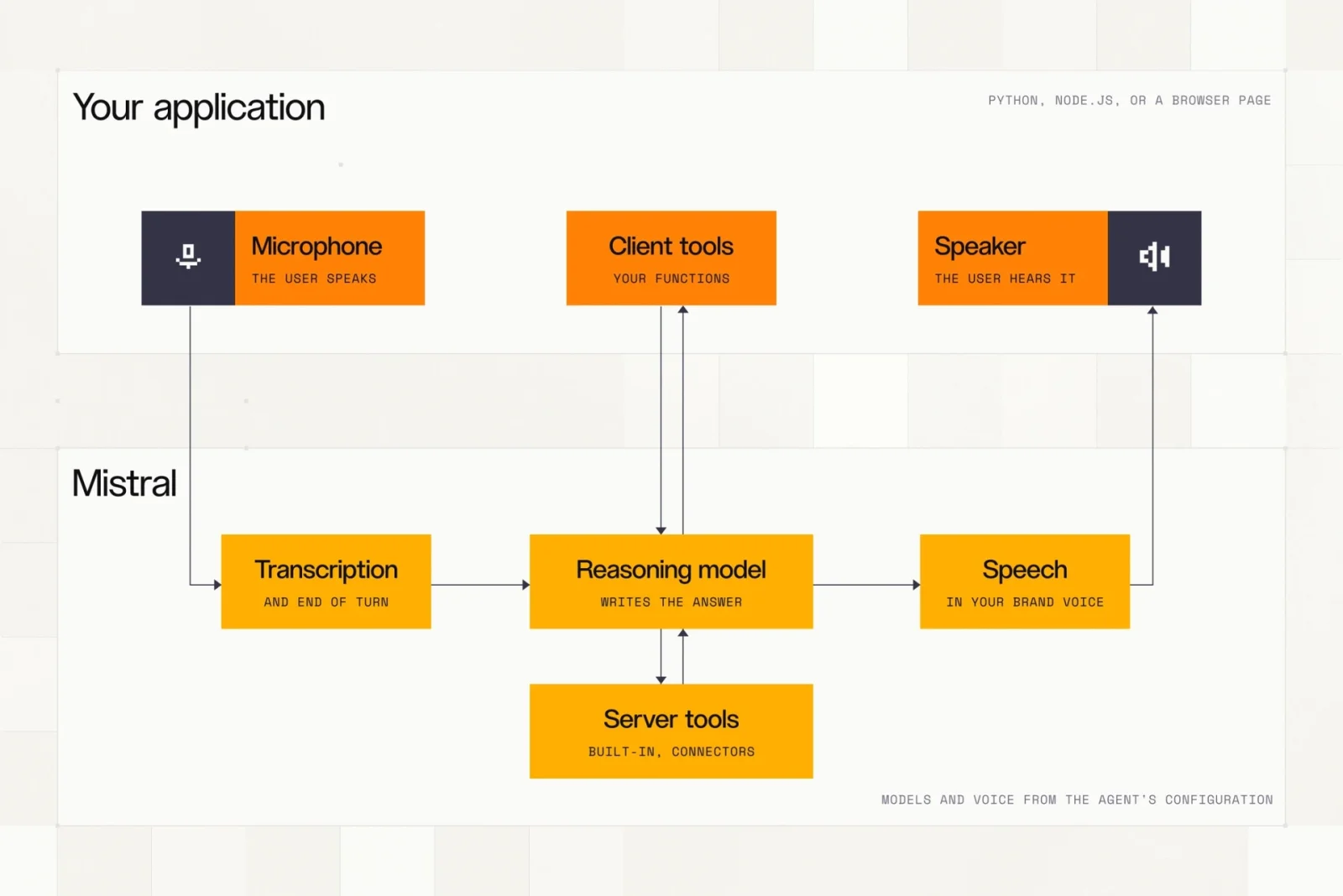 Voxtral 3 voice agent SDK pipeline from realtime transcription to reasoning to speech
Image: Mistral AI
The SDK is built on LiveKit, the open-source realtime media stack. Mistral describes three stages running as one streaming pipeline: Voxtral Realtime Transcribe 3 listens and detects when the caller has finished, a general model "like Mistral Small" reasons and calls tools, and Voxtral Speech 3 replies in the tone of the conversation so far.
"No stage waits for the one before it," Mistral writes, so each turn completes in under one second and the agent stops talking when the caller cuts in. That is a vendor claim about a demo configuration. Your numbers will depend on the language model you pick, tool latency, region and telephony hops.
The launch page walks through a worked example: a patient calls with a French referral letter, the agent calls a get_referral tool, reads the French note aloud as an English explanation, books a dermatology slot with a book_appointment tool, and offers to text the details in English. It is a good picture of the target use: multi-step workflows over a phone line, not dictation.
If you are building something like this, our Hugging Face speech-to-speech voice agent guide shows the open-source modular alternative, and Sarvam's voice agents launch shows how another regional lab approaches multilingual calls.
The benchmark claims, and how to read them
Mistral publishes several charts. It matters who built each one.
| Claim | Benchmark | Who ran it |
|---|---|---|
| Best multilingual transcription | FLEURS, 45 languages, forced and inferred language | Mistral's page; the metric is macro-average word error rate |
| Best diarization | cpWER over AMI, Switchboard, CallHome and AISHELL-4 | Mistral; 30-minute versions of AMI and AISHELL |
| Better term recall with context | Earnings-22 keyphrase recall with 0 to 100 distractors | Mistral |
| Best Artificial Analysis WER | Index over VoxPopuli, Earnings-22 and AgentTalk | Labeled Artificial Analysis on the page |
| TTS quality per dollar | Voice Code Bench by BeSimple AI, pronunciation control, multilingual, expressive English | Partly third party, partly internal evals |
Three cautions apply. First, the TTS charts labeled internal evaluations use Gemini 3.8 Flash as the judge, listening to clips and scoring them on a 1 to 5 scale. Model-as-judge scores are useful for ranking but can drift from human preference. Second, several evaluations use prompts "selected for release," which means a curated subset. Third, prices come from vendor pricing pages on the day the charts were generated, October 20, 2026.
None of that makes the claims wrong. It means the honest summary is "Mistral reports it leads on these tests," not "Voxtral 3 is proven best." Run your own audio: accented speech, phone-quality 8 kHz recordings, domain jargon and overlapping speakers are exactly where WER tables hide differences.
Price and where it runs
| Item | Mistral's listed price |
|---|---|
| Voxtral Mini Transcribe 3 (4B) | $0.0035 per minute |
| Other transcription variants | $0.008 and $0.0040 per minute appear in the pricing table |
| Voxtral Speech 3 (TTS) | $13 per 1M characters |
To put TTS in perspective, a minute of spoken English is roughly 900 to 1,000 characters, so $13 per million works out to about a cent or just over per minute of generated speech. That is our arithmetic, not a Mistral figure. Add transcription at $0.0035 per minute and a language model, and a cascaded voice agent lands in the low cents per minute before telephony.
The sovereignty pitch is the other half of the story. Mistral says you can use its EU-hosted API or deploy on your own infrastructure, and "control whether any audio is retained." For European banks, hospitals and public bodies that cannot send call audio to a US cloud, that is the reason to look. For background on how Mistral positions itself against US labs, see France's sovereign AI push. The launch page does not state weight licenses for self-hosting, so read the model cards before committing.
What to test before you switch
- Your audio, your languages. Take 50 real calls, including the worst ones, and compare word error rate and diarization against your current vendor. Check names and numbers separately.
- Interruptions. Measure how often the agent talks over a caller and how fast it stops. Mistral's under-one-second claim is the thing to disprove.
- Numbers and identifiers. The launch page demonstrates email addresses, prices and dates read correctly. Read-back of order numbers is where support agents fail, so build a test set.
- Cloning consent. Pro Voice and 30-minute cloning need documented speaker consent, and impersonation of customers or executives is a live fraud risk. If your agents take real actions over voice, decide what they may do before they do it. AgentBeam is the agent security platform from the explainx.ai team that checks agent actions before they run.
- Latency under load. Time to first audio at your concurrency, from your region.
How it compares with the rest of the field
Voxtral 3 is a cascade: separate transcription, reasoning and speech models joined by an SDK. ElevenLabs' and OpenAI's newest products go the other way, with end-to-end speech-to-speech models. Cascades are easier to debug, let you swap the language model, and let you log text at every stage. End-to-end models can sound more fluid and skip a hop. Neither is clearly better, and which wins depends on whether you value control or conversational feel.
On the TTS side, Bland's Speech v3 targets the same enterprise call-center buyer. Mistral's differentiators are price, European hosting, and one vendor across transcription and speech. Its weaknesses are the usual ones for a new release: no independent leaderboard results yet, and an SDK that has had no time in production.
Why this matters
Speech used to be the part of an agent that teams bought and forgot. Now it is where vendors compete on price, language coverage and data residency. A 4B transcription model at a fraction of a cent per minute, plus expressive TTS at $13 per million characters, pushes the cost of a voice agent down and lets smaller teams build in languages that were poorly served. If the independent numbers hold, Voxtral 3 is a credible European option next to the US labs. If they do not, you will find out quickly by running your own audio.
Details here reflect Mistral's October 20, 2026 launch page. Prices, language lists and benchmark charts may change; confirm with Mistral before building.