



Update — August 5, 2026: OpenAI's architecture disclosure clarifies a detail that wasn't obvious from the July launch materials alone: GPT-Live's delegation isn't a fallback for when the voice model "doesn't know" something — it's a structural design decision that every non-trivial query routes through, by design, regardless of how capable GPT-Live-1 itself might theoretically be at answering directly. That's a meaningfully different model than competitors that ship one large multimodal model handling both voice and reasoning in a single pass; OpenAI is explicitly betting that specialization — a fast, narrow voice model paired with a separately-scaled reasoning model — beats a single model trying to do both jobs well.
Update — August 5, 2026 (cont.): For developers watching this space, the architecture also previews what a future GPT-Live API might look like once OpenAI opens one up — likely a real-time media endpoint paired with a separate delegation callback, rather than a single request/response call like today's chat completions API.
Update — July 24, 2026: ChatGPT Voice is now in the desktop app (macOS + Windows) — GPT-Live steering Codex / ChatGPT Work agents, Mac Appshots, and plan/quota details in our desktop Voice guide. Same week Anthropic upgraded Claude Voice to Opus/Sonnet + connectors (turn-based, not GPT-Live duplex).
Update — August 4, 2026: OpenAI published the underlying system architecture behind GPT-Live's "listen while it speaks" behavior. A dedicated GPT-Live-1 model instance handles the real-time media path directly with the user (audio in, audio out) through a media frontend. When a query needs real reasoning or tools, the frontend fires an async delegation request to an application server, which routes it to a separate GPT-5.5 text-model instance with access to search, code, and retrieval tools — results and guidance flow back to the frontend without ever pausing the live audio stream. That split is what lets deeper reasoning happen mid-conversation without the model going silent while it "thinks."
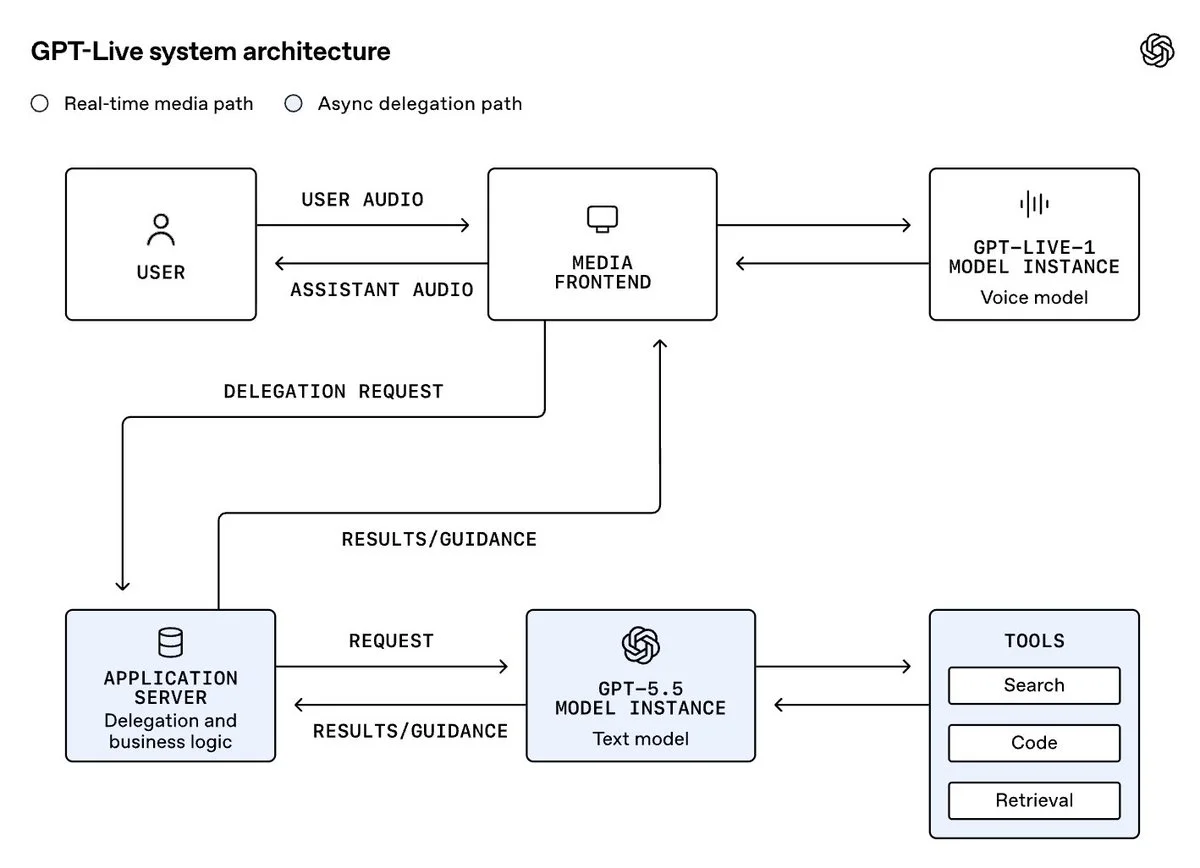 GPT-Live system architecture — user audio flows through a media frontend to a GPT-Live-1 voice model instance on the real-time path, while an async delegation path routes requests through an application server to a GPT-5.5 text model instance with search, code, and retrieval tools
The diagram makes explicit why this two-model split matters beyond a nice org chart: OpenAI is deliberately keeping the voice-facing model small, fast, and specialized for the real-time media path, while pushing anything that needs real reasoning capacity — search, code execution, retrieval — onto a separate, larger GPT-5.5 instance running asynchronously. A single unified model handling both jobs would force a tradeoff between response latency (favoring a smaller model) and reasoning depth (favoring a larger one); splitting the two into a real-time path and an async delegation path means GPT-Live-1 never has to compromise on either. The application server sitting between the two is where OpenAI's business logic for routing, rate limiting, and tool permissions presumably lives — it's the layer deciding when a delegation request is warranted versus when GPT-Live-1 can answer conversationally on its own without ever leaving the real-time path. This also clarifies why GPT-Live's tool access (search, code, retrieval) never introduces the dead-air pauses users associated with older voice assistants "looking something up" — the audio path and the tool-using path are architecturally decoupled, so GPT-Live-1 can keep talking, backchanneling, or waiting on the user while GPT-5.5 works in parallel on the actual answer.
On July 8, 2026, OpenAI launched GPT-Live — a new generation of voice models that replace the default ChatGPT Voice experience. The headline shift is architectural: full-duplex interaction where the model listens and speaks at the same time, not turn-based silence detection.
More than 150 million people use ChatGPT Voice or Dictation weekly. GPT-Live targets the friction everyone complained about — rigid turn-taking, interruptions on pauses, and slow cascaded pipelines — while routing hard questions to GPT-5.5 behind the scenes.
OpenAI's July 8 launch video — full-duplex voice with natural backchanneling and delegation to GPT-5.5.
TL;DR: What People Are Asking
| Question | Answer |
|---|---|
| When? | July 8, 2026 — rolling out globally over days |
| Models? | GPT-Live-1 (Go/Plus/Pro default) · GPT-Live-1 mini (Free) |
| Architecture? | Full-duplex — continuous listen + speak |
| Background brain? | GPT-5.5 Instant or Thinking for search/reasoning |
| Replaces AVM? | Yes as default; legacy modes still available |
| API? | Not yet — ChatGPT app only at launch |
| Video/screen? | No at launch — use legacy voice modes |
| vs GPT-Realtime-2? | Live = consumer ChatGPT; Realtime-2 = developer API |
The Two Architectural Moves
OpenAI framed GPT-Live as fixing two generations of voice AI tradeoffs:
1. Continuous interaction (full-duplex)
Instead of discrete STT → LLM → TTS turns or silence-gated Advanced Voice Mode, GPT-Live makes interaction decisions many times per second: speak, listen, pause, interrupt, or call a tool.
Practical effects OpenAI demonstrated:
- Backchanneling — "mhmm," "yeah," "got it" while you talk
- Interruptible — jump in mid-sentence without breaking the session
- Patient listening — waits when you think; stays quiet if asked
- Live translation — continuous duplex enables real-time translation flows
2. Delegation for deeper work
GPT-Live handles the conversation layer. When a question needs web search, multi-step reasoning, or agentic work, it delegates to GPT-5.5 and brings results back without killing conversational flow.
That decoupling matters for product longevity: as frontier models update, GPT-Live can swap the background brain without retraining the voice personality from scratch.
Evals OpenAI Published
| Benchmark | GPT-Live-1 vs Advanced Voice Mode |
|---|---|
| Human preference | Strongly preferred in 5–10 min matched conversations |
| GPQA | Substantial uplift on expert science reasoning |
| BrowseComp | Strong gains on difficult web search tasks |
| τ³-Voice Telecom | Better on multi-turn telecom support scenarios |
Paid reasoning modes use GPT-5.5 Thinking at medium or high effort; Instant modes use GPT-5.5 Instant.
New ChatGPT Voice Features
More natural: interrupt, pause, ask it to slow down; remastered nine ChatGPT voices.
Smarter: frontier-model answers on demand; Instant / Medium / High reasoning picker.
Better listening: background noise resistance; explicit "just listen" mode.
Visual cards: weather, stocks, sports, maps while voice continues — search, memory, images, and uploads still supported.
Safety: Voice-Specific Guardrails
OpenAI expanded audio-native evals for self-harm, psychosis/mania, emotional reliance, violence, and sexual content. Real-time safeguards can steer mid-utterance, surface crisis resources, or end sessions in high-risk cases.
Teen protections include parental Voice toggles and notifications on self-harm signals. GPT-Live uses predefined voices only — no real-person impersonation.
Full detail: GPT-Live system card (linked from the announcement).
GPT-Live vs GPT-Realtime-2 (API)
If you are building a product, do not conflate the launches:
| GPT-Live | GPT-Realtime-2 | |
|---|---|---|
| Surface | ChatGPT consumer app | Realtime API for developers |
| Architecture | Full-duplex native | Speech-to-speech with reasoning levels |
| Availability | July 8 ChatGPT rollout | API since May 2026 |
| Pricing | Included in ChatGPT tiers | $32/M audio in, $64/M audio out |
| Best for | Hands-free ChatGPT users | Custom voice agents, IVR, apps |
GPT-Live is the consumer polish layer. GPT-Realtime-2 remains the integration path until OpenAI ships Live on the API.
Honest Limitations
Language quality: OpenAI warns some languages may sound non-native or less fluent — early Hindi demos drew criticism in press briefings.
No video/screen on Live: camera and screen sharing stay on legacy voice modes for now.
No API day one: enterprise voice-agent builders wait — competitors like ElevenLabs and Deepgram still own developer mindshare for custom deployments.
Emotional reliance monitoring: OpenAI is explicitly watching affective use patterns post-launch — relevant if you are comparing to local voice stacks or FluidVoice for privacy-sensitive workflows.
The Bottom Line
GPT-Live is OpenAI's bet that voice UX is an architecture problem, not just a better TTS voice. Full-duplex + GPT-5.5 delegation makes ChatGPT Voice feel less like a phone tree and more like talking to someone who can quietly Google things while nodding along.
For builders: watch the API waitlist. For consumers: tap Voice in ChatGPT — GPT-Live-1 if you are on a paid tier, mini on Free.
Update — July 24, 2026: OpenAI also launched Presence — FDE-led enterprise voice/chat agents (limited GA), separate from GPT Live self-serve.
Update — September 10, 2026: GPT-Live-1 is now available directly in the OpenAI API, so developers can build voice agents with their own backend model and harness instead of being limited to ChatGPT Voice.
Related on explainx.ai
- God's Eye View: 28-tool Realtime voice on a public-data globe — OpenAI Realtime as a local GEOINT control plane, not ChatGPT Voice
- OpenAI Presence — enterprise voice & chat agents (Jul 22, 2026)
- Claude Voice mode — Opus/Sonnet + connectors
- ChatGPT Voice on desktop — GPT-Live for Codex & Work (Jul 23, 2026)
- Codex Micro — push-to-talk and agent keys on Work Louder pad
- GPT-Realtime-2 Voice Models API — developer voice stack before Live API
- GPT-5.6 Sol Preview — frontier model Live delegates to
- Miso One Open Voice Model — local TTS alternative
- FluidVoice macOS Dictation — on-device voice input
- Grok Voice Think Fast 2.0 — Speech-to-Speech API — xAI STS model + Aug 5
grok-voice-latestcutover - xAI Grok Voice Agent Builder — competing no-code voice agents
- AI Subscription True Cost 2026 — where Voice fits in ChatGPT pricing
- OpenAI AI companion speaker — Gurman Bloomberg Jul 2026 — GPT-Live reportedly powers first OpenAI hardware
- Overtone — Hinge founder's voice-first AI matchmaker — consumer voice onboarding for dating (July 2026)
Sources: OpenAI — Introducing GPT-Live · OpenAI on X (July 8, 2026).
Availability and feature flags reflect OpenAI's July 8, 2026 announcement — rollout may be staggered by region and tier.