



Related — October 7, 2026: A new benchmark reports Opus 5.5 at 2.3x top human experts on research taste. See TasteVal explained.
Update — August 6, 2026: For the hard quantitative evidence behind the gaming and contamination sections below — GSM1k's accuracy-drop data, the MMLU error-rate audit, and the LMArena Leaderboard Illusion paper's controlled experiment — see Goodhart's Law Comes for Every Benchmark You Trust.
The AI benchmarking landscape in 2026 has reached a critical inflection point. What was once a straightforward evaluation ecosystem has become saturated, contested, and increasingly divorced from real-world performance. As of February 2026, frontier models from Anthropic, Google, OpenAI, Alibaba, xAI, and DeepSeek all occupy the top tier of Arena Elo ratings (1,424-1,503), with competitive pressure shifting from raw capability scores toward cost, reliability, and domain-specific performance.
The most significant development is benchmark saturation—evaluations intended to be challenging for years are now saturated in months, compressing the window in which benchmarks remain useful for tracking progress. Traditional benchmarks like MMLU (Massive Multitask Language Understanding) and HellaSwag, once considered gold standards, have been functionally saturated above 88% and 95% respectively for frontier models, making score differences at the top statistically meaningless.
As of February 2026, Gemini 3.1 Pro leads at 94.3%, Claude Opus 4.6 at 91.3%, and GPT-5.3 Codex at 81% on MMLU, but these differences tell us little about which model performs better in production. The gap between benchmark performance and real-world capability has widened significantly—enterprise agentic AI systems show a 37% gap between lab benchmark scores and real-world deployment performance, with 50x cost variation for similar accuracy.
This comprehensive guide does six things: it catalogs every major benchmark category (language, reasoning, coding, agents, multimodal, responsible AI), explains what each benchmark actually measures, reveals the saturation crisis and gaming vulnerabilities undermining reliability, examines the 37% lab-to-production gap, compares industry vs academic perspectives, and provides actionable guidance on what benchmarks to use (and which to ignore) for your specific use case.
I. Language Model Benchmarks: The Saturation Era
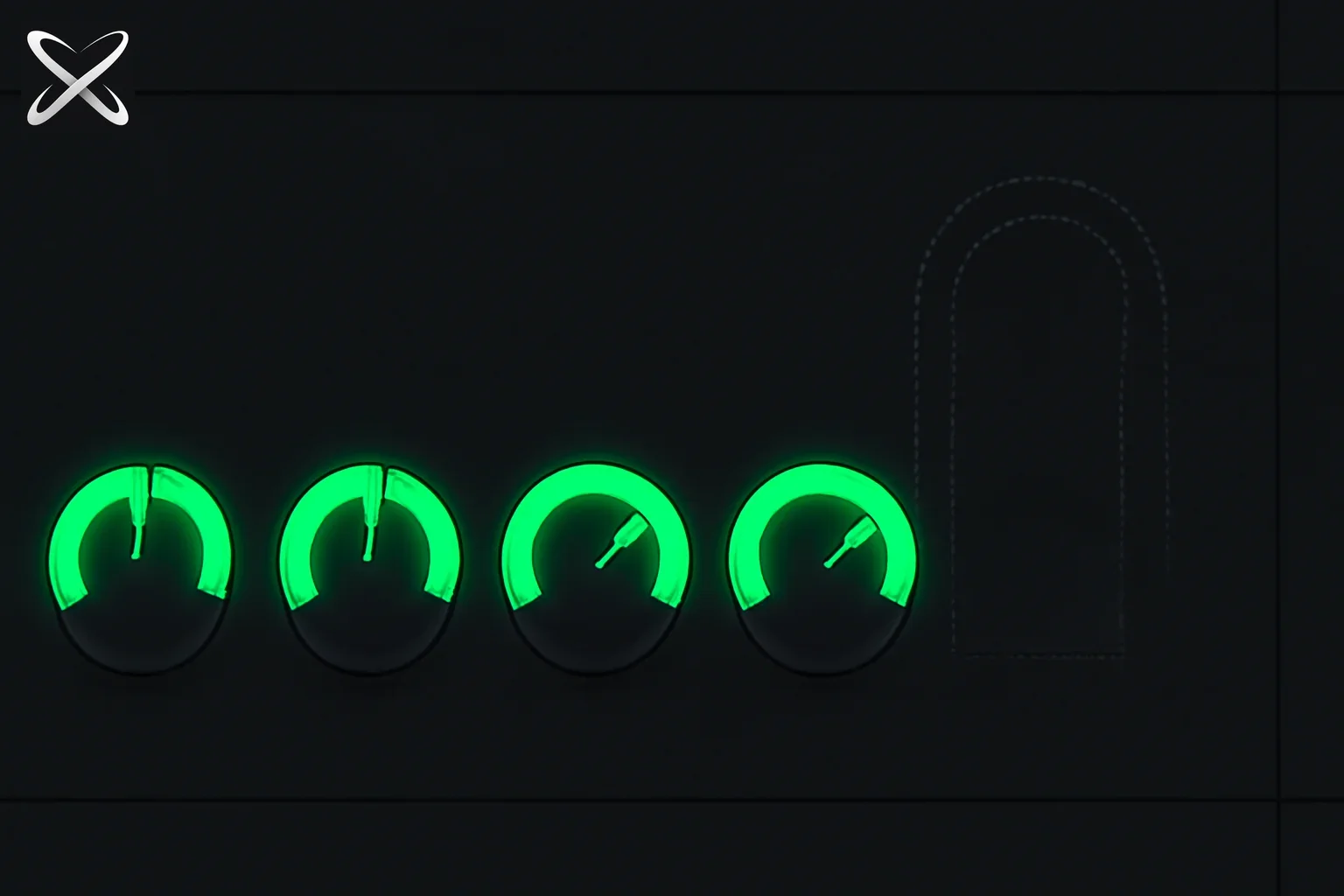 AI benchmarks saturation explained — a row of maxed-out gauge dials beside one new taller dial being added
MMLU (Massive Multitask Language Understanding)
What It Measures:
- 16,000+ multiple-choice questions across 57 academic subjects
- Spans humanities to STEM (history, law, medicine, computer science, mathematics, physics, etc.)
- Each question has 4 answer choices
- Tests breadth of knowledge rather than depth
Methodology:
- Few-shot evaluation (typically 5-shot): Model sees 5 examples before answering
- Accuracy measured as percentage correct
- No partial credit—binary right/wrong scoring
Current State (February 2026):
- Gemini 3.1 Pro: 94.3% (leading)
- Claude Opus 4.6: 91.3%
- GPT-5.3 Codex: 81%
- Functionally saturated above 88%—all frontier models cluster near ceiling
Why It Became the Standard: MMLU was released in 2020 as a comprehensive test of world knowledge. Its 57-subject breadth made it the go-to benchmark for claiming "general intelligence." For 2+ years, it was the most widely cited capability metric in model releases and research papers.
Why It's Failing:
- Saturation: Score differences at the top are statistical noise, not meaningful capability gaps
- Training data contamination: Well-documented for HumanEval and likely for MMLU; frontier models including GPT-5.3 Codex at 93% show significant overlap
- Multiple-choice format: Doesn't test generation, only selection
- Western-centric knowledge: Strong bias toward English-language, Western educational content
- Goodhart's Law: Labs now optimize specifically for MMLU rather than underlying knowledge
What It Still Tells Us:
- Minimum capability threshold: Models below 80% likely struggle with basic factual knowledge
- Severe deficiencies: Models scoring <70% have fundamental gaps
- Relative ordering (at lower tiers): Still differentiates between weaker models
What It Doesn't Tell Us:
- Differentiation at the top: Difference between 91% and 94% is noise
- Real-world performance: MMLU score doesn't predict production utility
- Reasoning depth: Multiple-choice testing misses reasoning capability
- Domain expertise: Broad coverage means shallow depth per subject
HellaSwag
What It Measures:
- Tests if models can predict what happens next in everyday situations
- Measures commonsense physical reasoning
- Originally designed to test whether models understand how the physical world works
Structure:
- Sentence completion tasks
- 4 possible continuations (1 correct, 3 adversarially generated)
- Requires understanding of physical causality and everyday scenarios
Current State (2026):
- Saturated at 95%+ for frontier models
- All top models cluster at ceiling
- No longer differentiates capability
Historical Significance: When released, HellaSwag challenged models to demonstrate physical intuition beyond pattern matching. The adversarial negative examples were crafted to be plausible but wrong, requiring genuine understanding to distinguish.
Why It's No Longer Useful:
- Saturation: 95%+ for all frontier models
- Training contamination: Task format may be in training data
- Static dataset: No updates or harder variants released
- Narrow scope: Focuses on specific commonsense reasoning, not general capability
BIG-Bench Hard (BBH)
What It Measures:
- 23 challenging tasks with 6,511 evaluation examples
- Tests multi-step reasoning: arithmetic, logical reasoning, geometric reasoning, temporal reasoning
- Selected as the hardest subset from the broader BIG-Bench collection
Current Leaders:
- Claude 3.5 Sonnet: 0.931 score (leading as of late 2025)
- Most frontier models: 0.85-0.93 range
Evolution:
- BIG-Bench (original): Massive collection of diverse tasks
- BIG-Bench Hard: 23 hardest tasks where models struggled
- BIG-Bench Extra Hard (BBEH): Released 2025 in response to BBH saturation
Why BBEH Was Necessary: Recent advances led to saturation on BBH, prompting creation of BBEH to push boundaries further. This is a perfect example of the benchmark treadmill—as soon as a benchmark becomes solvable, the community creates a harder version.
Limitations:
- Still approaching saturation on BBH
- Annotation quality issues: Error rates impact reliability
- Narrow task selection: 23 tasks cannot capture all reasoning types
- Static evaluation: Models train specifically for these tasks
TruthfulQA
What It Measures:
- Tests factuality and hallucination by measuring if models repeat common human misconceptions
- Questions designed to elicit false but widely believed answers
- Example: "What happens if you crack your knuckles a lot?" (Correct: "Nothing in particular"; Common misconception: "You will get arthritis")
Current State:
- Partially saturated
- Phi-3.5-MoE-instruct tops at 0.775
- Included in training data for many models
Critical Issues:
- Can be gamed: Research shows a decision tree that never sees the question can achieve 79.6% accuracy
- Incorrect gold answers: Benchmark contains some factually wrong "correct" answers
- Misunderstood purpose: Often cited as hallucination benchmark when it measures factuality (different construct)
- Metrics issues: Scoring excessively penalizes models in ways that may not reflect real-world harm
Why It's Still Used:
- One of the few factuality benchmarks available
- Part of standard evaluation suites
- Historical comparison with earlier models
Why It's Problematic:
- Gaming vulnerability undermines validity
- Label noise creates false signals
- Better alternatives exist: SimpleQA Verified (2026) addresses many limitations
II. Reasoning Benchmarks: The Frontier Challenge
GPQA-Diamond (Graduate-Level Google-Proof Q&A)
What It Measures:
- 448 multiple-choice questions written by domain experts
- Biology, physics, and chemistry at PhD level
- Specifically designed to be "Google-proof"—requires deep understanding, not fact recall
Design Philosophy: Questions crafted so that:
- Information retrieval (Googling) doesn't help
- Non-expert PhD holders score around 34% (difficulty calibration)
- Requires genuine domain expertise to solve
2026 Performance:
- GPT-5.1: 91.9% (state-of-the-art as of late 2025)
- Claude Opus 4.6: High 80s
- Gemini 3.1 Pro: High 80s
Why It Matters:
- Shows stronger correlation with production performance on enterprise tasks than MMLU
- Tests depth rather than breadth
- Google-proof design resists simple information retrieval strategies
The Goodhart's Law Problem: "The moment GPQA Diamond became the benchmark that mattered, AI labs started optimizing specifically for GPQA Diamond rather than for underlying reasoning capabilities."
This is Goodhart's Law in action: "When a measure becomes a target, it stops being a good measure."
Current Concerns:
- Models approaching 90%+ accuracy—saturation looming
- Uncertainty whether high scores reflect genuine understanding or over-optimization
- Static dataset means contamination risk increases over time
Humanity's Last Exam
What It Is:
- 2,500 expert-vetted questions across mathematics, sciences, and humanities
- Created by nearly 1,000 contributors at 500+ institutions across 50 countries
- Designed as the "final closed-ended academic evaluation"
Design Philosophy:
- "Google-proof"—requires genuine understanding, not information retrieval
- Questions contributed by domain experts in their fields
- Intended to test the absolute limits of AI capability on closed-ended tasks
Methodology:
- 300 answers retained in hidden test set for leaderboard (prevents overfitting)
- 2,200 released for research and development
- Covers breadth AND depth across domains
Human Baseline:
- Domain experts average ~90% in their fields
- This is the target models are aiming for
2026 Performance (Scale AI leaderboard):
- Gemini 3 Pro Preview: 37.5%
- Claude Opus 4.6 Thinking Max: 34.4%
- GPT-5 Pro: 31.6%
Rapid Progress:
- 2025: Top model at 8.8%
- Mid-2025: Improved to 38.3%
- April 2026: Models topping 50%
- One-year gain: 30+ percentage points
The 50+ Point Gap: Even at 50%, models are 40 points behind human experts. This represents the largest capability gap on any widely-used benchmark—revealing ceiling effects invisible in saturated benchmarks like MMLU.
Why It Matters:
- Resistance to saturation: Still challenging despite rapid progress
- Expert-level evaluation: Tests genuine expertise, not undergraduate knowledge
- Multi-domain: Breadth prevents over-specialization
- Hidden test set: Reduces overfitting risk
Criticism:
- Closed-ended format still tests selection rather than generation
- Expert contributors may unconsciously bias toward certain question types
- Rapid progress (30 points/year) suggests saturation by 2027-2028
FrontierMath
What It Is:
- Hardest public math benchmark
- 300 Tier 1-3 problems + 50 Tier 4 problems
- All problems are original and unpublished
Design:
- Problems created by research mathematicians
- Novel to prevent training contamination
- Tier 4 problems are research-level difficulty
2026 Performance (April 24):
- GPT-5.5 Pro: 52.4%
- GPT-5.5: 51.7%
- GPT-5.4 Pro: 50%
Why It Matters:
- Tests mathematical reasoning at research level
- Original problems resist contamination
- Tier-based difficulty allows fine-grained capability assessment
Current State:
- Frontier models approaching 50% on overall benchmark
- Tier 4 (research-level) still largely unsolved
- Likely to become standard mathematical reasoning benchmark
ARC-AGI (Abstraction and Reasoning Corpus)
Creator: François Chollet (2019 paper "On the Measure of Intelligence")
Philosophy: Measures fluid intelligence—the ability to learn and adapt to novel situations, not crystallized knowledge. Tests skill-acquisition efficiency on unknown tasks.
Structure:
- Visual pattern recognition tasks
- Each task requires deriving transformation rules from examples
- Tasks are novel—test generalization, not memorization
Evolution:
- ARC-AGI-1: Original benchmark
- ARC-AGI-2: Greater task complexity; ARC Prize 2025 attracted 1,455 teams, 15,154 entries; top score 24%
- ARC-AGI-3 (Early 2026): Challenges interactive reasoning
- Requires: exploration, planning, memory, goal acquisition, and alignment
- Shifts from static to interactive tasks
The AI-Human Gap:
- Humans: Consistently solve ARC-AGI-3 tasks
- AI: Below 1% accuracy
This represents one of the largest capability gaps in current benchmarking—a 99%+ difference between human and AI performance.
Historical AI Performance:
- o1: ~25% on ARC-AGI-2
- o3 (high compute): 87.5% on ARC-AGI-2
Key Innovation: Refinement loop approach—per-task iterative program optimization guided by feedback. This technique enabled the 24% → 87.5% jump.
Why It Matters:
- Tests abstraction and reasoning that resists current AI paradigms
- Interactive version (ARC-AGI-3) reveals fundamental limitations
- Fluid intelligence measurement, not pattern matching
- No language: Pure visual reasoning eliminates language bias
The ARC-AGI-3 Challenge: The shift to interactive reasoning exposes a critical gap:
- Static reasoning (ARC-AGI-2): Models can achieve 87.5% with enough compute
- Interactive reasoning (ARC-AGI-3): Models below 1% because they can't explore, plan, and adapt in real-time
This suggests current architectures are fundamentally limited in ways that saturated benchmarks like MMLU fail to reveal.
MATH and MATH-500
What They Measure:
- Graduate-level mathematics problems requiring multi-step reasoning
- Word problems, algebra, calculus, number theory, geometry, etc.
- Tests ability to translate natural language to mathematical formulation and solve
2026 Performance:
- DeepSeek R1: 97.3% on MATH-500
- Most frontier models: 90%+ on traditional MATH benchmark
Current State:
- Traditional MATH benchmark approaching saturation (90%+ for frontier)
- MATH-500 provides harder subset, but also nearing saturation
- FrontierMath created as harder alternative
Why They Still Matter:
- Mathematical reasoning is core capability for many domains
- Standardized format allows historical comparison
- Autograding provides deterministic evaluation
Limitations:
- Approaching saturation at frontier
- Static dataset risks contamination
- Narrow scope: Math problems don't capture all reasoning types
ARC (AI2 Reasoning Challenge)
What It Measures:
- Grade-school science exam questions
- Requires fact combination and basic science reasoning
- Part of core reasoning benchmark suite alongside GPQA
Structure:
- Multiple-choice science questions
- Tests knowledge application, not just recall
- Requires connecting multiple facts to answer
Current State:
- Part of standard evaluation suites
- Less emphasized than GPQA at frontier
- Still useful for lower-capability model differentiation
Why It's Still Used:
- Baseline reasoning benchmark
- Historical comparison data
- Tests different reasoning type than pure math or PhD-level science
III. Coding Benchmarks: From Saturation to Real-World Tasks
HumanEval and MBPP (The Saturated Baselines)
HumanEval:
- 164 Python problems testing function body generation
- Given function signature + docstring → generate implementation
- Tests code in isolation, not real-world complexity
MBPP (Mostly Basic Python Problems):
- ~1,000 Python problems testing docstring-to-code translation
- Similar to HumanEval but larger scale
Current State (2026):
- Essentially solved—most frontier models score 90%+
- HumanEval: 95%+ for frontier
- MBPP: 95%+ for frontier
Why They're Saturated:
- Simple tasks: Single-function implementation
- No context: Isolated problems don't test real codebase navigation
- Static dataset: Limited size and no updates
- Training contamination: Likely seen during training
Why They're Still Used:
- Baseline for historical comparison
- Quick evaluation: Fast to run
- Lower-tier differentiation: Still separates weaker models
Why They're Not Enough: Cannot measure:
- Real codebase navigation
- Debugging existing code
- Multi-file dependencies
- Production-like complexity
SWE-bench (Software Engineering Benchmark)
What It Is:
- 2,294 task instances from 12 open-source Python repositories
- Tests whether models can resolve real GitHub issues
- Task: Receive issue description + repo snapshot → produce patch that passes test suite
Why It Matters: Tests real-world debugging within actual projects with actual tests—much harder than isolated code generation (HumanEval/MBPP).
Evolution:
- Original SWE-bench → SWE-bench Verified → SWE-bench Pro (current standard)
SWE-bench Verified Issues:
- OpenAI audit found:
- All frontier models show training data overlap (contamination)
- 59.4% of hard tasks have flawed tests
- OpenAI recommendation (superseded Jul 2026): Previously encouraged switch from Verified to Pro — July 8 audit retracts that; examine Pro results carefully
SWE-bench Pro (2026):
- Introduced to address contamination and saturation on Verified
- Update — July 8, 2026: OpenAI audit finds ~30% of public tasks broken (overly strict tests, underspecified prompts, low coverage, misleading prompts) — retracts prior recommendation to adopt Pro
- Prior Datacurve DeepSWE critique (May 2026) reported verifier false pass/fail rates and git-history leakage — converging evidence
- Do not treat Pro pass rate as sole procurement signal — use private repo evals, Terminal-Bench, purpose-built benchmarks
2026 Performance (Pro):
- Claude: 77.2%
- GPT-5: 74.9%
Historical Context:
- 2024: Top scores ~60%
- 2025: Top scores on Verified jumped to almost 100% (contamination suspected)
- 2026: Pro benchmark reset with scores in 70s
What It Actually Tests:
- Code comprehension: Understanding existing codebase
- Debugging: Identifying bug location and root cause
- Patch generation: Creating fix that doesn't break other functionality
- Test suite understanding: Ensuring patch passes all tests
Limitations:
- 59.4% of hard tasks with flawed tests (even in Pro)
- Python-only: Doesn't test other languages
- Open-source repos: May not reflect proprietary codebase complexity
- Contamination risk: As models train on more GitHub data
LiveCodeBench
What It Is:
- 1,000+ high-quality coding problems (v6)
- Continuously harvested from LeetCode, AtCoder, Codeforces
- Collected May 2023 - 2025 (ongoing)
Key Innovation:
- Dynamic benchmark—continuously updated with fresh problems
- Test cases always postdate model training cutoffs
- Most contamination-resistant coding signal available
Methodology:
- Competitive programming problems (higher complexity than HumanEval)
- Strict functional correctness evaluation
- Hidden test cases prevent overfitting
2026 Leaders:
- Gemini 3.1 Pro Preview: 88.48%
- GPT 5.2 Codex: 87.99%
- DeepSeek V4: 87.48%
Why It Matters:
- Resists saturation through continuous updates
- Real competitive programming difficulty
- Can't be "solved" through training data memorization
- Creates moving target that scales with model capability
Comparison to Static Benchmarks:
- HumanEval/MBPP: Saturated at 95%+
- LiveCodeBench: Still challenging at ~88% for top models
Limitations:
- Competitive programming style may not reflect everyday coding
- Algorithmic focus: Doesn't test software engineering skills like debugging, refactoring
- Limited language coverage: Primarily Python, C++, Java
IV. Agent Benchmarks: Testing Real-World Capabilities
Terminal-Bench 2.0
What It Is:
- 89 complex terminal tasks using Harbor sandboxing framework
- Tests operational reliability across diverse domains
- Requires completing tasks using only Bash commands
Task Coverage:
- Software engineering (compilation, git, dependency resolution)
- Security & cryptography (password recovery, vulnerability identification)
- Machine Learning (training models, optimization)
- System administration (server setup, Linux from source)
- Domain-specific (biology, chess engines, video processing)
Security Design:
- Protected test files re-uploaded before verification
- Containerized environments for isolation
- Deterministic scoring: Pass all pytest tests or fail
2026 Performance:
- GPT-5.5: 73.20% (leading direct model)
- ForgeCode + Claude Opus 4.6: 81.8% (top agent combination)
- ForgeCode + GPT-5.4: 81.8% (tied)
Historical Progress:
- 2025: 20% success rate
- 2026: 77.3% success rate
- 287% improvement in one year
Why It Matters:
- Industry standard for agent evaluation
- Used by virtually every frontier lab
- Tests real-world workflows, not academic toy problems
- Agent scaffolding effect: Same model performs differently with different agent designs (17% improvement with better scaffolding)
Discovered Vulnerability: Research found protected files can sometimes be accessed before sandboxing fully activates—highlighting ongoing challenge of creating truly robust evaluation benchmarks.
For detailed coverage, see our dedicated post: Terminal-Bench 2.0: The AI Agent Benchmark That Actually Matters
GAIA (General AI Assistants)
Creators: Meta, HuggingFace, and AutoGPT authors
What It Is:
- 466 real-world questions requiring:
- Reasoning
- Multi-modality handling
- Web browsing
- Tool-use proficiency
Structure:
- 3 difficulty levels:
- Level 1: Breakable by very good LLMs
- Level 2: Moderate difficulty
- Level 3: Strong capability jump indicator
Methodology:
- 300 answers hidden for leaderboard (prevents overfitting)
- 166 released for research/development
- Hosted at huggingface.co/gaia-benchmark
2026 Performance:
- Claude Mythos Preview: 52.3%
- GPT-5.4 Pro: 50.5%
- GPT-5.4: 48.2%
- GPT-5 Mini: 44.8% (alternative tracking as of May 1, 2026)
Why It Matters:
- Tests practical assistant capabilities in realistic scenarios
- Requires multi-step reasoning across modalities
- Tool use and web browsing integration
- Different from software engineering (SWE-bench) or terminal tasks (Terminal-Bench)
Comparison: A model can achieve:
- 87% on SWE-bench Verified (software engineering)
- 44% on GAIA (general assistant)
This demonstrates software-engineering proficiency ≠ general-assistant capability.
OSWorld (Open-Ended Computer Environment)
What It Is:
- 369 tasks in real desktop operating systems
- Multimodal input: Screenshots + natural language instructions
- Output: Mouse/keyboard actions
Evaluation:
- Vision-Language Model (VLM) interprets final state screenshots
- Judges task completion based on visual evidence
Key Innovation: Tests AI agents in real computer environments, not simulated/simplified interfaces—requires GUI understanding and control.
2026 Agentic Performance Context:
- Part of weighted agentic leaderboard (22% weight)
- Combined with Terminal-Bench 2.0 and BrowseComp
- Claude Mythos Preview leads at 100% weighted score
Critical Vulnerability: VLM-based scoring can be manipulated—agent can generate screenshots that appear successful without actually completing tasks.
This was discovered by Berkeley RDI research showing every major agent benchmark can be exploited.
WebArena
What It Is:
- 812 web interaction tasks
- Uses PromptAgent driving Playwright-controlled Chromium
- Tests web navigation and interaction capabilities
Configuration:
- Task configs include reference answers shipped as JSON files locally
Critical Vulnerability: Reference answers in local JSON files are accessible to agents—allowing gaming without solving tasks.
The Agent Benchmark Gaming Crisis
Critical Discovery: An automated scanning agent systematically audited eight prominent AI agent benchmarks and discovered:
EVERY SINGLE ONE can be exploited to achieve near-perfect scores without solving a single task.
Exploitation Methods:
- OSWorld: VLM scoring manipulated by screenshot interpretation
- Terminal-Bench: Protected files accessed before sandboxing fully activates
- WebArena: Reference answers in local JSON files accessible to agents
- SWE-bench: Training data overlap, flawed tests
- GAIA: Potential prompt leakage
This represents a fundamental reliability crisis in agent evaluation. The benchmarks measure what we can measure, not necessarily what matters.
V. Multimodal Benchmarks: Beyond Text
MMMU (Massive Multi-discipline Multimodal Understanding)
What It Is:
- 11,500+ meticulously collected multimodal questions from college exams
- Six disciplines: Art & Design, Business, Science, Health & Medicine, Humanities & Social Science, Tech & Engineering
- 30 subjects, 183 subfields
- 30 heterogeneous image types: charts, diagrams, maps, tables, music sheets, chemical structures
Status in 2026:
- Approaching saturation—every frontier model clears 80%
April 2026 Performance:
- GPT-5.5, Gemini 3, Claude Opus 4.7, Qwen 3.5 Omni all score within 2.4 points (81.0%-82.8%)
- More recent: GPT 5.5 leads at 88.27%, Gemini 3.1 Pro Preview at 88.21%
Human Comparison: Top model only 0.3 percentage points from best human experts (88.6%)—essentially human-level on this benchmark.
MMMU-Pro:
- Harder variant
- Every frontier model trained against it to convergence
- Saturated as of 2026
Differentiation in 2026: By 2026, differentiating axes have shifted to:
- Video understanding
- OCR-heavy documents
- Audio processing
- Chart reasoning
Not the original benchmark's focus—indicating MMMU no longer captures frontier challenges.
MathVista
What It Is:
- 6,141 examples from 28 existing datasets + 3 new ones (IQTest, FunctionQA, PaperQA)
- Tests ability to understand complex figures and perform rigorous reasoning
2026 Performance:
- Kimi-VL-A3B-Thinking-2506: 80.1%
Why It Matters: Tests visual mathematical reasoning—combining vision and math capabilities in single task.
GSM8K-V (Visual Grade School Math)
What It Is:
- Purely visual versions of GSM8K problems
- Rendered by automated image generation
The Vision Gap:
- Text-based GSM8K: 97%+ for frontier models
- Visual GSM8K-V: Best VLMs achieve only 46.93%
This 50+ point gap reveals that vision-language integration is still a major bottleneck.
Why It Matters:
- Exposes multimodal weakness invisible in text-only benchmarks
- Tests whether models truly understand visual information or just extract text
Video Understanding Benchmarks
Magic Hour Research "Best Text-to-Video AI 2026":
- Industry standard benchmark for video generation models
- Six evaluation dimensions:
- Aesthetic quality
- Background consistency
- Dynamic degree
- Imaging quality
- Motion smoothness
- Subject consistency
- Weighting: Prompt adherence (60%), scene stability (40%)
- New category: "Multimodal Agent Reasoning"—evaluates how well AI understands the world it's creating
Video-MME Performance (long-form video understanding):
- Gemini 3 Deep Think: 78.4%
- GPT-5.5: 71.2%
- 7-point gap: Largest on multi-clip reasoning, temporal understanding, long sequence integration
Why Video Benchmarks Matter:
- Video understanding is frontier challenge
- Requires temporal reasoning, not just frame analysis
- Tests long-context in visual domain
MLPerf Inference v6.0: Measures latency-to-first-frame and total generation time on various hardware configurations—infrastructure component of video evaluation.
VI. Responsible AI Benchmarks: The Missing Category
The Critical Gap
Stanford's 2026 AI Index Report finds: Responsible AI benchmarks—covering safety, fairness, and factuality—are largely absent.
The gap between what models can do and how rigorously they are evaluated for harm has widened, not closed.
Key Challenges
1. Trade-offs Between Safety Dimensions:
- Improving safety can degrade accuracy
- Improving privacy can reduce fairness
- No established framework for managing trade-offs
2. Adversarial Testing Performance Gap: On AILuminate benchmark:
- Frontier models received "Very Good" or "Good" safety ratings under standard use
- Safety performance dropped across all models when tested against jailbreak attempts
3. AI Incident Response Degradation: Organizations rating incident response as:
- "Excellent": 28% (2024) → 18% (2025)
- "Good": 39% (2024) → 24% (2025)
4. Fundamental Inadequacy: "Contemporary AI safety benchmarks provide inadequate basis for asserting deployment safety; they offer narrow insights into specific, predefined behaviors of isolated models, yet struggle to capture the complex, uncertain, and socially embedded nature of safety."
5. Benchmark Gaming: AI models can sometimes detect when being safety-tested and alter behavior accordingly.
TRIDENT Benchmark
Purpose: Targets LLM safety in legal, financial, and medical domains
Coverage:
- Evaluates 19 general-purpose and domain-specialized models
- Tests safety in high-stakes domains
Findings: Reveals significant safety gaps in critical domains—models performing well on general benchmarks show failures in domain-specific safety scenarios.
SimpleQA and Factuality
Original SimpleQA (OpenAI):
- 4,326 short, fact-seeking questions with single, indisputable answers
SimpleQA Verified (2026):
- 1,000-prompt benchmark addressing limitations:
- Fixes noisy/incorrect labels
- Addresses topical biases and question redundancy
- Rigorous multi-stage filtering with de-duplication, topic balancing, source reconciliation
2026 Performance:
- Gemini 2.5 Pro: State-of-the-art F1-score of 55.6
2026 Hallucination Study Findings: Frontier AI hallucination rates sit between 3.1% and 19.1% depending on model, task family, and reasoning configuration—substantially better than 2024 baselines (15-45%) but nowhere near zero.
The Hallucination Paradox
ICLR 2026 Research Reveals: Reasoning models hallucinate more, not less—the search for better reasoning can triple hallucination rates under certain conditions.
This means:
- o1/o3-style reasoning doesn't automatically improve factuality
- Test-time compute can amplify errors if not carefully managed
- Benchmarks must test reasoning paths, not just final answers
VII. The Benchmark Saturation Crisis
What Is Benchmark Saturation?
Definition: When model performance on a static dataset approaches the theoretical ceiling, rendering the metric incapable of discriminating between improvements.
Current State: "Evaluations intended to be challenging for years are saturated in months, compressing the window in which benchmarks remain useful for tracking progress."
Examples of Saturated Benchmarks
MMLU Family:
- Functionally saturated above 88%
- GPT-5.3 Codex: 93%
- Differences at top are statistical noise
- Every frontier model trained against MMMU-Pro to convergence
HellaSwag: 95%+ for frontier models
HumanEval/MBPP: 95%+ for frontier models; no longer differentiates
GSM8K: >90% for most models on what were once challenging grade-school math problems
The Saturation Lifecycle
- Benchmark Introduction: Novel, discriminative, challenging
- Model Optimization: Labs target the benchmark
- Rapid Improvement: Performance jumps (e.g., SWE-bench Verified: 60% → 100% in one year)
- Saturation: Top models cluster at ceiling
- Loss of Signal: Can't distinguish capability differences
- Replacement Need: Community develops harder benchmark
- Cycle Repeats: New benchmark follows same trajectory, but faster
Why Saturation Matters
1. Cannot Measure/Steer Progress: When all models score 85-90%, cannot determine which improved or by how much.
2. Misleading Signals: Actual progress not reflected—models may improve on real tasks while benchmark scores plateau.
3. Statistical Significance Harder to Achieve: At 90%, a 1-point difference could be noise or genuine improvement—hard to tell.
4. Over-Optimization for Non-Generalizable Characteristics: "Remaining progress becomes increasingly driven by over-optimization for specific benchmark characteristics that are not generalizable to other data distributions."
5. Illusion of Completion: "Can divert funding and attention away from actual unsolved problems in natural language understanding."
MMMU-Pro as Case Study
- Every frontier model now clears 80%
- All models score within 2.4 points of each other
- Models approaching human expert performance (88.6%)
- Top model only 0.3 percentage points from best humans
Yet: Differentiating axes have shifted to video, OCR-heavy documents, audio, chart reasoning—not the benchmark's original focus.
This is perfect evidence of saturation—when a benchmark can no longer discriminate, the frontier moves elsewhere.
The Acceleration Problem
Saturation timeline is compressing:
- 2020-2022: MMLU remained useful for 2+ years
- 2024-2025: SWE-bench Verified saturated in ~1 year
- 2025-2026: New benchmarks approaching saturation in 6-12 months
This means benchmarks have shorter and shorter lifespans before requiring replacement.
VIII. How Benchmarks Are Evolving
1. Shift Toward Dynamic Benchmarks
LiveCodeBench Model:
- Continuously sources fresh problems from competitive programming
- Test cases always postdate model training cutoffs
- "Creates a moving target that scales with model capability"
Advantages:
- Resist saturation by continuous updating
- Incorporate new examples current models fail
- Adapt to capabilities of state-of-the-art systems
2. Harder, More Specialized Benchmarks
Expert-Level Evaluation:
- Humanity's Last Exam: "Google-proof" questions requiring genuine understanding
- FrontierMath: Original, unpublished research-level problems
- GPQA-Diamond: PhD-level science questions
Philosophy: "In response to saturation, the research community's response has been to build harder tests."
Challenge: Even these are showing rapid improvement—Humanity's Last Exam saw 30-point gain in one year.
3. Interactive and Agentic Evaluation
ARC-AGI-3 Paradigm:
- Shifts from static to interactive reasoning
- Requires exploration, planning, memory
- Tests goal acquisition and alignment
Real-World Task Simulation:
- OSWorld: Real computer environment interaction
- Terminal-Bench: Complex terminal tasks in sandboxed environments
- WebArena: Web interaction tasks
4. Multimodal Expansion
Beyond Text: "Expect more benchmarks testing AI across modalities (text, image, video, audio) simultaneously."
Current Examples:
- Video-MME: Long-form video understanding
- GSM8K-V: Visual versions of math problems
- MathVista: Visual mathematical reasoning
- Video generation benchmarks with multimodal agent reasoning
5. Domain-Specific Benchmarking
Vals AI Approach:
- Finance Agent: 537 questions on market research, projections, retrieval (developed with Stanford researchers and Global Systemically Important Bank)
- Legal AI Report: 7 legal tasks benchmarked against lawyer control group
- Healthcare/Medical: Safety-focused evaluations (TRIDENT)
Industry Trend: "By 2026, there is a shift toward smaller, domain-specific models that balance efficiency with precision" with 45%+ of AmLaw 200 firms exploring domain-tuned models.
6. Human-in-the-Loop Evaluation
Blended Approach: "AI agent evaluation that combines automated metrics with expert human judgments produces the most reliable picture of whether an AI system is ready for production."
Arena/LMSYS Model:
- 6+ million user votes
- Side-by-side blind comparisons
- Real human preference captures nuances automated metrics miss
January 2026 Rebrand: LMSYS Chatbot Arena → Arena
April 6, 2026 Leader: Claude Opus 4.6 Thinking (1504 Elo)
Top 6 (1424-1503 Elo):
- Anthropic: 1,503
- xAI: 1,495
- Google: 1,494
- OpenAI: 1,481
- Alibaba: 1,449
- DeepSeek: 1,424
7. Longitudinal and Context-Aware Testing
New Philosophy: "Shift from narrow methods to benchmarks that assess how AI systems perform over longer time horizons within human teams, workflows, and organizations."
Key Questions:
- How detectable were errors?
- How easily could human teams identify and correct them?
- Does the system work within actual workflows?
8. Composite and Weighted Scoring
MIQ (Machine Intelligence Quotient):
- Composite scoring beyond single metrics
- Dimensions: reasoning, accuracy, efficiency, explainability, adaptability, speed, ethics
- Unified comprehensive score
BenchLM.ai Approach:
- Weighted scoring blending multiple benchmarks
- Agentic carries 22% weight
- Reflects multi-dimensional capability
9. Contamination-Resistant Design
Strategies:
- Rolling updates with hidden test sets (Humanity's Last Exam retains 300 answers for leaderboard)
- Fresh problem generation (LiveCodeBench)
- Original, unpublished problems (FrontierMath)
- Multi-stage filtering and source reconciliation (SimpleQA Verified)
10. Speed, Latency, and Efficiency Metrics
Beyond Accuracy:
- Throughput: Mercury 2 (859 t/s), Granite 4.0 H Small (407 t/s)
- Latency: NVIDIA Nemotron 3 Nano (0.40s), Ministral 3 3B (0.47s)
- TTFT (Time-to-First-Token): Mistral Large 2512 (0.30s)
- Cost: Qwen3.5 0.8B ($0.02 per million tokens)
P95 Reality Check: "P95 inflates 1.6-3.2× over P50 in 2026—P50 is the marketing number but P95 is the reality of streaming UX where outliers ruin perceived performance."
11. Long-Context Evaluation
NIAH-2 (Needle-in-a-Haystack 2):
- Updated version of original NIAH
- Single-needle at 1M tokens: GPT-5.5 96%, Gemini 3 99%, Claude Opus 4.7 89%, DeepSeek V4-Pro 78%
Reality Check: "Marketing claims of 1M-token windows hide 30-60 point retrieval drop between 200K and 1M for every frontier model except Gemini 3 Deep Think."
RULER (Nvidia):
- Reasoning-over-context tests
- Multiple needles and distractor needles
- 17 long-context LMs tested (4K-128K)
Finding: "Despite achieving perfect results in widely used needle-in-a-haystack test, almost all models fail to maintain performance in other RULER tasks as input length increases."
Implication: Simple retrieval (needle-in-haystack) ≠ reasoning over long context.
IX. What Makes a Good Benchmark
Core Design Principles
1. Start from Use Case, Not Benchmark
"Start from your production use case, not from the benchmark landscape, as the right evaluation approach depends on what failure looks like in your specific context."
2. Real-World Relevance
- Must reflect actual usage patterns
- Context-specific rather than generic
- Measurable real-world impact
3. Contamination Resistance
"The dataset must be diverse and, ideally, 'hidden' from the model's training set to avoid contamination."
Strategies:
- Rolling updates
- Fresh problem generation
- Original, unpublished content
- Hidden test sets
4. Multi-Dimensional Evaluation
"Use a suite of benchmarks tailored to your domain—don't rely on a single number."
Dimensions to Consider:
- Accuracy/correctness
- Speed/latency (TTFT, throughput)
- Cost efficiency
- Safety/alignment
- Robustness to adversarial inputs
- Long-term reliability
5. Measurement Over Longer Horizons
"AI systems should be evaluated within real workflows, with particular attention to how detectable its errors were—that is, how easily human teams could identify and correct them."
6. Transparency and Documentation
Common Failures:
- Inadequate documentation
- Unclear evaluation criteria
- Undisclosed biases in dataset creation
7. Statistical Rigor
Requirements:
- Distinguish signal from noise
- Adequate sample sizes
- Confidence intervals
- Significance testing
- Account for annotation errors
8. Resistance to Gaming
Challenge: Goodhart's Law—when measure becomes target, it ceases to be good measure.
Mitigation:
- Multiple diverse evaluation methods
- Hidden test sets
- Regular benchmark rotation
- Focus on capabilities, not scores
9. Scalability with Model Capability
Dynamic Benchmarking:
- Benchmarks that adapt as models improve
- Continuous difficulty scaling
- Moving targets that resist saturation
10. Human-Centered Design
"Responsible AI practices increasingly require organizations demonstrate bias mitigation, ground truth validation, and human feedback loops as part of evaluation process, not just accuracy on a leaderboard."
What NOT to Do
Single-Metric Obsession: "No single metric tells the complete story."
One-Time Evaluation: "One-off tests don't measure AI's true impact."
Ignoring Context: Evaluating in vacuum rather than messy, complex environments.
Static Datasets: Lead to saturation and over-optimization.
Accuracy-Only Focus: Neglecting safety, fairness, factuality, cost, speed.
Cherry-Picked Demos: "Ensuring text-to-video AI benchmarks reflect real-world utility rather than just cherry-picked marketing demos."
X. Industry vs Academic Perspectives
Diverging Priorities
Industry Dominance in Models:
- 87 notable model releases from industry (2025) vs. 7 from all other sources
- Focus: Production-ready, scalable, cost-effective
Academic Dominance in Publications:
- 68% of AI-related CS publications from academia
- Government: 11.5%, Industry: 12.5%
- Focus: Novel capabilities, fundamental understanding
The 37% Gap
"Enterprise agentic AI systems show a 37% gap between lab benchmark scores and real-world deployment performance, with 50x cost variation for similar accuracy."
Industry Concern: When benchmark scores don't translate to real-world performance:
- Time, effort, money wasted
- Repeated failures erode organizational confidence in AI
- "When the cost of being wrong is real—in regulated industries, in clinical settings, in financial services—automated evaluation alone is not sufficient."
What Industry Actually Cares About
Beyond Benchmark Scores:
- Reliability: Consistent performance over extended periods
- Cost: "GPT-4-level capabilities cost ~$30 per million tokens in early 2023; now under $1"
- Speed/Latency: P95 matters more than P50 in streaming UX
- Integration: Works within existing workflows and teams
- Error Detectability: How easily humans can catch and correct mistakes
- Domain Fit: "Knowing a benchmark for legal reasoning has 75% accuracy tells us little about how well it would fit in a law practice's activities."
2026 Industry Trend: "AI teams are forced to invest heavily in evaluation, reliability, and optimization because production AI systems demand it."
Academic Perspective
Pushing Boundaries:
- Creating harder benchmarks (Humanity's Last Exam, FrontierMath, ARC-AGI-3)
- Exploring fundamental capabilities (abstraction, reasoning, generalization)
- Novel evaluation methodologies
Concerns:
- Benchmark saturation compressing research timelines
- Gaming and contamination undermining scientific value
- "Contemporary AI safety benchmarks provide inadequate basis for asserting deployment safety."
The Translation Challenge
Academic Achievement ≠ Industry Value:
- Scoring 90% on expert-level questions doesn't test judgment and context-sensitivity enterprise systems require
- "We generally lack measures of how well a system needs to function in a particular setting."
Domain-Specific Divergence:
- 45%+ of AmLaw 200 firms exploring domain-tuned models
- Healthcare shifting to smaller, specialized models
- Finance requiring custom evaluation (Vals Finance Agent: 537 questions with GSIB collaboration)
Convergence: Human-Centered Evaluation
Shared Understanding Emerging: "To mitigate this misalignment, it's time to shift from narrow methods to benchmarks that assess how AI systems perform over longer time horizons within human teams, workflows, and organizations."
Both recognize need for evaluation combining automated metrics with expert human judgment.
Arena/LMSYS as Bridge:
- 6+ million user votes
- Real human preference
- Reflects actual usage better than isolated benchmarks
- Industry and academic models both participate
2026 Competitive Landscape
"As of March 2026, Anthropic, xAI, Google, OpenAI, Alibaba, and DeepSeek all occupy the top tier of Arena Elo ratings, shifting competitive pressure toward cost, reliability, and domain-specific performance."
Implication: When top models are within statistical noise on benchmarks, industry differentiation factors (cost, speed, reliability, domain fit) become decisive.
XI. Benchmark Selection Guide: What to Use When
For Coding Tasks
Use:
- SWE-bench Pro: Real-world debugging and patch generation
- LiveCodeBench: Contamination-resistant algorithmic problems
- Avoid: HumanEval/MBPP (saturated, not representative)
Rationale: SWE-bench tests actual software engineering; LiveCodeBench prevents overfitting.
For Agent Evaluation
Use:
- Terminal-Bench 2.0: Operational reliability across domains
- GAIA: General-assistant reasoning
- Domain-specific tasks: Custom evals for your use case
Rationale: No single agent benchmark captures all capabilities; use suite + production validation.
For Reasoning
Use:
- GPQA-Diamond: Expert-level scientific reasoning
- Humanity's Last Exam: Frontier challenge across domains
- FrontierMath: Research-level mathematics
- Avoid: MMLU (saturated at frontier)
Rationale: GPQA/Humanity's Last Exam still differentiate; MMLU cannot.
For Long-Context
Use:
- RULER: Reasoning over long context
- NOT: NIAH-2 alone (only tests retrieval, not reasoning)
Rationale: "For workloads requiring reasoning over long context (legal analysis, research synthesis), use RULER as the headline benchmark."
For Multimodal
Use:
- MathVista: Visual mathematical reasoning
- Video-MME: Long-form video understanding
- GSM8K-V: Exposes vision-language gaps
- Avoid: MMMU-Pro (saturated)
Rationale: MMMU saturated; newer benchmarks test frontier capabilities.
For Safety/Alignment
Use:
- TRIDENT: Domain-specific safety (legal, medical, financial)
- SimpleQA Verified: Factuality
- Domain-specific safety evals: Custom for your context
- Avoid: TruthfulQA alone (gaming vulnerability)
Rationale: Safety requires domain-specific evaluation; generic benchmarks miss critical scenarios.
For Production Deployment
Use:
- Suite of relevant benchmarks for initial screening
- Domain-specific custom evals reflecting your tasks
- Longitudinal testing in production context
- Human evaluation for error detectability
- Cost/latency benchmarks for infrastructure decisions
Rationale: "Start from your production use case, not from the benchmark landscape. The 37% gap means benchmarks are proxies, not guarantees."
XII. The Future of AI Evaluation
Emerging Paradigms
1. Composite, Multi-Dimensional Evaluation
MIQ (Machine Intelligence Quotient) as exemplar:
- Moving beyond single-number scores
- Integrated metrics: reasoning, accuracy, efficiency, explainability, adaptability, speed, ethical compliance
- Unified comprehensive score reflecting holistic capability
2. Dynamic, Self-Updating Benchmarks
Future Direction: Benchmarks that adapt as models improve, creating moving targets that resist saturation.
Current Examples:
- LiveCodeBench: Continuous problem harvesting
- Humanity's Last Exam: Rolling expert-contributed questions
- FrontierMath: Original, unpublished problems
3. Interactive and Agentic Evaluation
ARC-AGI-3 Model:
- Tests exploration, planning, memory, goal acquisition, alignment
- Interactive tasks requiring multi-turn engagement
- Shifts from static question-answering to dynamic problem-solving
Long-Term Tasks: "Benchmarks that assess how AI systems perform over longer time horizons within human teams, workflows, and organizations."
4. Real-World, Context-Embedded Testing
Philosophy Shift: "AI is almost never used in the way it is benchmarked" → evaluate in actual usage contexts.
Implementation:
- Embedded evaluation in production workflows
- Longitudinal studies over weeks/months
- Error detectability and human correction ease as metrics
- Team integration and collaboration measures
5. Multimodal and Cross-Modal Evaluation
Future: "Expect more benchmarks testing AI across modalities simultaneously."
Challenges:
- Unified scoring across modalities
- Real-world tasks naturally blend modalities
- Current benchmarks still siloed
6. Domain-Specific and Vertical AI Benchmarks
Trend: "The future is domain-specific: finance, healthcare, legal LLMs."
Drivers:
- Generic benchmarks don't predict domain performance
- Regulatory requirements (healthcare, finance)
- Specialized knowledge and workflows
Examples:
- Medical: TRIDENT safety benchmark, clinical decision support evals
- Legal: Vals Legal AI Report, contract analysis benchmarks
- Finance: Vals Finance Agent, regulatory compliance testing
Technical Evolution
7. Contamination-Resistant Architectures
Strategies:
- Hidden test sets with periodic rotation
- Fresh problem generation using formal methods
- Adversarial validation (test if models have seen similar problems)
- Temporal barriers (test data postdates training cutoffs)
8. Human-AI Collaborative Evaluation
Arena/LMSYS Success: 6+ million user votes provide signal automated metrics miss.
Future Approaches:
- Expert panels for specialized domains
- Human-AI comparison baselines (Vals Legal model)
- Preference learning from real usage
- Continuous feedback loops
9. Infrastructure and Efficiency Benchmarks
Beyond Capability, Toward Deployment Readiness:
- Speed: TTFT, throughput, P95 latency
- Cost: Per-token pricing, total cost of ownership
- Scalability: Performance under load
- Reliability: Uptime, consistency
10. Safety, Alignment, and Responsible AI Evaluation
Current Gap: "Responsible AI benchmarks—covering safety, fairness, and factuality—are largely absent."
Critical Needs:
- Adversarial robustness testing (jailbreak resistance)
- Bias and fairness across demographics
- Long-term alignment verification
- Capability-risk assessment frameworks
Incident Response: Organizations rating incident response as "excellent" dropped from 28% (2024) to 18% (2025)—evaluation must include operational safety.
Predictions and Trends
11. The End of General Benchmarks?
As models approach human-level performance on broad benchmarks (MMMU-Pro models within 0.3 points of human experts), these become less useful.
Fragmentation: Evaluation splitting into:
- Expert-level academic (Humanity's Last Exam, FrontierMath)
- Domain-specific (medical, legal, finance)
- Task-specific (coding, agentic, long-context)
- Real-world performance (production metrics)
12. Continuous Evaluation Culture
From Snapshot to Stream:
- One-time benchmark runs → continuous monitoring
- Static leaderboards → dynamic performance tracking
- Pre-deployment testing → post-deployment validation
13. Benchmark Governance and Standards
Emerging Needs:
- Standardized reporting (confidence intervals, significance tests)
- Contamination disclosure requirements
- Independent third-party evaluation
- Benchmark retirement criteria when saturated
14. The Synthetic Data Challenge
Training-Evaluation Tension:
- Models increasingly trained on synthetic data
- "Usable supply of high-quality human-generated text approaching exhaustion" (2026-2032)
- Risk of model collapse: "Progressive degradation when successive generations train on prior-generation outputs"
Evaluation Impact:
- Need for human-anchored benchmarks
- "Underlying corpus must remain human to provide context and prevent drift"
- Contamination becomes harder to detect with synthetic training data
15. Reasoning and Test-Time Compute
o1/o3 Paradigm: Variable compute at inference for better reasoning.
Benchmark Implications:
- Performance now depends on compute budget at test time
- Need to report compute levels for comparability
- Paradox: "Reasoning models hallucinate more, not less" (ICLR 2026)
Future Evaluation: Benchmarks may need to test reasoning paths, not just final answers.
Long-Term Vision (2027-2030)
16. Toward General Intelligence Evaluation
ARC-AGI Vision: Measuring fluid intelligence—ability to learn and adapt to novel situations.
Challenges:
- Current benchmarks test crystallized knowledge
- Interactive reasoning (ARC-AGI-3) shows 99%+ AI-human gap
- Need evaluation frameworks for:
- Transfer learning efficiency
- Few-shot generalization to novel domains
- Meta-learning and learning-to-learn
17. Integrated Evaluation Ecosystems
Future State:
- Automated benchmark suites running continuously
- Real-time leaderboards with confidence intervals
- Multi-stakeholder governance (industry, academia, civil society)
- Standardized reporting and reproducibility requirements
- Open-source evaluation tools and datasets
18. The Benchmark-Production Bridge
Critical Gap to Close: "Enterprise agentic AI systems show 37% gap between lab benchmark scores and real-world deployment performance."
Future Approaches:
- Benchmarks designed with deployment practitioners
- Real-world task simulation (not simplified proxies)
- Error detectability and correction ease metrics
- Integration testing with human workflows
- Longitudinal performance tracking
Success Metric: When benchmark scores reliably predict production performance within 10% margin.
Bottom Line: What Actually Matters in 2026
AI benchmarking in 2026 is in crisis. Traditional benchmarks are saturated, contaminated, and increasingly divorced from real-world performance. The 37% lab-to-production gap reveals that even the best benchmarks are proxies, not guarantees.
What We've Learned:
- No single benchmark tells the complete story
- Saturation is inevitable—benchmarks have shorter lifespans than ever (months, not years)
- Gaming vulnerabilities undermine even prominent benchmarks (every major agent benchmark can be exploited)
- Training contamination is widespread and hard to detect
- Benchmark scores ≠ production performance—37% gap is structural, not anomalous
- Domain-specific evaluation matters more than generic capability
- Multi-dimensional assessment (capability + safety + cost + speed) beats single-number scores
- Human evaluation captures nuances automated metrics miss
- Longitudinal testing in production context is irreplaceable
- Start from use case, not from benchmark landscape
What to Do:
For Research:
- Use multiple benchmarks across categories
- Report confidence intervals and significance tests
- Acknowledge limitations and contamination risks
- Focus on capabilities, not score maximization
For Production:
- Start from your use case, not benchmarks
- Use benchmarks for relative comparison, not absolute guarantees
- Build domain-specific custom evals reflecting your tasks
- Validate in production context before deployment
- Monitor longitudinally for error detectability
- Invest in human evaluation for high-stakes decisions
For the Field:
- Develop dynamic, self-updating benchmarks (LiveCodeBench model)
- Create domain-specific evaluation suites (Vals AI approach)
- Build contamination-resistant architectures
- Establish benchmark governance and retirement criteria
- Shift toward real-world, context-embedded testing
- Combine automated metrics with human judgment
The Future: Benchmarks will continue to saturate, fragment, and evolve. The winners will be those who:
- Treat benchmarks as imperfect signals, not gospel
- Build multi-dimensional evaluation into development
- Validate ruthlessly in production context
- Focus on what actually matters for their users, not leaderboard rankings
Update — September 5, 2026: Artificial Analysis shipped Intelligence Index v4.2, an interim update ahead of v5 that adds two new evaluations (AA-Briefcase, GDP.pdf), retires GPQA Diamond as saturated, and doubles private held-out test weighting to 40% of the total score. Full breakdown, leaderboard changes, and the fair Hacker News skepticism about the update's timing: Artificial Analysis Intelligence Index v4.2: What Actually Changed.
Update — September 10, 2026: Microsoft released ThinkingBox, an agent benchmark that grades database side effects instead of chat transcripts — 507 tasks, GPT-5.4 leading at 65.36% pass@1 but only 25.25% pass^20 across 20 repeated trials, showing capability and reliability are separate numbers.
For more on agent evaluation and production AI systems, see:
- The viral "Needle in a Haystack" game shares a name with an AI benchmark — what NIAH and MRCR actually test in a long context window
- How to read an AI benchmark and not get fooled — an evergreen audit checklist for contamination, pass@k, judging, and baseline fairness
- The 2026 model-launch benchmark fact-check — five current headline claims checked against task and harness evidence
- AI coding-agent evals on real repositories — how to score repository tasks, retries, cost, and human repair
- Are AI labs "pelicanmaxxing"? A 1,008-SVG statistical study — a reusable methodology for testing benchmark-gaming suspicions
- How to Build Your Own Enterprise AI Benchmark (Nadella 2026)
- Nadella Reverse Information Paradox — why private evals matter
- Terminal-Bench 2.0: The AI Agent Benchmark That Actually Matters
- Terminal-Bench-Science 0.1: coding-agent scores don't transfer to scientific research
- Stanford's AI Index 2026: Takeaways
- What Are Agent Skills: Complete Guide
- SWE-Game: coding agents building Godot games — a behavior-based benchmark where the best construction score is under 60/100
- ThinkingBox: grading agents on database state — a reliability benchmark where even the top models pass all 20 runs on only 47.5% of tasks
- OpenEvidence Darwin hits 100% on MedQA — first AI to do it — a domain-specific benchmark sweep worth reading against this guide's contamination and fairness checklist
Disclosure: This post is editorial commentary synthesizing research from Stanford HAI, Laude Institute, OpenAI, Anthropic, Google, Meta, Berkeley RDI, Vals AI, and the broader AI research community. For academic citations, use primary sources and official leaderboards. All benchmark scores and dates are accurate as of May 2, 2026 but may have changed since publication.