



Update — October 3, 2026: Dedicated check of Salvatore Sanfilippo's engine — DwarfStar 4 (ds4): which Mac, which quant, and what tok/s. The June "about 33 tok/s and 103 GB" line below is an earlier citation; the repo's recorded Flash Q2 baseline is the one to use now.
Update — August 24, 2026: FreeToken serves Qwen3.6-35B-A3B on an 8GB RTX 4060 laptop at a reported 39.3 tok/s by coordinating GPU, CPU, host RAM, and PCIe. The new guide explains why that sparse-MoE result does not transfer directly to dense Qwen 3.6 27B.
Update — July 19, 2026: Alibaba announced Qwen 3.8 (2.4T params, open-weight soon, Max-Preview on Token Plan now). Qwen 3.6 27B remains the practical local tier until smaller 3.8 distillations ship.
Update — July 16, 2026: Google shipped a Gemma 4 community update (FA4, tool calling, vision). Qwen 3.6 27B still leads text-only local coding in community tests; Gemma 4 wins multimodal and edge — see the comparison table in the new post.
June 29, 2026 — Hacker News front page: Quesma co-founder Piotr Migdał published a hands-on verdict: Qwen 3.6 27B dense is the first local model that feels like general intelligence worth daily use — not a toy quant, not a MoE that races past instructions.
Update — July 3, 2026 (explainx.ai field test): After publishing this guide, @goyashy tested Qwen 3.6 27B on RTX 4070 + Ollama + OpenCode for routine daily tasks — GPU usage jumps to 90%+ on every prompt. Workable, but 12GB VRAM saturates fast. We folded this live feedback into the sections below (Ollama path, RTX tuning, honest expectations).
The post landed amid Fable 5 restoration July 1, GLM-5.2 open-weight momentum, and recurring HN threads on Mac vs Nvidia for local LLMs. Migdał's angle is narrower and more actionable: pick dense 27B over MoE 35B, run llama.cpp with MTP, wire OpenCode, measure ~32 tok/s on M5 Max, and accept the heat.
TL;DR — what people are asking
| Question | Answer |
|---|---|
| 27B dense or 35B A3B MoE? | 27B for quality (coding, instruction following). 35B A3B when you need ~3× speed and tasks are simple. |
| RAM needed (Q8)? | ~41–48GB unified on Apple Silicon; Q4 ~18GB for 32GB machines. RTX 5090: ~28/32GB VRAM at Q6_K per HN. |
| Best runtime? | llama.cpp + MTP in the source post; MLX slightly slower in Migdał’s M5 tests. |
| Agent harness? | OpenCode one-liner config to http://127.0.0.1:8080/v1 — also Pi, Hermes. Ollama on 11434/v1 works; see RTX 4070 field report. |
| vs Gemma 4 31B? | AA index 37 vs 29; sentiment favors Qwen for local coding; Gemma wins if you need multimodal local. |
| vs Agents-A1 35B MoE? | Agents-A1 wins vendor search/GAIA tables vs Qwen3.6-35B-A3B; dense 27B still wins hands-on instruction-following in OpenCode smoke tests. |
| vs cloud frontier? | Fine for practical single-prompt jobs; not Fable/GPT-5.6 tier on hard evals. |
| Next step up locally? | GLM-5.2 — heavier hardware, closer to frontier. |
Why dense 27B beats MoE 35B A3B (in practice)
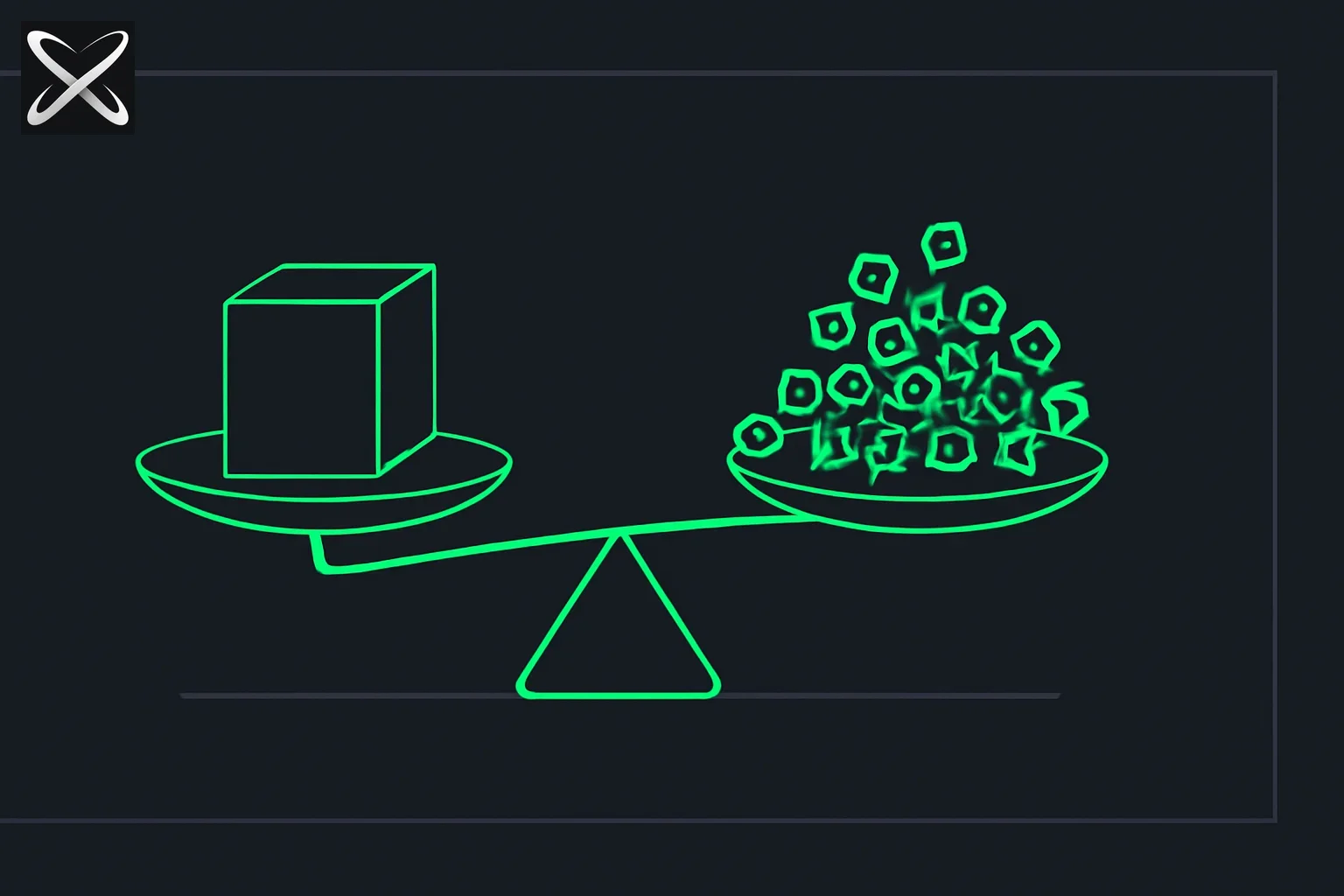 Qwen 3.6 27B dense model diagram showing a solid cube balanced against a scattered mixture of tiny cubes
Alibaba ships two local-friendly Qwen 3.6 shapes:
| Variant | Architecture | Migdał’s take |
|---|---|---|
| Qwen 3.6 27B | Dense | Recommended — slower, stronger instruction following |
| Qwen 3.6 35B A3B | MoE | 3× faster, but sloppier on agent tasks |
The minesweeper test in OpenCode crystallized it:
- 27B — hexagonal minesweeper, pnpm package, first prompt, proper Node layout
- 35B A3B — faster generation, but single
index.html, ignored “create a package”
That matches broader Mac local LLM guidance: MoE locals can loop, confuse identity, or skip structure — dense often wins for coding.
HN consensus echoed the post: “punches above its weight” — see threads like Will it Mythos? comparing local Qwen to past frontier tiers.
Smoke tests — from quantum poems to candle shops
Migdał’s eval ladder (beyond benchmarks):
Constrained writing
Quantum mechanics chat and an 8-line poem mixing Zouk dance and quantum physics — reasoning and rhyme deliberation both coherent. A year ago that quality needed GPT-4.5-class cloud spend (cf. Simon Willison’s “penguins on a bicycle” smoke test pattern).
Real-ish product work
Maciej Cielecki’s candle-shop prompt (AI Tinkerers Warsaw) via OpenCode — a few minutes → reactive landing page, sensible defaults, single short prompt. Not frontier-shocking in 2026, but a practical job that worked.
Simon Willison’s visual smoke test
Willison ran the same penguin on a bicycle prompt against 35B A3B then 27B — useful third-party replication anchor linked from the Quesma post.
explainx.ai read: treat these as integration tests, not SWE-bench. They predict “will my harness produce a repo I can npm install” better than MMLU alone.
llama.cpp setup — copy-paste
Foundation: New to the engine? Read what is llama.cpp? — install, GGUF, llama-cli vs llama-server, and flag reference before model-specific tuning below.
Server mode (agents + API)
Recommended quant: unsloth/Qwen3.6-27B-MTP-GGUF:Q8_0 — 8-bit, multi-token prediction support. See quantization guide for Q4/Q8 trade-offs.
llama-server -hf unsloth/Qwen3.6-27B-MTP-GGUF:Q8_0 \
    --spec-type draft-mtp -ngl 999 -fa on -c 65536 --port 8080
| Flag | Purpose |
|---|---|
-hf … | Download/reuse from Hugging Face |
--spec-type draft-mtp | MTP speedup |
-ngl 999 | Full GPU offload |
-fa on | Flash attention |
-c 65536 | 64k context (native 256k — tune down if RAM tight) |
--port 8080 | Pin port for harness configs |
Chat UI: http://127.0.0.1:8080
Local file instead of -hf:
llama-server -m ~/models/Qwen3.6-27B-Q8_0.gguf \
    --spec-type draft-mtp -ngl 999 -fa on -c 65536 --port 8080
Terminal-only chat
llama-cli -hf unsloth/Qwen3.6-27B-MTP-GGUF:Q8_0 \
    -ngl 999 -fa on -c 65536
Popular quants also from bartowski and other GGUF publishers on Hugging Face.
OpenCode config — local provider block
Add to ~/.config/opencode/opencode.jsonc:
{
  "$schema": "https://opencode.ai/config.json",
  "provider": {
    "llama": {
      "name": "llama.cpp (local)",
      "npm": "@ai-sdk/openai-compatible",
      "options": {
        "baseURL": "http://127.0.0.1:8080/v1",
        "apiKey": "local"
      },
      "models": {
        "qwen3.6-27b": { "name": "Qwen3.6-27B Q8 +MTP" }
      }
    }
  },
  "model": "llama/qwen3.6-27b"
}
Same server works for Pi, Hermes, or any OpenAI-compatible harness. Pillar guide: How to run open-source models locally in OpenCode — Ollama, LM Studio, and multi-provider tiering. For GLM and cloud fallbacks in one config, see How to Run GLM 5.2 on every harness.
Performance numbers — M5 Max 128GB
Migdał’s benchmarks (source notebook linked from Quesma post) on MacBook Pro Max M5, 128GB:
| Model · quant | Runtime | tok/s | RAM |
|---|---|---|---|
| Qwen3.6-35B-A3B · 8-bit | MLX | 85 | 37 GB |
| Qwen3.6-35B-A3B · 8-bit | llama.cpp | 93 | 44 GB |
| Qwen3.6-35B-A3B · 8-bit | llama.cpp + MTP | 105 | 45 GB |
| Qwen3.6-27B · 8-bit | MLX | 17 | 28 GB |
| Qwen3.6-27B · 8-bit | llama.cpp | 18 | 41 GB |
| Qwen3.6-27B · 8-bit | llama.cpp + MTP | 32 | 42 GB |
| DeepSeek-V4-Flash · Q2–Q4 | llama.cpp | 33 | 103 GB |
Takeaways:
- ~32 tok/s with MTP on 27B is within typical cloud API decode range for many products
- llama.cpp beat MLX in these runs (~95% GPU utilization)
- 35B A3B is 3× faster — but Migdál prefers ⅓ the tokens at higher quality
- DwarfStar4 (aggressive DS V4 Flash quant) matches ~33 tok/s but uses 103 GB RAM — poor laptop fit
HN RTX 5090 datapoint (gfosco): Q6_K + Q4_0 KV → ~50 tok/s at 123k context, ~28/32GB VRAM through LM Studio.
Both Qwen variants fit 48GB Apple Silicon at 8-bit; 4-bit under 18GB targets 32GB Macs. Consumer Nvidia needs aggressive quants but can exceed Mac tok/s — see Mac vs dedicated GPU guide.
Thermal warning: Migdał literally thermal-imaged the machine — 27B local is hot. Plan cooling and power.
Field report — RTX 4070 + Ollama + OpenCode (July 3, 2026)
We published this guide June 29. On July 3, explainx.ai founder @goyashy pulled Qwen 3.6 27B after reading it — testing whether it could replace basic day-to-day cloud models on consumer hardware:
| Setup | Detail |
|---|---|
| GPU | NVIDIA RTX 4070 (12GB VRAM) |
| Runtime | Ollama (lowest-friction path vs llama.cpp in the Quesma post) |
| Harness | OpenCode for routine agent tasks |
| Observation | GPU usage spikes to 90%+ on every prompt drop |
| Verdict | Works for routine tasks; VRAM headroom is the bottleneck |
This is exactly the kind of feedback we wanted when we wrote the guide — not benchmark theater, but "can I actually run my Tuesday workflow on this?"
What 90% GPU usage means on RTX 4070
12GB VRAM is tight for 27B dense at usable quants:
- Q8 — often won't fit with context + KV cache; expect OOM or aggressive swapping
- Q4_K_M — realistic default for 4070-class cards
- Context — start at 8k–16k, not 64k, until you profile VRAM
- Concurrent apps — close browser GPU tabs; 90% saturation leaves no margin
If Ollama saturates and throttles, switch to llama.cpp with partial CPU offload (-ngl tuned to leave ~1GB headroom) — the Quesma path in this guide.
Ollama quick start (4070 path)
ollama pull qwen3.6:27b
ollama run qwen3.6:27b
Point OpenCode at Ollama's OpenAI-compatible endpoint:
{
  "provider": {
    "ollama": {
      "name": "Ollama (local)",
      "npm": "@ai-sdk/openai-compatible",
      "options": {
        "baseURL": "http://127.0.0.1:11434/v1",
        "apiKey": "ollama"
      },
      "models": {
        "qwen3.6-27b": { "name": "Qwen3.6 27B" }
      }
    }
  },
  "model": "ollama/qwen3.6-27b"
}
Monitor GPU during first session:
# Windows — watch utilization while OpenCode runs
nvidia-smi -l 1
Honest tiering after this test:
| Hardware | Recommendation |
|---|---|
| RTX 4070 (12GB) | Qwen 3.6 27B Q4, short context, Ollama OK for routine tasks |
| RTX 5090 (32GB) | Q6_K at long context — see HN datapoint above (~50 tok/s) |
| 48GB+ unified RAM (Mac) | Q8 + MTP via llama.cpp — Quesma sweet spot |
| Need more headroom | Drop to Qwen 3.6 35B A3B MoE for speed-only tasks, or cloud tier |
We will keep updating this section as more readers report real-world configs — reply on X with your setup if you test.
Benchmark grounding — Artificial Analysis tiers
Migdał maps Artificial Analysis Intelligence Index scores to era:
| Model | AA score | ~Era (per post) |
|---|---|---|
| Gemma 4 31B | 29 | ≈ late 2024 (o1 / Claude 3.5 Sonnet) |
| Qwen3.6-35B-A3B | 32 | ≈ early 2025 (o3 / Claude 4 Sonnet) |
| Qwen3.6-27B | 37 | ≈ mid 2025 (GPT-5 / Claude Sonnet 4.5) |
| DeepSeek-V4-Flash (quant) | 40 | ≈ late 2025 (GPT-5.2 / Claude Opus 4.5) |
Caveats:
- Q8 Qwen barely hurts quality; 2–4 bit DwarfStar4 is not full V4 Flash
- Migdał’s impression: 27B ≈ or slightly beats DwarfStar4 within those quants; long-context projects may still favor DS4
- Gemma 4 on Cerebras is a cloud speed story — different from local 31B coding default
For Alibaba’s cloud/agent line, see Qwen 3.8-Max-Preview Token Plan (Jul 19, 2026), Qwen 3.7-Max agent frontier, and top Chinese AI companies.
Fable, subsidies, and what local buys you
Migdał closes with policy context explainx.ai readers already live:
- Fable 5 taken down — proprietary frontier access is policy-variable
- $100/mo consumer subs still imply massive inference subsidy — “use the discount while it lasts”
- Local weights — fine-tuneable, cannot be revoked, safe for proprietary code, offline, medical, or jurisdictional discomfort with US/China cloud
Tiered strategy (matches enterprise Fable alternatives):
| Tier | Stack |
|---|---|
| Sensitive / offline | Qwen 3.6 27B local |
| Frontier coding API | GLM-5.2, Kimi, DeepSeek, or restored Claude when available |
| Peak agentic | Cloud harness (Cline sub, Cursor, Claude Code) |
Next hardware step: GLM-5.2 via Unsloth — not laptop-friendly, but company-budget realistic for closer-to-frontier local.
Longer horizon: models may split intelligence from factual knowledge — raw weights for reasoning, tools/MCP for facts — shrinking local hardware needs. See agent skills guide and MCP overview.
Who should run Qwen 3.6 27B locally
Strong fit:
- 48GB+ Apple Silicon or 24GB+ Nvidia with acceptable quants
- OpenCode / Pi / Hermes users wanting offline or private agent loops
- Developers priced out of or blocked from frontier APIs post-Fable
- Volume coding where 32 tok/s is enough (build personal local AI system)
Skip or cloud instead:
- Hard SWE-bench / multi-hour agent runs — use GLM-5.2 harness or cloud
- Multimodal local — Gemma 4 12B/31B instead
- 32GB Mac without quant discipline — start Q4 and short context
Related on explainx.ai
- Gemma 4 26B A4B runs 2x faster on Mac — mlx.fast community leaderboard (Sept 2, 2026) — the MoE-on-Mac inference speed story for Qwen's closest local rival
- Qwen hits 3 billion downloads (Aug 17, 2026) — Hugging Face confirms Qwen is the most-downloaded open-weight model family, ahead of Google and Meta combined
- Qwen3.8-Flash-Next — leaked 125B-A6B MoE, expected Aug 26 (Aug 25, 2026) — the Qwen3.8 MoE tier HN asked for after the dense 27B; sized for 128GB Macs, not 35B-A3B
- Qwen3.8-27B — the local model Hacker News put at #1 (Aug 15, 2026) — the direct successor to this model, dense, runs on a single RTX 4090
- OpenCode Desktop tabs — Jul 15, 2026 — session-per-tab shell; worktrees deferred
- Fix local LLM looping with samplers and sandboxing — DRY/top_n_sigma sampler fixes for Qwen 3.6 27B looping, plus 2×3090 vs MacBook concurrency benchmarks
- PrismML Bonsai 27B — 1-bit 3.9GB + HN harness reality (Jul 2026) — extreme low-bit Qwen3.6 compression vs GGUF; Gemma 4 12B QAT comparison
- Meta Pocket vibe-coded gizmos — consumer-side prompt-native apps (contrast with dev local stack)
- Mac vs dedicated GPU for local LLMs — hardware thread Qwen 3.6 appears in
- Build a personal local AI system — Ollama vs llama.cpp vs vLLM
- GLM-5.2 Unsloth local setup — next step up from Qwen 3.6
- GLM-5.2 on OpenCode and harnesses — shared config patterns
- Gemma 4 12B local guide — multimodal local alternative
- Fable 5 open-source alternatives — tiered inference
- Top Chinese AI companies — Qwen in Alibaba stack
- Model quantization guide — Q8 vs Q4 math
Source: Quesma — Qwen 3.6 27B sweet spot for local development (Piotr Migdał, June 29, 2026) · unsloth GGUF · OpenCode config schema
Benchmarks and tok/s figures from Quesma's M5 Max tests and cited HN reports as of June 29–30, 2026. RTX 4070 Ollama field test added July 3, 2026 from @goyashy live testing. Verify on your hardware before production routing.