



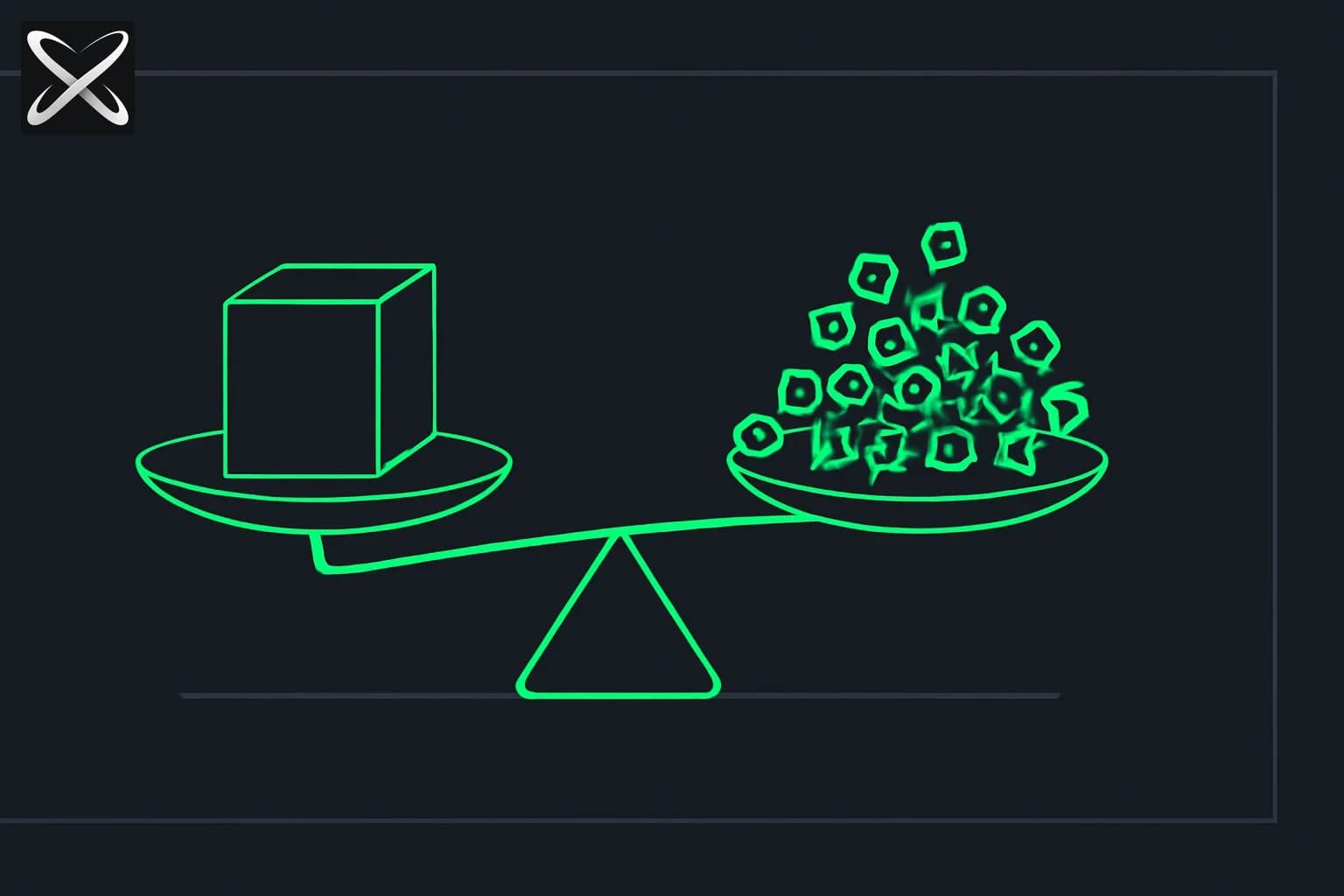
Alibaba's Qwen model family has been downloaded more than 3 billion times over the past six months, according to a Hugging Face report published August 14, 2026 — more than Google (418 million) and Meta (227 million) combined over the same window, per coverage from Bloomberg and Fortune. That makes Qwen the most-downloaded named model family on Hugging Face, and it's the clearest single data point yet that open-weight adoption has a leader — and it isn't a US lab.
We checked the aggregator headline against Hugging Face's own figures and the Bloomberg/Fortune/Business Standard reporting citing them before writing this. The number holds up. What it measures is narrower than the headline suggests, and that gap matters if you're deciding whether to build on Qwen.
What was actually verified
| Claim | Verified detail |
|---|---|
| "3 billion downloads" | Confirmed — Hugging Face's own report, dated August 14, 2026, cited by Bloomberg and Fortune |
| Timeframe | Roughly six months, not Qwen's full history since its 2023 debut |
| What's counted | Hugging Face download events across all Qwen model repos — pulls, not installs, active deployments, or unique users |
| "Most downloaded" claim | Qwen's six-month total exceeds Google's (418M) and Meta's (227M) combined totals in the same period, per Hugging Face's data |
| Model count | 460+ distinct Qwen checkpoints open-sourced by Alibaba |
| Derivative ecosystem | 300,000+ community fine-tunes and derivative models built on Qwen bases |
| Alibaba executive quotes | None found in primary coverage — the figures come from Hugging Face's own reporting, not an Alibaba press statement |
Hugging Face's characterization, per Fortune's reporting: Qwen has "become part of the default workflow for developers deciding what models to fine-tune and deploy." That's a description of developer habit, not a benchmark claim — worth keeping separate in your head.
One caveat the aggregator headline glossed over: a Hugging Face download is a single pull of a repo file, which happens every time a CI pipeline re-fetches weights, a mirror syncs, or a user re-downloads after clearing a cache. It is a real and useful adoption signal — but it is not the same measurement as monthly active API users, which is how OpenAI and Anthropic usually report scale. Comparing Qwen's download count to a closed lab's user count is comparing two different metrics, not two points on the same scale.
What Qwen actually is
Qwen is Alibaba Cloud's open-weight model family, spanning dense and mixture-of-experts (MoE) architectures across a wide size range — from sub-2B parameter models runnable on a phone up to frontier-scale MoEs like Qwen3.8-Max, whose 2.4T-parameter/95B-active-parameter open weights landed on Hugging Face in mid-August 2026. The lineup includes:
- General-purpose chat/reasoning models (the core Qwen3.x line, hybrid reasoning/non-reasoning modes)
- Coder-specific variants — Qwen2.5-Coder and successors, tuned for code completion and agentic coding, including tiny 1.5B builds that run shell-command generation on a laptop CPU with no GPU
- Vision-language and image-generation variants (Qwen-VL, Qwen-Image)
- Agent-oriented releases, including tool-use and long-horizon autonomy tuned checkpoints like Qwen3.7-Max's agent frontier work
That breadth — 460+ distinct checkpoints across sizes and modalities — is a large part of why the download total is so lopsided. Every size and specialization is a separate Hugging Face repo, each accumulating its own pulls, which compounds the family's total far faster than a competitor shipping fewer, larger flagship checkpoints.
This is also why "Qwen" as a single line item is a bit misleading. A developer picking a 1.5B coder model for a laptop CPU and a research team deploying a 2.4T-parameter MoE on a GPU cluster are both counted under the same "Qwen downloads" figure, even though they're solving completely different problems. The size range is the product strategy, not an accident — Alibaba is covering the entire spectrum from edge device to datacenter with one branded family, which naturally out-accumulates a competitor that ships two or three flagship sizes.
What people are actually asking about this milestone
Reactions to the download figure split into two camps once the initial headline circulated. One group treats it as confirmation that open-weight China-origin models have won the adoption race outright. The other points out, correctly, that a Hugging Face pull is a weak proxy for anything downstream of the download itself — it doesn't confirm the weights were ever loaded, fine-tuned, or put into a production request path. Both reactions are partly right. The download count is real and it is a meaningful adoption signal at this scale; it just isn't a substitute for a benchmark run or a usage-share report, and treating it as one overstates the claim beyond what Hugging Face itself is saying.
Why download counts matter — and why they don't tell the whole story
What they signal:
- Breadth of self-hosting adoption. A model that gets downloaded millions of times is being pulled into local inference setups, CI pipelines, and fine-tuning jobs at real scale — you can run Qwen locally via llama.cpp and opencode the same way tens of thousands of other builders already do.
- Ecosystem tooling support. Popular weights get GGUF quantizations, Ollama modelfiles, vLLM configs, and framework integrations faster, because tool maintainers prioritize what their users are actually running.
- License and portability confidence. Builders don't repeatedly download weights they don't trust to redistribute or fine-tune — sustained download volume is a soft signal that Qwen's licensing terms have been workable enough for wide reuse (though Qwen3.8-Max's newer revenue-share license terms are a notable exception worth reading closely before building a commercial product on it).
What they don't tell you:
- Production usage share. A download is not a deployed instance. Enterprises evaluating and discarding a model still register as downloads; a single high-traffic production deployment might download the weights once.
- Quality or benchmark standing. Download count says nothing about how Qwen performs against Claude Opus, GPT, or other open-weight rivals on any specific eval — those comparisons require running the actual benchmarks, not counting pulls.
- Revenue or paid usage. Alibaba's own hosted API revenue from Qwen is a separate, unreported number from open-weight download volume.
Qwen vs. the other open-weight families builders actually choose between
| Family | Maker | Notable strengths | Download/adoption signal | Caveat |
|---|---|---|---|---|
| Qwen | Alibaba Cloud | Widest size range (sub-2B to 2.4T MoE), strong coder and vision variants, fast Hugging Face/GGUF support | 3B downloads / 6 months, 460+ checkpoints, 300K+ derivatives | Newer flagship releases (Qwen3.8-Max) ship under a revenue-share license, not a clean open-source term |
| Llama | Meta | Deep US enterprise tooling integration, long-standing ecosystem maturity | 227M downloads in the same 6-month window, per Hugging Face | Trailing Qwen on raw download share despite earlier ecosystem head start |
| DeepSeek | DeepSeek | Strong reasoning-focused releases at aggressive open pricing and permanent API discounts | High developer mindshare in reasoning/coding benchmarks | Smaller total checkpoint catalog than Qwen's 460+ |
| GLM | Zhipu AI | Competitive agentic coding and cyber-defense-focused releases like GLM-5.3 | Growing fast but not reported in Hugging Face's top download tier | Newer entrant relative to Qwen and Llama's longer track record |
Read this table as a starting point for a bake-off, not a verdict — see explainx.ai's full framework for choosing between open-weight and closed models for the decision criteria that actually apply to your workload.
What this signals about the open-weight landscape
Three billion downloads in six months, concentrated in one family, is a data point about market structure, not just Qwen. A few things follow from it:
- Open-weight adoption is consolidating around a small number of high-velocity publishers. Alibaba's cadence — Qwen3.7-Max, Qwen3.8-Max preview, Qwen3.8-Max open weights, and specialized coder/agent variants all landing within months of each other — outpaces most rivals' release frequency, and frequency compounds download totals directly.
- China now leads a core open-source AI metric outright. This lands alongside Ollama's own reporting of roughly 9 million builders on its platform pulling models locally, reinforcing that self-hosted inference is a mainstream workflow, not a niche one — and that the models flowing through it increasingly originate outside the US.
- Self-hosting vs. hosted-API is a live decision again, not a settled one. When one open-weight family is demonstrably this widely adopted, the "just use a closed API" default gets harder to justify for cost-sensitive or customization-heavy workloads — which is exactly the calculus explainx.ai's open-vs-closed decision framework is built to walk through.
None of this means Qwen is the right model for a given task. It means Qwen has become the default first checkpoint a lot of builders reach for, which is a different and more durable kind of signal than a single leaderboard placement.
How to actually try Qwen this week
| Path | Best for | What you need |
|---|---|---|
| Pull weights from Hugging Face directly | Custom fine-tuning, research, framework integration | transformers/vllm, enough GPU memory for the checkpoint size you pick |
| Run a quantized build locally with Ollama | Fast local testing, no cloud spend | ollama pull qwen3 (or the specific variant tag), 8–32GB RAM depending on size |
| Run via llama.cpp | Maximum control over quantization and hardware | GGUF build of the Qwen variant, CPU or modest GPU |
| Call a hosted endpoint through OpenRouter | Production traffic without managing weights | API key, no local hardware required |
For a laptop-sized starting point, explainx.ai's ranked guide to open-weight models by memory footprint maps specific Qwen sizes to 8GB/16GB/24GB/32GB machines rather than leaving you to guess. If you want the fuller local setup walkthrough, how to run Qwen 3.6-27B locally with llama.cpp and opencode covers the exact commands.
Related reading
- How to Choose Between Open-Weight and Closed AI Models
- Qwen3.8-Max Open Weights Are Live — Stripped, Relicensed, and Half-Delivered
- Qwen 3.6-27B: Local Development with llama.cpp and opencode
- Top 10 Open-Weight Models You Can Actually Run on a Laptop
- Qwen 3.8-27B vs Claude Opus: Open-Weight Model Comparison
- What Is Ollama? $88M Funding, 9M Builders, and the Open-Models Bet
- GLM-5.3 Launch: Cyber Defense Benchmarks
- DeepSeek V4 Pro: Permanent API Pricing Discount
Official source: Hugging Face data as reported by Bloomberg and Fortune, August 14–15, 2026.
Download figures, model counts, and comparisons reflect Hugging Face data and press reporting as of the August 17, 2026 publication date and may shift as Alibaba, Hugging Face, or competing labs report updated numbers.
Update — October 3, 2026: Follow-up: Hirundo's Qwen censorship audit.