




Update — August 24, 2026: A new Google DeepMind preprint explores a different Gemma inference trade-off: Recirculation reports better state tracking and reasoning with frozen weights, while making prompt prefill serial.
On July 15, 2026, Google's @googlegemma account posted a community update (~192.5K views) across the Gemma 4 open-weight family — not a new major version number, but a same-day refresh of weights, kernels, and templates on Hugging Face. If you landed here asking "Is this Gemma 4.1?", "Does Gemma 4 beat Qwen 3.6 27B now?", or "Why did my tool calls get better?", this is explainx.ai's read after the thread, benchmark charts, and HF collection timestamps.
The update targets three pain points developers actually hit in production: slow prefill on long agent prompts, inconsistent tool-call JSON, and blurry vision OCR. For context on the broader Gemma 4 lineup, start with our Gemma 4 12B local guide and Ollama 0.31 MTP speedup — this post covers what changed on July 15 and what to re-pull.
TL;DR — what people are asking
| Question | Answer |
|---|---|
| Is this Gemma 4.1? | No — updated Gemma 4 weights/configs on HF, not a rebrand |
| Biggest perf win? | Flash Attention 4 on NVIDIA Hopper — +25–70% prefill, TTFT −31% max |
| Tool calling fixed? | Yes — patches for consistent execution; 31B +10.1% Tau2 Telecom |
| Vision change? | Default 280 token bucket; max_soft_tokens 1120 for sharp OCR (~2.51 MP) |
| Chat template? | Smoother conversational formatting — fewer stray role markers in multi-turn |
| Download where? | google/gemma-4 collection |
| vs Qwen 3.6 27B? | Qwen still leads text-only local coding; Gemma 4 leads multimodal + edge |
| Need new API keys? | No — Apache 2.0 open weights; cost is hardware + re-pull time |
What Google shipped (July 15, 2026)
The @googlegemma thread listed five concrete changes. None require a new product name — they are runtime and weight updates across the collection Google already publishes.
1. Flash Attention 4 on NVIDIA Hopper
Flash Attention 4 (FA4) integration targets NVIDIA Hopper GPUs (H100-class). Google reported:
- Prefill throughput: +25% to +70% (workload-dependent)
- Time-to-first-token (TTFT): down up to 31%
Why prefill matters for agents: Agent harnesses inject system prompts, tool definitions, MCP tool schemas, and RAG chunks before the model generates its first token. Prefill is often the hidden latency tax in OpenCode and Claude Code-style loops. FA4 attacks that phase — not decode tok/s, which Ollama MTP already improved on Apple Silicon.
FA4 is the same kernel generation other 2026 stacks cite for attention speedups (video agents, Nemotron-class serving). On Hopper, you need an inference stack that ships FA4 — vLLM nightly, compatible Transformers + flash-attn builds, or your cloud provider's Gemma 4 endpoint after they refresh.
2. Chat template polish
Google updated the chat template for smoother conversational formatting. In practice that means:
- Fewer role-tag leaks into assistant output
- More consistent multi-turn structure when you mix
user/model/ tool-result blocks - Better alignment with HF
apply_chat_templatedefaults so local servers match Google's reference formatting
If you fine-tuned on an older template or hard-coded Jinja in a custom server, re-test after pulling — template drift is a common source of "model got dumber" reports that are actually formatting regressions.
3. Tool calling reliability patches
Tool calling received patches for accurate, consistent execution — the kind of fix that shows up in agent benchmarks rather than MMLU slides.
Google's published net improvements (new weights vs previous Gemma 4):
Gemma 4 31B — agentic reasoning & tool calling:
| Benchmark | Previous | Net gain |
|---|---|---|
| BFCL (Tools) | 74.20% | +0.40% |
| TB2 (Agents) | 25.80% | +4.50% |
| Tau2 (Retail) | 77.60% | +3.10% |
| Tau2 (Airline) | 84.00% | +2.00% |
| Tau2 (Telecom) | 62.70% | +10.10% |
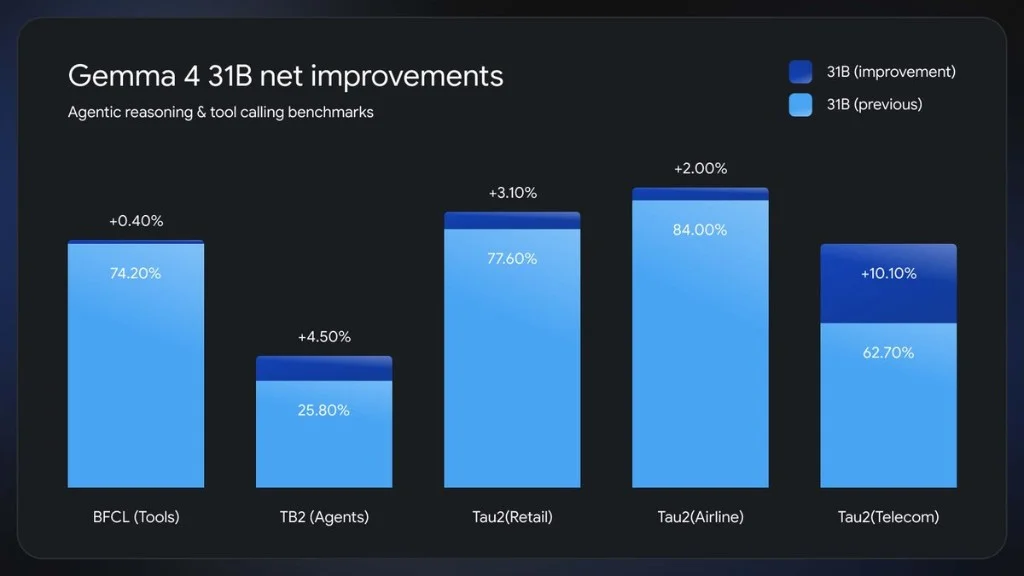 Gemma 4 31B net improvements on agentic reasoning and tool calling benchmarks — BFCL, TB2, Tau2 Retail, Airline, Telecom
Agentic benchmark deltas for Gemma 4 31B — July 15, 2026 @googlegemma community update. Tau2 Telecom shows the largest gain (+10.10%).
Gemma 4 E4B — same benchmark suite, edge-scale model:
| Benchmark | Previous | Net gain |
|---|---|---|
| BFCL (Tools) | 66.60% | +0.50% |
| TB2 (Agents) | 0.00% | +2.20% |
| Tau2 (Retail) | 60.50% | +0.90% |
| Tau2 (Airline) | 49.00% | +8.00% |
| Tau2 (Telecom) | 15.80% | +6.10% |
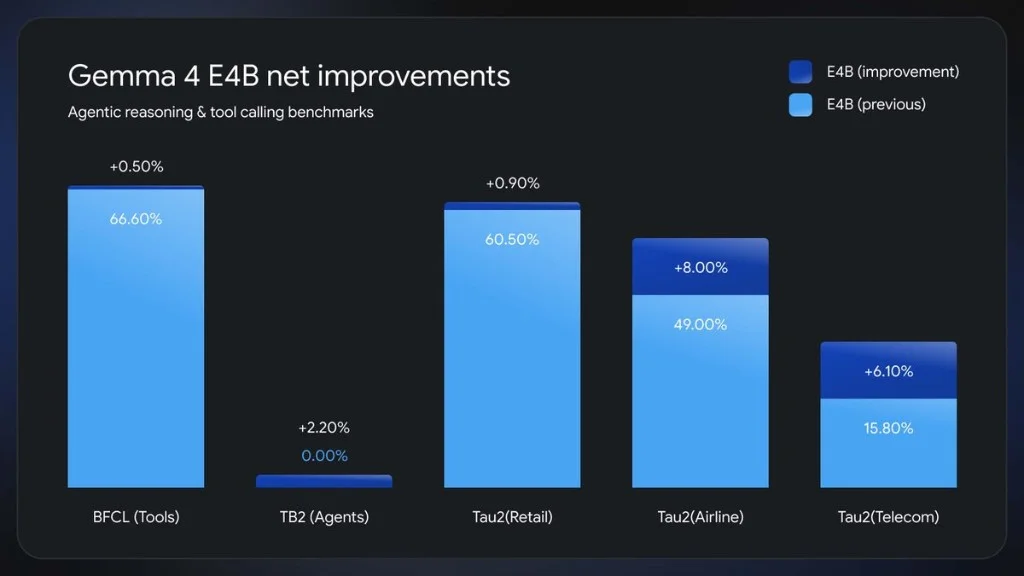 Gemma 4 E4B net improvements on agentic reasoning and tool calling benchmarks — BFCL, TB2, Tau2 Retail, Airline, Telecom
Agentic benchmark deltas for Gemma 4 E4B — largest gains on Tau2 Airline (+8.00%) and Telecom (+6.10%).
explainx.ai's read: Telecom and airline Tau2 domains reward multi-step tool plans with strict parameter schemas — exactly where bad tool definitions usually break agents. The double-digit 31B Telecom jump suggests Google fixed execution consistency (valid JSON, correct tool selection, fewer dropped calls) more than raw reasoning. E4B moving from 0% to measurable TB2 is noisy at small absolutes but directionally useful for on-device automation loops.
4. Vision — sharper OCR and 2.51 MP inputs
Vision defaults changed for document and screenshot workloads:
| Setting | Value | Effect |
|---|---|---|
| Default bucket | 280 tokens | Baseline vision encoding for typical images |
| max_soft_tokens | 1120 | Allows sharper OCR and ~2.51 megapixel inputs |
| Demo | HF Space | Interactive vision comparison in Google's Space |
If you run screenshot-to-patch or PDF OCR agents — the workloads Gemma 4 on Cerebras targets at cloud TPS — re-pull weights and bump vision token budget in your inference config. Low token buckets were a common reason early Gemma 4 vision felt "soft" on dense text.
5. Hugging Face collection refresh
All checkpoints in google/gemma-4 show recent update timestamps (~July 15, 2026). The collection spans:
| Tier | Examples | Best for |
|---|---|---|
| Edge | E2B, E4B | Phone, simulators, embedded agents |
| Local dense | 12B | 16GB VRAM multimodal (12B guide) |
| Large multimodal | 27B, 31B/33B-class | Cloud inference, heavy vision agents |
| Small Any-to-Any | 5B, 8B | Lighter unified multimodal |
Action: huggingface-cli download or re-pull via Ollama — stale caches are the #1 reason developers miss template and tool-call fixes.
"Gemma 4.1" vs "Gemma 4 with updates" — versioning confusion
Community threads immediately asked whether this was Gemma 4.1. Google's framing: same Gemma 4 brand, refreshed artifacts.
| Misread | Reality |
|---|---|
| "New major version" | Incremental weight + config refresh on existing repos |
| "Must update Ollama tag" | Re-pull same model names — verify release notes for template hash |
| "BFCL +0.4% means nothing" | Small BFCL deltas can still fix systematic JSON errors that tank agents |
| "31B beats everything now" | Domain-specific Tau2 gains ≠ winning Qwen 3.6 27B on coding smoke tests |
Treat this like a security patch for agent behavior — re-pull, re-run your eval harness, ship if your tool-call failure rate drops.
Gemma 4 vs Qwen 3.6 27B — after July 2026
The comparison that keeps appearing in community replies:
| Dimension | Gemma 4 (post-update) | Qwen 3.6 27B dense |
|---|---|---|
| Modalities | Vision + audio + text unified | Text-first (vision variants exist separately) |
| License | Apache 2.0 | Apache 2.0 |
| Local coding (text) | Good; MTP on Mac via Ollama | Community favorite for instruction-following |
| Agentic tool benchmarks | Improved Tau2/TB2 (31B, E4B charts) | Strong on coding agents; run your own Tau2 |
| Hardware sweet spot | 12B on 16GB; E4B on edge | 27B Q8 on 48GB Apple Silicon (llama.cpp guide) |
| Multimodal OCR | Sharper with 1120 soft tokens | Not the default local pick for screenshot agents |
Practical routing:
- Text-only coding agent on Mac/PC → start with Qwen 3.6 27B
- Screenshot / document / UI agent → Gemma 4 12B or 31B with updated vision buckets
- On-device iOS / edge automation → E4B + Argent-style loops
- Hopper datacenter serving → refresh for FA4 prefill before you benchmark decode-only tok/s
Neither model replaces frontier closed APIs on the hardest agent suites — see closed vs open alternatives for tiering.
How to apply the update locally
Ollama (fastest path)
ollama pull gemma4:12b-mlx
ollama pull gemma4:12b
# Verify template + tools in your agent
ollama launch claude --model gemma4:12b-mlx
MTP from Ollama 0.31 stacks with refreshed weights — you get decode speed from MTP and prefill speed from FA4 when your backend is Hopper + compatible build.
llama.cpp / OpenCode
# Example: refresh GGUF and restart server
llama-server -hf google/gemma-4-12b-it-GGUF:Q8_0 \
  -ngl 999 -fa on -c 65536 --port 8080
Point OpenCode at http://127.0.0.1:8080/v1 per local OpenCode setup. After pull, run one tool-call smoke test (weather API or filesystem tool) before long agent sessions.
vLLM / Hopper (FA4 prefill)
Use a Transformers + flash-attn build that exposes FA4 on Hopper. Benchmark TTFT with your real system prompt + tool schema token count — that is where Google claimed up to 31% improvement, not just synthetic prefill charts.
What people are still asking
Do I need to re-fine-tune?
Only if you fine-tuned on the old chat template or tool-call format. Base-model users: re-pull and re-eval.
Will MLX on Mac get FA4 gains?
Google's FA4 numbers target NVIDIA Hopper. Apple Silicon benefits from MTP on MLX and updated weights; do not expect identical prefill deltas.
Is E4B viable for agents now?
E4B Tau2 Airline +8% and Telecom +6.1% suggest edge agents are inching toward usable tool loops — still far below 31B absolutes. Use E4B for latency/privacy-bound tasks, 31B/12B for quality-bound tasks.
Where is the vision HF Space?
Google linked an interactive Hugging Face Space demo in the thread for side-by-side OCR — use it to calibrate max_soft_tokens before production document pipelines.
Related on explainx.ai
- TurboFieldfare — Gemma 4 26B in ~2 GB RAM on Apple Silicon — SSD-streamed MoE for 8 GB Macs
- Gemma 4 12B — multimodal local guide — unified architecture, 16GB VRAM, Apache 2.0
- Ollama 0.31 — Gemma 4 MTP ~90% faster on Mac — decode speed on MLX
- Gemma 4 31B on Cerebras — 1,851 TPS multimodal — cloud screenshot agents
- Qwen 3.6 27B local dev guide — text-only coding sweet spot
- Tool definition & schema design — why patches matter in harnesses
- How to run open-source models locally + OpenCode — full stack wiring
- Gemma 4 E4B + Argent iOS automation — on-device agent loop
Official sources: Gemma 4 HF collection · @googlegemma July 15, 2026 thread
Last updated: July 16, 2026. Benchmark deltas and FA4 figures are from Google's July 15, 2026 community announcement; hardware results vary by inference stack and batch size. Re-verify Hugging Face model revision hashes before production deploys.