



A student can ask a chatbot to explain photosynthesis, draft a history essay, or walk through a calculus problem — and get a fluent answer in seconds. That convenience raises a fair question for every teacher, parent, and curriculum designer: if AI can answer almost anything, what is school actually for?
The honest answer is not "nothing." It is that the bottleneck moved. Finding information used to be hard. Now judging it is hard. UNESCO's AI Competency Framework for Students (updated January 2026) frames this shift explicitly: students must become responsible users and co-creators of AI, not passive recipients of generated text. The OECD–European Commission AILit Framework — which feeds the PISA 2029 Media and Artificial Intelligence Literacy assessment — puts Critical Thinking first among the competences learners need to evaluate AI outputs for accuracy, bias, and ethical fit.
This guide synthesizes that policy research with classroom practice. It is not a grade-band syllabus — explainx.ai already publishes those for elementary, middle school, high school, and college. This is the why layer: five curriculum pillars every school should build toward, with practical moves for educators, parents, and learners.
TL;DR: five pillars when answers are cheap
| Question | Direct answer |
|---|---|
| Did AI make school obsolete? | No. It made verification, questioning, and transfer more valuable than memorizing answers AI can retrieve. |
| What matters most? | Critical thinking — verify outputs, detect bias, know when not to use AI at all (OECD AILit). |
| What skill did AI erode? | Asking your own questions. The Question Formulation Technique (QFT) exists because "not knowing what to ask" blocks learning. |
| What does research warn about? | Unchecked AI homework help raises scores short-term and cuts exam performance ~20% when students skip the reps (learning penalty study). |
| What should every graduate transfer? | Apply knowledge in new contexts without a model — Wiggins and McTighe's Understanding by Design calls this the ultimate goal of schooling. |
| Where does AI literacy fit? | Alongside CS fundamentals — know how systems work, not just how to prompt them (UNESCO student framework). |
The wrong frame: school as answer storage
For a century, much of formal education optimized for acquisition — memorize facts, reproduce procedures on tests, move on. That model assumed information was scarce and expertise was gated behind libraries, textbooks, and teachers who held answers you could not easily access elsewhere.
Generative AI inverts the scarcity. Answers are abundant. Plausible wrong answers are abundant too. Models confabulate citations, smooth over gaps in reasoning, and sound confident while being incorrect — the same pattern formal verification researchers describe when a beautiful proof still needs days of checking.
Schools that keep optimizing for "can the student produce the correct answer on demand?" are training for a job AI already does. Schools that optimize for "can the student decide whether an answer is correct, explain why, and apply the idea somewhere new?" are training for work AI cannot reliably do alone.
Grant Wiggins and Jay McTighe's Understanding by Design framework names three intertwined goals: Acquisition (get the facts), Meaning Making (understand why they matter), and Transfer (use them autonomously in unfamiliar situations). AI collapses Acquisition for many tasks. Transfer is still slow, social, and deeply human.
Pillar 1: Verification and epistemic humility
Curriculum goal: Every student can evaluate a claim — AI-generated or human — before treating it as true.
The OECD AILit Framework defines Critical Thinking in an AI context as questioning whether to use AI at all, verifying accuracy and relevance of outputs, and reflecting on how AI-mediated information shapes decisions. That is not a single lesson. It is a habit woven through science labs, history source analysis, math error-checking, and media literacy.
What to teach
- Triangulation: Compare an AI answer against a primary source, a textbook, and a peer's independent work. Disagreement is data, not failure.
- Confidence calibration: Teach students to distinguish "I found this" from "I checked this." A verified answer should survive the explain-it-back test — can you defend it with the laptop closed?
- Failure modes: Hallucinated references, outdated training cutoffs, sycophantic agreement, math slips on multi-step problems. Students should collect a personal "where AI lied to me" log — that journal builds skepticism faster than a lecture.
- Oral defense: Five-minute conversations where students walk through reasoning without notes. Teachers across subjects report this is the most AI-resistant assessment format because generation is cheap but live explanation is not.
Classroom moves
| Subject | Verification exercise |
|---|---|
| History | AI drafts a paragraph on a event; students must find one factual error and one missing perspective |
| Science | Compare AI explanation of an experiment to the actual lab data — which prediction failed? |
| Math | "Find the mistake" in an AI-generated solution; redo the problem by hand |
| English | AI summarizes a poem; student identifies one interpretation the summary flattened |
OpenAI's education materials emphasize Study Mode — Socratic, step-by-step guidance rather than immediate answers — for the same reason: the product design nudge should match the pedagogy nudge.
Pillar 2: Question formulation — the skill AI skips
Curriculum goal: Students produce, refine, and prioritize their own questions before searching for answers.
When you open a chatbot, it answers the question you asked — even if that was the wrong question. Dan Rothstein and Luz Santana's Question Formulation Technique, developed at the Right Question Institute and used in over a million classrooms worldwide, exists because questioning is a teachable skill, not a talent.
The QFT's six steps — Question Focus, produce questions, improve questions, prioritize, plan next steps, reflect — deliberately train divergent thinking (generate many questions), convergent thinking (choose the best ones), and metacognition (reflect on what you learned about your own inquiry). Those three modes are exactly what passive AI consumption skips.
Why this matters more with AI
Wiggins and McTighe define essential questions as inquiries "not answerable with finality in a brief sentence" — questions meant to "stimulate thought, provoke inquiry, and spark more questions." AI is optimized for brief, final-sounding sentences. School should be optimized for the opposite.
Practical integration:
- Start units with a QFocus (an image, data set, or conflicting headline) instead of a learning objective paragraph.
- Ban AI for the first 15 minutes of research projects — question generation only.
- Grade the quality of the question stack, not just the final report. A student who asks "Why did GDP rise but median wages flatline in this decade?" is thinking like an analyst; a student who asks "What is GDP?" is prompting a search engine.
Essential questions also recur across grades — "How do we know what we know?" in elementary becomes "What counts as evidence in this discipline?" in high school. That vertical alignment is how you build transfer goals that survive tool changes.
Pillar 3: Reasoning over retrieval — libraries, Google, AI
Curriculum goal: Students understand how knowledge is found, weighed, and constructed — not just what the latest tool returned.
Every generation had a retrieval technology that felt like cheating to the previous one. Card catalogs gave way to search engines; search engines gave way to conversational AI. The through-line is not the tool — it is the reasoning chain connecting a question to a justified conclusion.
Teach the stack explicitly:
- Libraries and primary sources — provenance, peer review, archival context
- Structured search — keywords, filters, source typing, date ranges
- AI-assisted synthesis — with mandatory citation back to non-AI sources
- Human judgment — what to accept, revise, or reject
The OECD AILit Framework organizes competences across four domains — Engage, Create, Manage, and Shape AI — precisely because literacy is not "know how to prompt." It is knowing where in the chain AI helps and where it introduces risk.
Assignments that force reasoning
- Source genealogy: Trace a claim backward through three layers — who said it first, who repeated it, what evidence exists?
- Pre-AI and post-AI compare: Solve a problem without tools, then with AI, then document where your reasoning diverged and which path you trust more.
- Red-team your own work: Student writes a paragraph, then prompts AI to attack it. Revise based on valid critiques only — practice distinguishing useful pushback from hallucinated objections.
Pillar 4: Learning and working without AI as the default
Curriculum goal: Build automatic skills that function in closed-book, closed-laptop conditions — because high-stakes life still has them.
The generative AI learning penalty is the clearest empirical warning here. A 30-month study of 26,811 secondary students found AI raised homework scores 18% and cut completion time 30% — while monthly exam scores fell 20% within six months. The penalty concentrated in students who used AI to outsource practice, not those who used it to check understanding.
Homework is not a product the teacher lacks. It is a gym. When AI lifts the weights, muscles do not grow.
Design principles
- AI-free reps for foundations: mental math sprints, handwriting fluency, spelling without autocomplete, coding syntax from memory before Copilot. These are not nostalgia — they are the baseline that lets you detect when AI output is wrong.
- Varied retrieval practice: quizzes, flashcards, teach-back sessions — the pattern Dartmouth's Phosphor study found drives real exam gains when AI is optional and production is required.
- Time limits without tools: short in-class writes, whiteboard derivations, oral math. Not punitive — diagnostic. You learn what actually transferred.
- Scheduled AI zones: "AI allowed for brainstorming only" vs "AI forbidden for this draft" removes the always-on default that erodes social learning and peer dialogue.
Parents can mirror this with the tutor-not-ghostwriter line without micromanaging every assignment. One well-run explain-it-back conversation per week teaches more than nightly screen surveillance.
Pillar 5: Computer science fundamentals and AI literacy foundations
Curriculum goal: Students understand how AI systems work well enough to use them responsibly and co-create — not just consume.
UNESCO's student framework spans four dimensions — human-centred mindset, ethics, AI techniques and applications, and AI system design — across progression levels from Understand to Apply to Create. That is broader than "how to write prompts" and narrower than "train a frontier model from scratch."
Minimum viable AI literacy (all students)
| Topic | Why it belongs in core curriculum |
|---|---|
| What models are (and are not) | Probabilistic pattern matchers, not oracles — connects to AI literacy basics |
| Training data and bias | Outputs reflect corpus gaps; fairness is a design question |
| Privacy and consent | What you paste into a chat may leave your control |
| Environmental cost | Compute has material footprint — sustainability is in UNESCO's teacher framework too |
| Appropriate use policies | Academic integrity, workplace norms, civic responsibility |
CS fundamentals that still matter
Even when AI writes code, students need:
- Logic and debugging — trace what broke and why
- Data representation — what is structured vs inferred
- Security basics — injection, phishing, deepfakes (verification guide)
- API thinking — inputs, outputs, failure modes (the same mental model as MCP and agent tools)
Grade-band specifics — Code.org AI Foundations, AP alignment, capstone projects — live in the high school curriculum guide. This pillar is the conceptual spine those resources hang on.
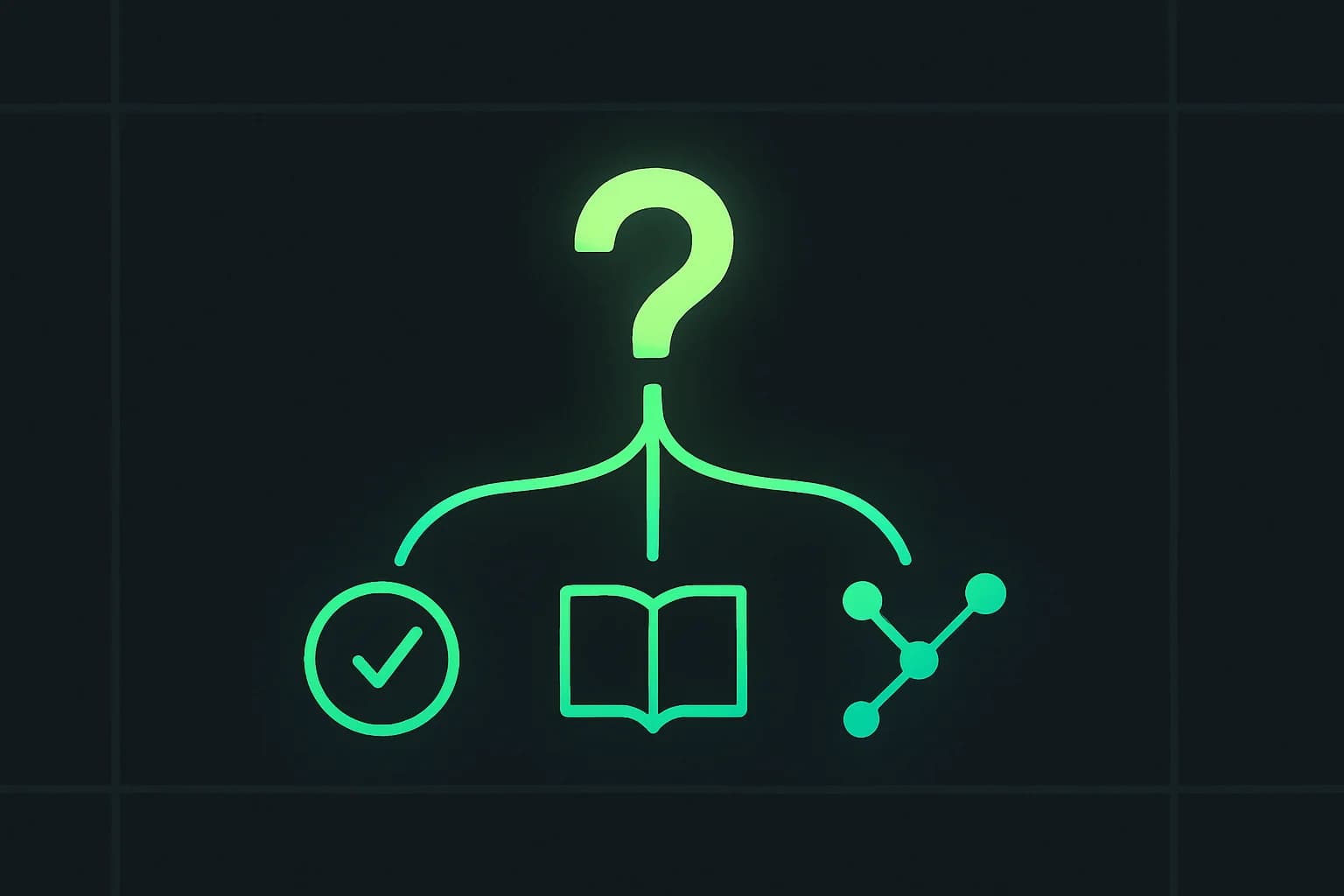
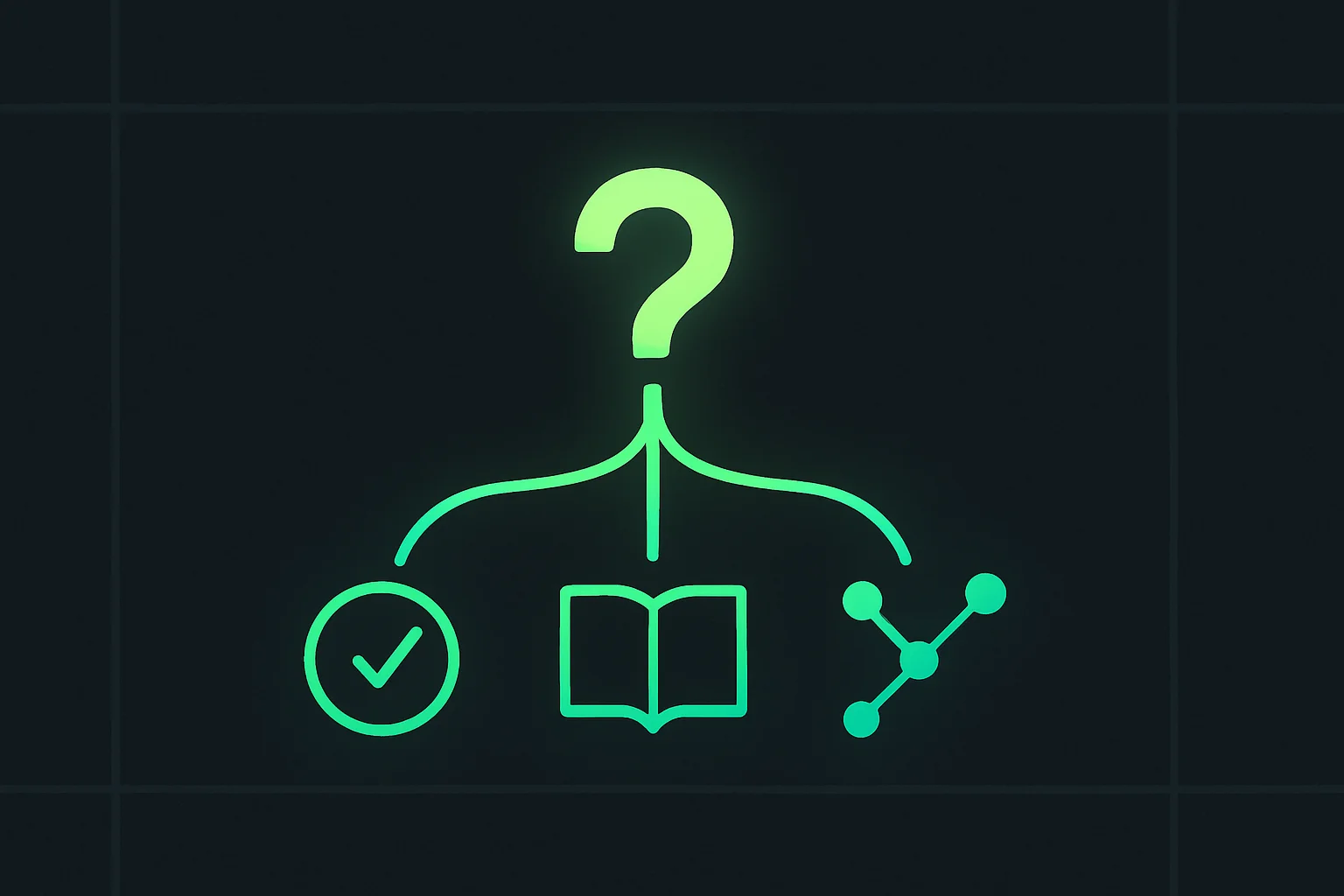 Curriculum pillars for the AI era: question formulation, verification, and foundational reasoning illustrated as branching paths from a central question mark
What this looks like by role
For educators
- Rewrite one unit using backward design: start with a transfer goal ("student can evaluate a news claim about climate data without AI"), then build assessments that require evidence of reasoning, not just output.
- Adopt QFT for one lesson per month — the Right Question Institute publishes free protocols.
- Train on UNESCO's teacher framework — 15 competencies across AI pedagogy and professional learning, released alongside the student framework in 2026.
- Use AI for prep, not proxy grading — lesson differentiation and rubric drafts are fair game; automating judgment on student thinking is not.
OpenAI's ChatGPT for Teachers and K–12 educator plugins can accelerate prep when bounded by district policy. The AI Literacy Blueprint gives leaders a policy starting point — but pedagogy still lives in your classroom.
For parents
You do not need to replicate school. You need three habits:
- Ask better questions at dinner — "What would convince you you're wrong?" beats "What did you learn today?"
- Model verification — look something up together, compare two sources, admit when you do not know.
- Protect unassisted practice time — reading, sport, instrument, craft — anything that builds skill without a generate button. Light touch on time and community matters; burnout from hyper-surveillance helps nobody.
For age-specific scripts, see the parent guide to teaching kids AI.
For learners (and adult upskillers)
The same pillars apply after graduation:
- Use AI as sparring partner, not answer key — how to learn AI in 2026 walks through verification at every stage.
- Join cohorts — social learning beats solo chat because peers force you to produce and defend ideas.
- Build a no-AI baseline for core professional skills — if you cannot do the task once without AI, you do not understand it yet.
On explainx.ai, Melo is deliberately built around Explain Back and Quiz modes — dialogic practice, not ghostwriting. Interactive pathways embed comprehension checks as you read. Workshops and bootcamps add human cohorts for the parts AI cannot model. None of that replaces school; it extends the same design principles for adults who are re-skilling.
Building a school-wide strategy (not a tool rollout)
UNESCO's Prep-AI initiative moves from frameworks to implementation — MOOCs for policy-makers, teacher training toolkits, and capacity building by country. The recommendation is consistent: integrate AI competency into a comprehensive strategy, not a single vendor purchase.
A workable sequence for districts:
- Publish clear use policies — when AI is allowed, required, or forbidden; align with homework integrity norms.
- Pick 3–5 transfer goals that recur K–12 — e.g., verify claims, ask essential questions, explain reasoning orally.
- Map existing standards to those goals — most literacy and science practices already fit; AI is the new context, not a new subject silo.
- Train teachers on pedagogy first, tools second — UNESCO's teacher framework puts AI pedagogy and ethics before tool tutorials.
- Measure transfer, not tool usage — exam performance under closed conditions, portfolio defenses, and real-world projects beat "number of prompts logged."
PISA 2029's MAIL assessment will eventually give countries external signal on whether these interventions worked. Schools that wait until 2029 to start will be optimizing for a test students were not prepared for.
Summary
AI did not make schools obsolete. It made cheap answers common and good judgment scarce. The curriculum response is not "more ChatGPT" or "ban everything" — it is five durable pillars:
- Verification and epistemic humility — trust is the job when answers are free
- Question formulation — teach asking before answering
- Reasoning over retrieval — understand the chain from question to justified belief
- Learning without AI as default — protect the reps that build unassisted skill
- CS fundamentals and AI literacy — co-create responsibly, not consume blindly
Frameworks from UNESCO, OECD, Wiggins and McTighe, and decades of classroom research point the same direction. The work is local: one unit redesigned, one family rule clarified, one learner who can explain an answer with the laptop closed.
Related on explainx.ai
- Bill Gates: the turbulent AI era essay, checked — Gates's "productive struggle" paragraph, and the entry-level jobs study behind his risk case
- HBS Foundry's AI professor avatars: pitch practice, not replacement — what a bounded, faculty-modeled simulation can and cannot claim
- When answers get cheap, trust becomes the job — verification in math, code, and daily work
- The generative AI learning penalty — homework up, exams down: what the data shows
- AI and homework: house rules that work — tutor-not-ghostwriter for families
- Social learning for AI — why dialogue beats solo chat
- High school AI curriculum (grades 9–12) — grade-band resources and capstones
- How to learn AI in 2026 — adult learner roadmap with verification built in
- Parent guide: should you teach your child AI? — age-appropriate starting points
- The research behind AI-graded quizzes: 20 studies on interactive textbooks — the evidence for embedded formative practice over open-ended chat
- Los Angeles reportedly bans student AI use across all K-12 — how a reported blanket ban compares to NYC's narrower pre-K-8 moratorium
- AI literacy (dictionary) · Learning pathways · Melo · Workshops
UNESCO and OECD framework versions, PISA 2029 timelines, and OpenAI education program details reflect public documentation as of August 21, 2026.