



Should you teach your child about AI? Yes—unambiguously.
Should you hand them ChatGPT and walk away? No—not at any age, and especially not before they've learned what AI actually is, where it fails, and why trusting it blindly is dangerous.
These are different questions, and conflating them is how families end up with kids who use AI daily but understand it poorly. After teaching 350,000+ students across age groups and watching school districts scramble to write AI policies in 2025–2026, the pattern is clear: AI literacy is essential; unsupervised ChatGPT access is not.
This guide is for parents—not teachers, not policymakers—who want a practical answer to "what do I actually do at home?"
Update — August 19, 2026: OpenAI launched ChatGPT for Teens with Study Mode, automatic minor routing, content restrictions, and opt-in parental controls — a real safety step, but still a general chatbot rather than a purpose-built learning product.
TL;DR for Parents
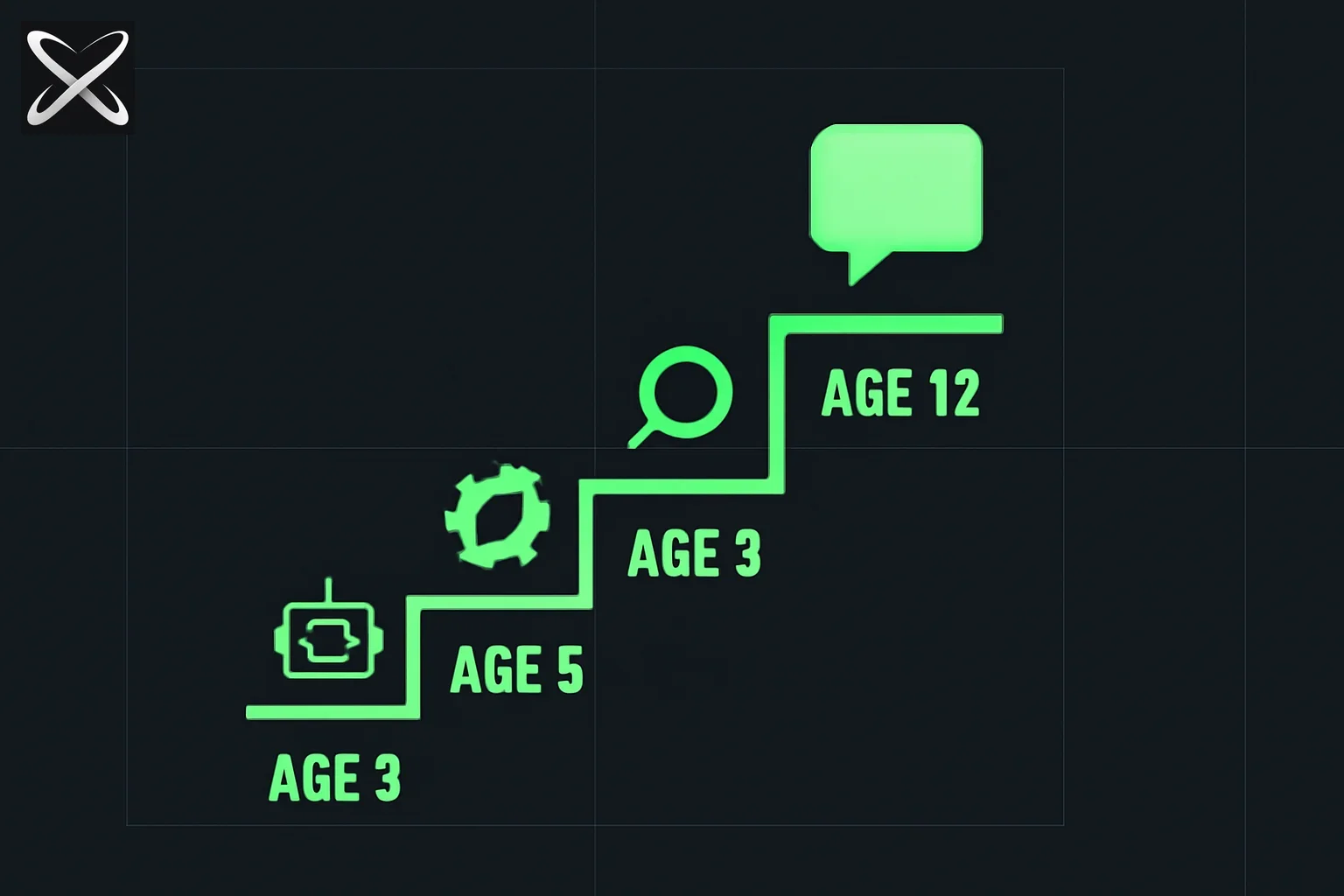 Teaching kids AI literacy diagram: an ascending staircase of age-graded steps, each with its own AI-literacy icon, a chat bubble only appearing on the top step
| Question | Short Answer |
|---|---|
| Teach about AI? | Yes, starting age 5+ with simple concepts |
| Give them ChatGPT? | Not before 13; supervised 13–17; never unsupervised for homework |
| Replace school with AI tutors? | No—use AI to explain, not to complete |
| Best free resource | MIT Day of AI |
| Key lesson | AI is made by people, often wrong, and doesn't know what it doesn't know |
| Full K–5 curriculum | AI Curriculum for Kids guide |
Why This Matters Now (Not "Someday")
Three forces converged in 2025–2026:
-
Ubiquity: Voice assistants, TikTok recommendations, AI homework helpers, and photo filters mean your child already interacts with AI daily—whether you've discussed it or not.
-
Policy momentum: California's 2025 TK–12 AI guidance, Malta's national AI literacy program (free ChatGPT Plus after completing a course), and dozens of state task forces treat AI literacy as a graduation expectation—not a elective novelty.
-
The homework crisis: Teachers report students submitting ChatGPT output verbatim. Kids who never learned to verify AI answers arrive in college unable to distinguish confident hallucinations from facts.
Malta's approach—AI literacy first, tool access second—is the right sequence. Literacy before keys.
Teach About AI vs. Give Access to ChatGPT
| Teach About AI | Give ChatGPT Access | |
|---|---|---|
| Goal | Critical understanding | Task completion |
| Age start | 5+ (concepts) | 13+ (account); supervised earlier if at all |
| Parent involvement | Active teaching | Active supervision required |
| Risk if skipped | Passive consumption, no judgment | Dependence, plagiarism, privacy leaks |
| Tools | Unplugged games, Teachable Machine, Day of AI | ChatGPT, Claude, Gemini (supervised) |
Teaching about AI means your child knows:
- AI is software built by people using data
- It predicts patterns—it doesn't "know" things
- It can sound confident while being completely wrong
- Sharing photos, voice, and personal details has consequences
Giving ChatGPT access without that foundation produces a child who treats the chatbot as an oracle.
What to Teach by Age
Ages 5–7: Awareness (No Chatbots)
Goal: Name what AI is. Build curiosity, not fear or worship.
| Activity | Time | What They Learn |
|---|---|---|
| "AI or not?" sorting game | 20 min | Calculator ≠ AI; voice assistant = AI |
| Quick Draw! | 15 min | Computers guess from patterns |
| "Can the computer be wrong?" discussion | 10 min | AI makes mistakes; ask a grown-up |
| Privacy: "Would you tell a stranger?" | 10 min | Apps collect photos and voice |
ChatGPT: Not appropriate. Use no tools that require accounts or collect child data.
Deep dive: AI Curriculum for Kids (K–5)
Ages 8–12: Hands-On + Critical Thinking (Still No Solo ChatGPT)
Goal: Understand training data, bias, and verification.
| Activity | Time | What They Learn |
|---|---|---|
| Train Teachable Machine on toys | 45 min | AI learns from examples you provide |
| Bias experiment: train on 3 faces, test on others | 30 min | Skewed data → unfair results |
| Day of AI "Truth, Tricks, and AI" unit | 1 hour | Verify information; spot manipulation |
| Write a "robot rules" list together | 20 min | When AI should/shouldn't decide |
ChatGPT: OpenAI's minimum age is 13. For mature 11–12 year olds, parent-supervised sessions only—you type together, you discuss outputs, you catch errors together. Never for homework submission.
Deep dive: Middle School AI Curriculum
Ages 13–17: Supervised Tool Use + Ethics
Goal: Productive AI collaboration with clear boundaries.
ChatGPT is permitted (with parental consent per OpenAI terms), but with structure:
| Allowed | Not Allowed |
|---|---|
| "Explain photosynthesis step by step" | Submit AI essay as own work |
| Brainstorm essay topics | Copy-paste AI paragraphs into assignments |
| Debug code with explanation | Let AI complete entire projects undisclosed |
| Practice language conversation | Share personal photos, addresses, school records |
| Compare AI vs. textbook answers | Trust AI for medical/legal/safety decisions |
Introduce the family AI agreement (template below).
Deep dive: High School AI Curriculum
The Family AI Agreement (Co-Author With Your Child)
Print this. Edit together. Sign it. Revisit monthly.
## Our Family AI Rules

1. **Disclose:** If I used AI on homework, I note where and how.
2. **Verify:** I check AI facts against textbooks, teachers, or primary sources.
3. **Create:** AI helps me think; I write the final work in my own words.
4. **Privacy:** I never share my full name, address, school, photos, or
   passwords with AI tools.
5. **Ask:** If unsure whether AI use is okay, I ask a parent or teacher first.
6. **Time:** AI sessions follow our screen-time rules. No AI after [time].
7. **Honesty:** AI being wrong is normal. Admitting I don't know is better
   than submitting a confident lie.
This works better than prohibition because your child will access AI anyway—at a friend's house, on a school Chromebook, at 11 PM on their phone. Rules they helped write stick better than lectures.
ChatGPT-Specific Safety Notes
Age and Account Requirements
- OpenAI Terms: Users must be 13+ to create a ChatGPT account
- 13–17: Parental consent required; use OpenAI's parental controls to manage features
- Under 13: Do not create accounts. COPPA (U.S. Children's Online Privacy Protection Act) restricts data collection from children under 13—general-purpose AI chatbots were not designed for this age group
What Can Go Wrong (Real Scenarios)
| Risk | Example | Prevention |
|---|---|---|
| Hallucination | AI invents a historical date; child cites it in report | Verify all facts; teach "AI doesn't know, it guesses" |
| Over-reliance | Child stops reading books because "ChatGPT summarizes" | Require source reading; AI explains, doesn't replace |
| Privacy leak | Child uploads school ID photo for "help with math" | Never share photos/documents with personal info |
| Plagiarism | Teacher detects AI voice in essay | Disclose AI use; edit heavily; focus on learning process |
| Emotional dependency | Child treats chatbot as friend/therapist | AI is not a counselor; talk to parents or professionals |
| Inappropriate content | Jailbroken or unfiltered outputs | Supervised use; parental controls; report issues |
Our guide on why AI models hallucinate is useful background for older teens—and for you.
What Schools Expect (And How to Align)
Many schools issued AI policies in 2025–2026. Common patterns:
- Disclosure required — Note when AI assisted work
- Process over product — Teachers grade thinking, not just output
- Banned for assessments — Tests and in-class writing often prohibit AI
- Encouraged for exploration — Research, brainstorming, coding help often permitted
Ask your child's teacher: "What's your AI policy?" before assuming home rules match school rules. Misalignment causes unnecessary conflict.
If your school has no policy yet, you're not alone—only ~12% of U.S. schools offer formal AI instruction. Home literacy fills the gap.
Free Resources for Parents (No CS Degree Required)
| Resource | Ages | Parent Effort | Link |
|---|---|---|---|
| MIT Day of AI | K–12 | Low—slides + guides included | dayofai.org |
| Code.org AI modules | 3–12 | Low—self-paced lessons | code.org/ai |
| Teachable Machine | 8+ | Medium—do it together first | teachablemachine.withgoogle.com |
| AI4K12 grade charts | K–12 | Reference only | ai4k12.org |
| Common Sense Media AI hub | All | Articles for parents | commonsensemedia.org |
One afternoon starter: Complete MIT Day of AI's 60-minute "Demystifying AI" workshop (free, online), then do one Teachable Machine project with your child. That single session covers 80% of what elementary-age kids need.
"But My Child Needs to Learn AI for Their Career"
Valid concern—but career readiness ≠ ChatGPT proficiency.
The skills that matter for an AI-shaped economy:
| Skill | How to Build at Home | ChatGPT Role |
|---|---|---|
| Critical evaluation | Fact-check AI answers together | Practice target, not authority |
| Problem decomposition | Break chores/homework into steps before asking AI | AI checks plan, doesn't replace thinking |
| Programming basics | Scratch (8+), Python (13+) | AI explains code; child writes it |
| Ethical reasoning | Discuss news about AI bias, deepfakes | Case study material |
| Communication | Present a "how AI works" talk to family | Research assistant only |
For teens serious about AI careers, see our High School and College curriculum guides—and eventually AI bootcamps for practitioner depth.
What About Other AI Tools?
| Tool | Ages | Parent Guidance |
|---|---|---|
| ChatGPT | 13+ | Supervised; parental controls; no homework substitution |
| Claude | 13+ (Anthropic terms) | Same rules as ChatGPT |
| Gemini | 13+ (Google terms) | Same rules; integrated in Google Workspace for schools |
| Character.AI / companion bots | Avoid under 16 | Emotional manipulation risk; not educational |
| AI image generators | 13+ supervised | Copyright, deepfake ethics, no photos of real people without consent |
| AI homework apps (Photomath, etc.) | Varies | Show work requirement; explain steps, don't just copy answers |
| Voice assistants (Alexa/Siri) | All ages | Fine for weather/music; discuss what's recorded |
Red Flags: When to Restrict Access
Pull back or pause AI tool access if you notice:
- Submitting AI work without disclosure despite agreement
- Declining grades alongside increased AI use
- Anxiety when AI is unavailable ("I can't do this without ChatGPT")
- Sharing personal information in prompts
- Believing AI outputs over teachers, textbooks, or parents
- Using AI for friendship or emotional support exclusively
These aren't moral failures—they're signals the literacy layer is missing. Return to concepts before restoring tool access.
The Bottom Line
| Do | Don't |
|---|---|
| Teach what AI is and how it fails | Assume school will handle it |
| Start concepts at age 5+ | Give ChatGPT to a 9-year-old |
| Co-author family AI rules | Prohibit AI entirely ( they'll use it anyway) |
| Supervise teens 13–17 | Trust AI for homework without verification |
| Use free MIT/Code.org curriculum | Replace reading and struggle with AI shortcuts |
| Model good AI use yourself | Use ChatGPT in front of kids without explaining |
Teaching your child about AI is one of the most useful things you can do in 2026. Letting them use ChatGPT without that foundation is one of the easiest ways to undermine the learning it's supposed to support.
Start with literacy. Add tools slowly. Verify everything.
Related Reading
- Character.AI files for Chapter 11 as Disney bids $20 million
- AI Curriculum for Kids (K–5): Complete Guide
- AI Curriculum for Middle School (Grades 6–8)
- AI Curriculum for High School Students
- Why AI Models Hallucinate
- OpenAI Malta: AI Literacy Before ChatGPT Access
- France and UK social media bans for under-15s/16s: what changes
Platform age requirements and parental control features verified against OpenAI and platform documentation as of June 2026. School policies vary by district—confirm with your child's teacher.