




Super Micro Computer told investors on October 20, 2026 that its fiscal first quarter, which ended September 30, brought in an estimated $18.5 billion to $19.5 billion in revenue. Its own guidance for the quarter had been $14.5 billion to $15.5 billion, so the new range sits roughly $4 billion higher. The company's filing credits "increased demand for AI platforms."
The headline circulating on social media says "$19.5B", which is only the top of the range. This post walks through what the 8-K actually says, what it leaves out, and why an AI server builder's numbers matter to anyone who builds on GPUs. Coverage from Investing.com and KSL, carrying Reuters matches the filing.
Update (November 3, 2026): Super Micro reports Q1 results, above its own range
Super Micro published its first quarter fiscal 2027 results (Business Wire release, unaudited) after the market closed on November 3. Net sales were $19,945,832 thousand, or $19.9 billion. That is above the top of the $18.5 billion to $19.5 billion range in the October 20 filing. That is roughly 298% growth against $5.0 billion a year earlier. The prior quarter was $11.1 billion.
The company's own table shows the following:
| Item | Q1 FY2027 | Q4 FY2026 | Q1 FY2026 |
|---|---|---|---|
| Net sales | $19.9B | $11.1B | $5.0B |
| GAAP gross margin | 12.7% | 17.5% | 9.3% |
| Net income | $1,594M | $1,178M | $168M |
| GAAP diluted EPS | $1.75 | $1.62 | $0.26 |
| Non-GAAP diluted EPS | $1.81 | not stated in the release | $0.35 |
Three details matter for the questions this post raised earlier:
- Margin. The gross margin of 12.7% is above the 12.0% to 12.5% preliminary range, but well below the 17.5% of the previous quarter. Volume grew faster than profit per server.
- Cash. Operating cash flow was negative $434 million. Accounts receivable rose from $6.1 billion to $9.7 billion, inventory from $12.9 billion to $15.1 billion, and total deferred revenue from $2.6 billion to $5.7 billion. Cash was $6.9 billion against $8.6 billion of bank debt and convertible notes, as the release states.
- Outlook. The company guides Q2 net sales to $19.5 billion to $21.5 billion, GAAP EPS of $1.59 to $1.83, and fiscal 2027 net sales of $72.0 billion to $82.0 billion. Our October 20 post could not see these numbers.
The release repeats that the figures are preliminary because the financial close is not complete, so they can still change. Charles Liang, the CEO, calls it "record revenue" and points to enterprise partnerships and expanding global production capacity. We have not heard the earnings call, so treat comments made there as unconfirmed until a transcript is available.
Super Micro's preliminary Q1 FY2027 numbers
| Item | New estimate | Prior guidance |
|---|---|---|
| Revenue | $18.5B to $19.5B | $14.5B to $15.5B |
| Gross margin | 12.0% to 12.5% | 10.4% to 10.8% |
| EPS | Not given | Not applicable |
| Earnings call | November 3, 2026, 5:00 p.m. ET | n/a |
The company says the numbers are unaudited, preliminary, based on management estimates, and not reviewed by its independent auditor. It warns that actual results "may differ materially."
What the filing does not say
The release is short, and the omissions are informative.
- No customer names. AI server revenue at this scale usually comes from a handful of buyers. The filing flags greater customer concentration as a risk but does not identify anyone.
- No product breakdown. Blackwell is not mentioned. "AI platforms" is the only driver named.
- No executive quote and no EPS. Profit per share is left for November 3.
- No explanation of margin beyond "customer and product mix." A margin that rises while revenue jumps by roughly a quarter against guidance is unusual for a system integrator, so the mix explanation will be the first question on the call.
Analysts had expected far less. Reuters puts the LSEG average at about $15.23 billion, while Investing.com cites about $14.99 billion. Either way the range clears expectations by roughly $3.3 billion to $4.5 billion. Shares rose after hours, with reports of gains around 10% to 12%.
Why AI hardware builders keep raising numbers
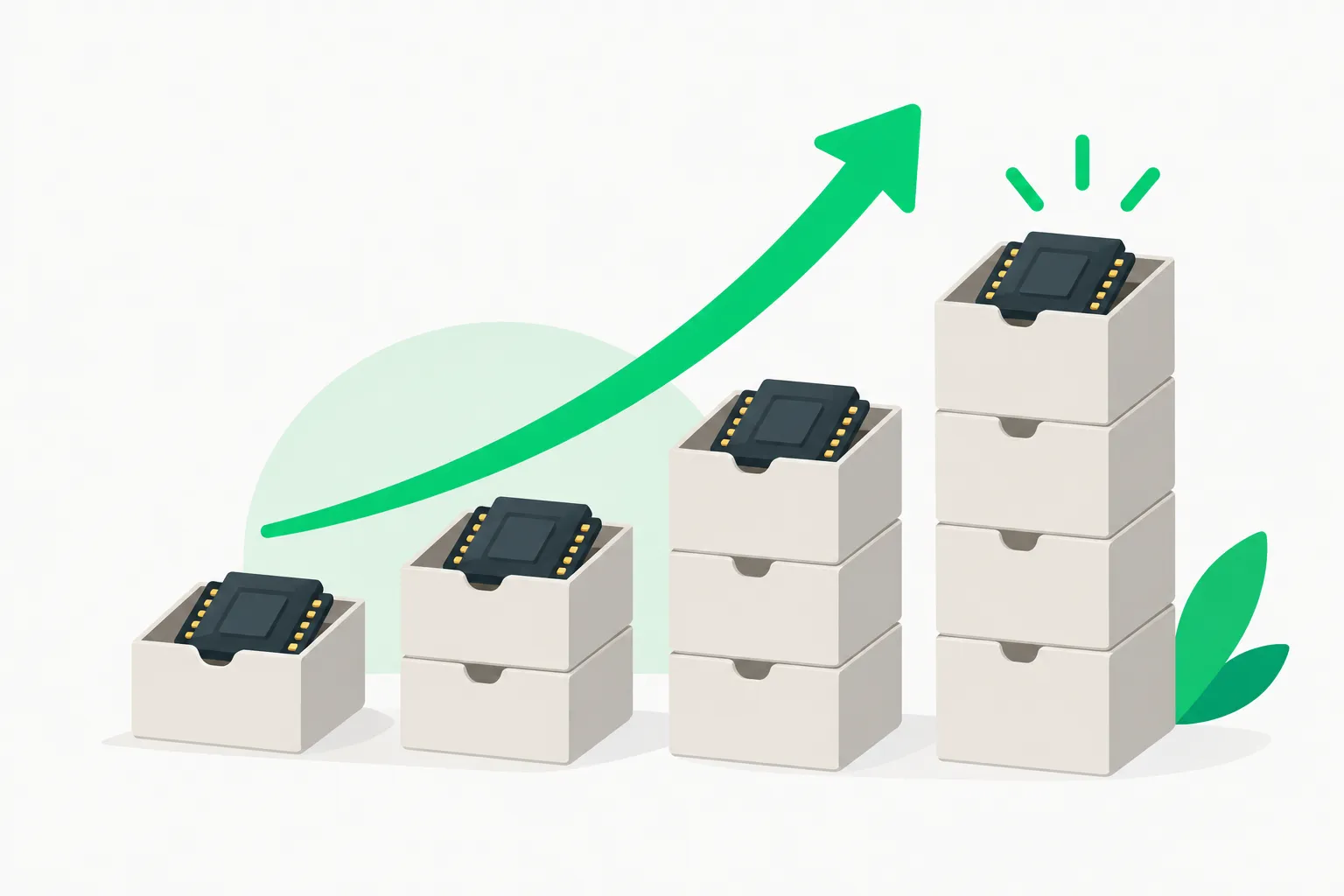 Rising stack of boxed chips illustrating Super Micro Q1 FY2027 AI server revenue above guidance
Super Micro does not make the chips. It builds servers and racks around GPUs from NVIDIA and others, so its revenue is a read on how many accelerators are actually leaving factories as complete systems. That makes it a useful cross-check for other supply-chain data points from this month:
- TSMC reported record Q3 profit, with AI demand as the driver.
- ASML said AI demand exceeds EUV supply into 2027 and 2028.
- SpaceX's Q3 results showed about $16.4 billion of quarterly AI capex, the kind of buyer that feeds integrators.
- Michael Dell argued the memory shortage is a four-year problem that gets worse in 2027, a constraint that can cap how many servers ship.
Read together, the wafer makers, the toolmakers, the buyers and now an integrator are all reporting demand above plan. What differs is the part of the chain each can see. TSMC sees chips, ASML sees fab tools, SpaceX sees its own build-out, and Super Micro sees finished systems going to customers.
How an AI server integrator makes money
A low gross margin is normal for this business, and it helps to see why. When Super Micro sells a rack of GPU servers, most of the invoice is the cost of the accelerators, memory and networking inside it. Super Micro adds design, assembly, validation and speed to market, and keeps a thin slice. A gross margin of 12.0% to 12.5% therefore means that out of every $100 of systems sold, roughly $12 remains after the cost of parts and manufacturing, before operating expenses.
This is also why the margin guidance moved by only about 1.6 to 1.7 points while revenue jumped. On $19 billion of revenue, each point of gross margin is about $190 million of gross profit. Moving from the guided 10.6% midpoint to roughly 12.25% adds on the order of $310 million of gross profit on top of the extra revenue. That is simple arithmetic on the company's ranges, not a company-reported figure, and it shows why the market treats the margin line as nearly as important as the revenue line.
Why companies pre-announce a quarter
A preliminary update before the formal earnings release is the company telling the market that the quarter landed well outside its own guidance. Companies generally prefer to disclose a large positive or negative gap early rather than let it surface on the call. The filing's careful language, estimates, unaudited, subject to the financial close, is standard for this kind of notice. It does not mean the number is soft; it means the books are not closed and the auditor has not signed off.
For readers, the useful framing is range arithmetic. The table below applies the company's own range to the gap against its prior guidance. These are our calculations from the filing, not company statements.
| Scenario | Revenue | Gap vs. guidance midpoint ($15.0B) |
|---|---|---|
| Low end | $18.5B | About +$3.5B (+23%) |
| Midpoint | $19.0B | About +$4.0B (+27%) |
| High end | $19.5B | About +$4.5B (+30%) |
Even the low end is a beat of more than a fifth against the company's own guide, which is why the stock reacted the way it did.
What to compare against when full results arrive
Three comparisons will tell you more than the headline once the 10-Q is out.
- Quarter over quarter. The company's prior-quarter results (fiscal Q4 2026, ended June 30) are the baseline for how much of this is sequential growth versus lumpy delivery timing.
- Customer concentration. The filing says the company is targeting larger customers and flags concentration as a risk. The percentage of revenue from top customers in the 10-Q is the number to find.
- Deferred revenue and backlog. If the quarter pulled forward deliveries, backlog and deferred revenue will show it. A strong backlog supports the idea that demand is durable; a thin one suggests a one-off.
None of these are in the preliminary release, so any commentary that explains the jump in detail before November 3 is speculation. We are labelling our own inferences as inferences and leaving the rest to the company.
The risks Super Micro lists itself
The release points to the fiscal 2026 Form 10-K for risk factors and calls out quarterly fluctuations, customer concentration as it targets larger customers, possible declines in average selling prices, and adverse economic conditions such as tariffs. Two of those deserve attention.
Concentration. If a few hyperscalers or neoclouds account for most of the quarter, the number is lumpy. It can overshoot and then undershoot. Our coverage of Gartner's neocloud shakeout warning is a reminder that some of the buyers in this market are financed on tight terms.
Compliance history. Super Micro's name has also been in the news for the wrong reasons: a contractor pleaded guilty in a case about smuggling NVIDIA-powered AI servers. Export-control tightening, including Taiwan's move to criminalize AI chip and server exports to China, raises the cost of mistakes for anyone shipping racks across borders. Nothing in the preliminary release connects that matter to the quarter, and we are not suggesting a link.
What this means for people who build or pay for AI
 Supply and demand curves crossing, showing what Super Micro AI server demand means for GPU capacity
- GPU rental prices. More finished servers in the channel eventually means more rentable capacity. But a $4 billion upside surprise in one quarter does not mean cheaper GPUs next month. Lead times and memory supply still gate deployment.
- Local AI buyers. Server demand and memory demand compete for the same parts. See how this showed up in consumer boxes in our DGX Spark memory cut post.
- Anyone modeling AI costs. Use the range, not the headline top end. A cautious model would use the $19 billion midpoint and wait for audited figures.
How to check this yourself
- Open the October 20 8-K on SEC EDGAR for Super Micro Computer and read the "preliminary" language and the risk list.
- On November 3, compare final revenue with the range. A result at the bottom ($18.5 billion) reads differently from the top ($19.5 billion).
- Read the customer concentration disclosure in the 10-Q for the quarter, which usually names the percentage of revenue from the largest customers.
- Compare gross margin with the 12.0% to 12.5% estimate. A big miss would suggest the mix explanation was incomplete.
What we do not know yet
- Which customers drove the increase, and how much was cloud providers versus enterprises.
- How much of the jump was pulled forward from the next quarter.
- Whether the margin level continues, or reflects a few large one-time system sales.
- What the company will guide for fiscal Q2.
We will update this post after the November 3 call.
Related reading
- TSMC Q3 2026 results
- ASML Q3: AI demand exceeds EUV supply
- SpaceX Q3 2026 earnings
- Michael Dell on the memory shortage
- Super Micro contractor guilty plea
- Gartner neocloud shakeout
Figures are Super Micro's unaudited preliminary estimates as of October 20, 2026. This is not investment advice.