



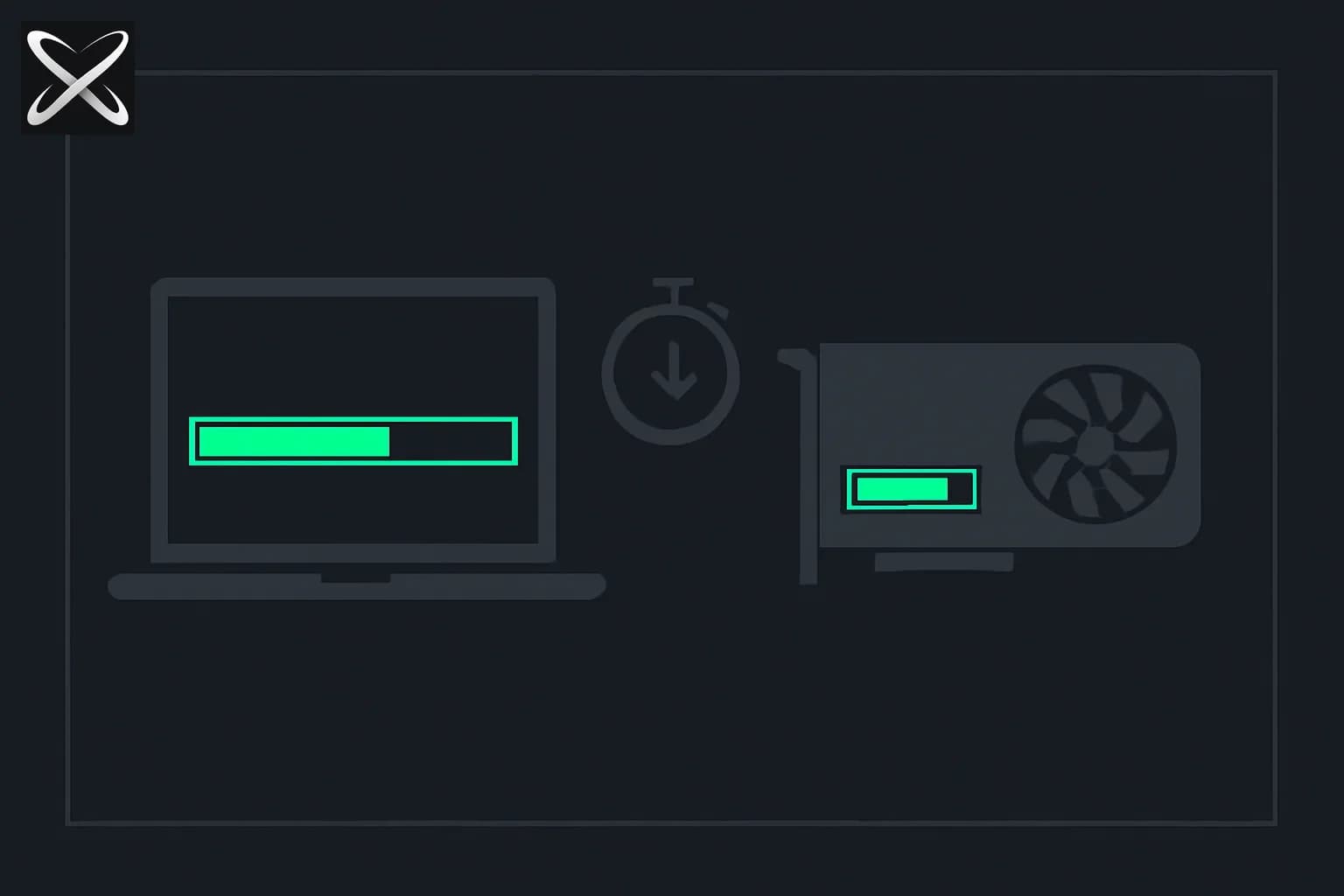
Feed digests on October 2–3, 2026 framed the story as "Nvidia Halves DGX Spark Memory in $4,999 Oct 23 Launch." That line is half right and half wrong. NVIDIA did announce a $4,999 starting price and an October 23 ship date — but it did not cut the existing 128GB machine down to 64GB. The official NVIDIA blog (Allen Bourgoyne, October 2, 2026) and the DGX Spark product page describe a new OEM-only 64GB unified-memory SKU beside the 128GB configuration.
For builders, the useful question is not "did they shrink my box?" It is: what RAM do you actually get for ~$5K, which models still fit, and does October 23 change the June DGX Spark local LLM guide?
 A small house-shaped box with a glowing green core.
TL;DR — verified facts vs the feed headline
| Question | Verified answer (as of Oct 3, 2026) |
|---|---|
| What shipped in the announcement? | A new 64GB DGX Spark / GB10 configuration — not a silent cut of the 128GB SKU. |
| Memory you buy at the headline price | 64GB coherent unified LPDDR5X (CPU+GPU same pool). |
| Price | Starting at $4,999 (OEM partners). |
| Date | Friday, October 23, 2026. |
| Who sells the 64GB SKU? | Acer, ASUS, Dell, Gigabyte, HP, MSI — OEM exclusive; not framed as NVIDIA.com Founders stock. |
| Same chip / software? | Same GB10 Grace Blackwell, DGX OS, CUDA stack, ConnectX-7. |
| NVIDIA's solo model claim | Up to ~100B parameters on 64GB; ~200B on 128GB. |
| Cluster path | Two 64GB units + ConnectX-7 + NVIDIA Sync Cluster Assistant → pooled 128GB / ~200B; NVIDIA cites up to 1.7x vs one unit on Qwen 3.8 27B. |
| Did they "halve" the product line? | No — they added a half-memory SKU. Correct the aggregator headline. |
What NVIDIA actually announced
NVIDIA's post is titled "NVIDIA DGX Spark 64GB Gives Developers More Ways to Build and Scale Local AI." The substance:
- 64GB unified memory configuration from manufacturer partners.
- Same GB10 Superchip, DGX OS, and NVIDIA AI software stack as the 128GB model.
- Positioned for on-device agents and models up to ~100B parameters.
- NVIDIA Sync Cluster Assistant to pair two boxes over the built-in ConnectX-7 (200 Gbps class fabric in NVIDIA's Spark docs) without a separate "cluster science project."
- Availability Friday, Oct. 23, starting at $4,999.
The product page now lists system memory as "64 GB LPDDR5X* or 128 GB LPDDR5x" with an explicit footnote that the 64GB option is only through participating OEM partners. Bandwidth stays listed at 273 GB/s for the platform — the cut is capacity, not a different memory architecture.
That is a SKU ladder, not a recall. If you already own or ordered a 128GB Spark, nothing in the October 2 post says your machine loses RAM.
Correcting the inflated headline
Aggregator phrasing ("halves memory") is the kind of rewrite that ranks because it sounds dramatic. Primary sources do not say the Founders / 128GB SKU was cut in half. They say:
- Memory supply has been painful (NVIDIA already raised Founders MSRP from $3,999 → $4,699 in the February 23, 2026 price-change forum post).
- Open models that matter for agents are often in a smaller memory envelope than "load 200B at once."
- NVIDIA wants an entry OEM price point while keeping the full-memory SKU for heavier local work.
Tom's Hardware and StorageReview coverage (October 2) match the official numbers: 64GB, $4,999 start, Oct 23, OEM list, with clustering as the scale story. Use those figures; discard "NVIDIA gutted the Spark to 64GB for everyone."
What $4,999 actually buys (builder math)
Treat $4,999 as an OEM starting MSRP, not a guarantee that every Acer/ASUS/Dell/Gigabyte/HP/MSI SKU lands at that number with the same SSD size.
| Spec that matters for LLMs | 64GB OEM Spark | 128GB Spark (existing) |
|---|---|---|
| Unified memory | 64GB | 128GB |
| NVIDIA parameter marketing | Up to ~100B | Up to ~200B |
| Chip | GB10 Grace Blackwell | Same |
| Tensor performance (NVIDIA) | Up to 1 PFLOP FP4 class | Same class |
| Memory bandwidth (listed) | 273 GB/s | 273 GB/s |
| Networking | ConnectX-7 | ConnectX-7 |
| NVIDIA list / starting price | $4,999 OEM start (Oct 23) | Marketplace still shows ~$4,699 Founders-style; street often higher |
| Best mental model | Agent / 70B–100B local box | Single-box 120B–200B class |
Rough weight math (4-bit class, order-of-magnitude — not a guarantee of usable context):
| Model class | Approx. weights | Fits 64GB solo? | Fits 128GB solo? |
|---|---|---|---|
| 27B–32B dense (e.g. Qwen 3.8 27B class) | ~15–20GB | Yes, generous headroom | Yes |
| 70B–72B 4-bit | ~35–40GB | Yes, with KV/context budget | Yes |
| ~100B 4-bit | ~50–55GB | Tight but in NVIDIA's solo claim | Comfortable |
| ~120B 4-bit | ~60–70GB | Usually no for full load | Yes (June guide territory) |
| ~200B aggressively quantized | approaches 100GB+ | No solo | Borderline / yes depending on quant |
So the $4,999 box is not the same purchase as the machine we described in June as a 200B-class desktop. It is a 100B-class desktop with a documented two-box path back to 128GB pooled memory.
If you mainly run 27B–70B coding / agent models — the same class that showed up in Perplexity's portable Computer on DGX Spark demos and in Qwen 3.8 27B Spark benchmarks — 64GB is often enough. If your plan was "one box, 120B+, fat context, fine-tune headroom," keep shopping the 128GB SKU or budget two 64GB units (~$10K before interconnect and tax).
How this changes prior DGX Spark advice
The June 2026 DGX Spark buyer's guide still stands for the 128GB story: unified memory, CUDA, Ollama / vLLM / llama.cpp, privacy vs cloud API burn. What October 3 changes:
- Entry SKU exists. Shoppers who bounced off 128GB street pricing get an OEM ladder on Oct 23.
- "~$4,679 for 200B" is no longer the only number. $4,999 for 64GB / ~100B is a different deal — sometimes worse value per GB if Founders 128GB is actually available near MSRP, sometimes better if 128GB street is $7K–$9K as secondary coverage has claimed.
- Cluster-first marketing. NVIDIA is leaning hard on Sync Cluster Assistant so two cheap(er) boxes become the path to 128GB — useful if you like modular buy-in, expensive if you only ever needed one full-memory unit.
- Software playbooks. NVIDIA points at upcoming 64GB playbooks (vLLM serve, OpenClaw local, multi-Spark) on build.nvidia.com — same ecosystem as Nemotron 3.5 Lightning's DGX Spark recipe.
- Home mesh still matters. NVIDIA PAIR still pools a Spark with other RTX machines on the LAN — complementary to Sync clustering, not a substitute for unified memory on one node.
Decision table (October 2026)
| Your workload | Prefer |
|---|---|
| Always-on coding / research agent on 27B–70B open weights | 64GB OEM on Oct 23 is enough for many builders |
| Single-box 120B-class chat / heavy context | 128GB Spark (or wait for stock) |
| Want 200B-class later but cash-constrained now | Start 64GB, plan second unit + Sync (accept ~2× hardware cost) |
| Laptop-first, travel, MLX workflows | Still Mac vs dedicated GPU territory — Spark is a desk appliance |
| DIY personal AI stack without NVIDIA enclosure | Build a personal local AI system — Spark is optional hardware |
| Extreme Mac / Strix Halo quants this week | Also track DwarfStar ds4 local inference — different stack, same "does my RAM fit?" question |
What people are asking
Is $4,999 "cheap" for a Spark?
Relative to a full workstation with discrete pro GPUs, NVIDIA still pitches Spark as accessible. Relative to the February MSRP of $4,699 for 128GB Founders, a $4,999 64GB OEM SKU is not automatically the bargain — capacity per dollar can be worse if you can still buy 128GB near list. The bargain case only holds when 128GB street price is inflated or unavailable. Always compare live quotes the week of October 23.
Will Perplexity-style local Computer demos run on 64GB?
Perplexity's August demo used DGX Spark for orchestrator + subagent + harness with PPLX 27B / Qwen 3.8 27B-class local models — well inside a 64GB envelope if you are not also stuffing a 120B primary. Multi-agent stacks with several large models resident at once still want 128GB or a cluster. See the portable Computer DGX Spark write-up for the product framing; treat RAM as the binding constraint, not the brand name on the chassis.
Does clustering two 64GB units match one 128GB?
NVIDIA's claim: pooled 128GB, up to ~200B, up to 1.7x on a Qwen 3.8 27B clustered test vs one system, plus 2× memory bandwidth marketing language when two nodes contribute. Reality checks for builders:
- You pay for two systems, power, and a QSFP path between ConnectX-7 ports.
- Latency and scheduling differ from a single coherent 128GB node — fine for many inference/agent patterns, riskier if you assumed "exactly one NUMA-free pool."
- Sync Cluster Assistant reduces ops toil; it does not erase physics.
Same 273 GB/s — why does capacity still dominate?
LLM decode is memory-bandwidth bound and capacity bound. Bandwidth sets tokens/sec once weights are resident; capacity decides whether the weights (plus KV cache) fit at all. Halving capacity drops you out of entire model tiers even if bandwidth is unchanged. That is why the SKU split matters more than another TFLOPS slide.
OEM vs Founders — software parity?
NVIDIA says the 64GB OEM config keeps DGX OS and the full NVIDIA AI software stack. Expect partner differences in storage SKUs, warranty, bundle pricing, and ship dates, not a different CUDA story. Still verify the specific OEM listing for NVMe size (product page lists up to 4TB NVMe class storage on the platform).
Practical setup on day one (Oct 23)
NVIDIA's own getting-started list is short and correct:
- Pick an inference runtime you already know — Ollama, vLLM, llama.cpp, or LM Studio.
- Download a model that fits 64GB with context — start with a 27B–70B 4-bit before you try to prove the 100B marketing line.
- For two-node scale-out: ConnectX-7 cable, launch NVIDIA Sync Cluster Assistant, let it validate and configure the fabric.
- End of month: watch for NVIDIA Sync Model Launcher (NVIDIA says it will one-click Qwen3.8 27B across a single Spark or a cluster and can wire OpenCode).
If your goal is a durable local workflow — not just a hardware unboxing — pair the machine with habits from build a personal AI system and keep cloud APIs as overflow, not the default.
Honest limitations
- $4,999 is not $2,499. Memory scarcity did not produce a hobbyist price; it produced a smaller SKU at a still-premium number.
- 100B marketing ≠ comfortable 100B with long context and tools. Leave headroom for KV cache, embeddings, and the agent runtime.
- Two×64GB ≠ one×128GB for every workload. Clustering helps; it is not free coherence.
- Availability will be OEM-gated. "Starting at" means hunt partner storefronts on Oct 23, not assume NVIDIA.com cart parity.
- Open weights ≠ frontier closed models. Local Spark still does not run Claude/GPT weights; it runs open stacks you host yourself.
Related on explainx.ai
-
NVIDIA Flare: Rust local inference server for SM120/SM121 and DGX Spark
-
NVIDIA DGX Spark: best local LLM setup (June guide — now bannered)
Official: NVIDIA blog — DGX Spark 64GB · DGX Spark product page · Feb 2026 Founders MSRP change (forums)
Specs, prices, and dates reflect NVIDIA's October 2, 2026 announcement and product page as checked on October 3, 2026. OEM street pricing, SSD configs, and stock will move — verify partner listings before purchase. The feed claim that NVIDIA "halved" DGX Spark memory describes a new 64GB SKU, not removal of the 128GB configuration.
Update — October 5, 2026: Related hardware launch — Ghost Core, a $3,499 on-device personal AI computer.
Update — October 22, 2026: NVIDIA announced official eight-node DGX Spark clusters with 1 TB of memory.
Update — October 9, 2026: New coverage — Gigabyte W775 GB300 deskside workstation, the high end above DGX Spark.