



Sakana AI opened the Applied Research Lab on November 21, 2026, a group inside the company that applies its agent and evolutionary research to large real-world systems. The announcement names Computational Finance and Economics (COFE) as the first program, with more domains to follow. The framing is explicit: one LLM agent cannot resolve a market or economy; you need models of units, links, and feedback loops, with humans still choosing the questions that matter.
That is a different bet from the Security Research Group Sakana launched on November 20, which targets cyber defense. Both labs sit on the same research stack (evolutionary search, multi-agent simulation, evaluation benches), but COFE points at prices, firms, and transactions instead of exploit chains.
TL;DR: what changed on Sakana's site
| Question | Answer |
|---|---|
| What launched? | Sakana AI Applied Research Lab |
| First program? | COFE — finance and economics |
| Core idea? | Human experts pick questions; agents implement and refine models at scale |
| Named prior work? | EDINET-Bench, CoffeeBench, Shachi ABM, ShinkaEvolve, The AI Scientist |
| Where? | Tokyo headquarters |
| How to join? | MTS internship or Visiting Researcher via careers page |
What is the Sakana AI Applied Research Lab?
Sakana's post defines the Lab as a research group that advances understanding of large complex systems and delivers that understanding as value to clients. It is not a single product launch. It is an org chart line that says Sakana will run long-horizon applied programs the way it already runs model research.
The intellectual split Sakana draws is practical for builders:
- Agents are strong at implementing, testing, and refining models quickly.
- Agents are weak at knowing which questions are worth asking in a reflexive system like a market.
- Progress, in Sakana's view, comes from combining human knowledge with agentic execution, not from scaling tokens alone.
That matches Sakana's public ideas-over-compute posture from founding in July 2023, but COFE adds reflexivity as a first-class constraint: markets answer back when you model them.
COFE: finance, economics, and firm-level AI
The Computational Finance and Economics program bridges two traditions Sakana names on the page:
- Finance has focused on asset prices.
- Economics has focused on the larger system under those prices.
Sakana argues AI can connect them at firm and transaction granularity and in near real time, so asset prices become a visible reflection of the economy rather than a separate puzzle. COFE studies both the traded surface and the real economy underneath.
For practitioners, that matters because many agent demos still treat "finance" as summarizing a 10-K paragraph. Sakana's cited benchmarks push toward structured filings, exam-level reasoning, and multi-agent economies:
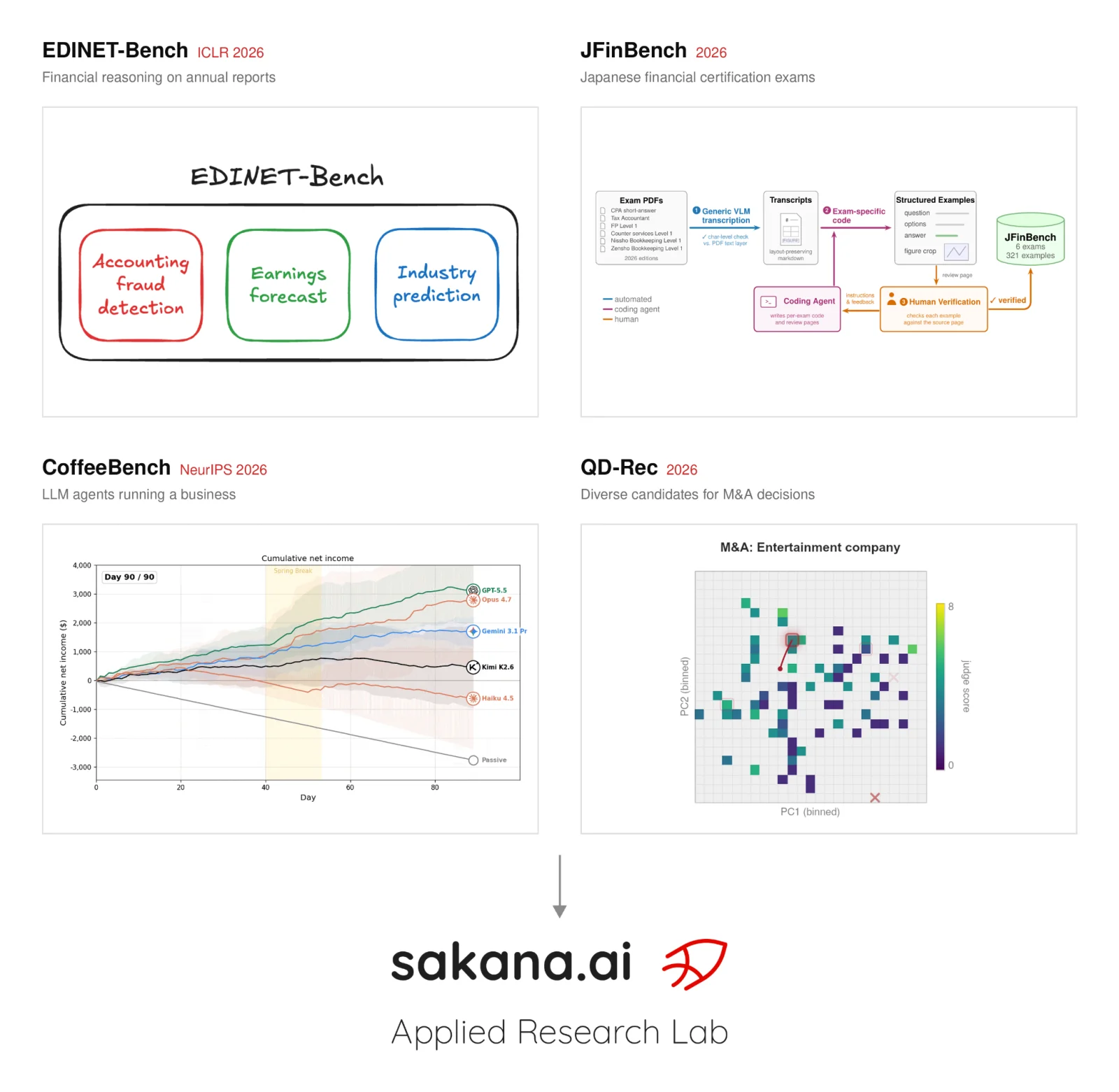
| Benchmark | What Sakana says it measures | Venue cited |
|---|---|---|
| EDINET-Bench | LLM reasoning on 10 years of Japanese corporate annual reports | ICLR 2026 |
| JFinBench | Six 2026 Japanese financial certification exams | Sakana announcement |
| CoffeeBench | Whether LLM agents run a profitable coffee supply chain for 90 days | NeurIPS 2026; with KPMG AZSA |
| QD-Rec | Quality-diversity archives for high-stakes choices like M&A | Sakana announcement |
The EDINET result Sakana highlights is deliberately sobering: on its page, leading LLMs only marginally beat logistic regression on fraud detection and earnings forecasting in a single-turn, non-agentic setup. That is the kind of number that tells you where agent harnesses might help (multi-step tool use, verification loops) versus where tabular baselines still win.
 Sakana Applied Research Lab prior finance benchmarks EDINET-Bench CoffeeBench Shachi
Image: Sakana AI
Our CoffeeBench explainx.ai coverage walks through why Sakana published full action logs for that 90-day sim. The Applied Research Lab announcement treats CoffeeBench as evidence that profitability over time is a harder bar than one-shot QA on filings.
Agent-based modeling: Shachi, CEDAR, and search on code
The Lab says an initial focus is agent-based modeling (ABM), building on prior Sakana work:
- Shachi (ALIFE 2026, per the announcement): LLM agents with modular minds (configuration, memory, tools) to study collective behavior, such as how a market reacts to a tariff shock.
- CEDAR (ALIFE 2026): LLM-guided tree search to discover and refine system structure toward target behaviors.
Those sit beside company-wide tools Sakana names for search over code, including ShinkaEvolve (ICLR 2026) and AB-MCTS (NeurIPS 2025), applied to examples like trading strategies. The through-line is not "chat about markets" but evolve and test executable policies under a harness.
If you build multi-agent simulations, compare this to Fugu multi-agent orchestration and the July Fugu-Cyber benchmarks: same company, different domain harnesses.
How the Lab relates to Sakana's existing products and research
The announcement reads as a capstone on two years of papers, not a pivot:
- The AI Scientist (Nature, March 2026, cited on the page) automated hypothesis-to-paper loops — relevant because COFE will need auditable research artifacts, not only trading signals.
- Automated scientific discovery and evolutionary search remain the engine; COFE is the first named client-facing vertical.
Sakana Chat and Fugu routing are not mentioned on the Applied Research Lab page. Treat product integration as unspecified. For what Sakana ships to developers today, see Sakana Chat with Fugu and Namazu and Fugu Max ultra routing.
 Sakana AI Applied Research Lab Tokyo computational finance economics program
Image: Sakana AI
Reflexivity: why Sakana calls markets a natural testbed
Sakana closes the announcement with reflexivity as a feature of human systems: when you model a market, participants change behavior in response to models, prices, and policies. That is not a footnote. It is why agent-based modeling shows up next to EDINET-Bench on the same page.
For builders, reflexivity implies three engineering constraints COFE is implicitly signing up for:
- Evaluation must be dynamic, not a frozen holdout set, when strategies feed back into the environment.
- Human experts remain in the loop on objective functions, because optimizing the wrong metric in a market sim can look profitable until it meets real counterparties.
- Audit trails matter as much as in CoffeeBench — Sakana already published full action logs there; COFE will need the same standard if clients trust agent recommendations.
Compare that stance to tabular fraud baselines beating LLMs on EDINET: the honest read is not "LLMs are useless for finance," but single-turn QA is the wrong harness for filings that require tool use, reconciliation, and multi-step verification — the same lesson chat-to-ERP agent posts draw for accounting plugins.
What COFE does not claim yet
The announcement is a mission and bibliography, not a results table:
- No live trading performance, Sharpe ratios, or client names for COFE deployments.
- No API or open-source repo tied to the Lab itself (unlike individual papers).
- Finance content can drift into market noise; Sakana here stays on modeling and benchmarks, not stock moves.
explainx.ai does not cover routine funding or share-price stories. This post sticks to what Sakana published about structure, programs, and cited evaluations.
 Sakana Applied Research Lab agent-based finance modeling pairs experts with scalable agent harnesses
Who Sakana wants to hire and partner with
The Tokyo lab is described as a small interdisciplinary team. Sakana names two profiles:
- Researchers from quantitative fields (physics, statistics, math, economics) with Python and real-data research experience. A PhD helps; a narrow specialty is not required.
- Engineers who build data pipelines, simulation infrastructure, and agent orchestration at scale and want those systems tested on hard financial data.
Entry paths are MTS internships and Visiting Researcher roles on the careers page, with a note referencing the Lab. Sakana also invites institutions, investors, policy-makers, and firms with hard problems to contact them — typical language for an applied lab, without pricing on the page.
For how Sakana structures defense advisor hiring elsewhere, see Michael Rogers and Tom Moran advisors. COFE is the civilian complex-systems counterpart.
How COFE fits Japan's data advantage
Several cited benchmarks are Japan-anchored: EDINET annual reports, domestic certification exams, and CoffeeBench with KPMG AZSA. Tokyo as headquarters is not decorative. Sakana can run regulatory-language-heavy evals that US-centric labs rarely reproduce.
If you build multilingual agents, treat COFE as a signal that non-English corporate disclosures are first-class evaluation terrain, not translation side quests. That connects to Sakana's JFinBench certification exams line of work, even though this Lab is vendor research rather than national policy.
What builders should watch next
Short checklist if you care about agentic finance rather than headlines:
- Paper and code drops from COFE that extend EDINET-Bench or CoffeeBench with multi-agent settings — that is where the Lab says single-turn LLMs underperform.
- Shachi-scale releases you can run locally: tariff-shock sims are a template for policy shock testing in other industries.
- Partnership announcements with named institutions; until then, treat COFE as research positioning.
- Separation from Fugu-Cyber: enterprises buying security orchestration should not assume COFE outputs ship inside the same SKU.
If you are choosing models for long-horizon agents, pair this roadmap with loop engineering for coding agents and what agent skills are — COFE will likely need the same harness discipline with different domain tools.
Related on explainx.ai
- Sakana AI Security Research Group (November 2026)
- CoffeeBench: 90-day profitable agent economy
- Fugu multi-agent orchestration
- Fugu-Cyber cybersecurity benchmarks
- Sakana Chat Fugu and Namazu
- Loop engineering with coding agents
- What are agent skills
Specifications and hiring details are accurate as of November 21, 2026 per Sakana's announcement.