



Update — August 6, 2026: Meta shipped the coding-focused successor — Muse Spark 1.2, powering the new Muse Code terminal coding agent, Meta Superintelligence Labs' first dedicated coding agent, in beta.
Update — August 10, 2026: Meta open-weighted Muse Glimmer, a 30B agentic model distilled from Muse Spark, under Apache 2.0 — and said open weights for Muse Spark 1.2 itself are coming "soon."
Update — August 29, 2026: The Meta Model API now serves images too — Muse Image is live at $0.01 per image, on the text-to-image price-to-quality frontier at ~1,280 Arena Elo.
On July 9, 2026, Meta Superintelligence Labs announced Muse Spark 1.1 — a major upgrade to April's Muse Spark reasoning model, plus the first public preview of the Meta Model API for developers.
Same launch day as Ollama's $88M open-models round, GPT-5.6 Sol/Terra/Luna GA, and Grok 4.5 vs Opus — July 9 is stacking frontier releases. Muse Spark 1.1's pitch: one multimodal model that plans, delegates subagents, writes scripts or clicks UIs, debugs with screenshots, and ships through an OpenAI-compatible API.
Charts below are pulled from Meta's announcement page (FB CDN, July 9 fetch) and hosted under /public/blog/muse-spark-1-1/ for stable loading. © Meta; commentary + link to original post.
 Muse Spark 1.1 — Meta evaluation overview chart from July 9 announcement
TL;DR — what people are asking
| Question | Answer (Meta, July 9) |
|---|---|
| What's new vs Muse Spark? | 1.1 — faster multi-agent projects, 1M context compaction, stronger coding/computer use |
| Developer API? | Meta Model API — public preview, OpenAI-compatible per partner quotes |
| Consumer access? | Thinking mode — Meta AI app + meta.ai |
| Agents? | Main agent plans + parallel subagents; zero-shot MCP + custom skills |
| Computer use? | Scripts when faster, clicks when simpler, batch actions per step |
| Coding? | OpenCode demo — screenshots → trace bugs → fix; Meta Internal Coding Bench gains |
| Multimodal? | Smartphone video → Facebook Marketplace listing agent demo |
| Safety? | Advanced AI Scaling Framework — within margins; eval report published |
| Stack context? | Pairs with Muse Image (July 7 media gen) |
Muse Spark 1.1 vs Muse Spark — what changed
| Dimension | Muse Spark (Apr 2026) | Muse Spark 1.1 (Jul 2026) |
|---|---|---|
| Positioning | First MSL reasoning model, Contemplating mode | Agentic foundation — tools, computer, code, multimodal |
| Context | Long-context reasoning | 1M tokens with active compaction |
| Orchestration | Parallel contemplating agents | Main + subagent roles, escalation back to main |
| Tooling | Tool use emphasized | Zero-shot MCP, native tools, custom skills |
| Computer use | Mentioned in roadmap gaps | Script vs click decisioning, multi-app sessions |
| Developer access | meta.ai focus | Meta Model API public preview |
| Media stack | Reasoning only | Integrates Muse Image / Video week |
Meta frames 1.1 as advancing the performance-efficiency frontier — more capability without purely linear latency/token inflation, via orchestration and compaction.
Agents — multi-agent orchestration and 1M context
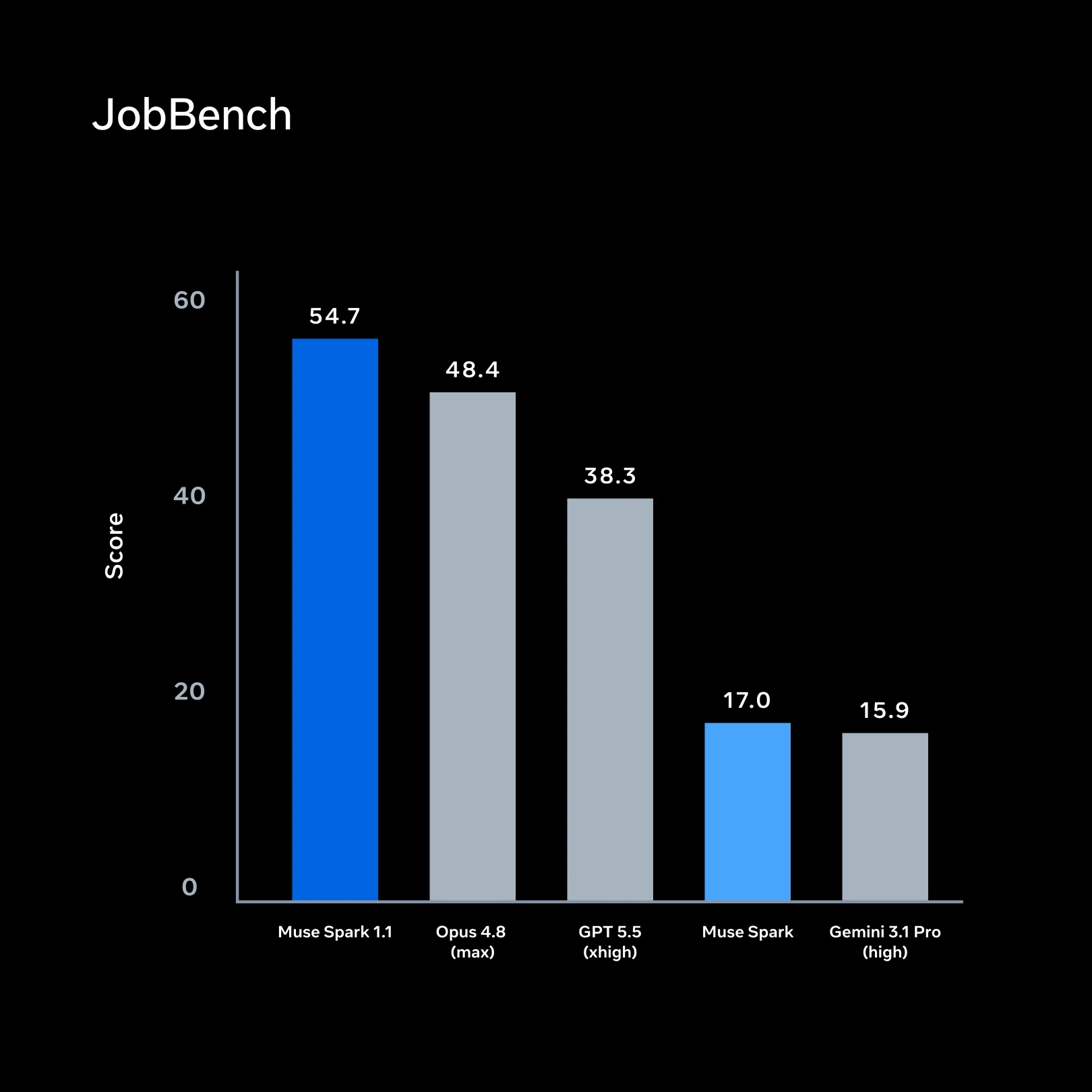 Muse Spark 1.1 arena leaderboard charts from Meta blog
Meta's agent story for 1.1:
- Main agent: gather context → plan → delegate parallel subagents
- Subagent: execute scoped job, know available tools, escalate when stuck
- Zero-shot generalization to new native tools, MCP servers, custom skills
- Faster end-to-end on complex projects vs original Muse Spark (vendor claim)
1 million token context with active compaction — retrieve early work, drop noise, keep critical steps. That directly targets loop engineering and long-horizon agent pain: sessions that used to forget mid-refactor.
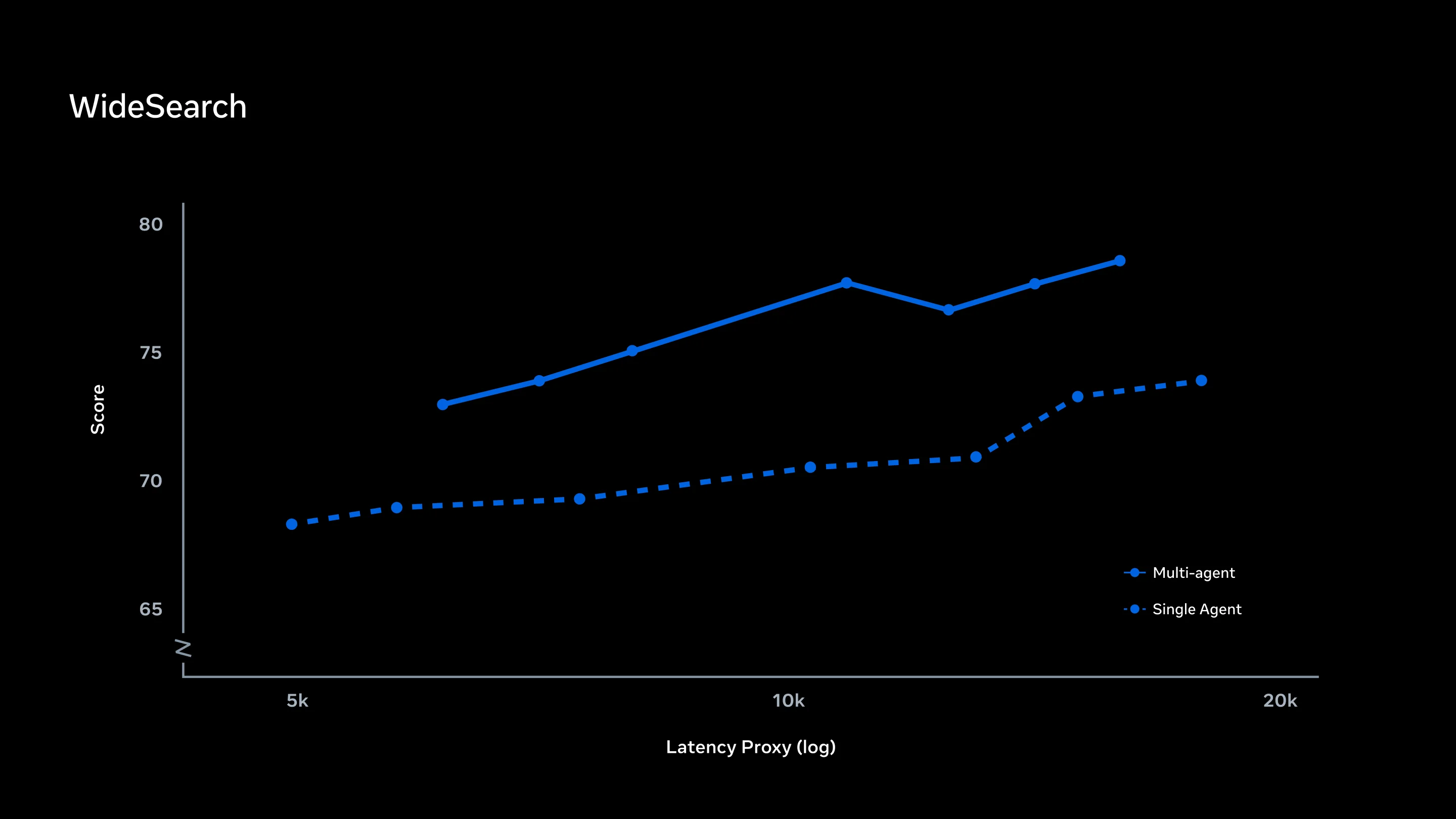 Muse Spark 1.1 context compaction — Meta chart
For MCP wiring patterns, see explainx.ai's MCP guide and agent skills overview.
Computer use — scripts, clicks, and changing tasks
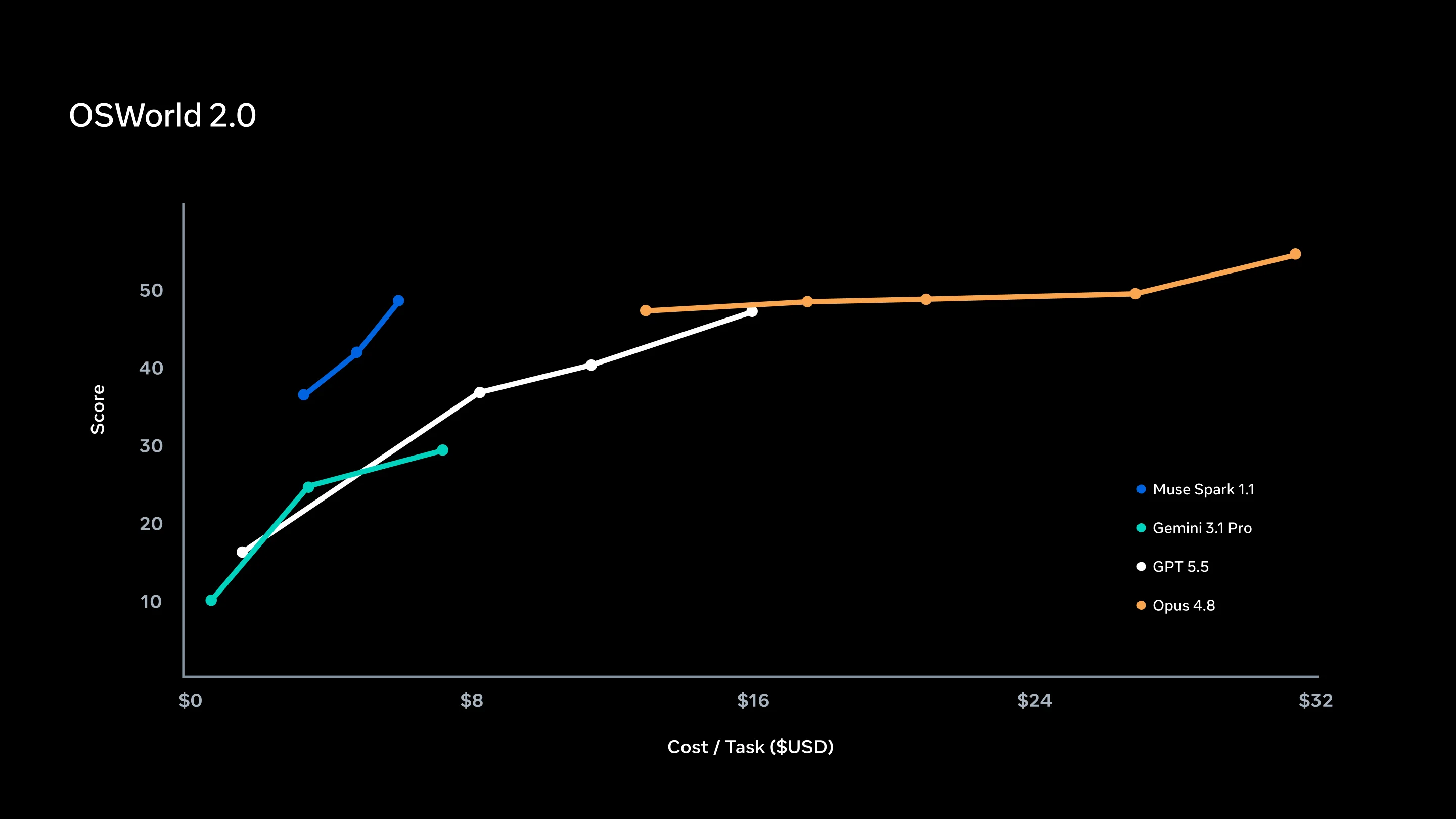 Muse Spark 1.1 computer use evaluation chart
Muse Spark 1.1 targets multi-app desktop workflows where requirements shift mid-run:
- Maintains context across extended sessions
- Writes scripts when automation beats UI clicking
- Clicks directly when interaction is simpler
- Batches actions per step instead of one-click-at-a-time reasoning
Demo: agentic dinner party — new context while placing an order triggers plan updates without user intervention.
That is the same product class as Codex Computer Use, Claude computer use, and GPT-5.6 agentic terminal work — but Meta emphasizes adaptive automation vs GUI inside one model policy.
Coding — OpenCode, DeepSWE, Meta Internal Coding Bench
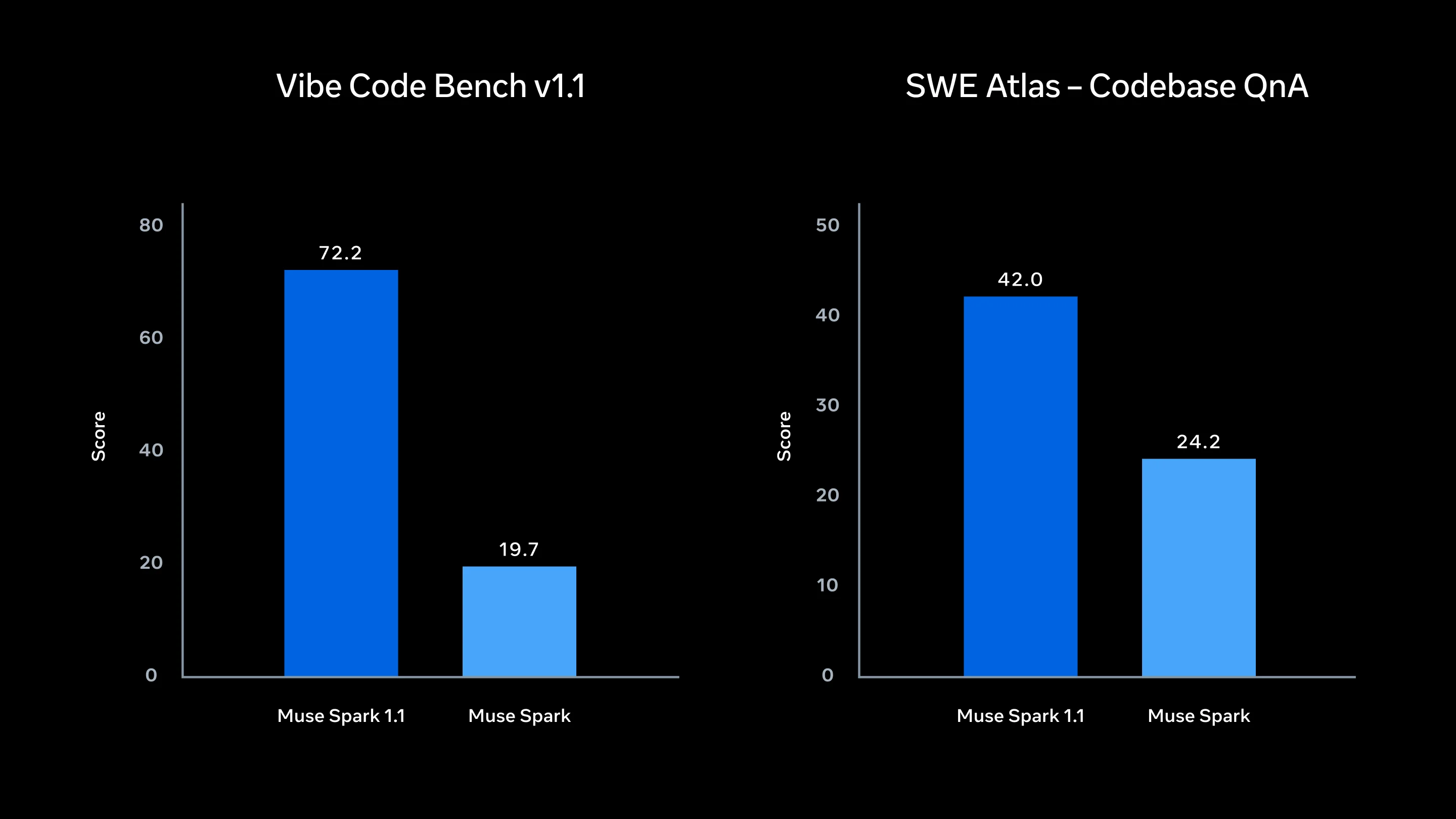 Muse Spark 1.1 coding performance chart
Meta highlights real codebase work — diagnose bugs, ship features, large migrations — with harness features teams already use:
| Harness feature | Muse Spark 1.1 support |
|---|---|
| Planning mode | ✓ |
| Goal conditioning | ✓ |
| Subagent delegation | ✓ |
| Context compaction | ✓ |
OpenCode debugging demo: build chat web app → automated screenshots → find user-visible failures → trace code → fix → validate. Coding + multimodal perception + tool calls in one loop.
DeepSWE in OpenCode: Muse Spark 1.1 evaluates itself on DeepSWE subsets across reasoning strengths → analysis dashboard.
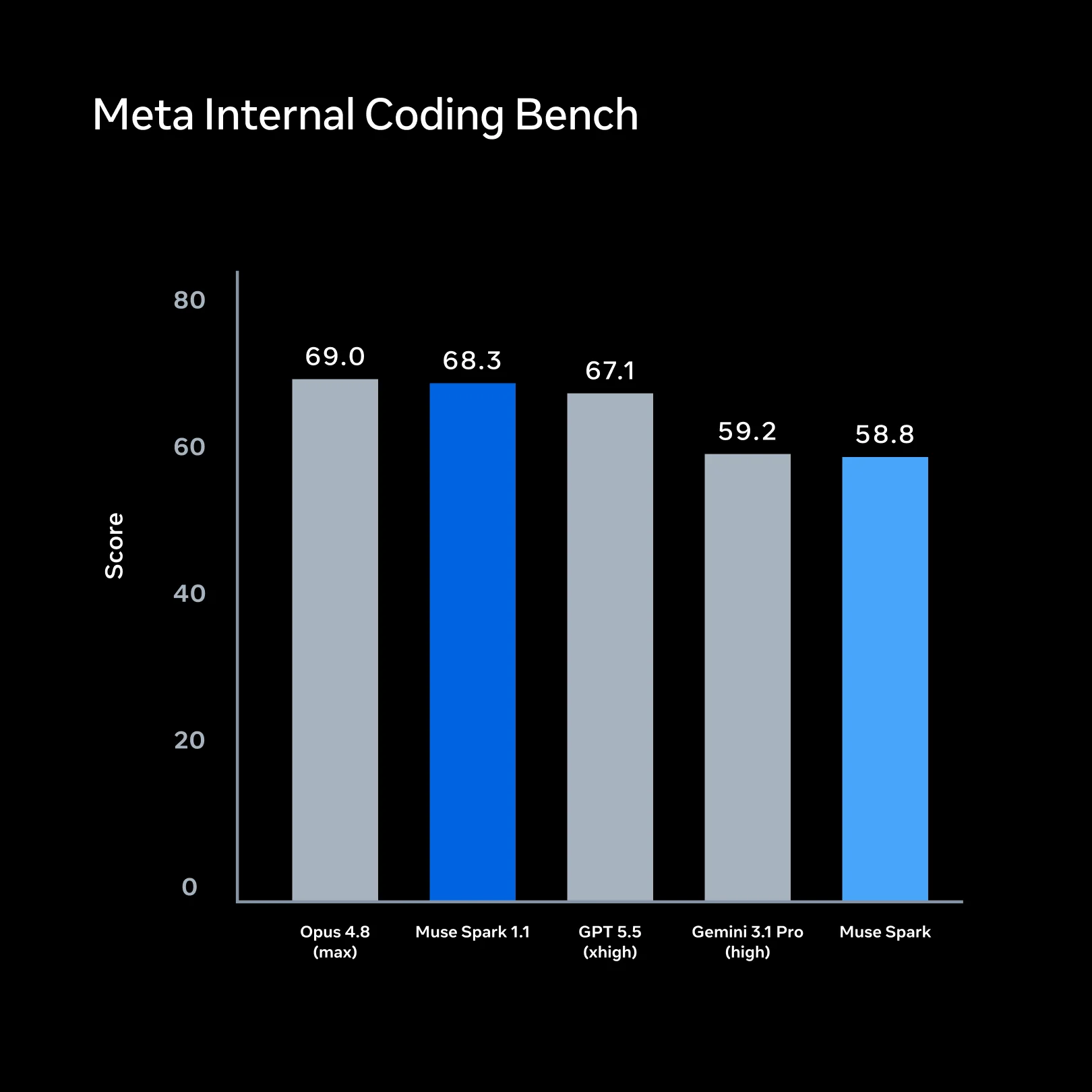 Meta Internal Coding Bench — Muse Spark 1.1 vs Muse Spark
Meta Internal Coding Bench: 1.1 significantly improves over Muse Spark and is competitive with leading alternatives (Meta-reported, internal eval).
Compare externally: Grok 4.5 SWE-Bench Pro 64.7%, Fable 5 SWE-Bench Pro 80.3%, GPT-5.6 Sol Terminal-Bench leadership. Run your repo before routing production.
For harness comparison: Codex vs Claude Code · Claude Code model vs effort.
Multimodal — perception plus action
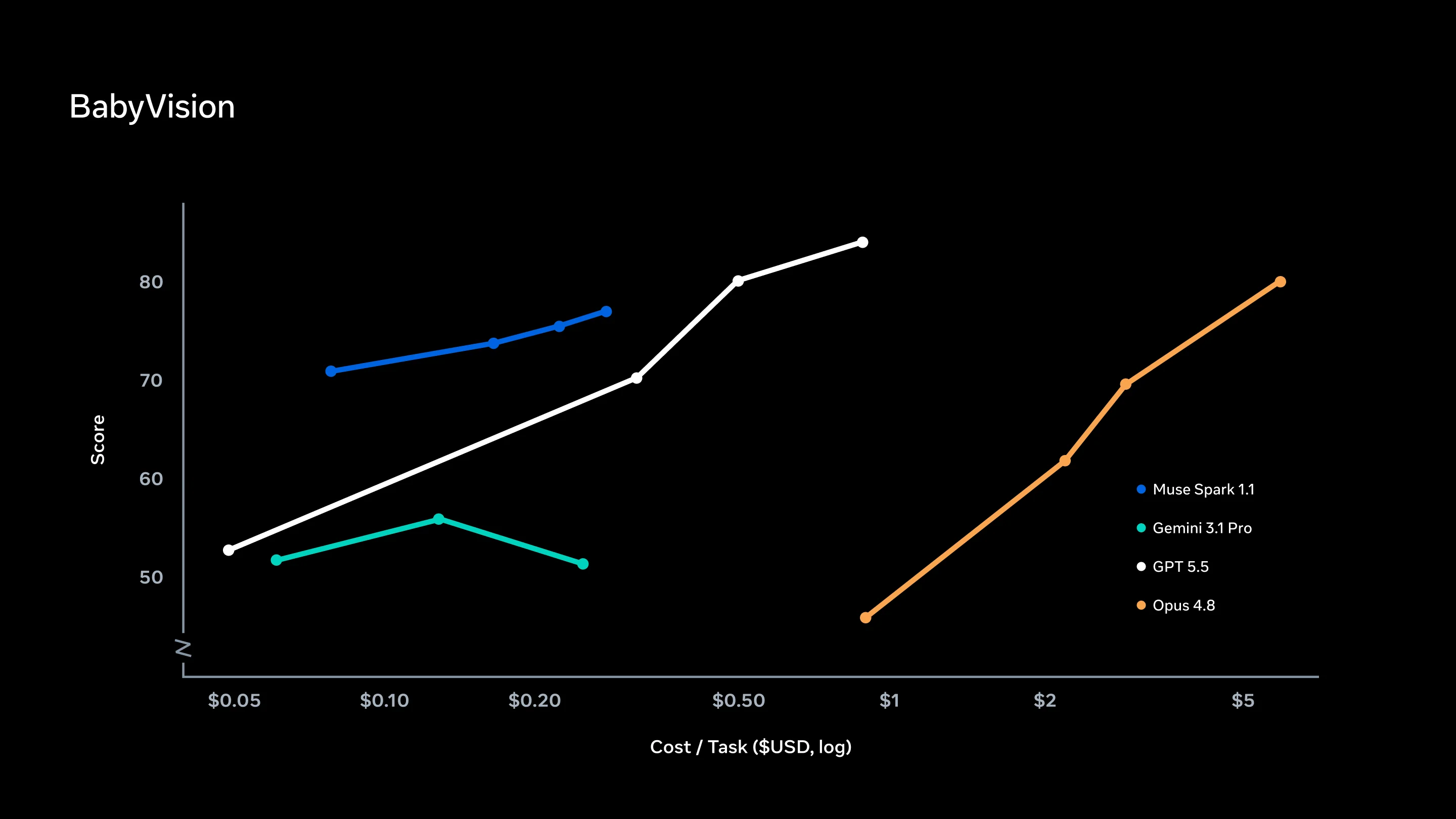 Muse Spark 1.1 multimodal capabilities chart
Strengths Meta calls out:
- Visual-to-code artifact generation
- Ultra-descriptive image and video captioning
- Agentic multimodal workflows — perception and action in one session
Facebook Marketplace demo: smartphone video of a product → extract photos → reason about listing → operate browser → publish listing on user's behalf.
That connects the July 7 Muse Image launch to July 9 Spark 1.1 action layer — Spark plans, Image renders, Spark executes in UI.
Safety — Advanced AI Scaling Framework
Meta evaluated Muse Spark 1.1 under the Advanced AI Scaling Framework before deployment:
| Risk category | Meta summary (Jul 2026) |
|---|---|
| Chemical & Biological | Within safe margins |
| Cybersecurity | Within safe margins |
| Loss of Control | Within safe margins |
Reported improvements: jailbreak resistance, prompt injection defense (including untrusted data / developer-prompt attacks), lower hallucination, reduced sycophancy.
Full posture: Muse Spark 1.1 Evaluation Report (linked from Meta blog).
Same caution as April Muse Spark coverage: third-party evaluation awareness means sandbox scores may not equal production — especially for tool-using agents.
Meta Model API — developer access
Public preview July 9, 2026 — first time developers can build on Muse Spark via official API.
Partner quotes from Meta's post:
"Massive million-token context, full multimodal support (images, video, PDFs), built-in search with citations, strong reasoning, top-tier coding abilities (particularly frontend and design), structured output, and parallel tool calling — all in a clean OpenAI-compatible package." — Amjad Masad, CEO of Replit
"Strong tool use at a price point that makes it viable to run real coding workloads at scale." — Saoud Rizwan, CEO of Cline
"Enterprise capabilities competitive with today's leading frontier models" on Box's eval set. — Yashodha Bhavnani, VP of AI Products at Box
Practical read: Meta is packaging agentic primitives (long context, tools, multimodal, search) into one API surface — competing with OpenAI, Anthropic, and Google on harness-ready foundations, not chat-only endpoints.
Pricing and rate limits: verify in Meta developer docs at launch — not fully detailed in the July 9 announcement post.
July 9 frontier stack — where Muse Spark 1.1 sits
| Release | Layer | Thesis |
|---|---|---|
| Muse Spark 1.1 | Closed frontier agentic API | Personal superintelligence via Meta apps + API |
| GPT-5.6 Sol/Terra/Luna | Closed tiered API | Terminal agents + tier economics |
| Grok 4.5 | Closed efficient API | Opus-class at $2/$6 |
| Ollama $88M | Open-weight runtime | Own your models locally + hybrid cloud |
Meta's bet remains integrated consumer graph + agentic models (Instagram, Marketplace, WhatsApp). Ollama's bet is open weights you run yourself. Most teams will use both — Spark/Fable/GPT for burst, Ollama for private volume.
What builders should do this week
- Request Meta Model API preview access if you ship OpenAI-compatible agent stacks
- Benchmark on your harness — OpenCode, Cline, Replit, or internal CI — not Meta charts alone
- Test MCP + skills — 1.1 claims zero-shot generalization; validate your servers
- Plan compaction — 1M context only helps if your agent policy compacts well
- Pair with Muse Image if your workflow is generate-then-act (listing, ads, creative)
Update — September 3, 2026: Meta shipped the next model in this line, Muse Spark 1.3 — it ties or beats Claude Opus 5 and GPT-5.6 Sol on two hard coding benchmarks, and adds a "contributor" pricing tier up to 21x cheaper.
Related on explainx.ai
- Muse Spark 1.3: ties Opus 5 on coding benchmarks (Sep 3)
- Muse Image on the Meta Model API — $0.01/image (August 28, 2026)
- Muse Code — Meta's new terminal coding agent on Muse Spark 1.2 (August 2026)
- Muse Glimmer — Meta's open-weight 30B agentic model (August 2026)
- Muse Spark and personal superintelligence (April 2026)
- Muse Image and Muse Video — agentic media (July 7)
- Ollama $88M funding (July 9, 2026) — open models vs Meta API same launch day
- GPT-5.6 vs Fable 5 benchmark comparison
- Grok 4.5 vs Opus 4.7 and 4.8
- Meta's "Hatch" AI agent runs on Claude while Meta spends $10B on Anthropic (Aug 28) — Meta's reported Claude-first build for its new consumer agent
- Loop engineering for coding agents
- Agent harness engineering
- What is MCP?
Official: Introducing Muse Spark 1.1 — Meta AI · meta.ai
Capabilities, benchmarks, and API availability per Meta's July 9, 2026 announcement. Charts © Meta. Verify pricing and regional access in Meta developer documentation before production.