



Grok 4.5 shipped July 8–9, 2026 — the same week GPT-5.6 Sol goes public and Anthropic publishes model vs effort guidance for Claude Code. Elon Musk's pitch: Opus-class, faster, more token-efficient, lower cost. He later clarified "roughly comparable to Opus 4.7, but much faster" — not a claim to beat Claude Opus 4.8 on every chart.
That nuance matters. Opus 4.7 (May 2026 predecessor) scored 64.3% on SWE-Bench Pro. Opus 4.8 jumped to 69.2% with better abstention and code self-review. Grok 4.5 posts 64.7% on SWE-Bench Pro — technically above 4.7, slightly below 4.8, while winning other benchmarks and undercutting both on price.
Update — August 13, 2026: Grok 4.6 shipped August 12 at the same $2/$6. Official evals vs Grok 4.5 High, GPT-5.6 Sol Max, and Fable 5 Max — 4.6 does not sweep Fable on coding benches. This 4.5-vs-Opus table stays as the July baseline.
This post is the head-to-head developers asked for in the Grok 4.5 launch thread: not marketing tiers, but which Opus generation Grok actually matches, where 4.8 still wins, and when efficiency math beats raw scores.
Update — July 14, 2026: Before routing proprietary code through Grok Build, read the repository-upload scandal — Musk pledged total deletion of prior uploads; /privacy is the user-facing control; trust is not restored for everyone.
Update — July 20, 2026: @AstraiaAI revived Sonnet 1T / Opus 5T / Fable 10T gossip — the ratios match Musk's earlier Grok 0.5T reply ("half Sonnet, one-tenth Opus"), but Anthropic still publishes zero official counts.
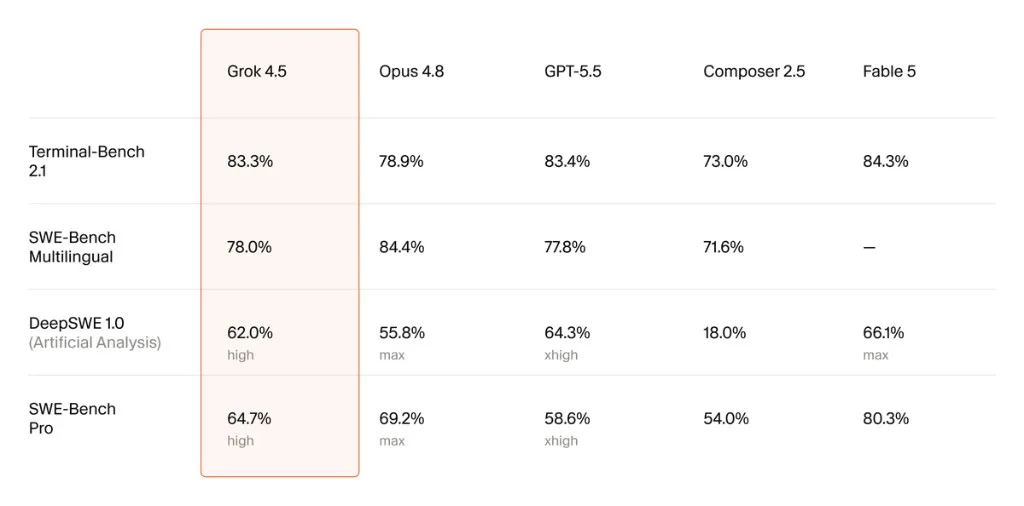 Grok 4.5 benchmark chart vs Opus 4.8, GPT-5.5, Fable 5
TL;DR — what people are asking
| Question | Answer |
|---|---|
| Opus 4.7 or 4.8? | Musk said 4.7-class; scores sit between 4.7 and 4.8 on SWE-Bench Pro |
| Beats Opus 4.8 on coding? | Mixed — Grok wins Terminal-Bench & DeepSWE 1.0; Opus wins SWE-Bench Pro & DeepSWE 1.1 |
| Beats Opus on professional work? | Yes — Snorkel GDPval+ 29% vs 21% mean pass rate |
| Price vs Opus 4.8? | $2/$6 vs $5/$25 per M tokens |
| Token efficiency? | ~4.2× fewer output tokens on SWE-Bench Pro tasks (xAI/Cursor data) |
| Beats Fable 5? | No on every published coding chart — Fable leads SWE-Bench Pro at 80.3% |
| Best for high-volume agents? | Grok 4.5 — cost × efficiency |
| Best for hardest repo bugs? | Opus 4.8 or Fable 5 |
Opus 4.7 → 4.8: what Anthropic actually changed
Before comparing Grok, anchor the Anthropic baseline:
| Metric | Opus 4.7 | Opus 4.8 | Delta |
|---|---|---|---|
| SWE-Bench Pro | 64.3% | 69.2% | +4.9 pts |
| Code flaw pass-through | baseline | ~4× less likely | major |
| Hallucination / incorrect rate | — | lowest tested | abstains when uncertain |
| Terminal-Bench 2.1 | — | 78.9% (max) | current ref |
| API price | $5 / $25 per M | $5 / $25 per M | unchanged |
| Fast mode | — | 3× cheaper, 2.5× speed | new |
Opus 4.8 is not a new price tier — it is better agentic reliability and honesty at the same list rates. Effort controls let you trade thoroughness for speed without switching models.
Grok's Musk framing targets 4.7 because that is the last generation where "Opus-class" meant strong but not frontier. Grok's SWE-Bench Pro score (64.7%) is essentially Opus 4.7 + one good eval run, not a clean beat of 4.8 (69.2%).
Agentic coding benchmarks — Grok vs Opus 4.8
Published July 2026 data from Cursor's Grok 4.5 blog, Decrypt's launch analysis, and The Decoder:
| Benchmark | Grok 4.5 | Opus 4.8 | Opus 4.7 (ref) | Winner |
|---|---|---|---|---|
| Terminal-Bench 2.1 | 83.3% | 78.9% | — | Grok |
| SWE-Bench Pro | 64.7% (high) | 69.2% (max) | 64.3% | Opus 4.8 |
| DeepSWE 1.0 | 62.0% (high) | 55.8% (max) | — | Grok |
| DeepSWE 1.1 | 53% | 59% | — | Opus 4.8 (3rd-party graded) |
| SWE-Bench Multilingual | 78.0% | 84.4% | — | Opus 4.8 |
explainx.ai read:
- Grok wins the terminal-agent lane — planning, bash, tool coordination (Terminal-Bench 2.1). That overlaps GPT-5.6 Sol's strength more than classic patch-the-repo SWE work.
- Opus 4.8 wins the repo-resolution lane — SWE-Bench Pro and the independently graded DeepSWE 1.1. When Medium and Decrypt say Grok "beats Opus on two of four charts," the two Opus wins include the benchmark engineers cite most and the only one not self-reported by the model vendor.
- Grok ≈ Opus 4.7 on SWE-Bench Pro — 64.7% vs 64.3% is noise-level; vs 4.8 it is a real gap (~4.5 points).
Fable 5 sits above all three on coding charts (80.3% SWE-Bench Pro, 84.3% Terminal-Bench) — though OpenAI's July 8 SWE-Bench Pro audit flags ~30% broken tasks and retracts its Pro endorsement. Grok vs Opus is a mid-frontier fight; Fable is the ceiling for Anthropic coding today.
Snorkel GDPval+ — where Grok pulls ahead of Opus 4.8
Independent of vendor charts, Snorkel AI evaluated Grok 4.5 on ~2,000 GDPval+ tasks — expert-authored professional deliverables across the U.S. economy (legal docs, spreadsheets, presentations):
| Model | Mean pass rate (GDPval+) |
|---|---|
| Grok 4.5 | 29% |
| GPT 5.5 | 22% |
| Opus 4.8 | 21% |
Domain highlights where Grok led:
| Domain | Grok 4.5 | Opus 4.8 |
|---|---|---|
| Legal | 40% | 27–28% |
| Education | 58% | 35–42% |
| Healthcare | 35% | 23–25% |
| QA analysis | 37% | 19–27% |
Opus 4.8 led among financial managers; GPT 5.5 led construction. Grok showed lowest error rates in all six Snorkel failure categories — especially "missing domain analysis" (40% vs 51–52%).
Methodology note: Grok ran with Grok Build; Opus 4.8 with Stirrup (Snorkel-tuned, reportedly beats Anthropic's proprietary Harbor agent on GDPval-style work). Even with favorable harness choices, Grok's professional-work lead is meaningful — and aligns with Cursor's positioning of Grok 4.5 as broader STEM + knowledge work, not a Composer-style coding specialist.
Even at 29% pass rate, expert-level AI work remains wide open — fewer than one in three criteria pass. Grok's lift is relative, not "job done."
Token efficiency — Grok's strongest economic argument
Raw scores understate Grok's pitch. On SWE-Bench Pro tasks:
| Model | Avg output tokens per task | Output $/M |
|---|---|---|
| Grok 4.5 | ~15,954 | $6 |
| Opus 4.8 | ~67,020 | $25 |
4.2× fewer tokens × 4.2× cheaper output compounds on agent loops. At loop-engineering scale — hundreds of tool calls per session — Grok can deliver Opus 4.7-ish outcomes at a fraction of the bill, even when Opus 4.8 scores higher per attempt.
xAI also claims ~80 tokens/second generation speed — Musk's "much faster" claim is partly latency, partly fewer tokens to completion.
When efficiency wins: batch refactors, CI fixer bots, high-volume MCP tool loops, Cursor background agents on Pro plans.
When efficiency loses: one-shot hard bugs where 69.2% > 64.7% matters more than cost — pay Opus 4.8 or Fable once instead of Grok three times.
Pricing comparison — Grok 4.5 vs Opus 4.7/4.8
| Model | Input / M | Output / M | Tier |
|---|---|---|---|
| Grok 4.5 | $2 | $6 | SpaceXAI / Cursor API |
| Grok 4.5 (fast) | $4 | $18 | lower latency variant |
| Opus 4.7 / 4.8 | $5 | $25 | Anthropic flagship (pre-Fable) |
| Fable 5 | $10 | $50 | Anthropic frontier |
| GPT-5.6 Sol | $5 | $30 | OpenAI flagship |
Grok is cheaper than Opus 4.7 and 4.8 at identical list tiers — there is no "4.7 discount" vs "4.8 premium" on Anthropic's side; both Opus generations share $5/$25. Grok undercuts both.
For subscription users: Opus 4.8 ships inside Claude Pro/Max and Claude Code pricing pools. Grok 4.5 ships inside Cursor plans with double usage week one — different economics; compare effective $/task, not sticker API rates alone.
Decision tree — Grok 4.5 or Opus?
Wrong answer after good context?
├── Need deepest repo reasoning → Opus 4.8 or Fable 5
├── Multilingual codebase → Opus 4.8 (84.4% SWE multilingual)
├── Legal / healthcare / education deliverables → Grok 4.5 (GDPval+)
├── Terminal / bash agent workflows → Grok 4.5 or GPT-5.6 Sol
├── High-volume agent loop, cost-sensitive → Grok 4.5
├── Lowest hallucination / abstention → Opus 4.8
└── Stretch task Opus can't finish → Fable 5 at [high effort](/blog/claude-code-model-vs-effort-knowing-more-trying-harder-2026)
Do not switch models first. Fix prompt, harness, and verification — same order Anthropic prescribes for effort vs model.
Honest limitations
| Caveat | Detail |
|---|---|
| CursorBench contamination | Cursor repo snapshot accidentally in training — in-IDE scores may be optimistic |
| Self-reported benchmarks | DeepSWE 1.1 (3rd-party) favors Opus; DeepSWE 1.0 (vendor) favors Grok |
| EU availability | Grok 4.5 not in EU at launch — mid-July target |
| "Opus-class" is vague | Marketing tier, not a single number — use tables above |
| Fable 5 context | Commerce export-control saga; global again July 1 |
| GPT-5.6 same week | Sol Ultra 91.9% Terminal-Bench — different frontier for agentic terminal work |
Related on explainx.ai
- Grok 4.6 launch — official evals vs 4.5, Sol, and Fable 5 (August 12)
- Grok 4.7 in 3–4 weeks — SpaceX training, September timeline (August 13)
- Grok 4.6 and 4.7: Musk's Announced Timeline, Explained — the July 25 Pareto-frontier claim against Opus 5
- Grok 4.5 VulcanBench 91.3% + Graffiti 284 (July 24)
- Grok 4.5 public launch — Cursor, SpaceXAI, full benchmark table
- Claude Opus 5 release speculation — Honeycomb leak, July 2026 timelines
- Claude Opus 4.8 launch — SWE-Bench Pro, fast mode, effort controls
- GPT-5.6 Sol, Terra, Luna vs Fable 5 — July 9 launch comparison
- Claude Code model vs effort — knowing more vs trying harder
- Fable 5 after relaunch — developer reactions
- SpaceX acquires Cursor — $60B context for Grok training data
- Claude Code vs Codex vs Gemini CLI
Official / third-party sources: Cursor Grok 4.5 blog · Snorkel GDPval+ eval · Anthropic Opus 4.8 · @ClaudeDevs model vs effort
Benchmarks, pricing, and availability accurate as of July 9, 2026. Vendor-reported scores may differ from independent reproduction.