



Update — August 29, 2026: Muse Image is now callable on the Meta Model API at $0.01 per image — Meta CAO Alexandr Wang put it on the text-to-image price-to-quality frontier at roughly 1,280 Arena Elo.
On July 7, 2026, Meta Superintelligence Labs announced Muse Image and a Muse Video preview — the lab's first shipping media generation models after April's Muse Spark reasoning launch.
The headline shift: Muse Image is not a prompt-to-pixels mapper. Meta describes it as an agent that searches the web, writes and runs code, reflects on drafts, and spends more compute at inference when quality demands it — then plugs into Instagram references, Facebook Marketplace shopping flows, and Muse Spark for joint planning.
The stills and clips below were pulled from Meta's July 7 announcement page (FB CDN URLs as of our fetch), converted to WebP/WebM, and hosted locally under /public/blog/muse-image-muse-video/ for stable playback. © Meta; used here for commentary alongside a link to the original article.
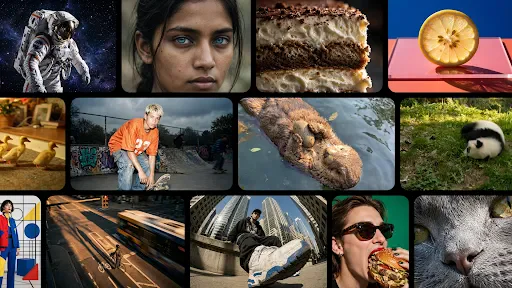 Muse Image hero gallery — agentic image generation examples from Meta's July 7 launch
TL;DR — what people are asking
| Question | Answer (from Meta's post) |
|---|---|
| Can I use it now? | Muse Image yes — Meta AI app, meta.ai, Instagram Stories (US), WhatsApp (limited). Muse Video preview only. |
| Is it #1 on Arena? | No. 2 on text-to-image, single-image edit, multi-image edit (Elo, July 5, 2026). Muse Video: No. 3 text-to-video. |
Update — July 10, 2026: Reve 2.1 also claims #2 on Arena text-to-image at 1306 Elo (+36 vs Reve 2.0) — verify current leaderboard; ranks shift weekly. | Agentic how? | Search (facts, trends), coding (plots, QR codes, HTML games), self-refinement (emerged in RL), test-time compute scaling. | | vs Muse Spark? | Shared tools; Spark + Image co-plan for GIFs, sites, interactive media. | | Provenance? | Content Seal invisible watermark + preview detector. | | vs OpenAI / Google image? | Meta claims strong editing + multi-reference compose; compare on your edit workflows — Arena is preference, not task accuracy. |
Muse Image: agentic image generation
Meta's framing:
Instead of directly mapping prompts to images, Muse Image operates as an agent: it invokes search and coding tools to improve accuracy, self-refines its own generations, and improves through scaling test-time compute.
Tool use
| Tool | What Meta demonstrates |
|---|---|
| Coding | RL-taught code execution for accurate plots, scannable QR codes, conditioning on rendered figures; with Spark — animated GIFs, websites with embedded images, interactive visual games |
| Search | Web search for current events, product catalogs, scientific diagrams — internal ablation shows higher win rate with search enabled |
| Commerce | Facebook Marketplace workflow for room restyle with real listing references (US) |
Looping excerpt from Meta's Conference QR Code demo — coding tool use, QR verification, and iterative scene composition. Converted to WebM for the blog.
Search. Muse Image learns to search the web to ground generations in factual and real-time information. Meta reports higher win rate with search enabled on knowledge-intensive prompts:
 Search-enabled generation accuracy chart — Muse Image win rate with web search from Meta internal ablation
This is loop engineering applied to pixels: plan → tool → draft → verify → revise.
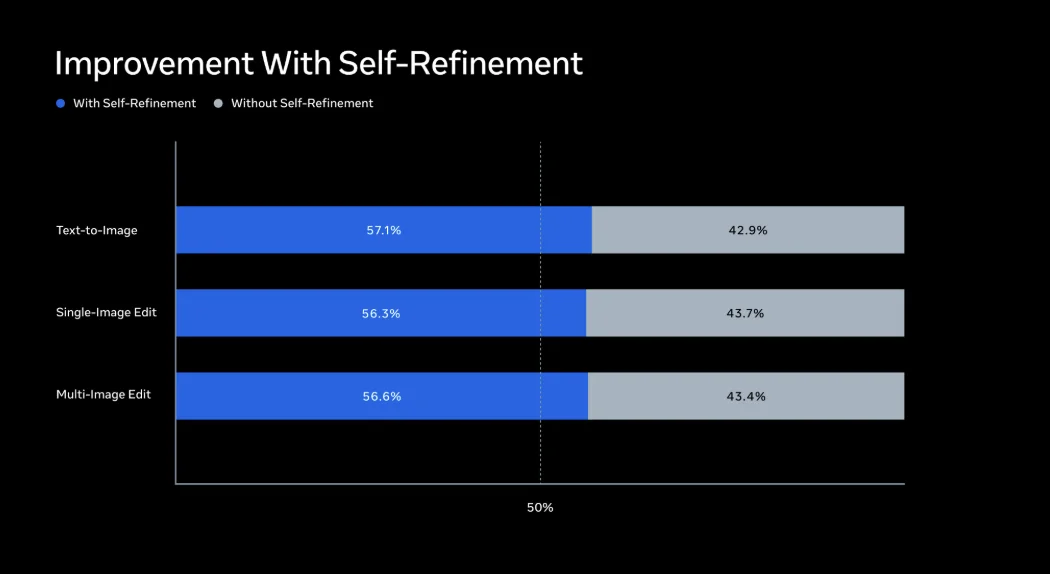
Self-refinement (emergent)
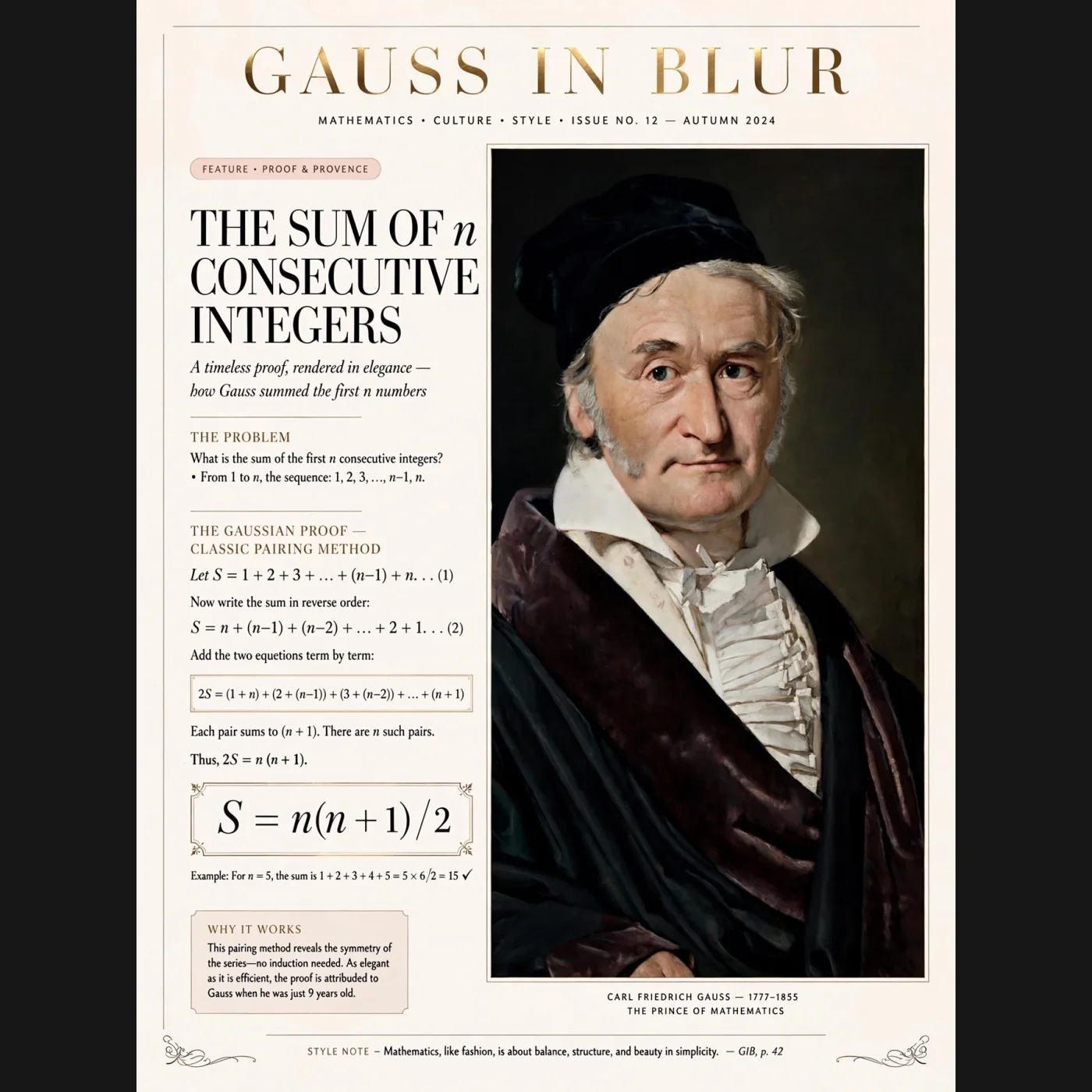
Meta did not hand-design a fixed "critique then redraw" template. Self-refinement emerged in RL because revised images scored higher reward — local edits for small errors, full regen when composition fails, or pivot to tools for factual tasks (magazine spread with corrected formula notation in their demo thread).
 Self-refinement capability comparison — Muse Image win rate with emergent self-refinement from Meta internal ablation
Test-time compute
Meta reports approximately log-linear Elo gains as combined text-reasoning + visual-generation compute increases. Key product insight from the post:
- Best-of-N saturates quickly.
- Deliberate reasoning + tool calls scales better than blind multi-sample.
- Reasoning and tools compound — search fills knowledge gaps reasoning alone cannot.
For builders routing media APIs, treat inference budget as a user-facing quality slider, not a hidden cost center — same lesson as agent harness engineering.
Editing and multi-reference composition
Single-image editing: fog removal, text on signs, rainbow petal gradients, iterative living-room Japandi restyles across turns — Meta stresses coherence across editing sessions.
Multi-reference composition: interleaved text + multiple input images — people, outfits, bikes, art styles, room patterns, TV screen content, pets on couches. This targets the failure mode of one-shot models on "use the lamp from image A in room B" prompts.
Arena rankings (July 5, 2026)
Meta-published leaderboard snapshots:
| Task | Muse Image rank |
|---|---|
| Text-to-image | #2 (human Elo) |
| Single-image edit | #2 |
| Multi-image edit | #2 |
| Text-to-video (Muse Video) | #3 |
Treat Arena Elo as blind preference duels, not calibrated accuracy on QR readability, text spelling, or IP safety. For production, run your edit suite and Content Seal checks.
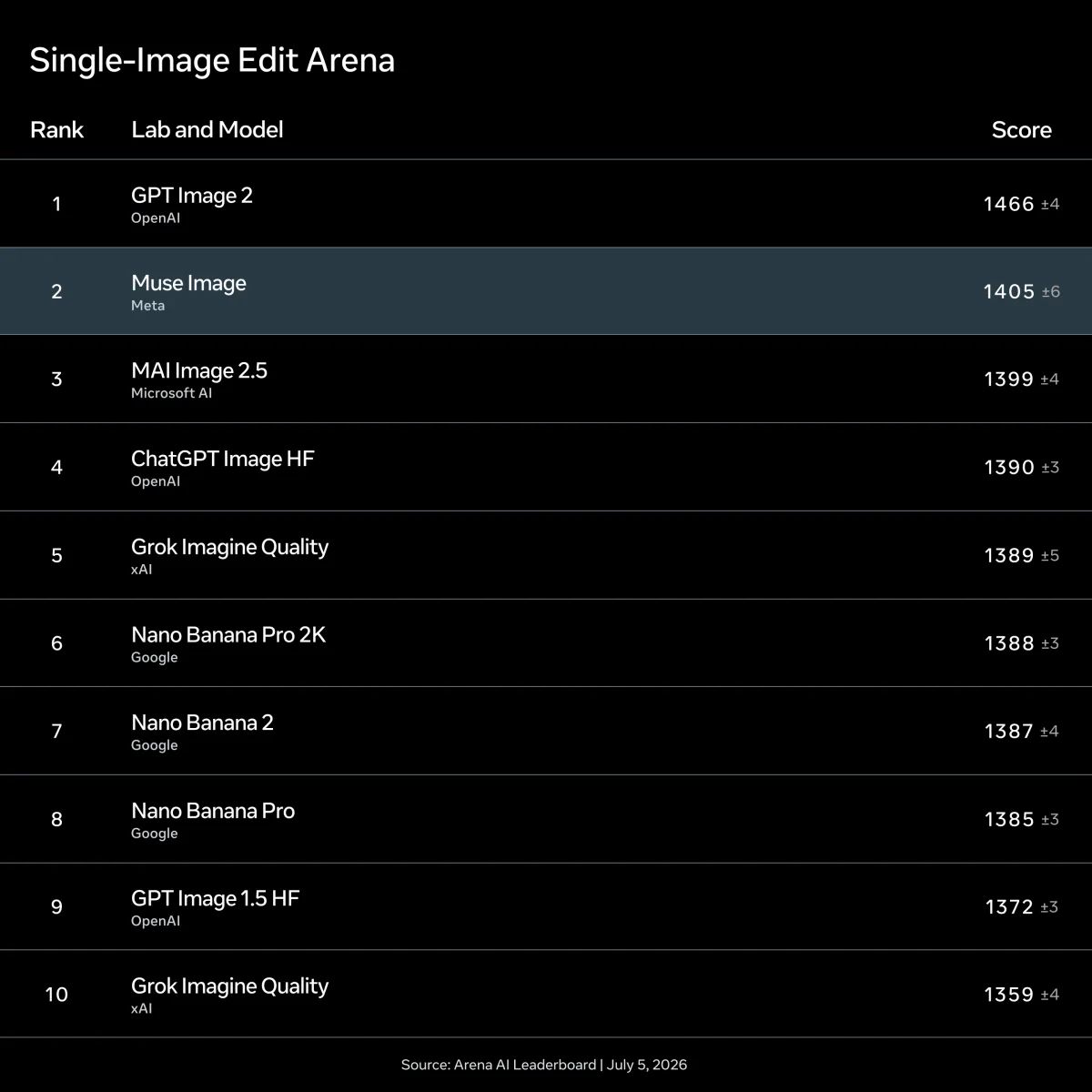 Arena Elo leaderboard — Muse Image No. 2 on text-to-image as of July 5, 2026 per Meta
Previewing Muse Video
Muse Video shares Muse Image's pretraining base. Meta highlights prompt adherence, visual fidelity, and temporal consistency, with native audio in preview clips (room tone, diegetic foley, voiceover sync in ad-style examples).
Known gaps (Meta-stated): audio-video synchronization, physically accurate fast motion — actively investing.
Availability: coming soon to creators and Meta AI — not consumer-wide at launch.
Preview clip from Meta's Muse Video section — native audio included. Converted to WebM for the blog.
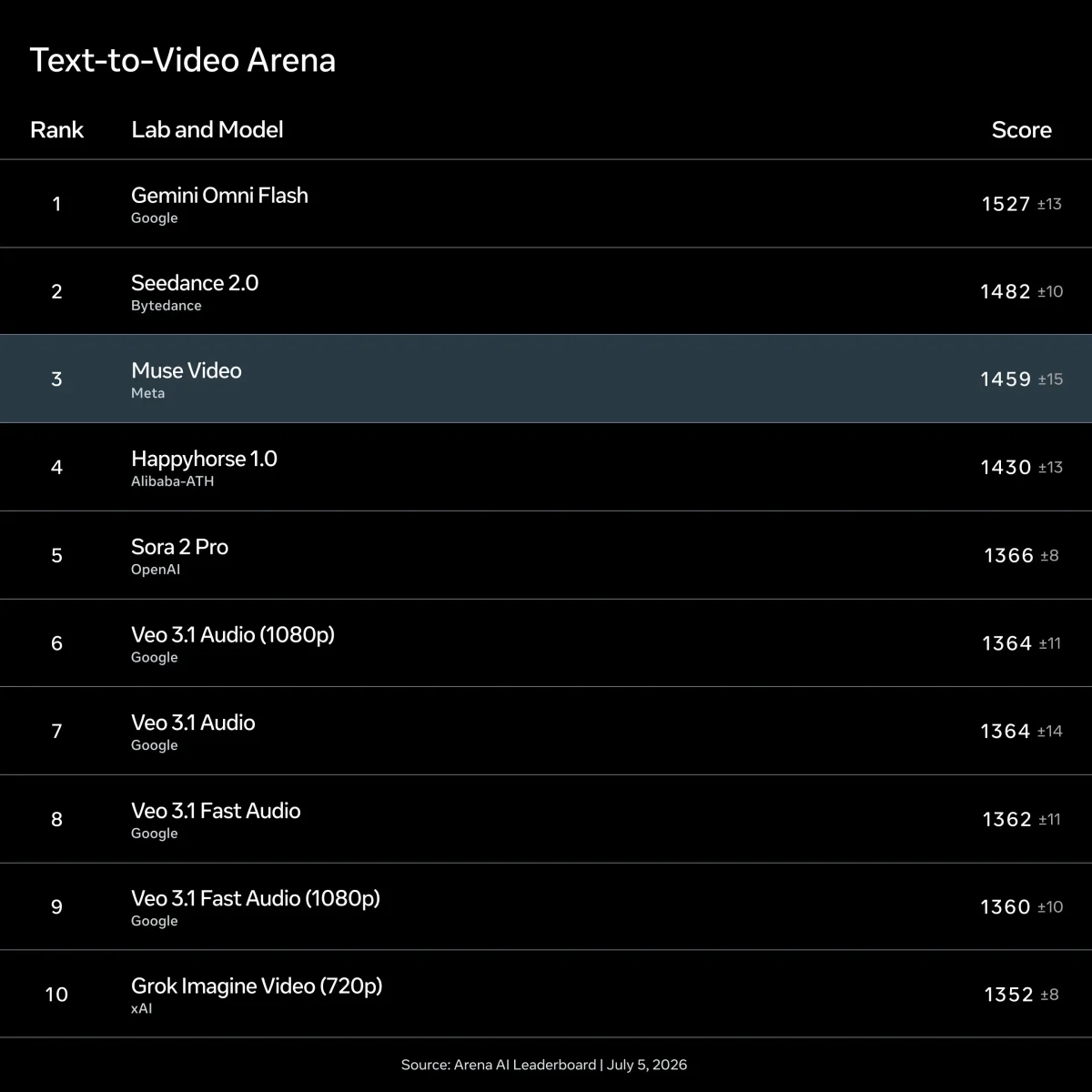 Muse Video Arena ranking — No. 3 on text-to-video human Elo as of July 5, 2026 per Meta
Content Seal — provenance
Muse Image outputs in Meta AI and meta.ai carry Content Seal — invisible watermark surviving crop, compress, resize, screenshot. Meta previews a detection tool and plans video extension.
For teams worried about synthetic media in feeds, this is Meta's answer to "was this AI?" — complementary to policy, not a substitute for human review on high-stakes claims.
Meta product integration
| Surface | Muse Image role |
|---|---|
| Meta AI / meta.ai | Core generation + friend co-creation |
| Instagram Stories (US) | Generation + @-mention public accounts as social reference |
| Instagram presets | Personalized styles in-product |
| Limited-country rollout | |
| Coming soon | |
| Small business ads | Example: @averyandme campaign assets |
The Instagram social context hook is the moat narrative — models that know your graph and public creator aesthetics, not just LAION-style averages.
How this fits the Muse / MSL roadmap
| Model | Layer | July 2026 status |
|---|---|---|
| Muse Spark | Multimodal reasoning + Contemplating agents | Shipped April 2026 |
| Muse Image | Agentic image gen + edit | GA in Meta apps |
| Muse Video | Audio-native video | Preview |
Read together: Meta is building personal superintelligence as a stack — Spark plans, Image renders, Video animates, tools bridge factual and commerce workflows.
What to test in your own workflow
Meta's launch material highlights its strongest examples, so the quickest way to learn whether Muse Image helps you is to run a small test set drawn from your own work. Based on the capabilities described above, a reasonable set would include:
- Factual prompts: something that needs current or product information, with search on, to see whether grounding actually improves the result.
- Exact-output tasks: a plot or a QR code, then verify that the code scans and the numbers are right, since Arena preference does not measure that.
- Multi-turn edits: a room or product restyle across several turns, checking whether the objects you want preserved stay coherent.
- Multi-reference composition: two or three input images combined, to probe the "lamp from image A in room B" failure mode.
- Provenance: a Content Seal check on a few outputs, using the preview detector.
Record latency alongside quality for each case. The post says quality rises with thinking budget, so the wait time you can tolerate directly shapes what you will get.
Honest limits — read before hype
- Benchmarks are Meta + Arena preference — independent spelling/QR/science accuracy evals not cited in the launch post.
- Muse Video is preview — sync and motion physics gaps acknowledged.
- Regional rollout is patchy — US Instagram Stories, limited WhatsApp, Facebook TBD.
- Agentic loops cost latency and compute — quality scales with thinking budget; product UX must cap wait times.
- Instagram/Marketplace integrations tie value to Meta accounts — less portable than API-only image stacks.
Update — August 6, 2026: If Muse Image or Muse Video being able to generate media of real people concerns you, BGBlur's guide covers how to opt out of Meta Muse and protect your photos from being used in AI-generated deepfakes.
Related on explainx.ai
- Muse Image on the Meta Model API — $0.01/image (Aug 28, 2026) — pricing and the Elo-vs-cost frontier
- Muse Spark 1.1 + Meta Model API (July 9, 2026) — 1M context, coding, computer use, API preview
- Muse Spark and personal superintelligence — April 2026 reasoning foundation
- Gemini Omni Flash video generation — Google's parallel media push
- Google Photos Video Remix — consumer Omni templates in Photos Create tab
- How diffusion image generation works — baseline mechanics Muse Image abstracts away
- Agent harness engineering — tool loops beyond single-shot APIs
- What is loop engineering? — plan-verify-revise pattern
Privacy note
Official sources
- Introducing Muse Image and Muse Video — Meta AI
- Try Muse Image in Meta AI
- Content Seal detection (preview) — linked from Meta's post as "Check Content Seal"
Capabilities, Arena ranks, and availability follow Meta's July 7, 2026 announcement. Muse Video remains preview-only; verify meta.ai and Instagram rollout in your region before planning production workflows.