



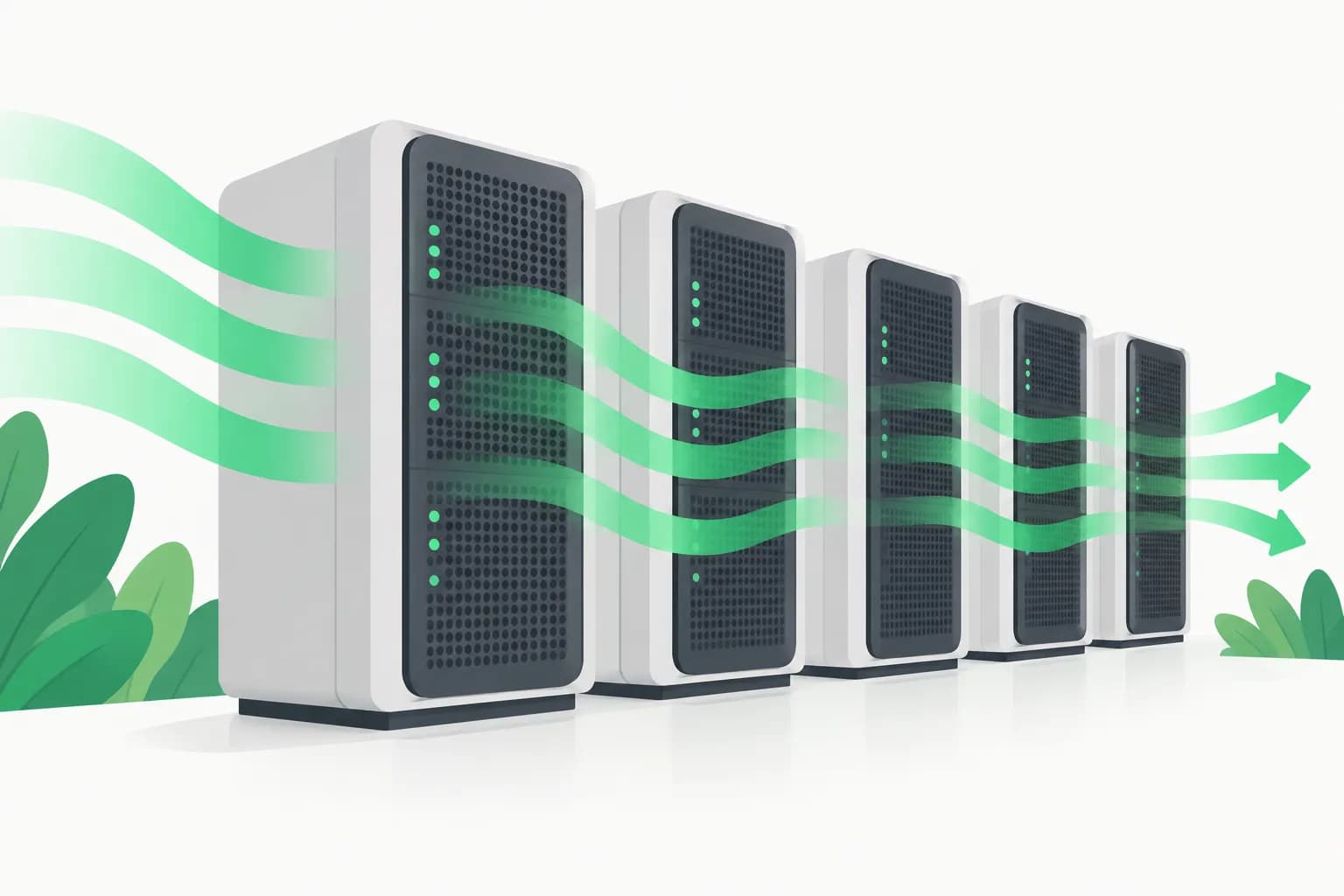
Microsoft has announced Maia 300, its third-generation in-house AI chip, and the pitch is simple: run inference for Copilot, GitHub Copilot, Foundry and Microsoft's own models on silicon Microsoft designs, and spend less power per token doing it. According to The Verge's report, Scott Guthrie, executive vice president of Microsoft's cloud group, says the company expects Maia 300 to deliver 40 percent more tokens per megawatt than leading GPU-based systems, with production rollout starting in 2027.
For anyone building on Azure, this is not a product you can rent today. It is a signal about where Microsoft's cost curve, and eventually its pricing, is heading. This post walks through what was announced, how it compares with Maia 200 and with the custom chips other labs are building, and what it does and does not change for builders.
Update (October 12, 2026): Is Microsoft really cutting Claude spend for Maia?
Aggregator posts circulating on X today tie the Maia 300 launch to a claim that Microsoft cut its Claude spend by more than a third "for the Maia pivot." The sourcing is thin: the chain traces back to social posts, not to Microsoft or Anthropic. The one-third cut itself comes from earlier reporting by The Information, covered in our Meta and Microsoft Claude cuts post, which described a roughly $1 billion internal plan trimmed by about a third. That reporting did not attribute the cut to Maia, and Maia 300 only reaches production workloads in 2027, so a causal link is the aggregators' inference.
A new profile of Microsoft Copilot chief Charles Lamanna by The Information, summarized by Techmeme, adds a different data point: a source says Microsoft is on track to pay Anthropic more than $2 billion per year. The Techmeme summary does not say what the figure covers, so it may not be comparable to the internal-employee budget, and neither company has confirmed it. An earlier Information report put the run rate near $500 million a year, so the number would be several times larger if accurate.
| Claim | Status |
|---|---|
| Internal Claude plan cut by roughly a third | Reported by The Information earlier this month; unconfirmed by Microsoft |
| Cut was caused by the Maia pivot | Not in any primary source we found; aggregator inference |
| Microsoft on track to pay Anthropic $2B+ per year | Single anonymous source in The Information profile; unconfirmed |
| Maia 300 starts production workloads in 2027 | Confirmed by Microsoft |
The honest read: Microsoft can be trimming internal Claude seats and still be a growing Anthropic customer for Copilot products. Maia is a 2027 story and does not explain a 2026 budget cut.
Maia 300 at a glance
| Question | Answer |
|---|---|
| What is it? | Microsoft's third-generation in-house AI accelerator, positioned as a full system rather than just a chip |
| Headline efficiency claim | 40 percent more tokens per megawatt than leading GPU-based systems (Microsoft projection) |
| Throughput claim | Up to 7x rack-scale token throughput of Maia 200 in a full 96-accelerator configuration |
| Process and design | TSMC N2P, chiplet architecture separating compute, memory controller and I/O |
| When? | Production rollout to AI workloads in 2027 |
| Target workload | Long-context reasoning, latency-sensitive conversation, sustained multi-step agentic tasks |
| Can I rent it now? | No. No Azure instance name or pricing has been announced |
| Who is it for first? | Microsoft's own products: Copilot, GitHub Copilot, Foundry and Microsoft AI models |
What exactly did Microsoft announce?
Per The Verge, Microsoft calls Maia 300 designed to be the "primary AI inference system" for its products and services. Guthrie framed it as a complete AI system built for the workloads that are emerging now: long-context reasoning, latency-sensitive conversational experiences, and sustained, multi-step agentic tasks.
Two numbers carry the announcement. The first is the 40 percent tokens-per-megawatt figure against leading GPU-based systems. The second is the rack-scale claim: in a full 96-accelerator configuration, Maia 300 delivers up to 7x the token throughput of Maia 200.
Guthrie also committed to scale: "We will scale our Azure Maia family to multi-gigawatt deployments starting in 2027, making Maia the primary AI inference system for Microsoft products and services." That is the line that matters strategically. Multi-gigawatt means Maia is meant to carry the bulk of Microsoft's own inference load, not act as a pilot.
Why tokens per megawatt is the right metric
 A power meter needle illustrating the Microsoft Maia 300 tokens-per-megawatt efficiency claim
Inference at scale is increasingly limited by electricity and cooling, not just by how many accelerators you can buy. Tokens per megawatt measures how much output a fixed power budget produces. If a data center campus is capped at a given number of megawatts, a 40 percent improvement means 40 percent more served tokens inside the same envelope.
This ties directly to the infrastructure fights we have been tracking. Power and siting constraints are what slow data-center expansion, as covered in our posts on Google's nuclear uprate deal for AI data centers and the Senate investigation into whether hyperscalers misled the public about data center costs. A chip that squeezes more tokens out of each megawatt is a way to grow capacity without winning every one of those local fights.
A caution applies. The comparison is against "leading GPU-based systems," which Microsoft has not named in the quoted material, and the figure is an expectation for hardware that has not shipped. Treat it as a design target until independent measurements exist.
How Maia 300 differs from Maia 200
Maia 200 was announced in January 2026; Microsoft's own introduction is on its newsroom. According to The Verge, Maia 200 already runs production AI workloads across Microsoft, including Microsoft Copilot, GitHub Copilot, Microsoft Foundry and Microsoft's own AI models. Guthrie called it "the best performing AI infrastructure in our fleet, measured in real world metrics for AI services."
So Maia 300 is not a first attempt; it is a second hardware iteration on a part that is already serving traffic. What changes:
- Chiplets. Maia 300 separates compute, memory controller and I/O functions into different pieces. Microsoft's Azure hardware team says this "increases the silicon area dedicated to compute performance and allows each function to use the technology best suited to its role."
- Process. It is built on TSMC's N2P node, a more advanced node than the one used by the previous generation.
- System framing. The 96-accelerator rack-scale configuration is part of the claim, meaning the gains come from networking and packaging as much as the die.
A chiplet design also hints at yield and cost flexibility: compute can sit on the leading-edge node while memory and I/O use cheaper technology. That matters because leading-edge wafer capacity at TSMC is contested by Nvidia, Apple and everyone else building AI silicon.
What was reported before the announcement
Before today, trade press reported that Microsoft could unveil Maia 300 as early as September and was seeking large TSMC capacity. TrendForce summarized Reuters and The Information in August: Microsoft was reportedly eyeing capacity for more than 300,000 Maia 300 chips for 2027 delivery. Today's announcement does not state unit counts, so that figure remains unconfirmed.
The same caution applies to specifications. Today's confirmed claims are the efficiency, throughput, process and rollout timing above. Memory capacity, bandwidth and peak compute for Maia 300 were not in the report we could verify, and leaked numbers from earlier coverage should be treated as unverified.
The competitive picture: everyone is building inference silicon
 A reserved block of capacity in a server tray, standing for hyperscaler custom chip supply beyond Maia 300
Microsoft is the latest hyperscaler to put real weight behind its own accelerators:
- Google keeps iterating TPUs; see our coverage of Google's Frozen v2 TPU and Gemini 4 pretraining.
- Meta is building its MTIA line toward large compute targets, as covered in Meta's Iris MTIA chip and 14 GW capacity plan.
- OpenAI has its own program, detailed in OpenAI Jalapeño, the first chip built for LLM inference with Broadcom, and a custom-chip partnership with Samsung.
The common thread is inference. Training still leans on Nvidia GPUs at most labs, but serving a billion daily requests is a different problem: the workload is predictable enough to specialize for, and the cost of every token shows up directly in margins. If your product is an assistant sold per seat, shaving power per token is the most direct margin lever you have.
Why Mustafa Suleyman cares: models and silicon co-designed
The Verge quotes Microsoft AI CEO Mustafa Suleyman tying Maia to the company's model ambitions: "We have to work across the full stack, all the way down to the silicon." He added that at that scale Microsoft needs "a platform that we own, and that we co-design with our models," and that running Microsoft AI models on Maia is "a critical focus."
That connects to the model line we have been following, such as the MAI-Code-1.1 Flash local model for Windows. Owning both the model and the chip lets Microsoft tune architectures for what the silicon does well, the same advantage Google has long had with Gemini and TPUs. It also fits Satya Nadella's broader framing of how Microsoft thinks about model risk and control; see Nadella's "assume all AI models are compromised" remarks.
What this means for what you build or pay
You cannot use Maia 300 yet, and you may never address it directly. Microsoft's language is about powering its own products. The likeliest way you will touch Maia is indirectly, through Copilot, GitHub Copilot and Foundry-hosted Microsoft models running on it.
Pricing pressure is the real effect. If tokens per megawatt improves by 40 percent and the saving is passed on, Microsoft-hosted inference can get cheaper or limits can loosen. That is a possibility, not a promise: nothing in the announcement mentions prices.
Do not plan around 2027 hardware today. Keep your architecture portable across providers and model families. Build evaluation harnesses so you can switch to cheaper endpoints when they appear, and track per-token cost in your own telemetry.
Watch for these signals:
- An Azure instance or Foundry SKU explicitly labeled as running on Maia.
- Independent latency and throughput measurements on Maia 200 workloads.
- Disclosure of volumes and TSMC allocation.
- Whether Microsoft shifts third-party models, not just its own, onto Maia.
What we still don't know
- Which GPU system the 40 percent comparison uses.
- Unit volumes and the actual production schedule inside 2027.
- Memory configuration, bandwidth and peak compute.
- Whether Maia 300 supports training or is inference-only in practice.
- How software support compares with CUDA for outside developers.
The last point is the long-term constraint on any custom accelerator. Nvidia's software ecosystem is the moat; Microsoft sidesteps it by controlling the stack for its own workloads, but external customers will want mature tooling before they commit.
Bottom line
Maia 300 is a credible next step in a strategy already in production with Maia 200. The claims are Microsoft's, the numbers are projections, and the hardware arrives in 2027. The durable takeaway is directional: hyperscalers are moving their biggest inference loads onto custom silicon, and efficiency per megawatt is becoming the metric that decides who can serve AI cheaply.
Details are accurate as of October 12, 2026 and rest on Microsoft statements as reported by The Verge. We will update this post when Microsoft publishes full specifications.