



SK hynix’s five-year 1.4 trillion won (about $1.05 billion) mutual-growth pledge for Korean materials, parts, and equipment suppliers—first outlined in its July 2026 newsroom policy post—got concrete Trinity Fab numbers on November 16, 2026 when EDAILY reported on a November 10 press tour of the shared 12-inch demo line at Yongin, targeting May 2027 handover and 874.6 billion won total project cost.
If you model AI supply risk, this is not a earnings slide. It is infrastructure for verification: giving smaller vendors a production-like stage before they fight for scarce slots on live high-bandwidth memory lines.
What SK hynix announced
SK hynix’s newsroom describes mutual growth policies for partner companies. EDAILY’s November 16 English report adds numbers reporters repeated through Reuters syndication:
| Program | Amount (won) | Role |
|---|---|---|
| Five-year supplier support | 1.4 trillion | R&D, testing, mass production, sales stages |
| Trinity Fab total | 874.6 billion | Shared demo fab (government + local + SK hynix) |
| SK hynix share of Trinity Fab | 443.2 billion | Cleanroom, 55 tools, staffing |
| R&D Challenge Reward | 100 billion / 5 years | Up to 50% upfront dev costs; partial pay on failed projects |
| Export supply chain guarantee | 2 trillion (with banks + K-sure) | Loans suppliers repay—not SK hynix equity |
| Supplier payment support fund | 50B → 100B | Working-capital help for partners |
Do not add the three big numbers. The 1.4 trillion is SK hynix’s planned spend; the 2 trillion guarantee is credit; Trinity Fab includes 373.6 billion from Seoul and 57.7 billion from Gyeonggi and Yongin.
Trinity Fab and the AI memory bottleneck
Trinity Fab lives in Fab 1 of the Yongin cluster, where SK hynix is building four fabs on a 600 trillion won roadmap. The name reflects government, local authorities, and SK hynix jointly funding verification capacity partners could not afford alone.
 12-inch wafer semiconductor fab tower representing SK hynix AI memory supply chain test capacity
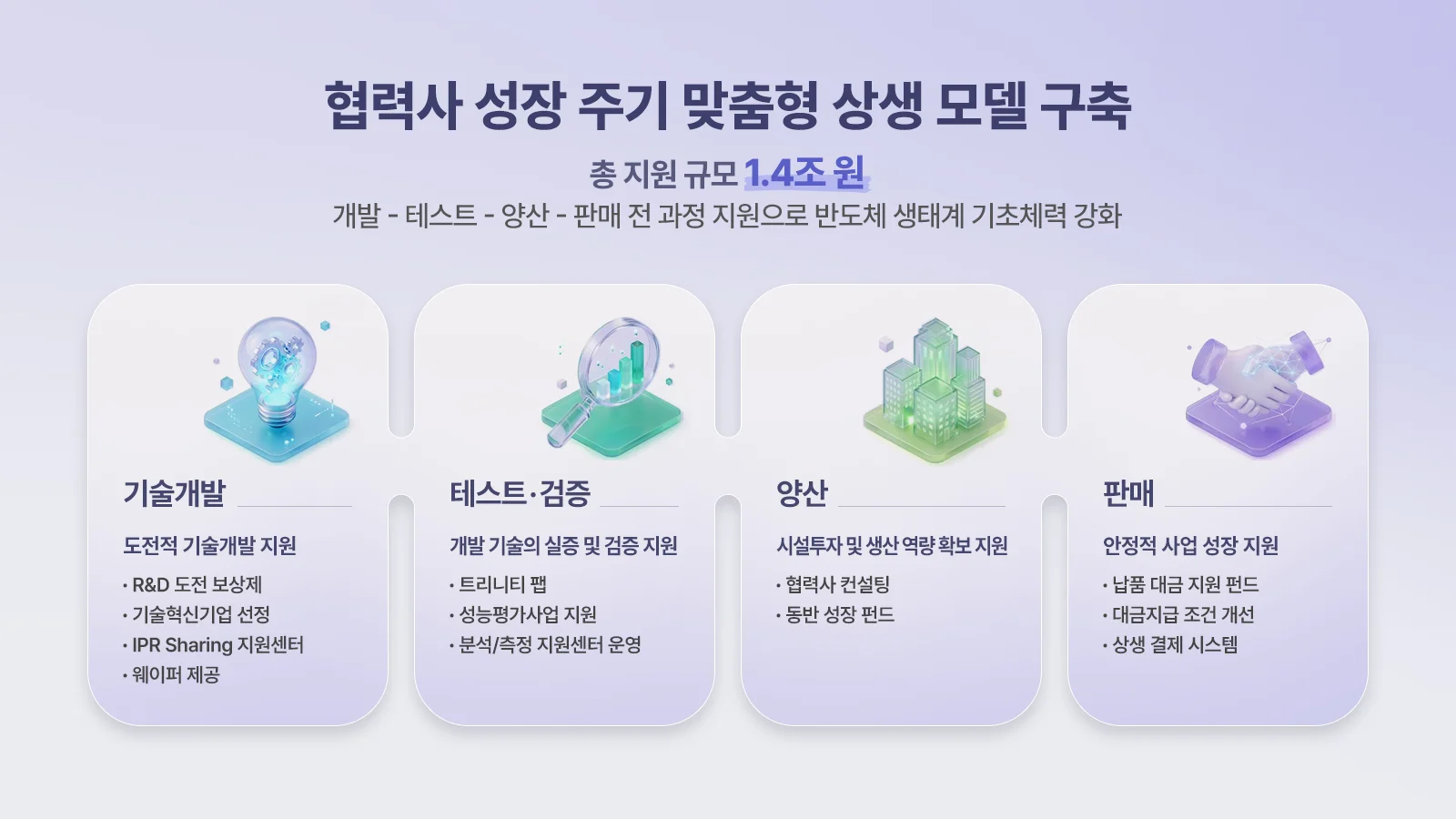 SK hynix partner mutual growth policy graphic for AI memory supply chain suppliers
Image: SK hynix
EDAILY quotes Lee Ki-jeong, CEO of the Trinity Fab Foundation, saying materials, parts, and equipment competitiveness equals chip competitiveness. The site plans:
- ~1,000 pyeong cleanroom with 55 tools (lithography, etch, deposition, clean, metrology) on 12-inch wafers
- ~800 pyeong mass-production feasibility zone plus ~200 pyeong with ~15 tenant cleanrooms
- Seven-year operation at minimal usage fees via an independent nonprofit to protect IP
- Goal to cut 2–3 year qualification cycles by 30–50%
TEMC CEO Yoo Won-yang told EDAILY verification today takes six months to two years because live lines prioritize output, not vendor experiments. TES vice chairman Lee Jae-ho said even passable lab results can fail on real lines, and measurement tools cost 1–5 billion won each.
For AI builders, the friction shows up indirectly: delayed inspection or deposition recipes slow HBM stacks, which tightens GPU bundles. explainx.ai tracked adjacent stress in Samsung’s Taylor HBM base-die bookings, Micron’s Taoyuan pause, and TSMC–Nvidia 3D DRAM talks.
R&D risk sharing and finance layers
SK hynix’s R&D Challenge Reward Program is the novel piece for tool startups: upfront cash plus tiered compensation when projects fail, judged on technical merit and supply-chain contribution. Lee Hyun-cheol, head of procurement strategy, told EDAILY partners felt stranded when development died without payment—a common reason Korean equipment SMEs avoid frontier HBM specs.
The 2 trillion won export supply chain guarantee (newsroom post) pairs SK hynix, commercial banks, and Korea Trade Insurance Corporation so vendors can finance export-scale tooling. That is debt with state backing, not a grant.
Together, the package mirrors Korea’s sovereign AI posture: NVIDIA and MSIT’s November package, Lee Jae Myung’s 2027 budget lines for chips, and memory rivalry with Huawei Ascend sourcing rumors.
What developers should watch
Near term (2026–2027): Trinity Fab is still steel and concrete—89% progress on Yongin Fab 1 per EDAILY. Do not expect instant HBM relief. Watch tenant rules and whether second-tier subcontractors inherit guarantee access.
Medium term: If 30%+ faster qualification holds, Korean etch, clean, and metrology vendors may ship into non-SK fabs, echoing Analog Devices’ edge chip M&A on the packaged AI side.
Financing context: Fed and IMF warnings on advanced-computing debt do not block fab builds, but they matter if equipment SMEs rely on bank guarantees during a sentiment dip.
Geopolitics: US–China export friction keeps Korean memory strategically valuable; supplier resilience is national policy, not charity.
How Trinity Fab differs from a normal pilot line
Most fabs run internal pilot tracks vendors rarely see. Trinity Fab is externalized:
- Nonprofit operator to reduce IP leakage fears
- Government co-investment so rent stays low
- Production-scale tool park, not university lab kits
- Explicit failed-R&D compensation to encourage risky process experiments
That matters when AI memory iterations require new dielectric stacks or bonding chemistries vendors cannot test in isolation.
Demand signal from the supplier survey
SK hynix surveyed ~500 domestic firms; ~270 want access, with ~50 in deeper diligence. Capacity will not serve everyone on day one—expect queueing much like GPU cloud waitlists, but for wafer slots.
Comparison table: who this helps
| Stakeholder | Benefit | Limit |
|---|---|---|
| Materials startups | Real-line data before HBM insertion | May 2027 earliest demos |
| Equipment OEMs | Shared metrology capex | Must meet foundation eligibility |
| SK hynix | Faster qualified vendors, ecosystem lock-in | Capital intensity at Yongin |
| AI cloud buyers | Indirect yield upside years out | No 2026 spot GPU effect |
| Policy makers | Domestic supply chain resilience | Overlaps with other Korea chip funds |
What SK hynix Trinity Fab is not
It is not a new DRAM product launch, not open fab capacity for fabless AI chips, and not a substitute for Sam Altman–Samsung demand debates. It is supplier plumbing for the memory wall in frontier training clusters.
Practical checklist for teams tracking HBM supply
- Bookmark SK hynix newsroom fact-08 for policy PDFs.
- Map your vendor SLAs against 2027 qualification lead times, not 2025 assumptions.
- Cross-read Foxconn AI server earnings context for downstream demand.
- Treat guarantee loans as balance-sheet debt for partners, not revenue.
- Compare Korea’s move with CIA semiconductor espionage reporting when assessing dual-use tooling risk.
Why this story cleared the bar
AI hardware supply chain news directly affects what you can rent, buy, or deploy. SK hynix is a top HBM vendor; verification bottlenecks are the quiet limiter behind headline GPU counts. The November 16 disclosure is primary-sourced (newsroom + on-site press tour per EDAILY), material for weeks, not hours.
Yongin cluster context for infra planners
The Yongin site is not a single fab announcement. SK hynix is stacking four fabs, a supplier industrial complex (~140,000 pyeong, ~50 firms), and now Trinity Fab as a pressure-release valve on qualification queues. EDAILY notes Fab 1 construction at ~89% as of the press tour—meaning 2027 services align with HBM4-era ramps rather than legacy DRAM lines.
If your capacity model assumes Korean memory output grows linearly with announced capex, adjust for tooling lead times: a vendor that wins Trinity Fab slot in 2028 might still wait quarters before a design touches high-volume HBM metal stacks. That lag is why governments co-fund shared metrology: without it, every SME buys redundant 5-billion-won inspectors or gives up on frontier nodes.
Reading the Korean won figures without double counting
International headlines round 1.4 trillion won to “more than $1 billion.” Inside Korea, reporters stress three buckets:
- Direct SK hynix spend on partners (the 1.4T program).
- Trinity Fab capex split with MOE/MOTIE and Gyeonggi.
- Bank-guaranteed loans (2T) that stay on supplier balance sheets.
Analysts modeling SK hynix operating margin should treat (1) and its share of (2) as opex/capex guidance, not (3). Builders sourcing Korean equipment should treat (3) as availability of credit, not subsidy.
Link to AI workshop skills (optional path)
Teams learning supply-chain analytics agents can practice the same multi-source reconciliation this post uses—official newsroom Korean copy, on-site Korean press English, and syndicated wires—in live AI workshops without touching export-controlled fab data.
Historical pattern: when memory leaders fund tool chains
Samsung and TSMC historically relied on captive vendor programs rather than tenant fabs, but Korea’s equipment SME base is thinner at the leading edge than Japan’s or the Netherlands’. SK hynix’s mutual growth push is therefore partly industrial policy: keep domestic etch, clean, and metrology firms alive as China and the United States fight over WFE export classes. None of that shows up in a GPU benchmark, yet it sets the ceiling on how fast HBM stacks can iterate when AI labs request higher stack counts each quarter. Track Trinity Fab tenant announcements in 2027 if your roadmap assumes Korean tool vendors shrink qualification time.