



Y Combinator’s Fall 2026 Requests for Startups is not a meme list of “AI wrappers.” The official framing is blunt: AI is moving into the physical world — education, healthcare, defense, finance, infrastructure, and work itself. For the first time, the RFS includes a request from the sitting U.S. Secretary of the Army.
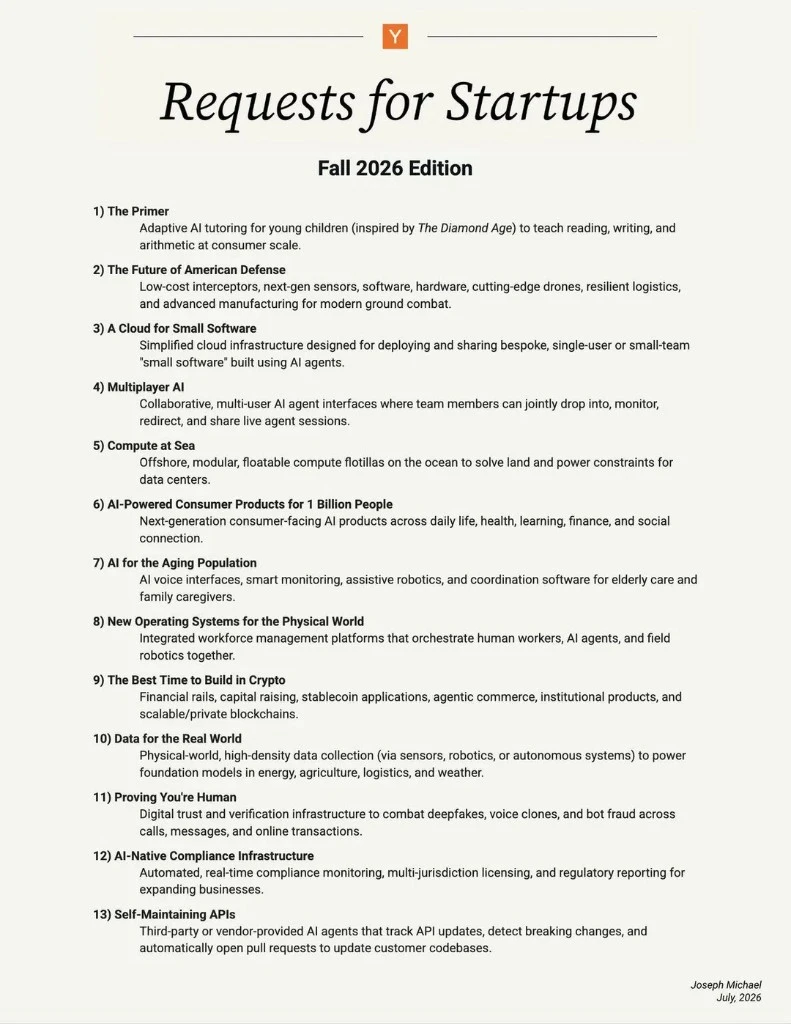 Y Combinator Requests for Startups Fall 2026 — 13 ideas summary
Summary graphic of the Fall 2026 titles. Full essays live on YC’s RFS page.
On-time apply deadline: July 27, 2026, 8:00 p.m. PT. Batch: October–December in San Francisco. This explainx.ai guide is the builder map — all 13 asks, who wrote them, and how they connect to agent stacks you already know.
TL;DR — What People Are Asking
| Question | Answer |
|---|---|
| Theme? | AI → physical world systems |
| Count? | 13 requests |
| Unusual? | First RFS from sitting Army Secretary |
| Deadline? | Jul 27, 2026 · 8pm PT |
| Must build RFS? | No — optional validation |
| Agent-heavy? | Multiplayer AI · Small Software cloud · Self-maintaining APIs |
| Physical-heavy? | Defense · Compute at sea · Field OS · Real-world data · Aging |
| Official source? | ycombinator.com/rfs |
How to Read an RFS (Without Cargo-Culting)
YC’s own disclaimer: RFS is a fraction of what they fund. Treat titles as demand signals, not a homework assignment. The winning move is usually:
- Match your unfair advantage to one essay’s pain (not the title alone)
- Ship a wedge that produces data or distribution the next model generation can’t scrape
- Ignore “AI for X” unless X has a buyer, a workflow, and a retention loop
If you only rename your deck to “Multiplayer AI,” you will lose to teams who already live in the problem.
The 13 Requests — Builder Decode
1. The Primer — Andrew Miklas
Ask: Adaptive AI tutoring for young children — reading, writing, arithmetic — at consumer scale, inspired by The Diamond Age Primer. Supplement teachers, don’t replace them; start as a parent purchase, ambition toward years-long adaptive tutoring.
Why now: One-on-one tutoring quality historically didn’t scale. Frontier models make long-horizon adaptive teaching feel plausible — though Miklas is honest we’re “a long way” from Stephenson’s full Primer.
Builder note: Edtech graveyard is full of “ChatGPT for homework.” Win on curriculum fidelity, safety, longitudinal memory of the child, and parent trust — not chat demos. Related: Claude for teachers.
2. The Future of American Defense — Daniel P. Driscoll (US Secretary of the Army)
Ask: Low-cost interceptors / lower cost-per-kill components; next-gen sensors, software, payloads, hardware for open architectures; drones; resilient logistics; advanced manufacturing — all surviving extreme climates. Army actively funding; “door is wide open.”
Why unusual: A sitting Cabinet-level service secretary writing into YC’s RFS is a procurement signal, not just vibes. Commercial modular open systems beat glacial acquisition theater.
Builder note: Dual-use ethics and export rules matter. Pair ambition with compliance. Context: DARPA VENOM / AI flight, Unitree AS2-W dual-use chatter.
3. A Cloud for Small Software — Pete Koomen
Ask: Infrastructure for bespoke, one-user or small-team software built by agents — as easy to share as a Google Doc. Incumbent clouds optimize Big Software; Small Software needs less complexity, better auth/permissions, and secure sharing of arbitrary code to nontechnical users.
Why now: Agents make personal tools cheap to write; deploy/share is still painful. This is the missing layer between “vibe coded script” and “production SaaS.”
Builder note: Auth, tenancy, and sandboxing are the product. See vibe-coding trust and agent harnesses.
4. Multiplayer AI — Aaron Epstein
Ask: Collaborative agent sessions — teammates drop into, monitor, redirect, and hand off live agent work the way they would a human teammate. End single-player chat boxes and read-only transcript shares.
Why now: Agents run for hours/days; that work was never meant to be solo. Docs/Figma won by going multiplayer; AI hasn’t.
Builder note: This is graph engineering meets product UX — org graphs, shared state, permissions, and audit trails. Also Block Buzz / humans+agents.
Update — September 5, 2026: This exact ask now has a name and a manifesto — Superconductor cofounder Sergey Karayev published the Multiplayer AI Manifesto, arguing private local agent sessions impose a "context tax" and proposing cloud-based, joinable sessions as the fix. Read it alongside GitHub Next's Chopin, which shipped two days earlier for the narrower planning-phase slice of the same problem.
5. Compute at Sea — Francois Chaubard
Ask: Offshore, modular compute flotillas — standardized vessels as a global cloud — to escape land/power/permitting constraints. Ocean as heat sink and space.
Why now: AI demand for megawatts + local opposition to land campuses. Sounds sci-fi; the constraint is real.
Builder note: This is energy, maritime law, and systems engineering as much as GPUs. Don’t pitch “floating H100s” without cooling, interconnect, and ops.
6. AI-Powered Consumer Products for 1 Billion People — Raphael Schaad
Ask: Next consumer giants across getting things done, mobility, learning, health, money, play, social — not just another ChatGPT icon. Intelligence “good enough” and getting cheap enough (token cost falling ~10×/year narrative).
Why now: Platform-shift pattern: web → Google/Airbnb, mobile → Instagram/DoorDash; AI consumer moment “lands very soon.”
Builder note: Consumer AI wins on habit and distribution, not model brand. Differentiation after chat commoditization.
7. AI for the Aging Population — Max Kolysh
Ask: Voice that holds real conversations, monitoring for independence, assistive robotics, caregiver coordination — for a market where ~1 in 5 Americans will be 65+ by 2030 and caregiving labor is scarce.
Why now: Consumer voice UIs fail seniors; AI conversation + robotics finally match the job.
Builder note: Accessibility, reliability, and family multiplayer matter more than demo wow. Privacy is table stakes.
8. New Operating Systems for the Physical World — Charlie Warren
Ask: Workforce platforms that orchestrate AI agents + field robots + humans (with wearables) for construction, maintenance, fleets — not 20-year-old dispatch/track/bill software.
Why now: 80% of workers aren’t desk workers; labor spend dwarfs software spend; end-to-end work data becomes a moat.
Builder note: Routing jobs across agent/robot/human and safety side-by-side is the product. Ties to MotionBricks / Unitree and HIW-500.
9. The Best Time to Build in Crypto — Nemil Dalal
Ask: Capital raising, stablecoins/apps, agentic commerce, trading, institutional products, scalable/private chains — especially in a dispiriting price environment that weeds out yield theater.
Why now: Regulatory clarity improving; fintechs outside crypto already on crypto rails; agents need payment rails; bear markets favor builders.
Builder note: YC’s crypto optimism is structural (rails + agents), not a price call. Agentic commerce is the crossover with Multiplayer AI / Small Software.
10. Data for the Real World — Austin Tindle & Diana Hu
Ask: Dense physical-world data collection (sensors, robotics, autonomous systems) for energy, agriculture, logistics, weather — sparse remote-sensing data isn’t enough for foundation models that control physical systems.
Why now: Sensor costs down; examples like Gecko Robotics and Sorcerer’s autonomous weather balloons.
Builder note: Data flywheels beat model wrappers. Model → control → better collection → better model.
11. Proving You’re Human — Max Kolysh
Ask: Trust infrastructure against deepfakes, voice clones, bot fraud — without destroying privacy. The $25M deepfake video-call wire story as wake-up.
Why now: Seeing/hearing someone is no longer proof. Banks, apps, and calls need a new trust layer.
Builder note: Hard privacy–verification tradeoffs. Winner becomes default check before trust.
12. AI-Native Compliance Infrastructure — Daivik Goel
Ask: Real-time monitoring, multi-jurisdiction licensing, reporting — replace spreadsheet/CCO stacks with AI-default compliance ops for global expansion.
Why now: Compliance cost grows faster than revenue across state/country patchworks; monitoring/report generation is AI-shaped work.
Builder note: Regulators still expect accountability. Automate evidence, don’t hallucinate policy.
13. Self-Maintaining APIs — Harsha Gaddipati
Ask: Vendor or third-party agents that track API changes, detect breaks, and open PRs in customer codebases — Dependabot for APIs, or “install Stripe’s update agent.”
Why now: Agentic coding tools (Claude Code, Devin, etc.) already have codebase access; announcements alone don’t fix broken integrations. AWS anecdote: large share of downtime from unnoticed external API/package changes.
Builder note: Closest RFS to day-to-day Claude Code workflows. Trust, permissions, and blast-radius review are the product. Pair with context engineering — thin durable rules, progressive disclosure for migration playbooks.
Clusters — Where Capital Attention Is Actually Going
| Cluster | RFS items | Shared bet |
|---|---|---|
| Agent product UX | Multiplayer AI, Small Software cloud, Self-maintaining APIs | Collaboration + deploy + maintain |
| Physical systems | Defense, Field OS, Real-world data, Aging, Compute at sea | Robots, sensors, energy, logistics |
| Trust & institutions | Prove human, Compliance, Crypto rails | Identity, money, regulation |
| Mass consumer | Primer, Billion-person consumer | Habit + distribution |
If you’re an explainx.ai reader shipping agents: the agent cluster is the near-term product surface; the physical cluster is where proprietary data moats form; trust is the tax every app will pay.
What to Do Before July 27
- Read the full essay, not the title, on yc.com/rfs
- Write one paragraph: who pays, what workflow breaks today, what data you uniquely capture
- Ship a wedge demo that a stranger can use in under 5 minutes
- For agent products: show multiplayer or automated maintenance, not another private chat
- For physical/defense: show environment + cost constraints you survive
- Apply even if you’re “not on the list” — RFS is optional validation
RFS fit check (paste into your notes):
- Pain is paid weekly by whom?
- Why now (model cost, regulation, hardware, distribution)?
- What proprietary loop do we create in 12 months?
- What’s the smallest multiplayer / physical / trust demo?
Honest Limitations
- RFS is marketing + signal — not a grant award.
- Defense and dual-use ideas carry export, ethics, and reputation risk.
- “Compute at sea” and Primer-scale tutoring are capital- and safety-heavy; most teams should start narrower.
- Consumer “billion people” claims age poorly without distribution.
- Deadlines move; verify on YC Apply before you plan around July 27.
Related on explainx.ai
- Adalat AI joins YC F26 — first nonprofit in ~5 years, courtroom ASR
- What is a software factory? The SMB promise — the process layer next to YC's "cloud for small software" deploy/share ask
- Graph engineering — multi-agent orgs
- What is an agent harness?
- Claude 5 context engineering
- Claude Opus 5 launch
- Opus 5 for developers
- Unitree AS2-W wheel-legged robot
- HIW-500 Unitree G1 dataset
- How do we stop vibe coding?
- Open Weights American AI leadership letter
- Block Buzz — humans and agents in one workspace
- Software for one — the "personal runtime" gap, built today with Claude Code (Aug 1)
- YC Paper Club: Why Robotics Still Isn't Solved (But Could Be Soon) — the technical brief behind why YC keeps betting on robotics despite a decade of "almost there" calls
Sources: Y Combinator — Requests for Startups (Fall 2026) · YC Apply — Fall 2026
RFS text summarized from Y Combinator’s official Fall 2026 page as of July 25, 2026. Re-verify deadlines and essay wording on ycombinator.com before applying.