




Maritime is a Y Combinator Fall 2026 managed cloud that gives every end-user AI agent its own isolated, persistent computer instead of sharing one ephemeral sandbox across customers. Founders Maria Gorskikh and Aryaman Shrivastava opened a Launch HN thread on November 18, 2026 pointing builders to maritime.sh and the YC company profile.
The bet is product shape, not a new model. As multi-tenant personal assistant products, Grok Bot marketplaces, and coding agents move toward one agent per customer, teams lose weeks to provisioning, sleep and wake, login handoffs, and fleet updates. Maritime wraps micro-VMs with billing, monitoring, and SDK methods so startups can sell agent products without operating a miniature cloud provider.
TL;DR
| Question | Answer (per Maritime docs, Nov 2026) |
|---|---|
| What ships? | Isolated agent boxes, optional sandboxes, Linux/Windows desktops, Android phones |
| Entry price | Agent box from $1/month per 2 GB (awake or asleep) |
| Core API | provision({ externalId }) for idempotent per-customer agents |
| Wake latency | About 1 second for agent boxes (site and Launch HN) |
| Trial | 7-day trial; card when first machine starts |
| Founders | MIT NANDA alumni; YC F26 |
Why Maritime exists now
Maritime’s Launch HN post argues that sandboxes are only part of production agents. Builders still need lifecycle management: triggers, schedules, recovery, per-agent spend caps, login handoffs for Gmail or OAuth, and fleet rollouts when you ship a new image.
That matches what explainx.ai has tracked across agent sandbox comparisons, AWS AgentCore identity, and Codex harness hosting. Ephemeral runtimes excel at one-shot code execution. Products like personal assistants or vertical AI employees need state that survives between tasks.
Maritime targets teams selling agents, not hobbyists running a single CLI session. The YC launch names startups that want millions of isolated agents with operations handled for them.
 Maritime marketing visual for isolated agent micro-VM fleets
Image: Maritime (YC F26)
What Maritime manages under the hood
According to the founders’ HN introduction and the SDK reference, Maritime composes:
| Layer | What the platform handles |
|---|---|
| Compute | Micro-VM per agent with persistent disk |
| Orchestration | Sleep, wake, triggers, schedules, rollbacks |
| Observability | Logs, per-agent spend tracking, monitoring hooks |
| Network | Internet policy, private access rules, connection tests |
| Channels | Webhooks with rotate-able invoke tokens |
Maritime also documents Agent boxes, Sandboxes (with Swarms on higher plans), and Computers (Linux, Windows, Android) as separate machine types. Coding flows might use Sandboxes for generated code and Agent boxes for the long-lived customer assistant.
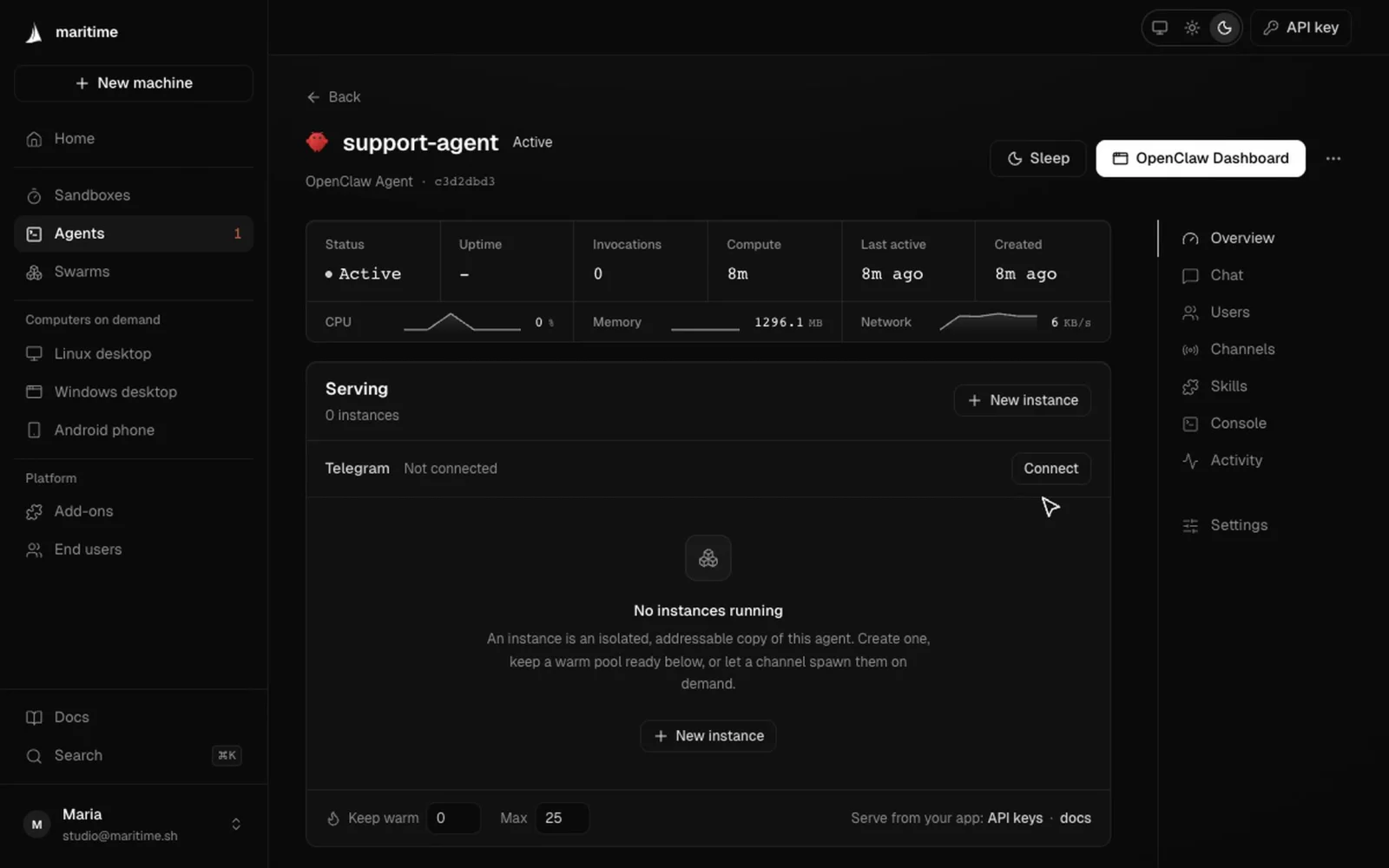 Maritime managed cloud dashboard for production AI agents with per-customer isolated VMs
Image: Maritime (YC F26)
Pricing: agent boxes vs bursty sandboxes
maritime.sh/pricing separates always-addressable agent boxes from per-second sandboxes and desktops.
Agent boxes bill $1 per month per 2 GB of RAM whether the machine is awake or asleep, with unlimited awake hours on that tier and 5 GB disk included. More disk is $0.08 per GB-month. A 4 GB box is $2 per month on that table.
Sandboxes bill while awake at $0.0055 per vCPU-hour plus $0.00275 per GB-hour (the default 2 vCPU / 4 GB size is $0.022/hour on the pricing page). Linux desktops, Windows desktops, and Android phones have higher hourly rates while awake.
Plans (Starter $20, Growth $100, Scale $500, Dedicated $5,000) convert the monthly fee into usage credit and cap how many machines can be awake concurrently (5, 25, 60, and 500 on the public tiers). The trial stops usage at $20 unless you convert on day seven.
For founders comparing unit economics, the headline $1 agent is the contrast to always-on GPU sandboxes. You still pay model API costs; Maritime does not bundle AI credits.
SDK: provision one VM per customer ID
The Agents SDK page is the integration surface most SaaS teams will read first.
The recommended pattern is provision({ externalId, … }): idempotent create-or-return keyed to your customer identifier. That mirrors how billing systems think about seats.
Other methods cover the lifecycle builders asked about on HN:
| Method family | Typical use |
|---|---|
chat, exec, logs | Operate a deployed agent without SSH |
sleep / wake / restart | Cost control and recovery |
setEnv / reloadEnv | Secrets and configuration pushes |
network / testNetwork | Egress policy before production |
webhookToken | HTTP triggers that wake sleeping agents |
Maritime documents TypeScript and Python clients with the same surface. Errors on sleeping agents return Retry-After semantics so clients can backoff, per the SDK notes.
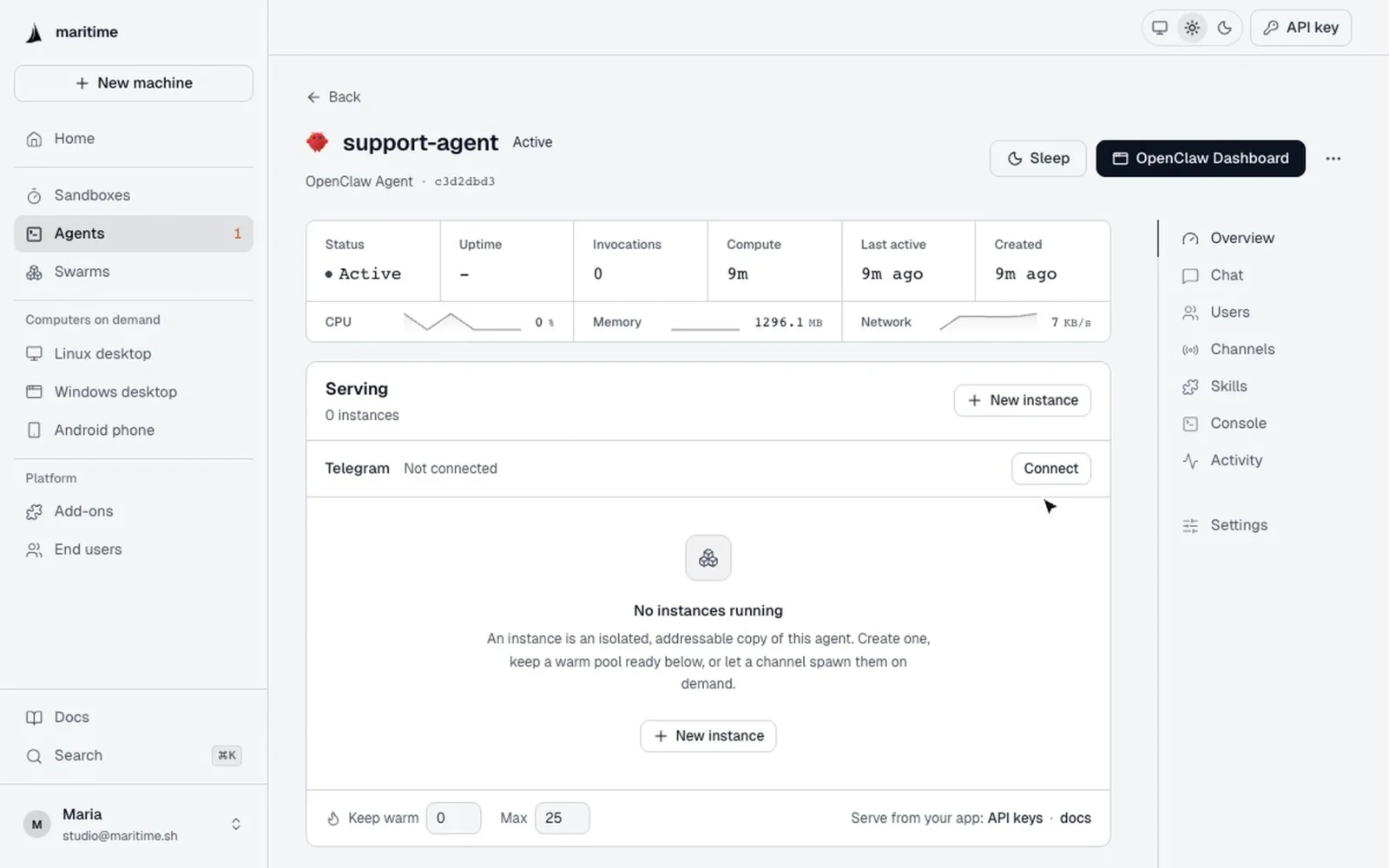 Maritime light-theme fleet dashboard for per-customer agent VMs
Image: Maritime (YC F26)
How Maritime compares to E2B, Modal, and DIY AWS
Maritime maintains maritime.sh/compare.md, a source-linked matrix against E2B, Daytona, Modal, Vercel Sandbox, Boat, Browserbase, Windows 365 for Agents, AWS, and others. Treat it as vendor positioning, not neutral benchmarking, but it states Maritime’s design goal clearly: persistent per-user computers with sleep and wake, not only ephemeral execution.
If you already run agents on Modal or E2B for coding tasks, Maritime is pitching the next layer up when your product gives every customer a named agent with files and logins intact.
Several HN commenters said they self-hosted on AWS with credits. Maritime’s answer in the thread is that lifecycle and cost optimizations (scale-to-zero, copy-on-write images, compressed memory snapshots) are the product, not raw VM rental.
What developers are saying on Hacker News
The Launch HN thread had substantive builder questions by November 19, 2026 UTC.
binsquare framed the category as evolution from VMs to serverless agents, comparing the moment to EC2 and functions.
ATechGuy2 noted lifecycle management on top of micro-VMs as the painful production layer, from experience at a neocloud.
agent_yard asked how spend caps behave when an agent loops mid-task, and how wakeup interacts with checkpoints—questions Maritime’s docs partially answer through stop, sleep, and webhook triggers, but buyers will still stress-test in trial.
stevelacey argued many builders only need Claude Code in tmux plus Telegram, challenging the managed-cloud value prop for solo developers.
MisterMunchkin questioned economics at $1 per month versus YC funding and crowded competitors—a fair founder concern when model APIs dominate margin.
Paraphrase commenter reports as opinion, not verified benchmarks. The thread’s signal is buyer sophistication: teams already run agents and want concrete answers on caps, OAuth, and state—not hype.
How to try Maritime this week
- Create an account at maritime.sh. The site advertises three agents free to start and documents the 7-day trial flow on the pricing page.
- Install the SDK from Maritime’s docs and call
provisionwith a testexternalIdtied to a fake customer record in your staging database. - Deploy your agent image or use a documented template so the container is not a broken bare framework (the SDK warns that empty templates produce bad images).
- Set
networkrules before you connect production OAuth secrets; pair with your existing MCP security checklist if the agent uses tools. - Compare wake latency and monthly box cost against your current sandbox bill on realistic idle patterns.
If you sell agents to enterprises, read Maritime’s Dedicated plan as a signal they expect hands-on onboarding for larger fleets, similar to how Microsoft Agent 365 pitches FinOps for agents.
Machine types beyond agent boxes
Maritime’s marketing site groups Sandboxes, Swarms, Computers, and Android phones as separate products. That matters when your agent needs a browser desktop, a mobile app workflow, or parallel rollout workers.
| Machine type | When builders pick it |
|---|---|
| Agent box | Default per-customer persistent assistant |
| Sandbox | Short coding or tool bursts inside Swarms on Scale+ |
| Linux desktop | Full GUI computer-use loops |
| Windows desktop | Apps that only exist on Windows |
| Android phone | Mobile-only flows or messaging apps |
The agent guide on Maritime’s domain is written for agents themselves, listing prices and API entry points. For human teams, treat it as a machine-readable supplement to the dashboard docs.
Integration patterns that fit Maritime
MCP bridge: Maritime says you can keep your agent logic on your existing backend and use MCP to control a Maritime computer. That mirrors how Home Assistant HA-MCP keeps the brain in Claude while tools run elsewhere.
Bring your own harness: Docs name OpenClaw, Hermes, Claude Agent SDK, and Codex images. If you already standardized on OpenCode 2.0 for coding, you might still park customer-specific state on Maritime while batch coding stays in CI sandboxes.
Marketplace products: Grok Bot-style marketplaces imply many tenants and heterogenous skills. Maritime’s per-externalId provision call is the hook those products need so two customers never share one disk by accident.
Security and trust boundaries
Maritime runs customer agents on its infrastructure. That shifts responsibility: your threat model must cover Maritime’s control plane, webhook URLs that wake agents, and secrets stored via setEnv.
This is not a breach post. If your agents call production APIs, still apply the patterns in Nadella’s compromised-model containment talk and isolate credentials per agent box.
What Maritime does not solve
Maritime does not replace model routing, eval harnesses, or legal review of agent actions. You still need verification workflows and product policies.
It also does not eliminate vendor lock-in: migrating off a hosted per-user VM platform means exporting customer disk state and rebuild images.