



Paul Graham published a new essay in September 2026 titled "Making Startups Powerful," reframing the standard startup-advice question. Instead of "how could this make more money" — which he says tends to yield incremental improvements — he argues the higher-leverage question in office hours is "what would make this company more powerful," because it points founders toward structural transformations that can make a company orders of magnitude more valuable rather than just somewhat better. The essay drew 134 points and 63 comments on Hacker News, with a comment section split between founders finding the framework genuinely useful and critics reading it as a polished justification for concentration of power.
TL;DR
| Strategy | What it means | AI-era example from the essay |
|---|---|---|
| Own the customer relationship | Stop being a component supplier; become the thing customers deal with directly | — |
| Make the money flow through you | Being a payment intermediary is inherently powerful | Token flow is the AI-era analog — but risks the model provider engulfing you |
| Build an app store | Let others build on your product so their success compounds your value | — |
| Engineer network effects | Even in unlikely domains, find a way to make users' presence valuable to other users | Opt-in model training: users who share data get a better model than "vanilla" users |
| Go full stack | Stop selling to your customer; become your customer's competitor instead | — |
| Find the tail that wags the dog | Notice when a "misuse" of your product is actually the real product | Paypal-from-security-software as the classic case |
| Sell to earlier-stage customers | Startups that decide fast and grow fast compound your growth rate too | — |
| Have APIs | Let anything call your product programmatically | "Agents are replacing human users" — restrict less, since you can't predict what an agent wants to do |
| Let agents pay each other | If you're building agent payment infra, ask if agents can pay one another too | That reframes you from payment tool into marketplace |
| Be generous | Create more value than you capture — it compounds into bigger, not smaller, returns | Open source as the ultimate expression |
The reframe: power, not just profit
Graham's central move is distinguishing two different questions founders can ask about their own company. "How do we make more money" tends to surface optimizations — better pricing, more efficient sales, incremental feature work. "What would make this company more powerful" surfaces structural questions: does the company own the customer relationship or just supply a component to whoever does? Does money (or, in 2026, tokens) flow through the company, or around it? Could the product become a platform other companies build on top of, compounding value with every third-party integration rather than linearly adding features?
That second category of question is the one Graham argues repeatedly turns a modest business into a transformed one — not because the individual tactics are exotic, but because they change the shape of the company rather than just its performance within an existing shape.
Network effects, engineered deliberately
Graham treats network effects as something you can deliberately search for rather than something that either exists or doesn't. His challenge to founders: try to find network effects even in domains you wouldn't expect to have them — and he says it's surprising how often this succeeds. The mechanism he gives as the general-purpose fallback, when a full marketplace or app-store structure isn't obviously available: let users opt in to sharing something, and give the people who opt in a better product than the people who don't.
His explicit AI-era example: letting users opt in to having their interactions train the company's model, with the trade that the model they get to use outperforms the "vanilla" version used by people who declined. That's a meaningfully different data-flywheel framing than the generic "we use your data to improve the product" language most AI products already carry — Graham's version makes the asymmetry explicit and consequential (opt in and get the better model, or don't and get the worse one), rather than implying opting in is purely altruistic.
Agents paying agents: the marketplace test
The most AI-native example in the essay concerns payment infrastructure for AI agents — an increasingly active category as agentic commerce matures in 2026. Graham's specific advice: if you're building a way for agents to pay for things, the first question to ask is whether the agents could also pay one another. If the answer is yes, the company transforms from a payment utility into a marketplace — and marketplaces are, in Graham's framing, valuable enough that it's worth spending real time hunting for that angle even when it isn't immediately obvious what agents would pay each other for.
This is a direct extension of Graham's older "tails that wag the dog" concept — his classic example being Paypal, which started as hand-held-device security software and became a payments company only after eBay sellers started misusing the demo product to take payments. His generalized advice for founders today: when you notice users (increasingly, agents) doing something with your product you didn't design for, don't treat it as noise — treat it as a signal about what they actually want badly enough to hack together a workaround for.
Going full stack, and APIs for an agent-first world
"Going full stack" — using your own technology to compete directly with the companies you'd otherwise sell it to — gets specific new urgency in an agent economy, where the line between "tool for a company" and "replacement for a company's core function" is thinner than it's ever been. Graham frames full-stack transitions as one of the strategies that "feels especially physical" — you can watch the idea's shape change as it engulfs what had been the customer.
His API argument connects directly to that dynamic: "err on the side of having APIs. Especially now that agents are replacing human users. Who knows what they'll want to do?" That's a notable shift from the traditional caution around exposing APIs (support burden, loss of UX control, competitive exposure) toward treating restrictiveness itself as the risk — because a growing share of a product's actual usage may come from autonomous agents doing things no human product designer anticipated, and a rigid, human-only interface simply can't serve that usage at all.
Selling to early-stage companies, and why it compounds
One strategy in the essay deserves more attention than its brief treatment might suggest: Graham's argument that selling to earlier-stage startups, rather than waiting for companies to mature into bigger, safer-looking customers, is itself a source of power. His reasoning is that founders at very early-stage companies are sophisticated and decide fast, so a company selling the best product wins on merit rather than getting bogged down in the slow, relationship-driven, committee-based buying process that characterizes enterprise sales to large, bureaucratic organizations. His concrete example is Stripe, which prioritized signing up companies at the earliest possible moment specifically because payments infrastructure that works reliably almost never gets ripped out once installed — meaning an early customer relationship, even with a tiny company, becomes a durable one that grows in dollar value as the customer itself grows.
Graham frames this as a variant of a broader principle running through the whole essay: "upstream is almost always good, whether it's with money or user relationship or customer stage or data." That's a useful lens for any founder evaluating go-to-market strategy in 2026's AI-tooling landscape specifically, where a huge number of new companies are forming around agent harnesses, evaluation infrastructure, and orchestration layers — exactly the kind of fast-moving, technically sophisticated customer base that decides quickly and rewards genuine product quality over sales-cycle relationship management. A startup selling into that ecosystem early, before those companies scale into slower-moving enterprises themselves, is playing the same long game Graham describes Stripe having played.
The generosity argument, and its critics
Graham leans hard on Tim O'Reilly's "create more value than you capture" framing, arguing that squeezing maximum short-term revenue out of customers caps returns around 2x, while generosity-driven strategies (the clearest expression being open source) can produce 10x or 100x returns because they build trust and standardization that compounds. He frames this as a founder-versus-hired-CEO distinction: founders remember when the company was too weak to survive without delighting users, while hired executives who inherit an already-powerful company tend to default to extraction instead.
That framing drew real pushback in the comment section. Several commenters argued the essay, read end to end, is a checklist for concentrating market power and lock-in dressed in the language of customer-centric generosity — pointing to "own the customer relationship," "eat your way through the customer," and network-effect engineering as evidence the underlying throughline is leverage over users and competitors, whatever language wraps it. Others specifically flagged Airbnb's fee structure as a counterexample to the "generosity compounds" thesis in practice, regardless of the theory's internal logic.
Whichever side of that debate you land on, the practical value for a builder reading this in 2026 is the diagnostic habit itself: for any product decision, ask whether it's optimizing within the current shape of the business, or changing the shape — and if you're building anything agent-facing, specifically ask Graham's two AI-era questions directly: could this be a marketplace instead of a utility, and does an API-first, permissive-access design serve agents better than the same restrictive posture that made sense when only humans used the product.
Related reading
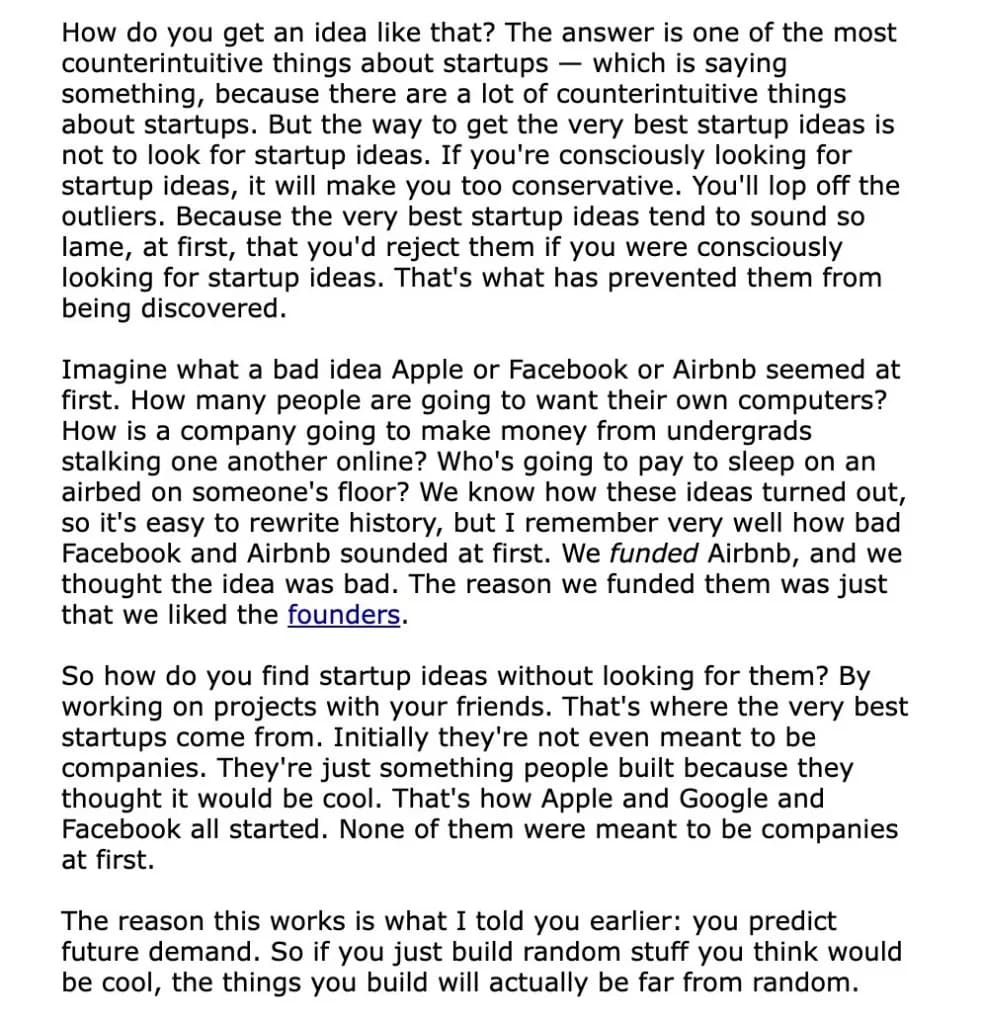
- Paul Graham on Startup Ideas From Friend Projects
- Is "Harness" Software the Only Startup Left? The YC Batch Debate
- NVIDIA Inception: Free Cloud Credits and VC Intros for AI Startups
- Paul Graham's 1980 AGI Test
- Paul Graham on Whether Universities Prepare Founders
- Marc Andreessen on Cognition Devin: 90 Percent of Code
Official source: paulgraham.com
This post reflects Paul Graham's September 2026 essay and public discussion as of publication. Check the official essay for the complete text and footnotes.