



Related — August 27, 2026: This argument now has a chart-eligibility test case — ARIA's ban on wholly AI-generated songs needs signed provenance at creation time, because post-hoc detection of AI audio cannot carry the enforcement burden.
The reaction to Claude watermarking was almost uniformly negative, and most of it was aimed at the wrong target. Anthropic began marking all Claude text output in August 2026, and within a day the discourse settled on a handful of positions: it is surveillance, it degrades output, it claims ownership of your work, it is the EU's fault, cancel your subscription.
Some of those are wrong on the facts. Some are right but incomplete. What almost nobody wrote was the case in favour — which is stronger than the volume of criticism suggests, and worth stating properly even if you end up disagreeing with it.
This is an argued position, not a neutral summary. Our announcement coverage and mechanism explainer carry the skeptical analysis; this piece deliberately makes the other case.
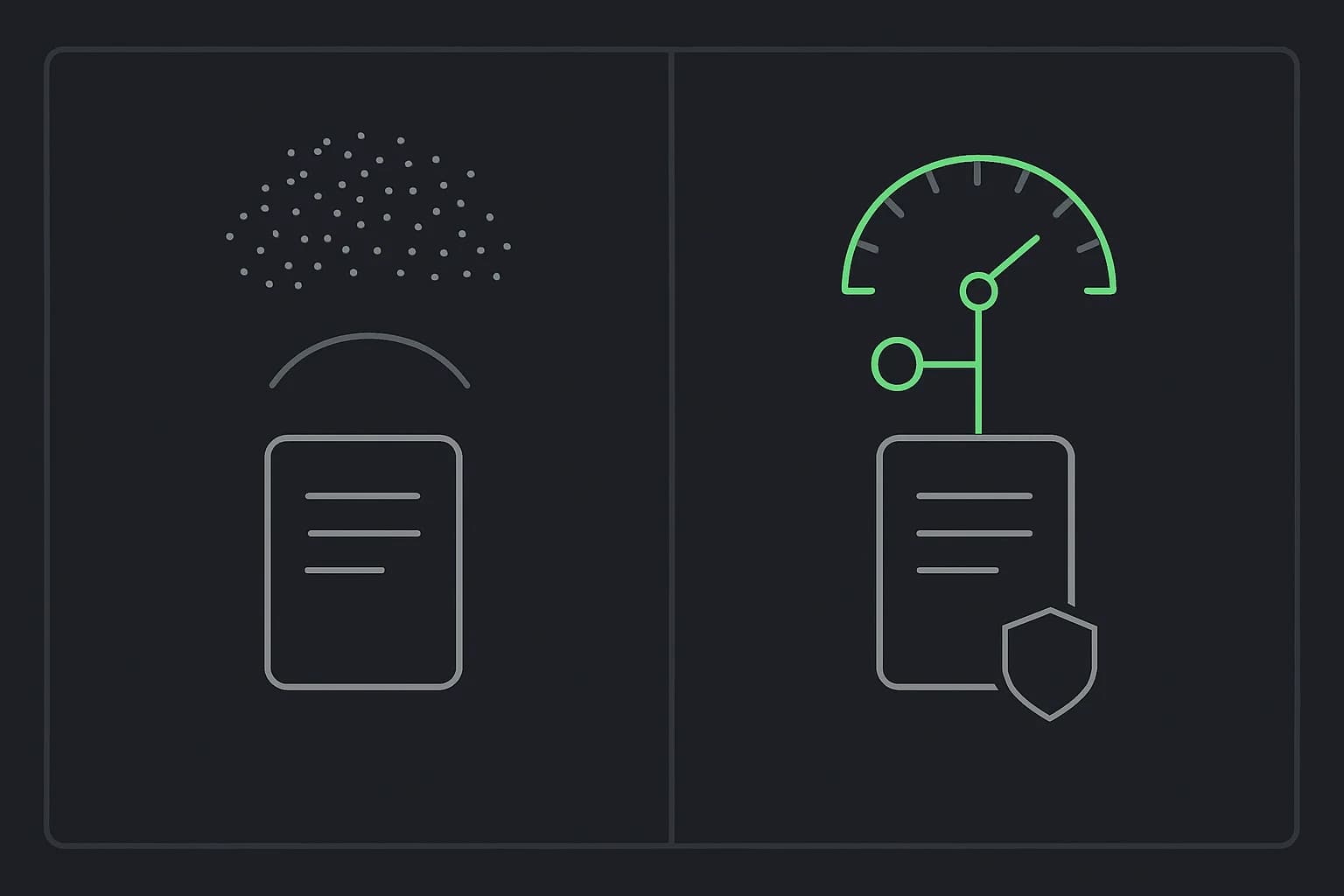
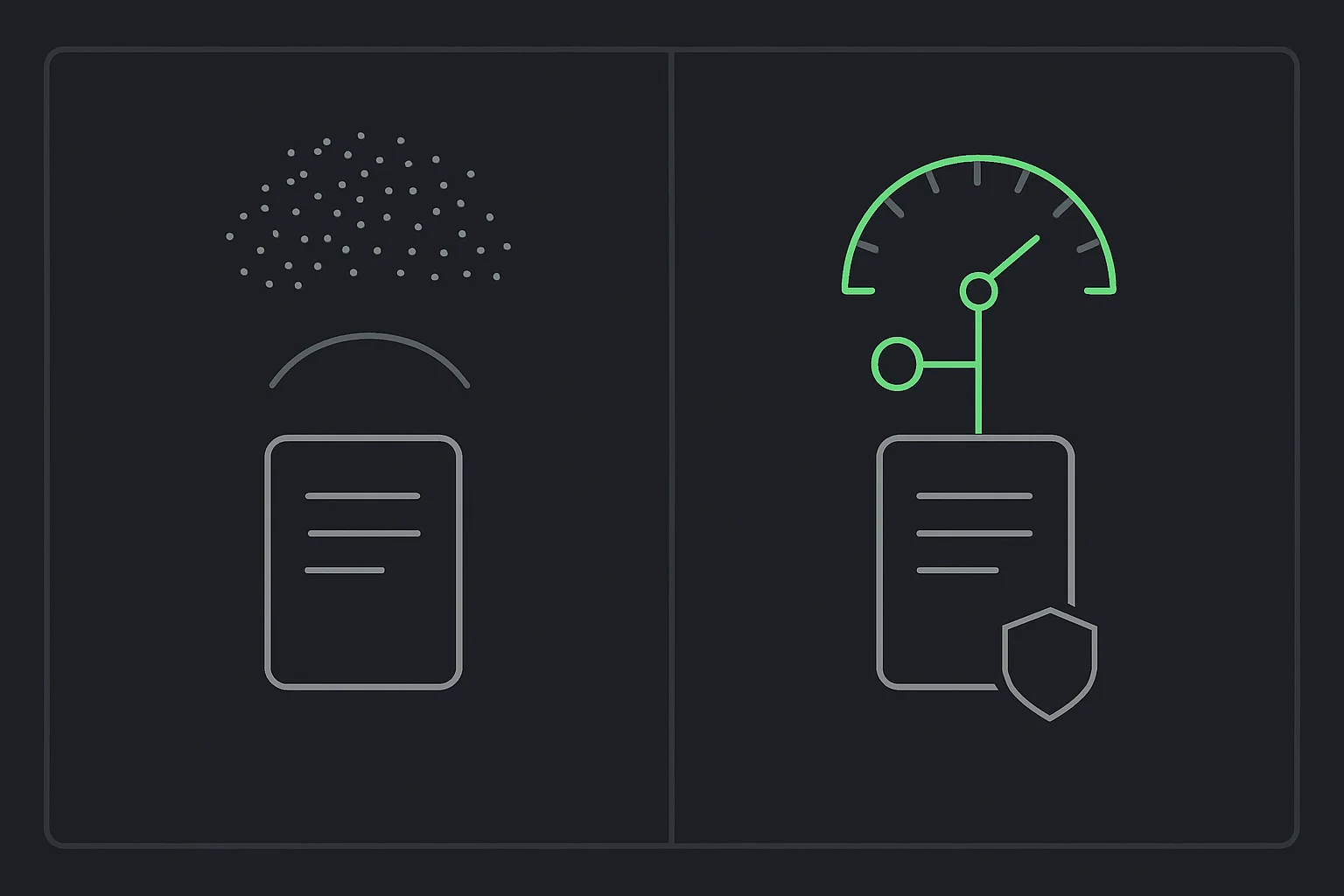 Diagram contrasting a vague probabilistic AI accusation with a keyed provenance signal that supports a human authorship claim
TL;DR — the six arguments
| Argument | The short version |
|---|---|
| 1. Copyright | Human authorship is what copyright protects; distinguishing it helps human creators |
| 2. Defends the accused | It replaces vibes-based detectors that already produce false positives |
| 3. Saturation defuses stigma | When most content is marked, the mark stops being an accusation |
| 4. It prevents worse rules | The alternatives are logging, ID checks, and licensing regimes |
| 5. It funds itself | Distillation defence gives labs a reason to build detection users get free |
| 6. It enables permission | Institutions ban AI when they cannot verify anything; provenance is the alternative to bans |
Before the arguments below, it helps to actually see the mechanism the whole debate is about — try the interactive version:
A model doesn't know "the next word" — it has a shortlist with preferences. Roll the dice and watch it land somewhere on the shortlist, matching the odds.
The results of the study were quite …
A teaching model with illustrative parameters — not any provider's actual watermarking scheme.
1. It strengthens human copyright claims, not the lab's
The most repeated objection — that Anthropic is staking a claim on your work — has it exactly inverted.
Copyright in major jurisdictions attaches to human authorship. Purely machine-generated output is generally not registrable. That is settled enough to plan around, and it means the boundary between human and machine contribution is a boundary that human creators have a direct interest in being able to draw.
If you wrote a novel and used a model to fix comma splices, your position is stronger, not weaker, when there exists a mechanism that distinguishes "an AI touched this text" from "an AI wrote this text." The alternative — a world where nobody can tell, and where any work can be alleged to be machine-generated — is the world in which your registration is hardest to defend.
Marking does not transfer ownership. Anthropic's terms assign output rights to the customer, and a provenance signal creates no copyright interest whatsoever. The r/claude thread that framed this as "our data, Anthropic's mark" got the second half right and the implication wrong.
There is a second copyright angle that cuts in creators' favour too: detecting unauthorized training. Rights holders have spent three years unable to prove their work was ingested. A world with robust output provenance is a world where that class of claim gets easier to evidence, not harder.
2. It is a better deal for the falsely accused
This is the argument that should have led every defence of watermarking, and it went almost entirely unsaid.
The status quo it replaces is not "nobody accuses you of using AI." The status quo is classifier-based detectors — tools that guess from sentence-length variance and phrasing patterns, that were deployed at scale in education, and that produced false positives with real consequences for real students, particularly non-native English writers whose prose reads as more uniform.
Against that baseline, a keyed statistical watermark is a strict improvement for the person being accused:
- The false-positive rate is derivable, not guessed. You know the null distribution exactly, so the probability of a hit on unwatermarked text is a computed number rather than an empirical hope.
- The vendor has stated the limits in writing. Anthropic's own documentation says a mark means content "may have been processed by Claude," not authored by it. An engineer conceded on the record that the mark "is not perfect, you can edit it." Those sentences are a defence exhibit.
- A negative result is explicitly meaningless. Which removes the "the detector cleared everyone else and flagged you" dynamic.
If you are worried about being wrongly accused of AI use, the thing to want is a better signal with published limitations — not the continuation of a worse one with none.
3. Everyone uses AI, and that is an argument for marking
The objection goes: soon everything will be marked, so the mark will mean nothing.
Correct, and that is a feature.
A signal that fires on a small minority functions as an accusation. A signal that fires on most professional output functions as metadata. Nobody experiences EXIF data as an indictment of a photograph, because every photograph has it. When AI assistance is genuinely ubiquitous — and in 2026 it very nearly is across writing, code, and design — a universal mark stops carrying stigma by simple arithmetic.
The awkward transition period is real. Right now marking is partial, so a hit still feels like being singled out. But the direction of travel resolves that rather than worsening it, and the people arguing "everyone uses AI, so this is unfair" are describing the exact condition under which it stops being unfair.
4. The alternatives are much worse
Watermarking exists because of EU AI Act Article 50 transparency obligations and parallel California legislation. That much the critics have right. What they skip is what else could have satisfied those obligations.
The menu of mechanisms that achieve "AI-generated content is identifiable" includes:
| Mechanism | What it costs you |
|---|---|
| Output watermarking | A statistical mark in generated text. Collects nothing about you |
| Mandatory prompt and output logging | Your conversations retained and inspectable |
| Identity verification for model access | Your legal identity attached to every generation |
| Licensing regimes for generative systems | Fewer providers, higher prices, permission to build |
| Mandatory visible disclosure labels | Every AI-assisted document carries a banner |
Marking is the only entry on that list that satisfies the regulatory goal without collecting a single additional thing about the user. It happens in the sampler, it requires no account linkage, and per the reported design there is no per-user keying. Compared to a regime where your prompts are retained for inspection, an invisible statistical tilt in word choice is a remarkably light-touch answer.
People treating this as the maximally invasive outcome have not looked at what was on the table.
5. Distillation defence is what pays for it
A frequent accusation: they are not doing this for transparency, they are doing it to catch competitors training on their outputs.
Probably partly true. Also fine — and structurally load-bearing.
Detection infrastructure is expensive to build and, as we argue in whether watermarks are monetisable, very hard to sell. Nobody is going to fund a high-quality provenance system on the strength of per-check API revenue from individuals. The thing that makes a lab willing to build it properly is that it also protects a multi-billion-dollar training investment.
That alignment is why users get a detection API at all. A purely altruistic transparency product would have been under-resourced and half-shipped. A dual-purpose one gets engineering attention.
6. Provenance is the alternative to outright bans
Watch what institutions do when they cannot verify anything. OpenJDK banned AI-generated contributions outright. Journals ban AI-assisted submissions. Employers write blanket prohibitions. Every one of those bans exists because the alternative — permitting AI use under conditions — requires being able to check whether the conditions were met.
Blanket bans are worse for people who use AI responsibly than disclosure regimes are. They are also unenforceable, which means they mostly punish the honest.
A working provenance layer is what makes conditional permission possible: use AI for drafting, disclose it, do not use it for the analysis section. That policy is writable only in a world where something can be verified. Every institution currently choosing prohibition is doing so partly because verification does not exist.
The same logic drives platform decisions like Spotify demoting AI-generated artist profiles rather than banning AI music outright. Provenance enables the graduated response. Its absence forces the binary one.
Where the critics are right
An honest case has to concede the strong counterarguments, and there are two.
The incidence is inverted. Marking lands on people using official APIs for ordinary work and misses anyone determined to avoid it, because open-weight models control their own sampler and produce no mark at all. The propaganda operations and content farms most often invoked to justify marking are precisely the users least affected. This objection is correct and has no technical answer.
Downstream misuse is near-certain. A probabilistic, authorship-agnostic signal will be read as proof by schools, employers, and platforms, exactly as the previous detector generation was. Anthropic documented the limitations clearly. Almost nobody downstream will read them. The harm from that misreading is real, and "the documentation said otherwise" is thin comfort to someone it happens to.
Both are reasons to demand published false-positive rates, appeals processes, and policy language before deployment. Neither is a reason to prefer the world with no provenance at all — which was a world of unverifiable accusations, unenforceable bans, and detectors that guessed.
Bottom line
The backlash treated watermarking as something being done to users. On the strongest reading it is closer to infrastructure being built for them: it supports human authorship claims that copyright actually turns on, it replaces guessing detectors with a signal that has stated limits, and it is the least invasive mechanism that satisfies a transparency requirement which was going to be satisfied one way or another.
That does not make it well-designed, well-priced, or evenly applied — it is none of those yet. But "this is a first step with real problems" and "this is surveillance that steals your work" are very different claims, and the second one dominated a conversation it did not deserve to win.
Update — October 2, 2026: The provenance argument now has a biology chapter — SynthID Bio marks AI protein designs so synthesis screeners and databases can check origin.
Update — August 17, 2026: John Gruber made the strongest version of the "steals your work" case yet — arguing the watermark makes every piece of Claude's writing measurably worse, on purpose. The technical rebuttal it drew, and where each side actually has a point, in the full breakdown →
Related on explainx.ai
- C2PA Android cameras broken: Pixel AL2 forged anyway — what camera C2PA can and cannot promise
- Anthropic is watermarking Claude text — the announcement and the backlash this piece answers
- How AI text watermarking actually works — the mechanism behind every claim here
- Will every AI model watermark its output? — the open-weight objection, taken seriously
- Are AI watermarks monetisable? — why distillation defence funds the whole thing
- How to detect a Claude watermark — what verification looks like today
- LLM text detection with classical ML — the worse baseline this replaces
- OpenJDK bans AI-generated code — what happens when verification is impossible
- Spotify labels AI artists — provenance enabling a graduated response instead of a ban
- What AI watermarking changes for developers · for marketers
- EU AI Act and US policy: complete guide — the obligations and the alternatives to marking
- What actually changes after the EU AI Act — what enforcement actually changed, and the penalty tiers behind it
- Niu Lai: the hand-drawn Chinese film that went viral for not being AI — provenance without a watermark: audiences reading visible flaws as proof of human authorship
Primary sources: Anthropic Help Center, "How Claude marks AI-generated content" (August 11, 2026) · Anthropic engineering commentary on X (August 11–12, 2026) · EU AI Act Article 50(2) Code of Practice on Transparency of AI-Generated Content
Accurate as of August 12, 2026. This post argues a position deliberately; see the linked coverage for the skeptical analysis. Statements about copyright reflect the general human-authorship requirement in major jurisdictions and are not legal advice. Follow @explainx_ai for updates.