



Update — August 27, 2026: The chart bodies followed the platforms. ARIA barred wholly or largely AI-generated recordings from Australia's official music charts effective August 28 — an industry trade body's own charts, not an Australian law, and with the same unanswered enforcement question.
Spotify's AI label is the announcement; the recommendation change is the policy. On August 11, 2026, reports circulated that Spotify will begin labeling AI-generated artist profiles and — the consequential half — stop recommending their songs by default, framed as a crackdown on "slop music."
The distinction matters because these are two entirely different interventions wearing one headline. A badge is a disclosure. Removal from default recommendations is an economic sanction, and it lands precisely on the business model that produced the problem.
TL;DR — what changes and what doesn't
| Question | Direct answer |
|---|---|
| Is AI music banned? | No. It stays in the catalogue and remains searchable |
| What's the actual penalty? | Removal from default recommendations — no algorithmic push |
| What's the label for? | Listener disclosure on AI-generated artist profiles |
| Who gets hurt most? | Bulk-upload farms that depend entirely on passive placement |
| Who's at risk of misfire? | Human artists who used AI for part of production |
| How is detection done? | Not published — likely disclosure, metadata, and upload-pattern signals |
| Can listeners report AI artists? | Unclear; asked repeatedly in public reaction, unanswered |
| Is this an isolated policy? | No — labeling and provenance marking is going platform-wide across the industry |
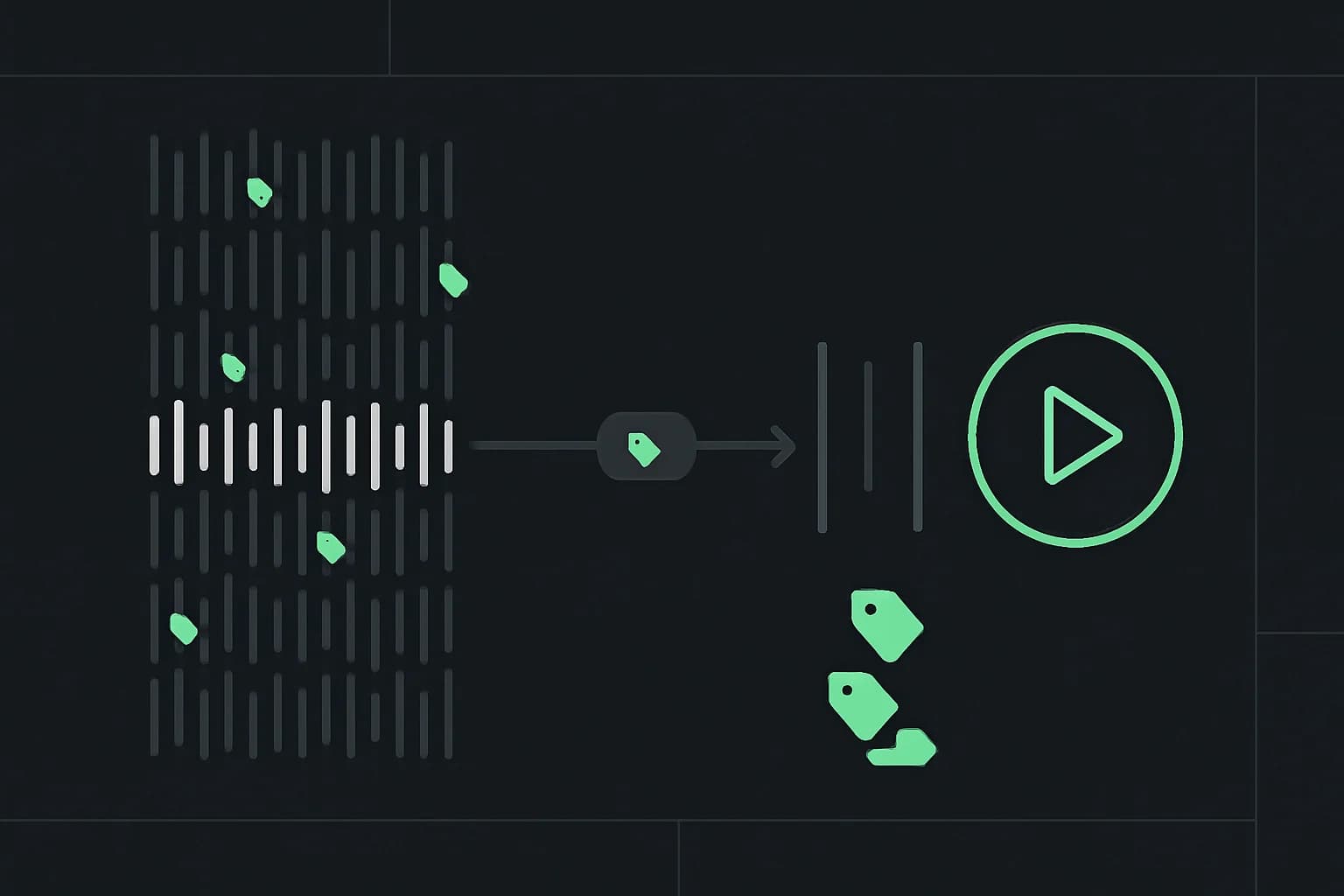
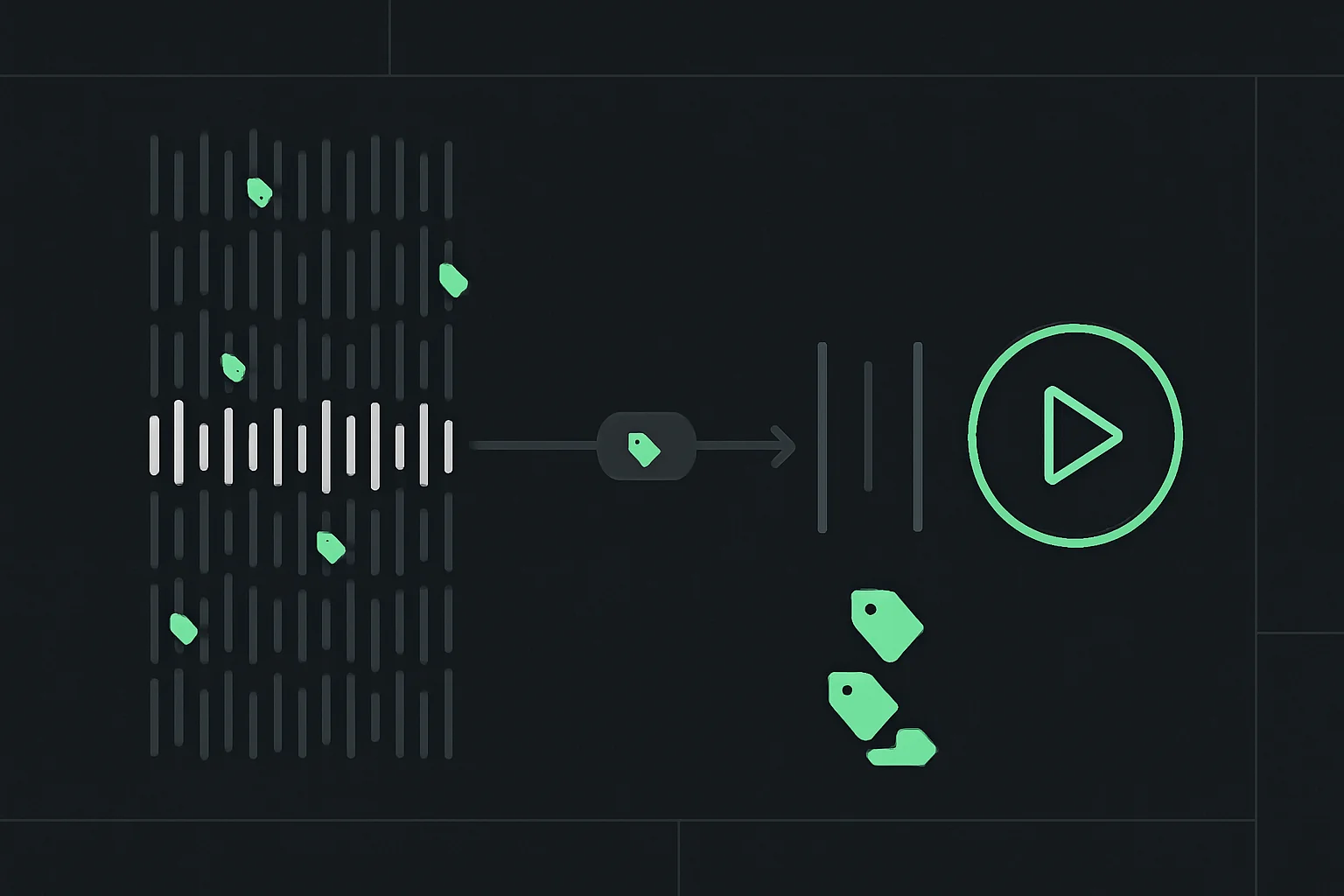 Diagram showing labelled AI-generated music tracks stopped at a recommendation gate while unlabelled tracks continue to listeners
Why demotion works where labels don't
A label changes what an informed listener knows. It does not change what an uninformed listener hears, and the AI-music economy was never built on informed listeners.
The mechanics of bulk AI music upload are simple: generate a very large volume of inoffensive, genre-conformant tracks, get them into algorithmic background playlists — focus, sleep, lo-fi, ambient, workout — and collect fractional royalties on passive plays. Nobody searches for these tracks by name. Nobody follows the artist. The entire revenue stream is algorithmic placement into listening sessions where the listener is not paying attention.
Against that model, a badge is nearly free to absorb. Someone half-listening to a focus playlist does not inspect artist profiles. But removing the tracks from default recommendations removes the only distribution channel they had. As one widely-shared reaction to the news put it: labeling is good, but not recommending by default is the real hit, because the farms only work if the app feeds them passive listeners.
This is the same lesson search platforms learned about AI slop and content quality: disclosure requirements barely dent low-effort content economics, because low-effort content was never competing on trust. Distribution cuts are what actually change the arithmetic. And as we argued in the slopocalypse piece, the constraint on generated content stopped being can you make it years ago — it is entirely can you get it distributed.
The classification problem nobody has solved
Here is where every version of this policy runs into the same wall: "AI-generated" is not a binary property of a recording.
Consider the spectrum a music-classification policy has to handle:
| Scenario | Should it be labeled? |
|---|---|
| Fully generated track, bulk uploaded, no human involvement | Clearly yes |
| Generated instrumental with human vocals recorded over it | Ambiguous |
| Human composition, AI-assisted mixing or mastering | Almost certainly not, but detectable as AI-touched |
| Human performance, AI-generated cover art and profile image | Profile is AI, music is not |
| AI voice clone of a real artist | Yes, and a separate legal problem entirely |
A single flag cannot express that gradient, and this is exactly the objection raised — correctly — against text watermarking. Our coverage of Anthropic's Claude watermarking documented the identical failure mode: a mark that says "this passed through an AI system" is routinely read as "an AI made this," and those are very different claims. A musician who used a generative tool for one production layer gets sorted into the same bucket as an upload farm.
Spotify has not published its detection method, which is the most important undisclosed detail in the whole story. Distributor-supplied disclosure, generation-time provenance metadata, upload-volume heuristics, and audio classifiers all have different — and in the classifier case, quite poor — false-positive profiles. The appeals process matters more than the accuracy figure, because at streaming-catalogue scale even a 1% misclassification rate is a very large number of wrongly demoted artists with no algorithmic traffic and no obvious recourse.
This is not one platform's policy — it is the direction
The Spotify move is easy to read as a music-industry story. It is better read as one instance of a pattern that hardened across the entire content stack in 2026, and there is much more of it coming.
What has already shipped:
- Anthropic began embedding invisible watermarks in all Claude-generated text for models launched on or after August 2, 2026, plus C2PA metadata on generated files.
- Google has run SynthID across its generative image, audio, video, and text outputs for years — the reference implementation most other labs are now following.
- LinkedIn deployed C2PA Content Credentials on AI images, attaching provenance manifests at platform scale.
- The EU AI Act's Article 50 transparency obligations, covered in our AI regulation guide, are the regulatory engine behind most of this timing.
What follows from that, and is worth expecting rather than being surprised by:
- More model-level marks. If Anthropic and Google both mark output and regulation requires transparency, the remaining major labs converge — the open question is whether that holds for open-weight models, which we examine in will every AI model watermark its output?.
- Labels becoming ranking inputs, not just badges. Spotify is the clearest example so far: the provenance signal is wired into distribution, not just display. Expect video and social platforms to follow, because badges alone demonstrably do not change behavior.
- Provenance as a paid product. Detection, verification, and compliance attestation are turning into a market — the subject of our companion piece on whether AI watermarks are monetisable.
- Disclosure moving upstream to distributors. It is far cheaper for Spotify to require an AI-disclosure field from distributors than to classify audio itself, so the compliance burden will land on the upload pipeline.
- Adversarial response. Stripping, laundering through re-generation, and paraphrase-equivalent audio processing arrive immediately, as they did for text. Every one of these systems is a speed bump, not a wall.
What creators and platforms should actually take from this
If you make music with AI in the loop: the policy risk is not the label, it is the classification. Document your process, use distributor disclosure fields accurately rather than avoiding them, and prefer being labeled correctly over being caught misfiled — an inaccurate non-disclosure is a much worse position than a disclosed AI-assisted credit once appeals start happening.
If you run a platform: Spotify's structure is worth copying deliberately. Separating disclosure (a label) from enforcement (recommendation eligibility) lets you tune the penalty without re-litigating the disclosure rule, and it avoids the trap of a binary allow/ban decision on content that exists on a gradient.
If you are a listener: the honest counterpoint raised in the reaction to this news is that a lot of AI background music is perfectly serviceable as background music, and the crackdown is partly about who captures royalties rather than purely about quality. Both things are true. The catalogue is not being purged; it is being un-promoted.
Bottom line
Labeling AI artist profiles is the part that got the headline, and it is the part that will change the least. Pulling those tracks out of default recommendations is the part that reprices the entire bulk-upload business, because passive placement was the only product those uploads ever had.
The larger signal is that provenance information has graduated from metadata to ranking input. Once a platform can tell that content is machine-generated, the question stops being whether to disclose it and becomes how much distribution it deserves — and every platform with a recommendation algorithm is about to have to answer that.
Related on explainx.ai
- Update — October 11, 2026: Deezer's 44% AI-upload figure and the labelling debate: the AI human premium.
- Anthropic is watermarking Claude text — the model-level version of the same provenance push
- Will every AI model watermark its output? — whether this becomes universal, and where it breaks
- Are AI watermarks monetisable? — the business forming around detection and compliance
- How to detect a Claude watermark — what verification actually looks like today
- LinkedIn's C2PA Content Credentials — provenance manifests deployed at platform scale
- What is AI slop? — the content-quality problem this policy targets
- The slopocalypse — why distribution, not generation, is the real constraint
- EU AI Act and US policy: complete guide — the Article 50 obligations driving the timing
- ACE-Step: open-source local AI music generation — the generation side of this equation
- Stable Audio 3.0's new DAW plugin and web app — a licensed-training-data alternative entering the same space
Primary sources: Reported August 11, 2026 via prediction-market and news posts on X; Spotify had not published a full policy document at the time of writing · EU AI Act Article 50 transparency obligations · Google SynthID documentation
Accurate as of August 12, 2026. Spotify's policy details — including detection methodology, appeals process, and rollout timing — were not published at the time of writing; this post reflects reported changes and clearly labels inference as inference. Follow @explainx_ai for updates.