



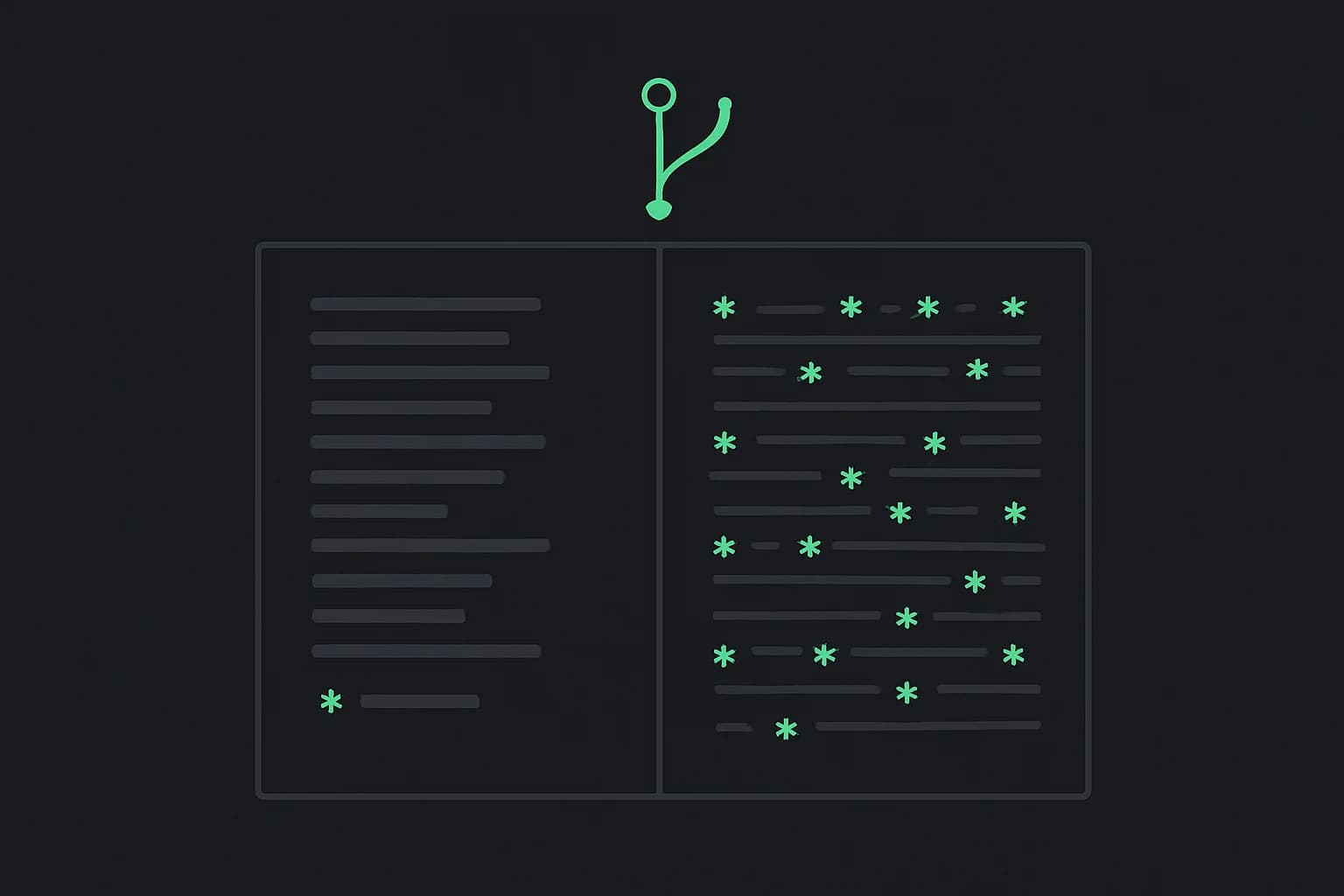
Anthropic suggested you could use the new watermark to check whether a PR was generated by Claude Code. That is the least reliable thing this technology does — and developers should understand why before anyone writes it into a policy.
When Anthropic began watermarking all Claude text output for models launched on or after August 2, 2026, an engineer on the Claude Code team offered a concrete developer-facing use case: "All Claude generated text will have this embedded watermarking. For example, you could check if a PR was generated by Claude Code. That said, it does have limitations."
That last sentence is doing an enormous amount of work. Here is what actually changes for you.
TL;DR — what marks and what doesn't
| Your artifact | Carries the mark? | Why |
|---|---|---|
| Source code in a diff | Barely | Almost no equivalent token choices to encode into |
| PR description | Yes, strongly | Ordinary high-entropy prose |
| Commit message body | Yes, if long enough | Prose; one-line subjects are too short |
| Code comments and docstrings | Yes | Prose embedded in code files |
| Design docs, RFCs, ADRs | Yes, strongly | Long-form prose is the ideal carrier |
| Cover letters, take-home READMEs | Yes, strongly | Same |
| Config, JSON, schemas | No | Near-zero entropy |
| After a formatter or linter pass | Weaker still | Rewrites the few free choices that existed |
Why your code barely marks at all
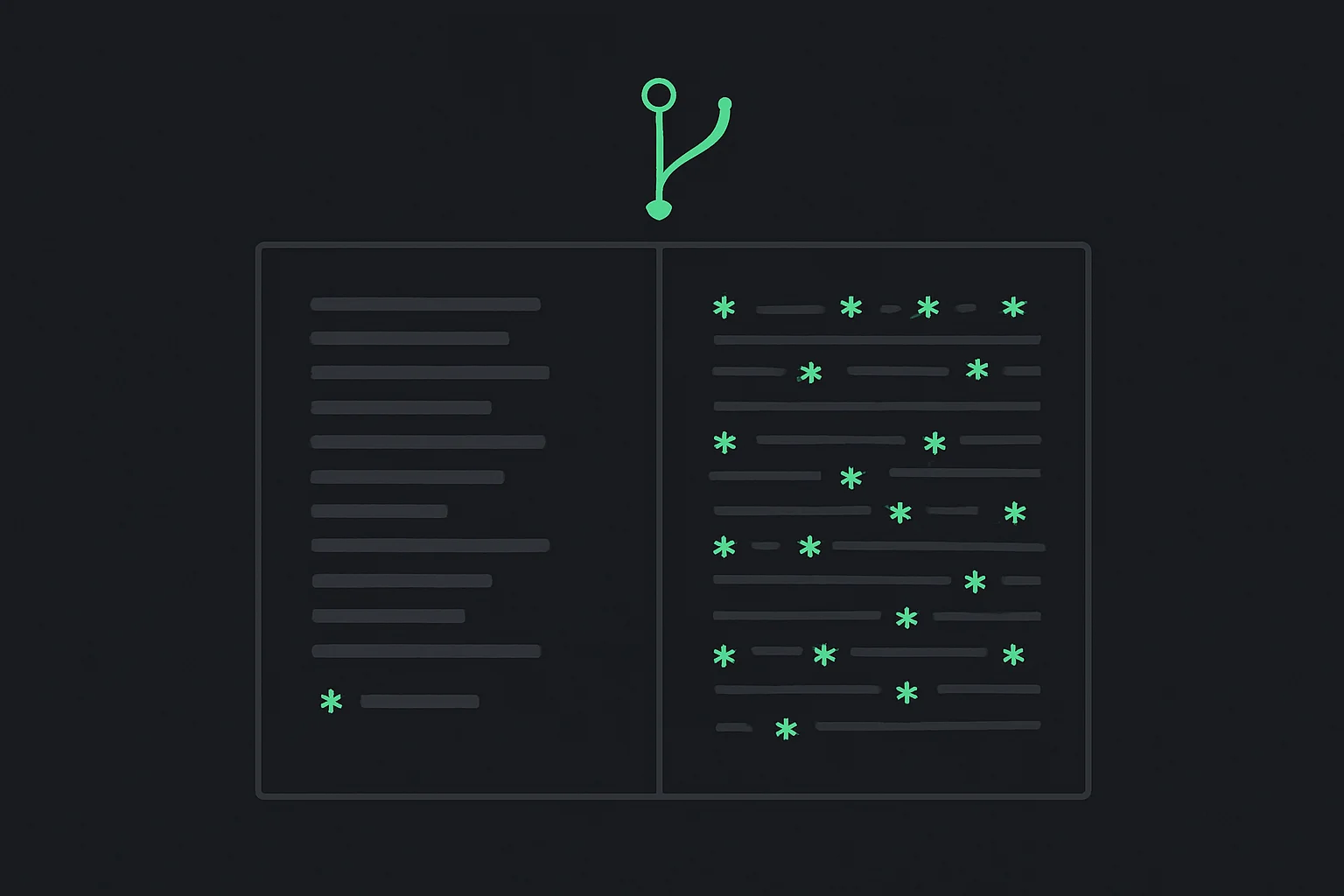 Diagram showing a code diff carrying almost no AI watermark signal while the written pull request description is densely marked
The mechanism behind text watermarking needs one thing to function: multiple acceptable next tokens at each step. A secret key splits the vocabulary, the sampler tilts toward one half, and detection measures the resulting skew across hundreds of tokens.
Prose supplies that abundantly. There are a dozen ways to open this paragraph, all equally valid.
Code does not. If the function is getUserById, there is no synonym. If the variable was declared as retryCount, every reference must say retryCount. Braces close where they close. The handful of genuinely free choices a model has in code — whether to use a ternary, whether to extract a helper, quote style, trailing commas — are exactly the choices your formatter overwrites on save. prettier is, without intending to be, an adversarial attack on token-level watermarking.
Update — August 16, 2026: Anthropic's own interactive explainer put a number on this, and it is smaller than even this section assumed. Asked to write a four-line Python function with one comment, the model faced exactly two free choices on the whole path: the wording of the comment, and the name of one variable. The arithmetic — sum(prices), round(total, 2) — had no room to vary at all. And the two forks are not independent: pick a different variable name and the return line must follow, so consistency eats part of the second one.
Two free choices in a whole function is not a detection surface. It is noise. Run black, prettier, or any linter with naming rules and both are gone. The comparison in Anthropic's own chart puts code at 2 forks against 3–4 for a single sentence of creative prose — meaning one sentence of your PR description carries more signal than an entire generated function.
The demo below shows the prose side of that contrast directly — the weighted word choice and keyed green/red split that your PR description gets and your diff mostly doesn't, since a diff rarely has the "several equally fine options" the mechanism depends on:
A model doesn't know "the next word" — it has a shortlist with preferences. Roll the dice and watch it land somewhere on the shortlist, matching the odds.
The results of the study were quite …
A teaching model with illustrative parameters — not any provider's actual watermarking scheme.
So the honest version of the PR claim is: your PR description will mark well, and your diff will not. Any team planning to screen contributions this way is building on the weakest part of the mechanism, and they should wait for a published false-positive rate on code specifically before they do. Projects that actually care have taken the blunter route instead — OpenJDK banned AI-generated contributions outright rather than pretending they can detect them.
The Co-Authored-By trailer is the useful comparison
Developers already have one AI attribution mechanism, and putting the two side by side clarifies what actually changed.
Claude Code has appended a Co-Authored-By: Claude trailer to commits since well before any of this, and it started an argument that reached half a million views: is crediting a tool honest disclosure, or is it absurd because we do not credit Visual Studio?
| Property | Co-Authored-By trailer | Model-level watermark |
|---|---|---|
| Visible | Yes, in git log | No |
| Removable | Yes — one settings.json key | No — applied below the model |
| Applies to | Commits and PRs from Claude Code | All text from marked Claude models, every surface |
| Chosen by | You | Anthropic, and the EU AI Act |
| Says what | "Claude helped write this commit" | "This text passed through a Claude model" |
The interesting shift is not that AI attribution now exists in your repo. It already did, and you could argue about it. The shift is that the version you cannot turn off arrived, and it makes a vaguer claim than the one you could.
That is worth sitting with if you were on the "I pay for the tool, it is not a co-author" side of the original debate. The trailer respected that position — you disabled it and moved on. The watermark does not offer the option, and the reason is regulatory rather than product: this is compliance with Article 50 transparency obligations, not a feature someone chose to make sticky.
What it means for job hunting
This is the part with the most anxiety attached and the least published information, so let us be precise about what is actually true today.
Nothing can be screened right now. No public detector exists. Anthropic has announced a text detection API but has not shipped it, priced it, or published a false-positive rate. Any company claiming to detect Claude-marked submissions in August 2026 is running a general style classifier, which is the previous generation of technology with all its known false-positive problems.
When it does ship, your writing is the exposure, not your code. A take-home submission's README, your architecture rationale, your PR description, your cover letter — those are long-form prose and mark reliably. The code you submit is the part that will not.
This inverts the intuition most candidates have. People worry about the code being detected. The realistic scenario is a recruiter running your cover letter through a detector and never looking at the repository.
The practical adjustments are small and mostly things you should do anyway:
- Write your own explanation of the design. If you used an agent to build the take-home, write the "why I structured it this way" section yourself. It marks clean, and more importantly it is what the interviewer is actually assessing.
- Do not paste generated cover letters. This is the highest-detection, lowest-value use of a model in the entire job search.
- Expect to defend the code verbally. Employers who care about AI use are converging on live discussion rather than detection, because it works and detectors do not.
- Disclose when asked, accurately. "I used Claude Code for scaffolding and tests, and wrote the state machine myself" is a strong answer. Getting caught in a denial is much worse than the assistance ever was.
- Remember a mark means "processed," not "authored." If you ran your own writing through a model to fix grammar, that text is marked. Anthropic says this explicitly. If anyone treats a hit as proof, that caveat is your answer, and it is the vendor's own language.
The long-tail risk: your repository history
The sharpest version of the developer objection came from a thread on the Claude subreddit that cleared 2,100 upvotes, and it is not about detection at all:
"The problem isn't that Anthropic suddenly owns Claude-generated code — they don't. The problem is that code you own can now carry a persistent, machine-readable fingerprint identifying the AI provider that touched it."
The ownership panic in that thread is wrong — a provenance mark creates no copyright interest, and your output rights are unchanged. But the worry underneath is legitimate: marks accumulate across files and years, third parties will eventually be able to scan for them, and due diligence in an acquisition, a compliance audit, or an employer's AI policy could treat that signal as meaningful without any of the nuance about proofreading versus authorship.
The entropy limit is genuinely reassuring here — your .ts files are poor carriers, so a codebase-wide "percentage AI" scan is not a coherent thing to run. Your comments, docstrings, READMEs, and docs directory are a different matter.
Cheap insurance, none of it exotic:
- Keep your own provenance record. Knowing which subsystems were AI-assisted, and how, is better evidence than someone else's scanner.
- Write disclosure into your team's policy before the first dispute. Specifically the "detected means processed, not authored" line.
- Treat your docs directory as the marked surface. That is where the signal actually lives.
Bottom line
For developers, the practical footprint of AI watermarking is narrower than the discourse suggests and pointed at a different target than people expect. Your code is close to the worst possible carrier for this technique. Your prose is close to the best.
So the change is not "your commits are now traceable." It is that the writing around your code — PR descriptions, docs, cover letters, design rationale — became the detectable surface, at the same moment that writing is what most teams use to judge whether you understand what you shipped. That was already the right thing to do yourself. Now there is a second reason.
Related on explainx.ai
- What AI Watermarking Actually Changes for Students and Teachers — the same proofreading-exposure problem, playing out in classrooms
- How AI text watermarking actually works — the mechanism, and why entropy decides what marks
- Anthropic is watermarking Claude text — the policy and the developer backlash
- Claude Code adds itself as git co-author — and how to disable it — the attribution you can still control
- How to detect a Claude watermark — what verification looks like today
- Will every AI model watermark its output? — the open-weight escape hatch
- OpenJDK bans AI-generated code — a project that chose policy over detection
- LLM text detection with classical ML — why the previous detector generation misfired
- What AI watermarking changes for marketers — the same mechanism, a very different exposure
- EU AI Act and US policy: complete guide — the obligations behind the rollout
- What actually changes after the EU AI Act — provider vs deployer duties, and why the mark does not discharge yours
Primary sources: Anthropic engineering commentary on X (August 11–12, 2026) · Anthropic Help Center, "How Claude marks AI-generated content" · r/claude discussion thread, August 2026
Accurate as of August 12, 2026. No public Claude watermark detector existed at the time of writing. Statements about how token-level watermarking behaves in source code reason from the published mechanism and its entropy requirements, not from confirmed Anthropic implementation details or a published false-positive rate. Follow @explainx_ai for updates.