



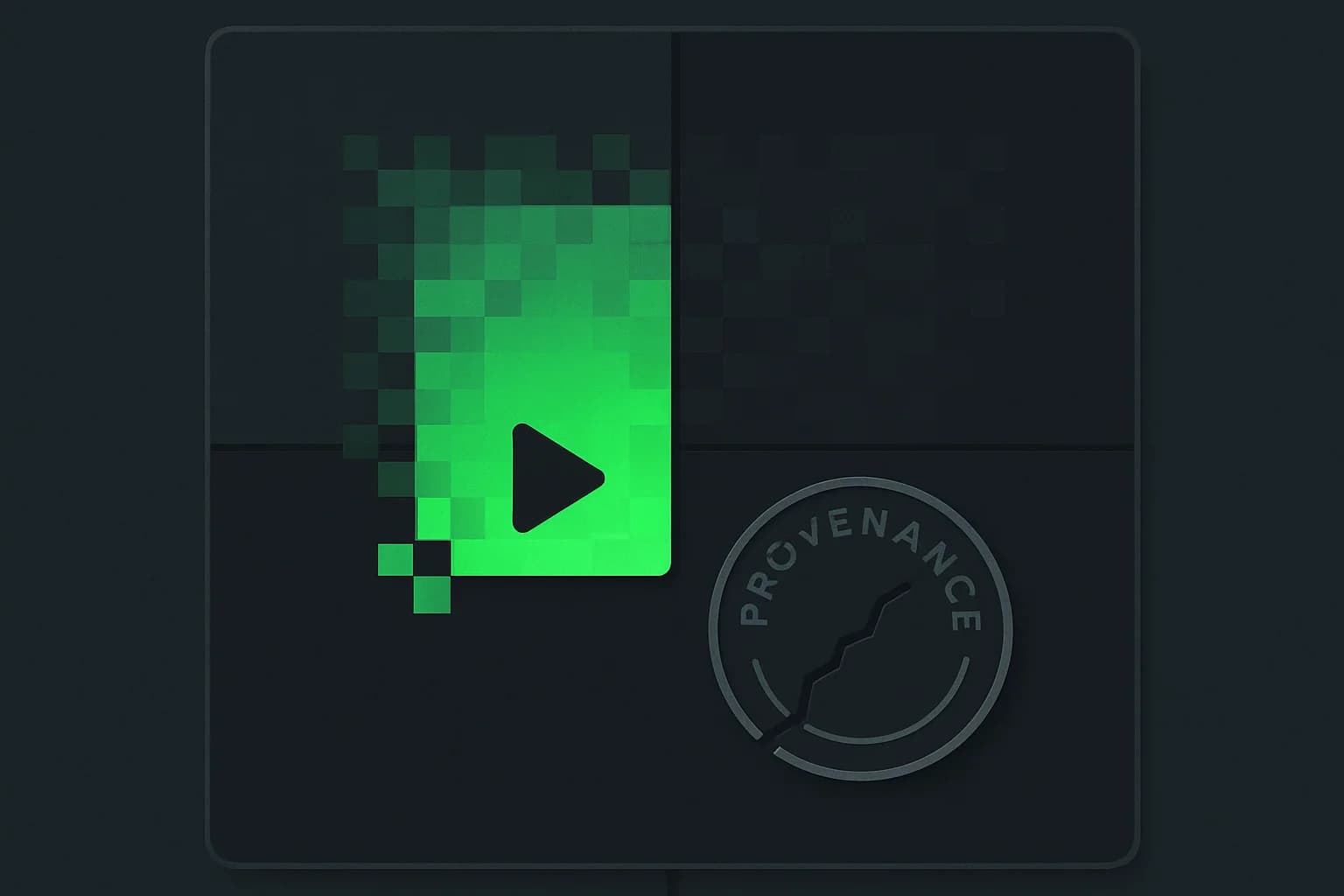
 AI watermark removal right and wrong — visible logo reconstruction versus broken provenance metadata on AI-generated content
"Remove the AI watermark" is one search query hiding two completely different engineering problems — and most coverage collapses them into a single moral panic or a single product demo.
If you generated a Sora clip and want the moving corner badge gone before you publish it on your channel, that is visible watermark removal: a logo burned into pixels, erased by reconstructing what should be behind it. If you pasted Claude output into a doc and want the invisible provenance marks gone before submission, that is provenance stripping: metadata bytes and statistical word-choice bias, handled by an entirely different toolchain with entirely different success rates and legal exposure.
This guide separates the two, explains what is right and wrong in each case, and points to the right visible-watermark workflow for your format: BGBlur's AI watermark remover — with its pillar guide on removing Sora, Veo, and Gemini watermarks — for video and multi-frame inpainting, plus BGRemover.video's model-specific removers for ChatGPT, Claude, and Gemini image exports. For the invisible-provenance side, see our existing coverage of watermarks-remover and whether stripping marks is legal.
TL;DR — right vs. wrong at a glance
| Question | Direct answer |
|---|---|
| Two types of "AI watermark removal"? | Visible stamps on video/images vs. invisible provenance in metadata and text |
| Right use of visible removal? | Cleaning up your own AI-generated export for branded publishing |
| Wrong use of visible removal? | Erasing marks from someone else's content and reposting as yours |
| Best method for visible marks? | AI inpainting/reconstruction — not crop, blur, or sticker overlay |
| Recommended tools for visible marks? | Video / moving stamps: BGBlur. ChatGPT / Claude / Gemini images: BGRemover.video model pages |
| Can metadata stripping defeat detection? | No — C2PA strips easily; statistical text watermarks only degrade via rewrite |
| Does removal = undetectable AI? | No — layers are independent; removing one does not clear the others |
| Is it automatically illegal? | No — intent and jurisdiction matter; see legal explainer |
Two watermarks, two problems — do not conflate them
Every "AI watermark removal" headline you read this year is about one of these — rarely both:
Type A: Visible export stamps (video and images)
What it looks like: a corner logo, a moving badge (Sora's travels around the frame), a translucent "AI" stamp, burned-in text, TikTok repost marks, stock-footage logos.
Where it lives: in the pixels — same layer as the footage itself.
Why it exists: platform branding, tier upsell (watermark-free exports on paid plans), and a visible signal that the clip came from a specific generator.
How removal works: detection + tracking + background reconstruction (inpainting). The AI finds the mark, follows it frame-by-frame, and generates what the background should look like without it.
Tool reference: BGBlur's watermark remover — browser-based, handles Sora, Veo, Gemini, ChatGPT, and Nano Banana stamps on video and images via inpainting. The step-by-step pillar guide covers tool-specific quirks (Sora's moving mark vs. Veo's fixed corner badge). For single-frame image exports from specific generators, BGRemover.video also ships dedicated pages: ChatGPT watermark remover, Claude watermark remover, and Gemini watermark remover.
Type B: Invisible provenance marks (text and file metadata)
What it looks like: nothing — by design. C2PA manifests in file headers, invisible Unicode carriers in text, statistical bias in token sampling.
Where it lives: metadata layers and word-choice distribution — not a visible overlay.
Why it exists: EU AI Act Article 50 transparency obligations, platform disclosure rules, and research into detectable AI output — the case we made in why AI watermarks are good.
How removal works: two very different sub-layers:
| Sub-layer | Mechanism | Removal success |
|---|---|---|
| Metadata (C2PA, EXIF, doc properties) | Bytes in file headers | Deterministic — delete the bytes |
| Invisible Unicode (zero-width chars, bidi controls) | Characters in text body | Deterministic — strip the characters |
| Statistical token watermark (SynthID-Text, Claude marking) | Word-choice bias across passage | Best-effort paraphrase only — degrades writing, unverifiable |
Tool reference: watermarks-remover — covered in our August 2026 news post. Layer A (metadata) works reliably. Layer B (statistical) is rewrite-and-hope.
Confusing Type A with Type B is how you get headlines that treat "I removed the Sora logo" and "I defeated Claude's watermark" as the same achievement. They are not.
What "right" looks like — visible watermark removal done properly
The legitimate use case
You generated a clip with Sora, Veo, or Gemini. You own the generation rights under the platform's terms. You want to publish it in a client reel, a YouTube video, or an Instagram campaign without a third-party badge floating in the corner. That is the use case BGBlur's tool and its pillar guide are built for.
The watermark was never meant to live in finished published content — it marks raw export, promotes the generator, and nudges upgrades. Cleaning it from your own output before professional use is standard post-production, not deception.
The right technique: inpainting, not crop or blur
Before AI inpainting, creators had three bad options — and BGBlur's guide documents why each fails:
| Method | What goes wrong |
|---|---|
| Cropping | Destroys composition; useless for moving watermarks like Sora's |
| Blurring | Obvious smudge in every frame; viewers see something was hidden |
| Sticker overlay | Trades one distraction for another |
AI reconstruction does something different: it analyzes surrounding pixels and neighboring frames, then generates the missing content so the area matches color, texture, lighting, and motion. The frame keeps full resolution and aspect ratio.
Workflow (3 steps):
- Upload your AI video (MP4, MOV, AVI, MKV — up to 1GB on paid plans) to BGBlur's watermark remover
- Select the watermark area — for moving marks like Sora's, the AI tracks it automatically across frames
- Preview and download — scrub through motion-heavy sections before export
For AI-generated images (Gemini, ChatGPT, Nano Banana stamps), BGBlur handles single-frame reconstruction — near-instant because there is only one frame to rebuild. BGRemover.video's model-specific removers offer the same job tuned per generator: ChatGPT, Claude, Gemini.
Tool-specific notes
| Generator | Watermark behavior | Removal note |
|---|---|---|
| Sora | Moving badge travels around frame | BGBlur — motion tracking required; static masks fail |
| Veo | Fixed corner badge | BGBlur — straightforward selection; rich scene detail underneath matters |
| Gemini | Stamp on video and images | Video: BGBlur. Images: BGRemover.video Gemini remover |
| ChatGPT / Nano Banana | Image stamps | BGRemover.video ChatGPT remover or BGBlur single-frame inpainting |
| Claude | Visible image export stamps (when present) | BGRemover.video Claude remover — not for invisible text provenance |
Practical tips for clean results
From BGBlur's pillar guide:
- Upload the highest quality export you have — re-compressed downloads give the AI less to work with
- Select tightly around the watermark — less area to reconstruct means fewer artifacts
- Preview motion-heavy moments — fast pans and scene cuts are the hardest frames
- Remove the watermark before editing — add titles and transitions after, not before
What "wrong" looks like — four failure modes
1. Removing watermarks from content you do not own
Erasing a TikTok repost mark or a stock-footage logo from someone else's clip and publishing it as your own is copyright infringement regardless of which AI tool you use. The inpainting quality is irrelevant — you did not have the rights to the underlying footage.
BGBlur's responsible-use note states this plainly: the tool is for content you own or are licensed to edit.
2. Stripping provenance to evade disclosure requirements
If your jurisdiction or platform requires labeling AI-generated content — EU AI Act Article 50, emerging California rules, academic integrity policies — removing visible marks and metadata to present synthetic content as human-made is the wrong side of the line. The legal analysis is in our DMCA and EU AI Act explainer; the ethics framing is in top 10 AI ethics rules.
Removing a visible export stamp from your own clip for aesthetic reasons is not the same problem as stripping C2PA to hide AI involvement where disclosure is mandatory.
3. Believing metadata removal defeats statistical watermarks
This is the watermarks-remover hype cycle in one sentence: stripping C2PA is trivial and always was — any re-save clears metadata without a dedicated tool. Claiming that same tool "defeats Claude's watermark" conflates byte deletion with statistical signal degradation.
The statistical watermark lives in which words the model chose, not in deletable bytes. The only disturbance is paraphrase — which changes tone, precision, and meaning. The tool's author states no public detector exists to verify success. That gap is structural, not a missing feature.
We broke down the mechanism in how AI text watermarking actually works: green-listed tokens, sampling bias, and why deletion and degradation are different operations.
4. Assuming one removal clears all layers
Removing a visible Sora badge does not remove:
- SynthID pixel watermarks (if embedded in image domains — a harder problem, explicitly out of scope for text/metadata tools)
- C2PA manifests (unless you also strip file metadata on export)
- Statistical text marks (if the clip has captioned AI-generated script attached)
Provenance is layered. Clearing one layer says nothing about the others — the same insight behind C2PA's design, which treats a missing manifest as inconclusive rather than proof of human authorship.
The AI angle — why inpainting works and why paraphrase does not
Visible marks: generative reconstruction
Modern visible-watermark removal is a conditional inpainting problem. The model conditions on:
- Pixels surrounding the watermark in the current frame
- Temporal context from adjacent frames (for video)
- Semantic understanding of what class of content sits underneath (sky, skin, fabric, architecture)
That is the same engine behind BGBlur's object remover — a watermark is treated as one more object to erase. The difference from generic object removal is tuning for semi-transparent overlays, text, and logos that sit on top of footage rather than inside the scene.
This works well because visible export stamps occupy a small, localized region with recoverable context around them. Success rate depends on source quality, watermark size, and motion complexity — not on breaking cryptography.
Invisible marks: metadata vs. statistics
| Layer | Engineering problem | Removal class |
|---|---|---|
| C2PA / EXIF / doc properties | Parse file format, delete metadata fields | Solved — deterministic scripts |
| Invisible Unicode | Regex / Unicode normalization | Solved — deterministic scripts |
| Statistical token watermark | No bytes to delete; signal is distributed across token choices | Unsolved publicly — paraphrase degrades quality, cannot self-certify |
The asymmetry matters for policy: regulators mandating "marking" are often mandating metadata and disclosure labels (Layer 1) while researchers hope statistical watermarks (Layer 3) will survive adversarial pressure. Removal tools expose that only Layer 1 was ever fragile. Layer 3's status remains unknown because no vendor has shipped a public detector.
What people are asking
Can I remove the Sora watermark even though it moves?
Yes — that is exactly the case inpainting + motion tracking was built for. BGBlur's guide confirms the AI follows Sora's traveling badge across every frame without manual keyframing. Cropping cannot do this; static blur boxes fail the moment the mark moves.
Is BGBlur's tool the same as BGRemover.video?
No — same vendor family, different primary jobs, and both now handle visible AI stamps in different formats. BGRemover.video started as a background removal tool (subject segmentation, transparent exports) and now also ships model-specific AI watermark removers for ChatGPT, Claude, and Gemini image exports. BGBlur focuses on privacy redaction (face/plate blur) and video watermark inpainting — Sora's moving badge, Veo's corner logo, and multi-frame reconstruction via its pillar guide. Use BGRemover.video for a single ChatGPT, Claude, or Gemini image stamp; use BGBlur's watermark remover when the mark is on video or you need the full Sora/Veo workflow.
Does removing the visible watermark reduce video quality?
No — when inpainting is done correctly, only the watermark pixels are reconstructed. Resolution, frame rate, and aspect ratio stay intact. The rest of the footage is untouched. Blurring or cropping does reduce effective quality; inpainting does not.
Will platforms detect that I removed a watermark?
Platform AI-content classifiers look at many signals — not just visible stamps. Removing a corner badge does not make a Sora clip undetectable as AI-generated to a classifier trained on motion, texture, and temporal artifacts. It makes the clip presentable for publishing, not unidentifiable as synthetic.
Should I remove watermarks from AI text output?
Different question, different answer. If you want to clean metadata from a file you generated for privacy or formatting reasons, metadata stripping is deterministic. If you want to pass AI writing off as human-authored in a context where that matters — an academic submission, a disclosed-reporting environment, a regulated disclosure context — the ethical and legal problems are covered in our legal explainer and ethics rules, not in a watermark-remover README.
A decision framework — 30 seconds before you click "remove"
Run through these four checks:
- Do I own or have license to edit this content? If no → stop.
- Is this a visible stamp or invisible provenance? Visible → inpainting: video / moving stamps → BGBlur; ChatGPT / Claude / Gemini images → BGRemover.video model pages. Invisible → understand you are in metadata/paraphrase territory, not pixel erasure.
- Am I removing for presentation or for concealment? Presentation (clean export for your brand) → legitimate. Concealment (evade required AI disclosure) → wrong side of ethics and possibly law.
- Do I understand what removal does not do? It does not clear other provenance layers, does not defeat statistical watermarks verifiably, and does not make content undetectable as AI-generated.
Summary
AI watermark removal is two problems wearing one name. Visible stamps on AI-generated video and images — Sora's moving badge, Veo's corner logo, Gemini's export mark — are legitimate to remove from your own content using AI inpainting: BGBlur's watermark remover with its pillar guide for video and multi-frame work, and BGRemover.video's ChatGPT, Claude, and Gemini removers for model-specific image exports.
Invisible provenance — C2PA metadata, invisible Unicode, statistical token watermarks — is a separate stack. Metadata strips easily and always could. Statistical marks resist byte-level deletion and cannot be verifiably defeated without a public detector nobody has shipped.
The right move depends on which problem you actually have — and honest tooling separates them instead of selling one button labeled "remove AI watermark" for both.
Related on explainx.ai
- A watermark removal tool added OpenAI and Gemini support — the
watermarks-removerCLI and the metadata-vs-statistical split - Is removing an AI watermark illegal? — DMCA § 1202, EU AI Act, intent requirements
- How AI text watermarking actually works — why statistical marks resist deletion
- Anthropic is watermarking Claude text — the two-layer provenance Anthropic ships
- Why AI watermarks are good: the case for provenance — why the marking debate exists
- What is C2PA? Content Credentials explained — the metadata layer removal tools target first
- Top 10 AI ethics rules — the Verify-Protect-Disclose-Own framework
- What does redact mean? — redaction vs. watermark removal (different goals)
External references
- BGBlur — Watermark Remover From Video (tool)
- BGBlur — Remove Watermark from AI Videos: Sora, Veo, Gemini (pillar guide)
- BGBlur — Video Eraser & Watermark Remover feature page
- BGRemover.video — ChatGPT Watermark Remover
- BGRemover.video — Claude Watermark Remover
- BGRemover.video — Gemini Watermark Remover
- watermarks-remover on GitHub
Tool capabilities, pricing, and regulatory references reflect publicly available documentation as of August 29, 2026. Legal and platform-policy requirements vary by jurisdiction and context — confirm obligations with qualified counsel where they apply.