



Related — August 27, 2026: A live test of why provenance beats detection — ARIA barred wholly AI-generated songs from Australia's music charts, with an eligibility rule ("substantially human-made") that no audio classifier can actually adjudicate.
C2PA is not a company's feature — it's an open standard. When you see a small "Cr" icon on an image generated by ChatGPT, Gemini, or Claude, or notice a "Content Credentials" label on a photo in your feed, that badge is the visible surface of a much larger technical specification most people never see: a cryptographically signed record of exactly how that file was made.
Update — August 26, 2026: Security researcher David Buchanan broke C2PA on Android — forging Pixel Camera's Assurance Level 2 signatures after root via LPE. Root can sign arbitrary files via KeyStore even when StrongBox keys cannot be extracted.
Given how often "watermark," "C2PA," and "Content Credentials" get used interchangeably — including on this blog, where we cover AI text watermarking mechanics and Claude's own invisible watermarks — it's worth pinning down what C2PA actually is, on its own terms.
TL;DR
| Question | Answer |
|---|---|
| What does C2PA stand for? | Coalition for Content Provenance and Authenticity |
| What is it? | An open technical standard, not a product |
| What does it attach to a file? | A cryptographically signed "manifest" recording creation and edit history |
| What do users see? | A "Cr" icon / "Content Credentials" label |
| Who backs it? | Adobe, Microsoft, OpenAI, Google, Amazon, Sony, Anthropic, and others |
| Does it survive a screenshot? | No — it's metadata, and metadata is easy to strip |
| Is it the same as a watermark? | No — see the comparison below |
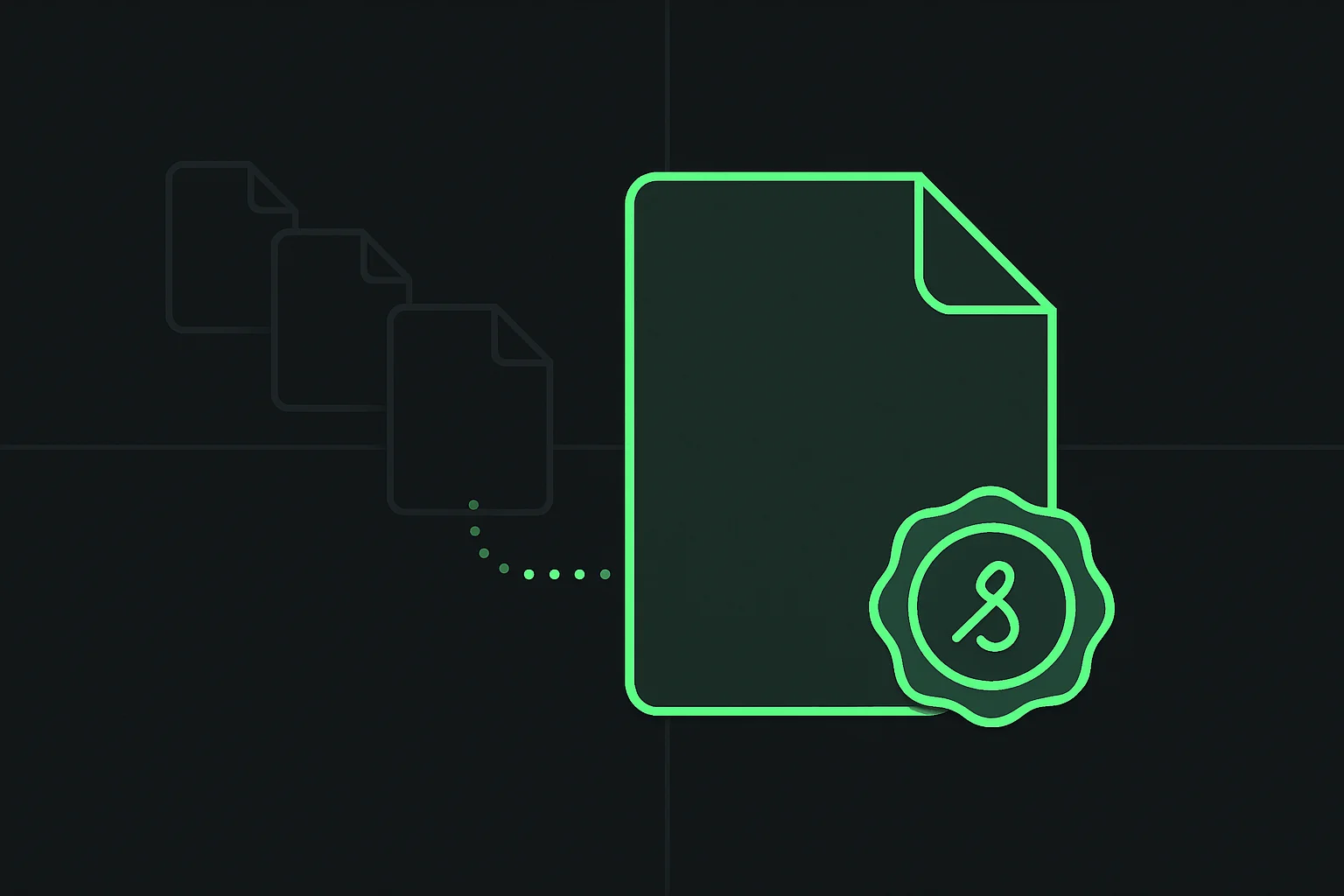 Illustration of a signed content manifest chained to its edit history, representing the C2PA content provenance standard
What C2PA actually specifies
C2PA — the Coalition for Content Provenance and Authenticity — formed by merging two earlier, competing provenance efforts: Adobe's Content Authenticity Initiative and the Microsoft/BBC-backed Project Origin. Rather than each major tech company shipping an incompatible provenance scheme, the coalition converged on one open specification that any tool can implement.
The specification defines a manifest: a structured, cryptographically signed record attached to a media file. A manifest can capture:
- The originating tool — which application or model produced the file
- Edit history — a chain of subsequent actions (cropped in Photoshop, color-graded in Premiere, and so on)
digitalSourceType— a field that specifically flags whether the content involved AI generation, and at what step- A cryptographic signature — tying the manifest to a signing identity, so it can't be silently altered without invalidating the signature
That signature is the part that makes C2PA meaningfully different from a plain EXIF tag: EXIF metadata can be edited freely with any text tool, while a C2PA manifest is signed, so tampering with the claimed history breaks verification rather than just changing a field.
Who's actually behind it
C2PA's steering committee reads like a rare instance of direct competitors agreeing on shared infrastructure: Adobe, Microsoft, OpenAI, Google, Amazon, Intel, Sony, Truepic, and Anthropic are all members, alongside publishers and camera manufacturers. That breadth is why Content Credentials show up consistently across outputs from ChatGPT's image tools, Google's Gemini and Nano Banana models, Adobe Firefly, and Claude — it's genuinely one shared standard, not four companies each building their own badge.
For a closer look at how one major platform has implemented it, see LinkedIn's rollout of Content Credentials for AI images.
Where C2PA breaks: it's metadata, and metadata doesn't survive
C2PA's biggest practical limitation is also the most predictable one: it's a container-level attachment, not something baked into the pixels or the audio waveform. A manifest can be, and routinely is, stripped by:
- Taking a screenshot of the image
- Re-saving the file through most photo editors
- Uploading to a platform that re-encodes media on ingest (common for social platforms)
- Simple copy-paste in some applications
The content looks completely unchanged after any of these — same pixels, same audio — but the provenance record is gone. This is precisely why C2PA is increasingly deployed alongside, not instead of, invisible statistical watermarking. A watermark like SynthID or a text green-list scheme survives some of these transformations specifically because it's embedded in the content's statistical structure rather than attached as a separate metadata block. See our deep technical breakdown of how AI watermarking actually works for the mechanism, and whether removing a watermark is legal for the regulatory angle on stripping either kind of signal.
C2PA vs. AI watermarking: two different tools
| C2PA (Content Credentials) | AI watermark | |
|---|---|---|
| What it is | Signed metadata manifest | Statistical signal embedded in content |
| Human-readable? | Yes — shows tool, edits, source type | No — requires a detector |
| Survives editing/screenshots? | No, easily stripped | Often more resilient, but not guaranteed |
| Requires a secret key to verify? | No — signature is publicly verifiable | Usually yes, held by the issuing lab |
| What it tells you | Explicit edit history and tool provenance | A probabilistic "this was likely AI-generated" signal |
Neither one alone is a complete solution, which is why the current industry direction — visible in how Anthropic layers Claude's invisible watermarks with C2PA — is to ship both and accept that a determined bad actor can still defeat either.
Why this matters right now
Provenance tooling like C2PA is moving from optional to expected, driven by both regulation and plain necessity — as the volume of AI-generated content circulating without disclosure grows, so does the incentive to fake authenticity or, inversely, to falsely dismiss real content as fabricated. Our recent coverage of GTA 6's AI-generated "leak" footage is a concrete example of exactly the gap C2PA is meant to close: without a reliable provenance chain, sourcing and corroboration are the only tools left, and most viral clips carry neither a C2PA manifest nor an easy way to verify their origin.
explainx.ai signs its own AI-generated blog imagery with C2PA manifests as a matter of practice — see our coverage of how AI watermark removal tools work and whether AI watermarks are commercially monetisable as a detection API business for where this space is heading next.
What does a valid credential prove, and what remains unknown?
A valid signature supports the integrity of the signed provenance claims and their connection to the asset under the specification's rules. It does not establish that every claim is true, that a scene happened as depicted, or that the signer is trustworthy for your purpose. Read the claim, signing identity, and validation result together.
The C2PA specification distinguishes technical provenance from judgments about whether content is good or truthful. That is an important product boundary. A news photograph can carry a valid edit history while its caption is misleading. A synthetic illustration can carry honest credentials and still be entirely fictional.
Why missing credentials should not become an accusation
An image without credentials may come from a tool that never attached them, or from a platform that removed them. The absence of a manifest therefore does not prove AI generation, tampering, or dishonesty. Present it as unavailable provenance, then use sourcing and corroboration appropriate to the context.
Likewise, an invalid result needs interpretation. The file may have changed, a referenced asset may be unavailable, or the verifier may encounter an unsupported feature. Preserve the original file and the exact validation message before drawing conclusions. A binary “real/fake” badge hides distinctions the user may need to understand.
How should publishers handle credentials in an upload pipeline?
Keep the original upload when your retention policy permits it, and compare credentials before and after resizing or transcoding. A service can unintentionally remove provenance while optimizing images. Test the actual delivery artifact, since credentials present in source storage may be absent from the file readers download.
If the pipeline creates a new derived asset, decide how its edit history should be represented using supported tooling. Do not claim that merely copying metadata preserves a valid chain. Signing and validation need to follow the specification and the chosen implementation's documented behavior.
For users, display the known facts plainly: which tool or signer supplied a claim, whether validation succeeded, and which history is available. Keep the explanation close to the media rather than relying on an unfamiliar icon alone. Provenance helps people evaluate an asset when the interface preserves its limits as carefully as its claims.
Related on explainx.ai
- Love, Rendered: DeepMind reconstructs a memory never filmed — consent-driven AI documentary where provenance and disclosure still matter
- AI agents can now "hand-draw" art and fake the timelapse too — why process footage is no longer proof, and where signed provenance still holds up
- C2PA Android cameras broken: Pixel AL2 forged anyway — August 2026 root/LPE break of the strongest mobile implementation
- What Is AI Ethics? A Complete Guide — C2PA as the leading technical standard behind the transparency dimension of AI ethics.
- How does AI text watermarking actually work?
- Anthropic's Claude now has invisible watermarks and C2PA
- How to detect Claude's AI watermark and C2PA credentials
- LinkedIn's Content Credentials rollout for AI images
- Is removing an AI watermark illegal?
- Are the GTA 6 leaks AI generated?
Primary source: C2PA specification and steering committee
Describes the C2PA specification as of August 21, 2026. The standard continues to evolve through the coalition's working groups.