



We posted a simple line on explainx.ai's LinkedIn company page and on X (@explainx_ai) — "Otherwise, what's the point?" — with the same AI-generated image: two figures planting a flag that read "Upskilling should be fun" atop a skyscraper spire.
Both platforms labeled it.
On LinkedIn, viewers could click View C2PA information and see a Content Credentials panel:
- AI was used to generate all of this image
- App or device used: OpenAI Media Service API
- Content Credentials issued by: OpenAI OpCo, LLC
- Issue date: Jul 2, 2026
On X, the post carried a Made with AI disclosure — a simpler inline tag on the same OpenAI-signed file, without LinkedIn's expandable provenance panel.
Neither platform ran a mystery classifier on our pixels. Both read C2PA metadata the image already carried at upload — and that shift matters for every marketer, founder, and creator posting AI visuals in 2026.
TL;DR — LinkedIn CR vs X "Made with AI"
| Question | X (Twitter) | |
|---|---|---|
| Label UX | CR icon → expandable Content Credentials panel | Inline Made with AI text on the post |
| Detection method | Parses C2PA manifest at upload | Parses C2PA at upload (+ optional creator toggle) |
| Detail shown | Tool, issuer, date, AI assertion | Disclosure tag; less provenance detail in UI |
| Pixel watermark (SynthID)? | No — metadata only | No — investigators confirm X cannot verify SynthID |
| After re-download | Credentials may remain in original uploads | X re-encodes images — C2PA often stripped from saved files |
| Mandatory? | Automatic when C2PA present | Auto when C2PA present; opt-in toggle also exists |
| Who adds metadata? | The creating app (OpenAI, Adobe, Google) — not the platform |
Shared truth: absence of a label does not prove human authorship. Many AI tools still do not sign C2PA; metadata can be stripped before upload.
Why now: C2PA adoption across platforms + EU AI Act Article 50 pressure on synthetic media marking (August 2026 enforcement window for many deployer obligations).
 A social platform automatically attaching a content credentials badge to an AI-generated image
What we posted — and what LinkedIn and X showed
We generated the hero image with GPT Image 2 via OpenAI's image API (surfacing in credentials as OpenAI Media Service API — the same stack documented in our ChatGPT Images 2.0 guide). The visual is unmistakably synthetic: perfect flag typography, cinematic lighting, figures in tactical gear on an impossible spire — classic high-end generative aesthetics.
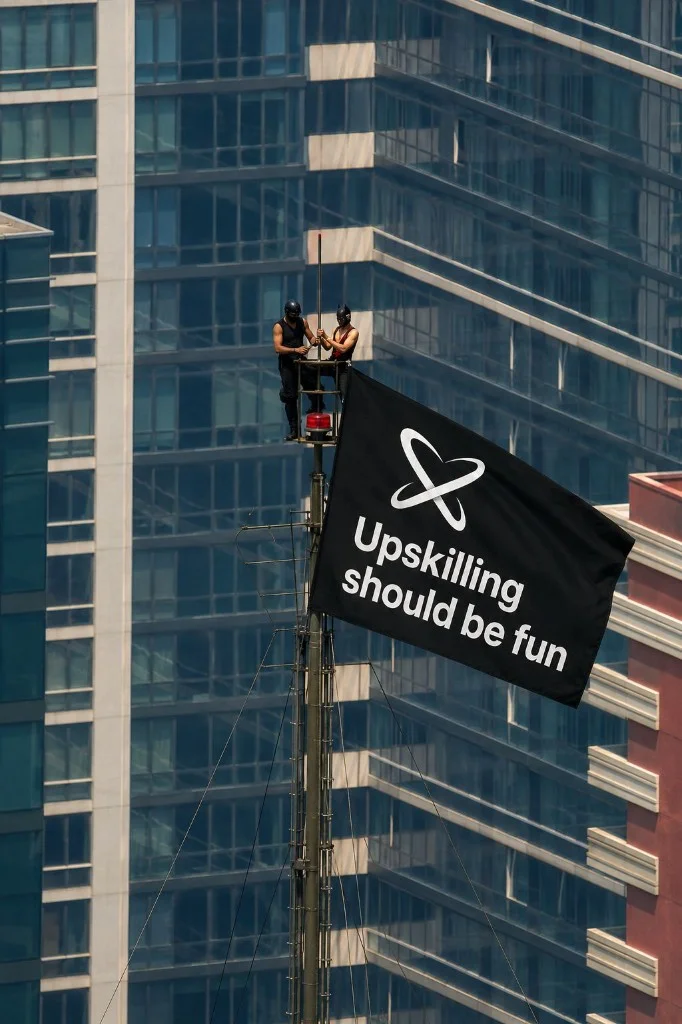 AI-generated image posted on explainx.ai LinkedIn — "Upskilling should be fun" flag on a skyscraper spire
On upload, LinkedIn placed the small CR badge on the image. Tapping it opened the Content Credentials modal our team captured:
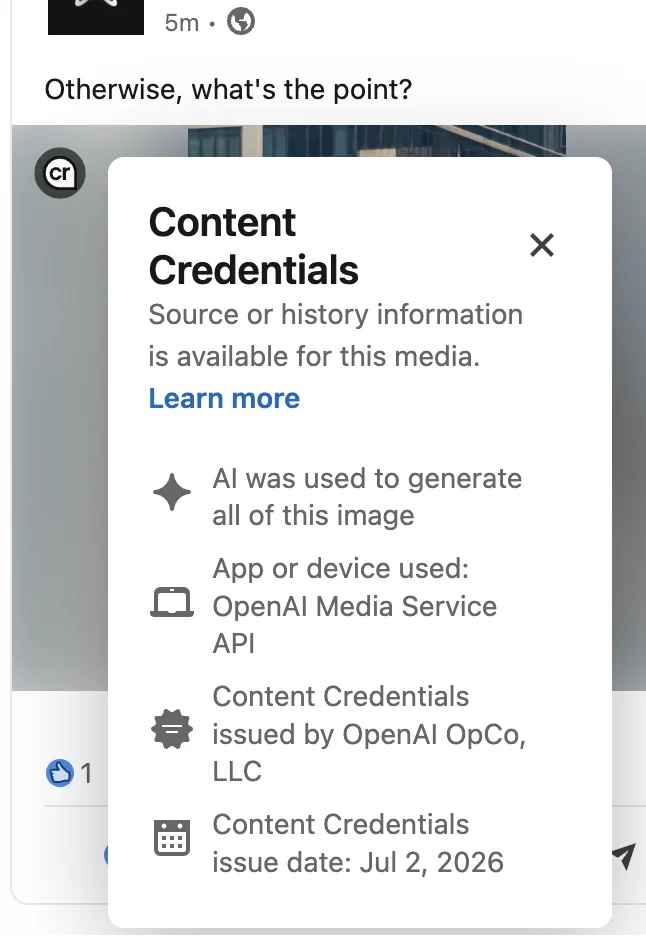 LinkedIn Content Credentials panel for an OpenAI-generated image — AI assertion, issuer, and issue date
This matches LinkedIn Help's description: signed C2PA content gets an icon; members can inspect assertions about AI use, app or device, issuer, and issue date.
Patrick Corrigan's LinkedIn adoption announcement framed the goal plainly: "help members harness the power of generative AI without being misled." LinkedIn notes rollout is gradual — you may not see the badge on every account or surface yet. Ads coverage is expanding; single-image Sponsored Content shows the icon when the uploaded asset contains credentials.
X also labels it — "Made with AI"
The same OpenAI-signed PNG on X triggered a Made with AI disclosure on our post. X's implementation is less verbose than LinkedIn's CR panel — viewers see a platform label, not a full issuer manifest — but the underlying signal is the same family of metadata.
How X applies the label
Per platform investigations and X's evolving policy stack (Ledger guide, Agile Insider C2PA test):
- Upload-time C2PA parse. X reads provenance blocks embedded in PNG/JPEG at ingest — OpenAI's signed manifest in the
caBXchunk, includingdigitalSourceType: trainedAlgorithmicMedia. Match → Made with AI applied. - Voluntary composer toggle. Creators can also self-disclose AI media in the post flow. Fraud accounts skip this; C2PA auto-labeling is the reliable path for signed generator outputs.
- Not SynthID. OpenAI embeds both invisible SynthID watermarks and C2PA credentials. X verifies file metadata only — it does not have keys to read pixel-level SynthID.
- Storage strips metadata. After upload, X re-encodes images for delivery. Download an image from X and the C2PA block is often gone — even though the post still shows Made with AI. LinkedIn preserves more inspectable provenance in-product.
X joined the C2PA steering committee in late 2025 and has listed ML roles around synthetic media — expect the label UX to harden, not soften.
LinkedIn vs X — same file, different chrome
| X | ||
|---|---|---|
| Viewer experience | Tap CR → full credential sheet | Made with AI inline on post |
| Provenance depth | Issuer, tool, date, AI assertion | Disclosure without full manifest UI |
| Opt-in path | N/A when C2PA present | Toggle + auto-detect |
| Typical audience | Professional / B2B | Real-time news / meme velocity |
| Our July 2 test | ✅ Labeled | ✅ Labeled |
For explainx.ai, posting the same asset on both networks meant double disclosure from one generator signature — no extra work beyond uploading the original signed file.
How C2PA works (the 60-second version)
C2PA (Coalition for Content Provenance and Authenticity) is an open standard backed by Adobe, Microsoft, OpenAI, Meta, Amazon, BBC, and others. Content Credentials are its consumer-facing label — a cryptographically signed manifest attached to an image or video.
Creation (OpenAI / Adobe / camera)
    → embed signed C2PA manifest ("AI generated", tool name, timestamp)
Upload to LinkedIn or X
    → platform parses manifest at ingest
LinkedIn: CR badge + expandable Content Credentials panel
X: "Made with AI" inline label (+ optional creator toggle)
Viewer inspects (LinkedIn) or scrolls past label (X)
    → reads platform disclosure, not a forensic verdict
Important nuance from practitioners (Medium breakdown, TrueScreen on limits, X C2PA investigation):
- Platforms display; they do not adjudicate. If OpenAI signs "AI generated all of this image," LinkedIn and X repeat that signal in their respective UIs. Wrong metadata is a signer problem, not a solved forensic guarantee.
- Metadata is fragile. Screenshots, aggressive JPEG recompression, some CDN pipelines, and "save for web" exports can remove C2PA blocks. The image may still be synthetic; labels vanish. X additionally strips C2PA on stored re-encodes — labels live on posts, not necessarily in re-downloaded files.
- Coverage is partial. Tools that do not implement C2PA produce no label — which is not proof of human authorship. X's ML fallback for unsigned AI images is inconsistent in public testing.
This is provenance labeling, not slop detection. For quality and intent, platforms still need human moderation and separate policies — the subject of our Slopocalypse coverage.
Who signs today — and who reads it
| Layer | Examples | Role |
|---|---|---|
| Generators | OpenAI (GPT Image 2 / Media Service API), Adobe Firefly, Google (Nano Banana, Gemini image), Microsoft Designer | Embed credentials at creation |
| Devices | Leica M11-P, Samsung Galaxy S25, Sony PXW-Z300, Nikon Z-series | Sign camera-origin content |
| Platforms (display) | LinkedIn (CR panel), X (Made with AI), Meta (AI Info on IG/FB), TikTok/YouTube (auto-label from C2PA) | Surface disclosure UI to viewers |
| Editors | Photoshop, Lightroom | Preserve or update credential chain on edits |
Our explainx.ai test sits in the GPT Image 2 → LinkedIn + X display path — the same chain Amy Hopper and others documented when posting ChatGPT-generated images to LinkedIn, now mirrored on X for signed uploads.
What this means for creators and brands
1. Assume disclosure by default on LinkedIn and X
If you generate thought-leadership visuals with ChatGPT Images 2.0, Adobe Firefly, or Nano Banana / Gemini image tools, expect CR on LinkedIn and Made with AI on X when you upload the original signed file. Labels are visible to all viewers — not just you.
For explainx.ai, the label aligns with how we talk about AI: we build at the frontier and we are honest about tooling. Upskilling should be fun does not need to pretend a photographer rappelled off the Chrysler Building.
2. Stripping metadata is a strategy — and a liability
Some teams will re-export assets to avoid badges. That may work technically today on some platforms. It is a poor long-term brand strategy on a network built on professional trust, and it runs toward — not away from — regulatory direction in the EU.
Article 50 of the EU AI Act requires machine-readable marking of AI-generated synthetic audio, video, and images, with enforcement timelines landing August 2, 2026 for many deployer obligations. C2PA is the technical shape lawyers and vendors cite most often.
3. Human + AI hybrid work needs credential hygiene
If a designer composites AI background + real product photo in Photoshop, credentials may assert partial AI use. Workflow matters: Adobe's chain records edit history. Random PNG merges from five sources may carry no coherent provenance — worse for trust than a clean "AI generated all" label.
4. This does not fix text slop
C2PA today is media-first. Your LinkedIn caption can still be generic AI prose — credentials will not flag that. Pair visual transparency with content quality standards and editorial review, especially for SEO/GEO pages where provenance and citations matter.
Limits and honest skepticism
| Claim you might hear | Reality check |
|---|---|
| "LinkedIn/X detect all AI images" | False. Primarily C2PA-signed uploads with intact metadata at ingest. |
| "No label = authentic photo" | False. Unsigned AI and stripped credentials both show no label. |
| "X reads SynthID watermarks" | False for public labeling — C2PA at upload, not pixel keys. |
| "CR badge / Made with AI = legal proof" | False. Signed assertions and platform UX — dispute resolution is immature. |
| "Download from X still has C2PA" | Often false. Re-encoding strips manifests; post label remains. |
| "Deepfakes are solved" | False. Video lip-sync without C2PA, voice clones, and text hoaxes sit outside this fix. See Gemini Omni Flash video generation and NotebookLM Short Video (Nano Banana 2 Lite). |
Implementation bugs happen. Reports note occasional date display issues and cases where valid metadata did not surface the icon — treat the system as early infrastructure, not finished law enforcement.
Practical checklist before your next LinkedIn or X post
- Know your generator. GPT Image 2 (
gpt-image-2) and ChatGPT Images 2.0 exports → expect labels on both LinkedIn and X. Confirm whether your tool signs C2PA before campaign launch. - Decide disclosure up front. Write posts that acknowledge AI visuals when labels will appear — or when your audience expects authenticity.
- Avoid accidental stripping. Do not screenshot AI art for upload; post the original signed file if you want consistent provenance (and accept the label).
- Plan per-platform UX. LinkedIn gives you a credibility panel; X gives you a speed-networking tag. Same ethics, different presentation.
- Separate image truth from caption quality. Run text through the same editorial bar you'd use for loop-engineering-grade technical posts — credentials do not make weak copy trustworthy.
- Watch ads and company pages. LinkedIn documents CR on Sponsored Content uploads; company pages behaved like member posts in our July 2 test. X labeling applies to the same signed assets on brand accounts.
FAQ — quick answers
Will Meta/Facebook/Instagram show the same badge? Meta is a C2PA steering-committee member and applies AI Info labels on Instagram and Facebook when credentials or disclosure rules match. UX differs from LinkedIn's CR panel and X's Made with AI string.
Does the label hurt reach? Neither LinkedIn nor X has published clear penalty data for C2PA-labeled posts. Speculation runs both ways — some audiences reward transparency; others scroll past obvious synthetic hero images. Test on your accounts; measure saves and comments, not vibes.
Should explainx.ai stop using AI images? No — we use AI where it helps tell the story, and we accept labels that say so on LinkedIn and X. The alternative is slop aesthetics without craft or disclosure.
Can I use X's toggle instead of C2PA auto-label? You can self-disclose, but auto-labeling from signed files is more reliable for compliance-shaped workflows. Manual toggles are skipped by bad actors; metadata is harder to forget accidentally when your generator signs every export.
Related Reading
Update — October 9, 2026: A microscopy contest winner was disqualified over generative AI; see Nikon Small World in Motion.
Update — September 22, 2026: An essay argues invisible watermarks like SynthID deserve a separate name — "spymarks" — from disclosed, standardized formats like C2PA. See "Spymarks," the argument and the pushback.
-
Anthropic is watermarking Claude text — and attaching C2PA to files — the same standard, now applied at the model level
-
How AI text watermarking actually works — why text needs a different mechanism than C2PA metadata
-
Spotify labels AI artists and demotes them — provenance graduating from a badge to a ranking input
-
Google Earth + Nano Banana 2 image generation (Jul 30) — place-anchored AI scenes; disclose as synthetic
-
ChatGPT Images 2.0 and gpt-image-2 — OpenAI's current image stack
-
No, YouTube didn't delete the Rick Roll — you just got rick rolled — a fake screenshot with no metadata to check
First-hand test: explainx.ai company post on LinkedIn and X, July 2, 2026. Official references: LinkedIn Help — Content credentials, LinkedIn adopts C2PA (Corrigan), C2PA, contentcredentials.org. X labeling mechanics corroborated via Agile Insider C2PA investigation and Ledger X AI guide. Credential UI and artwork captured from our live LinkedIn post.