



A screen recording of the drawing process used to be the strongest evidence an artist could offer. No diffusion model could fake the messy, iterative back-and-forth of an actual creative process — the false starts, the layer reordering, the moments where a hand hesitates and redraws a line. That gap is closing, not because diffusion models got better at faking a timelapse, but because a different kind of AI system no longer needs to fake one at all.
TL;DR
| Question | Answer |
|---|---|
| What changed? | Computer-use AI agents can now operate real drawing software directly — mouse, stylus, and keyboard — instead of generating an image in one diffusion pass. |
| Is the resulting timelapse fake? | No — that's the problem. The screen recording and layer history are genuine, because the agent actually performed each stroke. |
| Does this replace diffusion image generation? | Not for most use cases — it's slower and more expensive per image. It matters specifically where authenticity is being tested. |
| Can you still spot it by stroke pattern? | For now, sometimes. It's not a durable signal — it degrades as agents get tuned to look more human. |
| What actually still works? | Cryptographic provenance signed at creation time (C2PA-style manifests), not after-the-fact process footage. |
| Who needs to care right now? | Digital artists proving authorship, platforms judging AI-art policy violations, and anyone building "prove this is human-made" verification products. |
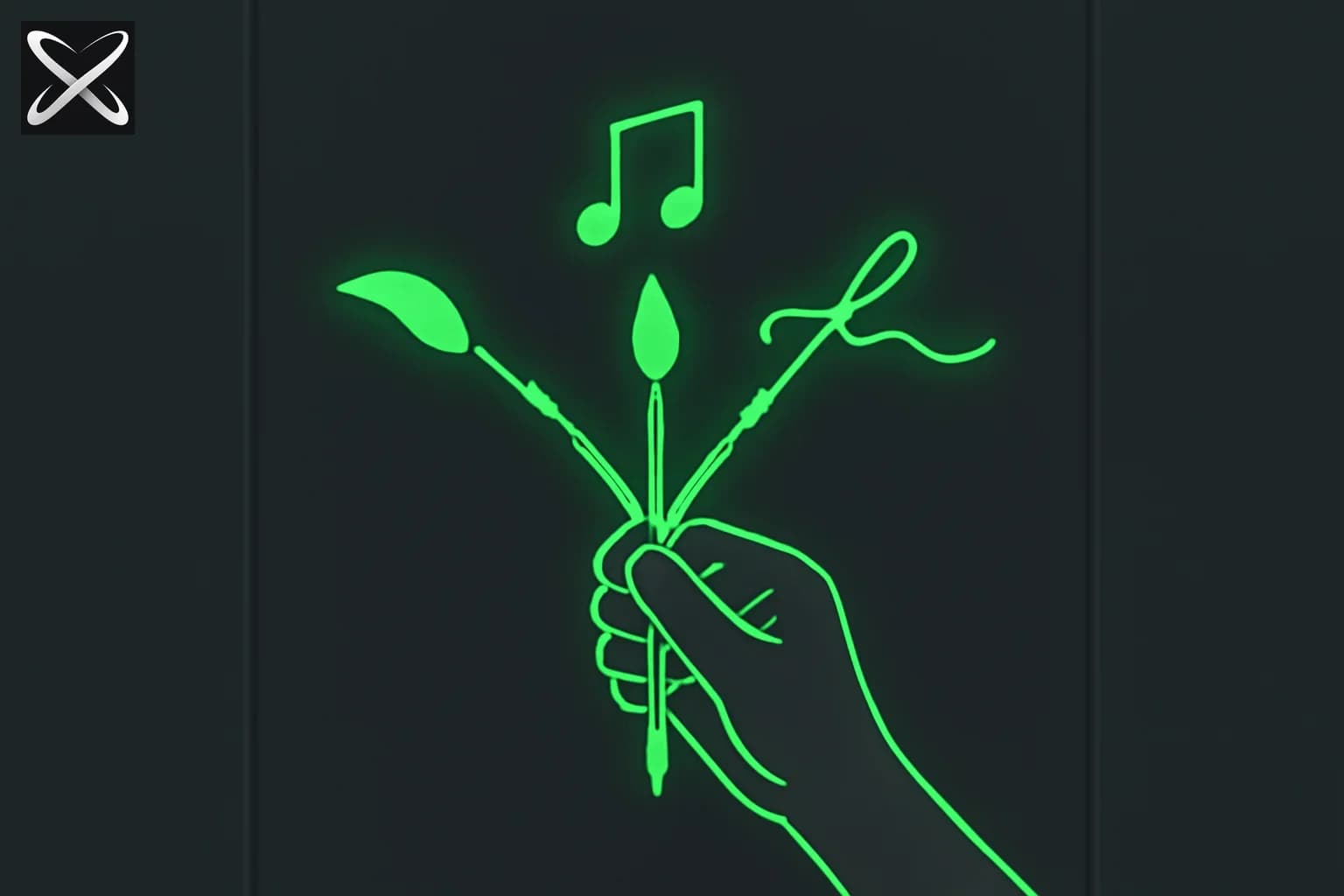
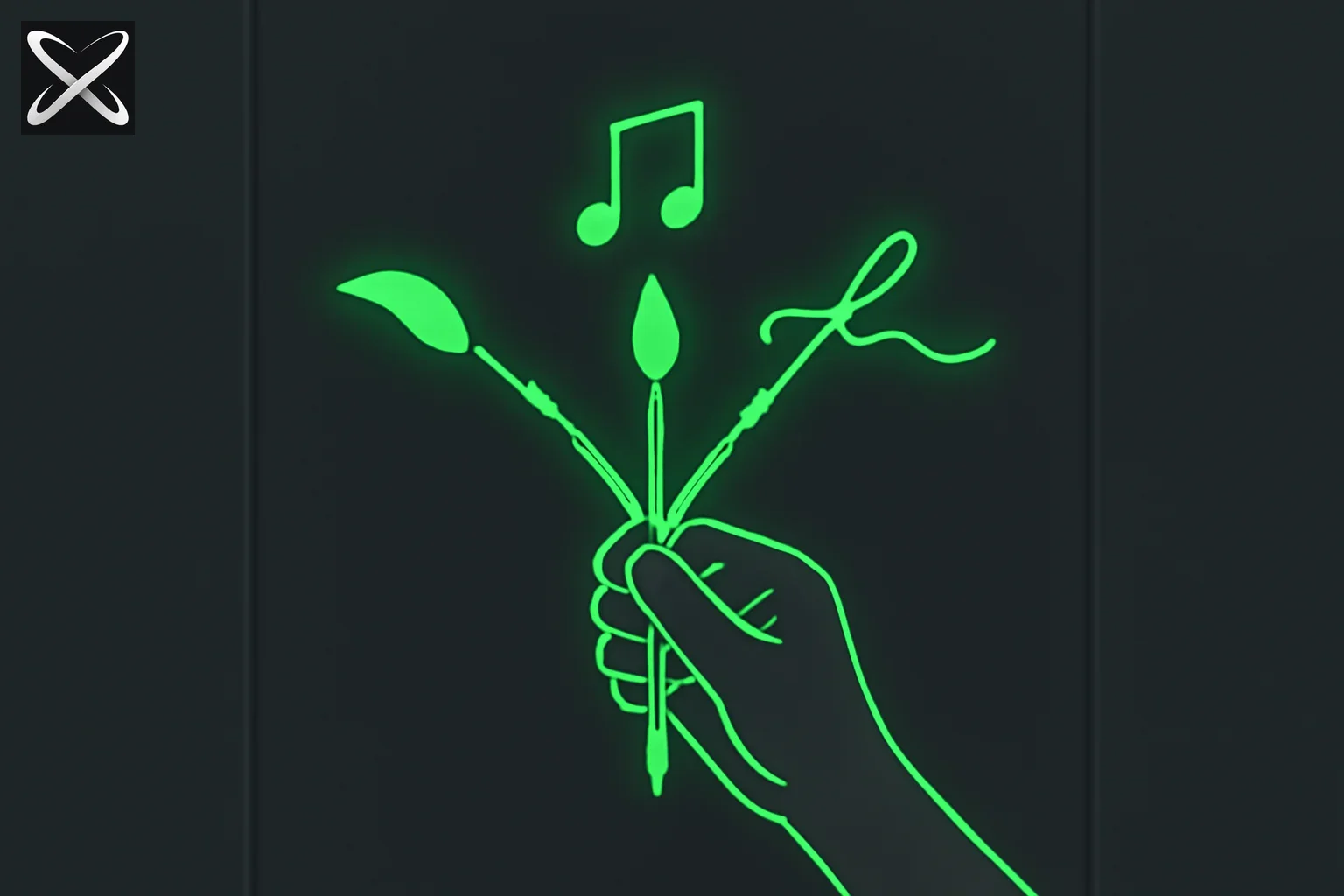 A hand holding a paintbrush, stylus, and pen, symbolizing the blurred line between AI-driven and human-made creative work
The old detection heuristic: watch the process, not the pixel
Detecting diffusion-generated images has always been a pixel-statistics problem: warped hands, inconsistent lighting, telltale frequency artifacts in the noise pattern. Detectors and generators have spent years in an arms race over those signals, covered extensively in our breakdown of how AI watermarking actually works.
But the community-level heuristic that actually spread — the one non-technical viewers relied on — was simpler and had nothing to do with pixels: "show me the timelapse." A finished diffusion image has no meaningful intermediate states. It exists in a handful of denoising steps that look nothing like a human drawing process. So a genuine screen recording of hours of layered, iterative work became the de facto proof of authorship — used on art platforms, in freelance disputes, and in social-media callouts alike.
That heuristic depended on one assumption holding: that producing a process, not just an output, was something only a human bothered to do.
What a computer-use agent changes
A computer-use agent is a model given the ability to see a screen and issue real input — mouse movement, clicks, stylus pressure, keyboard shortcuts — the same interface a human uses. Instead of generating a finished image in one diffusion pass, the agent opens an ordinary drawing application and places strokes sequentially: sketch, block in shading, add linework, adjust layers, export.
This produces output that is not synthetic in the way a diffusion image is. The file has a real stroke-by-stroke edit history, because the strokes were actually issued to real software over real time, one action after another. A screen recording of the session captures an authentic process — corrections, layer changes, brush switches, all of it. None of that has to be fabricated or composited afterward; it's a straightforward byproduct of how the image was actually produced.
Why this breaks more than "spotting AI art"
The practical consequence isn't just that AI art gets harder to detect — plenty of tools already handle that reasonably well for pure diffusion output. It's that the specific class of evidence people treat as authoritative just stopped being reliable, without most platforms or communities having updated their policies yet.
Consider what still relies on "show your process" as a verification method:
- Art platforms and competitions that require a process video or PSD file with intact layers as proof of human authorship
- Freelance and commission disputes where a client asks an artist to prove originality by sharing their working file
- Social-media callouts, where a timelapse posted in response to accusations has historically been treated as case-closed
- Educational and portfolio contexts, where students demonstrate skill progression through saved iteration history
Every one of these treats "I can show you how it was made" as equivalent to "a human made it." That equivalence was accurate right up until an agent could genuinely show you how it was made too — this is the same gap covered in our look at how AI is copying human creativity in the shadcn debate, applied to process evidence instead of output style.
What still works — and what doesn't
Doesn't work anymore, or won't for long:
- Timelapse or screen-recording review — the recording can be entirely genuine and still document an agent, not a person
- Layer count and file structure — an agent operating real software produces a normal-looking layer stack, not a suspiciously flat one
- Brush stroke variance as a tell — early agents may show unnaturally even pressure or overly efficient stroke ordering, but that's a training gap, not a fundamental limit. Treat it the way early diffusion "six-finger hands" were treated: a temporary crutch, not a lasting signal.
Still works, with caveats:
- Cryptographically signed provenance at creation time. A C2PA manifest recorded by the software itself — not assembled afterward from a video — can flag whether the input stream driving the strokes came from an agent versus direct human interaction, similar to how camera manufacturers sign photos at capture. The catch: this only works if the drawing application actually implements it, and most consumer art software doesn't yet. It also inherits C2PA's known weakness — manifests don't survive a screenshot or re-export, so a determined actor can still launder the file through a lossy step that strips the signature while keeping the pixels intact.
- Platform-side account and behavior signals — upload cadence, session timing patterns, and cross-referencing against known agent-driven automation are harder to fake at scale than a single file's metadata, though they're probabilistic, not conclusive.
- Policy that doesn't ask for the impossible. The platforms handling this best are the ones that stopped treating "I can show you my process" as sufficient proof at all, instead requiring tool-level signed provenance or simply not adjudicating authorship claims they can't actually verify — the same posture Australia's ARIA took by banning wholly AI-generated music from its charts using an eligibility rule rather than an audio classifier.
The pattern to recognize
This is the same shift that has already played out with other "just look at the artifact" heuristics: chess platforms stopped trusting "I would never cheat" once engines got strong enough to look human-paced, and video platforms stopped trusting a raw clip once frame-level fabrication got cheap. In every case, the fix wasn't a better detector for the old tell — it was moving verification earlier, to the point of capture or creation, where a signature can be attached before there's anything left to fake.
Digital art is now in that same transition. The tell that used to work — "watch it happen" — has stopped being decisive, and the industry hasn't yet converged on what replaces it the way C2PA has started to for photography. Anyone building verification tooling, platform policy, or even personal proof-of-work for commissioned art should assume timelapse and layer-history evidence is now necessary-but-not-sufficient, not the final word it used to be.
What can a signed creation record establish?
A signature can establish that a record was signed by a particular credential and has not been altered in a way that invalidates that signature. It does not independently establish that a person held the stylus. A claim about human input depends on what the signing software observed, how the input was classified, and whether you trust that implementation.
For an art commission, combine the record with a clear process agreement and the source files needed to inspect the work. State which assistance is allowed and what evidence will be provided. This makes the review about a defined requirement rather than asking a timelapse to answer every question about authorship.
Absence of provenance is also inconclusive. Exporting or sharing can remove metadata, so a missing manifest is not proof that an image was generated by AI. The useful distinction is between evidence that supports a particular claim and a binary detector that promises to classify every artifact.
When evaluating a tool, inspect the actual assertions it emits and how a verifier presents them. A badge with no explanation of its issuer or meaning can encourage viewers to infer more than the record says. Prefer a readable account of the supported claim and its limits.
Related on explainx.ai
- What is C2PA? Content Credentials, explained — how signed provenance manifests work and where they break
- C2PA on Android cameras got broken anyway — a live example of provenance signing being forged after the fact
- Anthropic's Claude now has invisible watermarks and C2PA
- OpenAI Codex computer-use: Windows and mobile control — the underlying agent capability this relies on
- AI copying human creativity: the shadcn debate
- Australia bans wholly AI-generated music from its charts — provenance-by-policy applied to a different medium
- How does AI text watermarking actually work?
Reflects the state of computer-use agents and content-provenance tooling as of September 6, 2026. Both are moving quickly — check current platform policies before relying on any specific detection method.