



Perceptron said on November 20, 2026 that Isaac 0.5 now has ready-to-run checkpoints for YAM, SO-100/101 and LIBERO, distributed through Hugging Face and LeRobot, according to the company's social announcement relayed across robotics feeds the same day. The weights sit on PerceptronAI/Isaac-0.5 and embodiment-specific repos such as Isaac-0.5-YAM, but the model card is explicit: use Perceptron's pinned Isaac repository, not vanilla Transformers.
Isaac 0.5 is a 36-billion-parameter open embodied foundation model Perceptron introduced on its blog with a Business Wire launch statement. November 20's checkpoint message is the builder beat: download, pin commits, run policies on named arms and simulators.
TL;DR: Isaac 0.5 checkpoints
| Item | Detail |
|---|---|
| Model family | Isaac 0.5, 36B sparse MoE |
| Nov 20 checkpoints | YAM, SO-100/101, LIBERO |
| Weight host | Hugging Face PerceptronAI org |
| Runtime | perceptron-ai-inc/isaac at commit be6507b per model card |
| Integration | LeRobot with perceptron_isaac extra |
| Not supported | Stock Transformers and stock LeRobot alone |
What Isaac 0.5 does
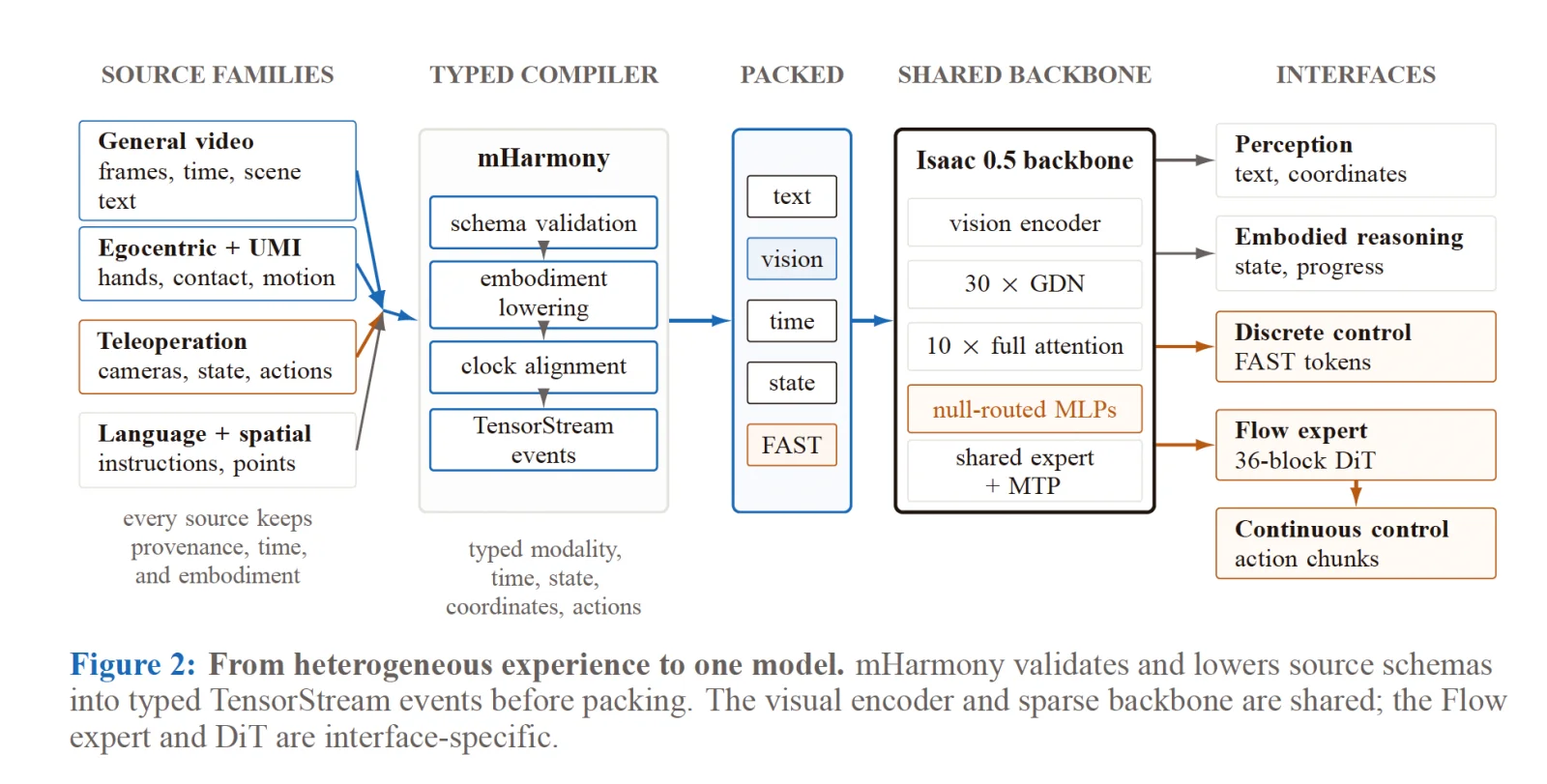 Isaac 0.5 architecture diagram from the Hugging Face model card
Image: Perceptron
Perceptron's Hugging Face card describes Isaac 0.5 as merging multimodal video understanding, embodied reasoning, spatial grounding, task-progress estimation, and robot control in one model. Inputs include images, video, language, robot state, and previous actions. Outputs can be text, normalized coordinates, task-state signals, or robot actions.
The architecture page on Hugging Face lists a 36B Qwen-family vision-language backbone with sparse experts, FAST discrete action tokens, and a Flow expert with a diffusion transformer for continuous control. Perceptron claims co-training on 35+ robot systems, 100,000 hours of robot experience, one million hours of general video, and three trillion multimodal tokens in its launch materials.
For context on Perceptron's commercial API line, see our Egocentric 1.0 video annotation post. For NVIDIA's sim stack, see SimReady pick-and-place agent demos.
November 20 ready-to-run checkpoints
Perceptron's November 20 message names three deployment targets:
- YAM manipulator policies via Isaac-0.5-YAM
- SO-100/101 low-cost arms via Isaac-0.5-SO100_101
- LIBERO benchmark suites via Isaac-0.5-LIBERO
The YAM model card describes a policy that combines three camera views, a language instruction, and both arms' state to predict joint and gripper targets, with examples for inference and fine-tuning in the repo.
This is distinct from the initial Isaac 0.5 launch week, which emphasized technical report, scaling laws, and customer adaptation. The checkpoint drop is the "download today" milestone Hugging Face lists with recent robotics tags.
How to install the supported runtime
The Hugging Face model card prints the supported bootstrap commands. Paraphrased for readability with the exact pin preserved:
git clone https://github.com/perceptron-ai-inc/isaac.git
cd isaac
git checkout be6507b4aed7472f2029606c22684d4ebc9d73e6
git submodule update --init --recursive
git -C lerobot fetch origin main
git -C lerobot checkout e12389c1f8f591ad05dced4e284d4e92e48c5df4
cd lerobot
uv sync --locked --extra perceptron_isaac
The card states the lockfile in the pinned commit defines supported versions. If uv sync fails, do not bump packages casually; open an issue against the Isaac repo with your CUDA driver and GPU model.
Perceptron's blog adds that Isaac ships as a complete system: checkpoints, training code, inference code via LeRobot, and a reference policy server in the GitHub project.
Comparison table Perceptron publishes
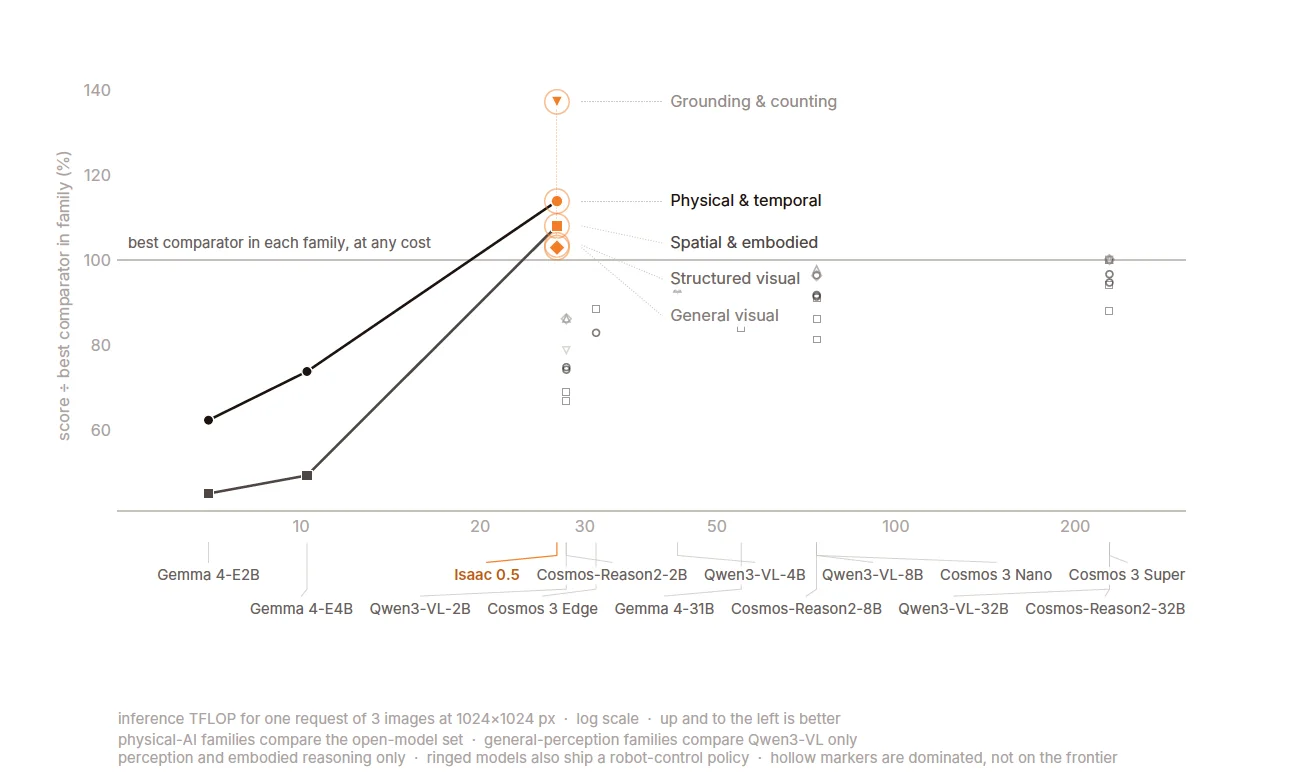 Isaac 0.5 perception benchmark chart from Perceptron
Image: Perceptron
Perceptron's materials include a feature matrix against π0.5, Qwen-VLA, LingBot-VLA, MolmoAct2, SmolVLA, Octo, and OpenVLA, noting RTC training, mistake modeling, non-robot video, and flow expert rows. explainx.ai does not reprint scores not sourced in the card; treat the table as vendor positioning until you run LeRobot eval scripts on your hardware.
Community builders often cross-shop against DaisyRose 27B agent RL for policy learning and NVIDIA GR00T microduck sim training for sim-first stacks.
Fine-tuning and deployment paths
Perceptron's launch post says teams may:
- Fine-tune Isaac as a robot policy on new demonstrations
- Use visual outputs inside planners or data engines
- Deploy through LeRobot or Perceptron's reference server
Business Wire quotes customers in manufacturing, logistics, warehousing, security, and mobility, with Perceptron offering deployment support. Open weights lower the barrier; field safety review remains on the integrator.
If you run Unitree or DIY arms, compare dataset formats with LeRobot hub adapters and Qwen Hermes terminal benchmarks only where tasks overlap; Isaac is continuous control, not coding agents.
Licensing and safety notes
Read LICENSE files on Hugging Face and GitHub before commercial deployment. Robotics policies carry physical risk: start in simulation, add hardware estops, and log OOD detection when language instructions fall outside training domains.
Perceptron is not a top-lab org, but open-weight robot models with model cards clear explainx.ai's tool coverage bar regardless of company size.
Scaling law Perceptron emphasizes
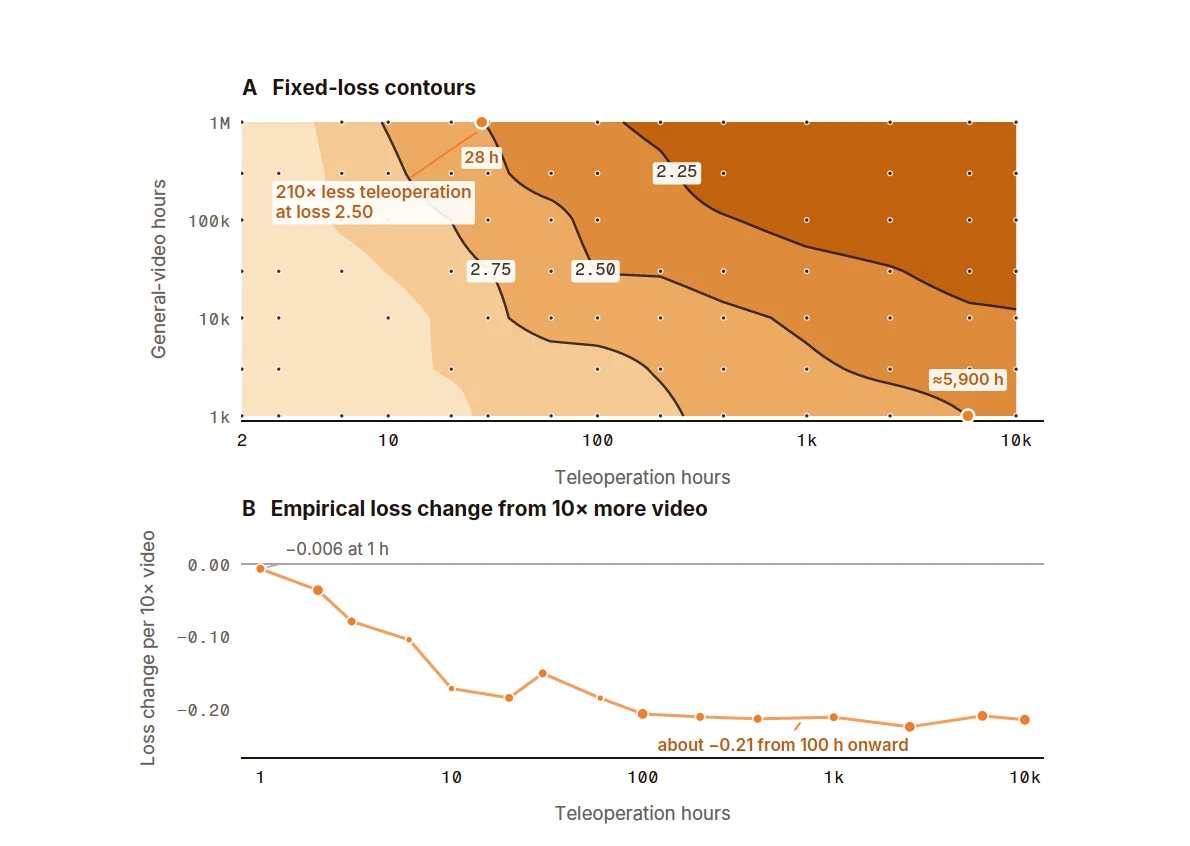 Isaac 0.5 video versus teleoperation scaling law contours
Image: Perceptron
Perceptron's launch blog claims a data scaling law: raising general video from 1,000 hours to one million hours cut teleoperation hours needed to hit a target action loss from about 5,900 to 28 in their reported experiment. That is vendor-reported lab science, not a guarantee on your factory floor.
Still, it explains why Isaac chases multimodal video instead of teleop-only policies like some smaller open models. Teams with large unlabeled video but scarce robot demos should read the technical report linked from Hugging Face before betting fine-tune budgets.
SO-100 and LIBERO in the community stack
SO-100/101 arms became a maker-lab default because of cost and LeRobot compatibility. Shipping Isaac checkpoints for those arms lowers the time-to-first-policy compared with training VLA models from scratch.
LIBERO suites standardize long-horizon manipulation benchmarks. A checkpoint drop means researchers can compare Isaac against π0.5 baselines on shared tasks without reimplementing Perceptron's data pipeline.
If you already use Hugging Face harness adapters for coding agents, do not confuse that tooling with robot policy servers; Isaac expects continuous action tensors, not terminal bench tasks.
Discrete FAST tokens vs Flow expert continuous control
The Hugging Face architecture section notes 2,048 FAST action tokens for discrete control and a Flow expert with diffusion transformer for continuous chunks. Practitioners should pick the head matching their robot interface:
- Gripper discrete goals may map cleanly to FAST
- Joint-space smooth trajectories may need Flow
Misconfiguration often shows up as jittery policies or failure to converge during fine-tune; log action space in LeRobot dataset cards before merging Isaac weights.
Hardware planning for 36B MoE inference
Perceptron does not publish a single-GPU recipe on the model card. 36B MoE with up to eight routed experts per token implies multi-GPU inference for low latency. For lab prototyping:
- Start LIBERO sim eval before real arm torque
- Use chunked observations (1–3 steps listed in vendor table) to bound memory
- Profile RTC-trained checkpoints if your stack supports real-time correction
Compare against OVH Olala mini MoE only for compute budgeting culture, not task equivalence.
Industrial deployment narrative
Business Wire quotes Perceptron working with manufacturing, logistics, warehousing, security, and mobility customers. Open weights help pilots; field safety, latency SLAs, and insurance still gate production.
Readers tracking humanoids should cross-read Chinese humanoid CES visa denials for geopolitical demo risk, separate from Isaac's software release.
Troubleshooting the pinned commit workflow
If git submodule update fails behind corporate proxies, mirror lerobot and isaac forks internally but keep commit hashes unless Perceptron bumps support. If uv sync --extra perceptron_isaac conflicts with your global Python, use containers with CUDA versions listed in the Isaac lockfile.
When upgrading later commits, re-run LIBERO smoke tests; MoE routing changes can alter action statistics enough to require re-normalization.
Where Isaac sits in the November robotics news stack
November 2026 also brought Waymo regulatory friction in California's DMV freeway ban and Tesla assisted-driving approvals in Italy. Those stories cover deployment law, while Isaac covers open model weights for manipulation.
NVIDIA's Ignite demos pitched GR00T and robot sim assets for enterprise Azure buyers. Isaac targets teams that self-host on LeRobot without cloud vendor bundling.
Pick Isaac when you need open checkpoints and can absorb pinned-repo ops. Pick vendor sim stacks when you already bought Omniverse pipelines.
Data collection tips before fine-tuning Isaac
Perceptron's materials emphasize mistake modeling and previous-action history in the training mix. When logging your own demos:
- Record language instructions verbatim
- Keep extrinsic and wrist cameras time-aligned
- Mark failure segments instead of deleting them; Isaac claims mistake-aware training
Upload datasets in LeRobot format before merging weights; mixing ad-hoc numpy dumps forces custom collators the reference server may not support.
Join Perceptron's GitHub discussions when checkpoints drift from main; open-weight robotics moves fast, and embodiment-specific heads may ship days apart from backbone updates.
Budget two engineering weeks for a first LIBERO replay plus one real-arm safety review before you promise production timelines to operations managers.
Store checkpoint SHA and isaac commit hash in your experiment tracker so regressions after Perceptron updates are easy to bisect.
When demos fail, capture observation tensors and language prompts; Perceptron's mistake modeling only helps if your fine-tune data includes similar failures.