



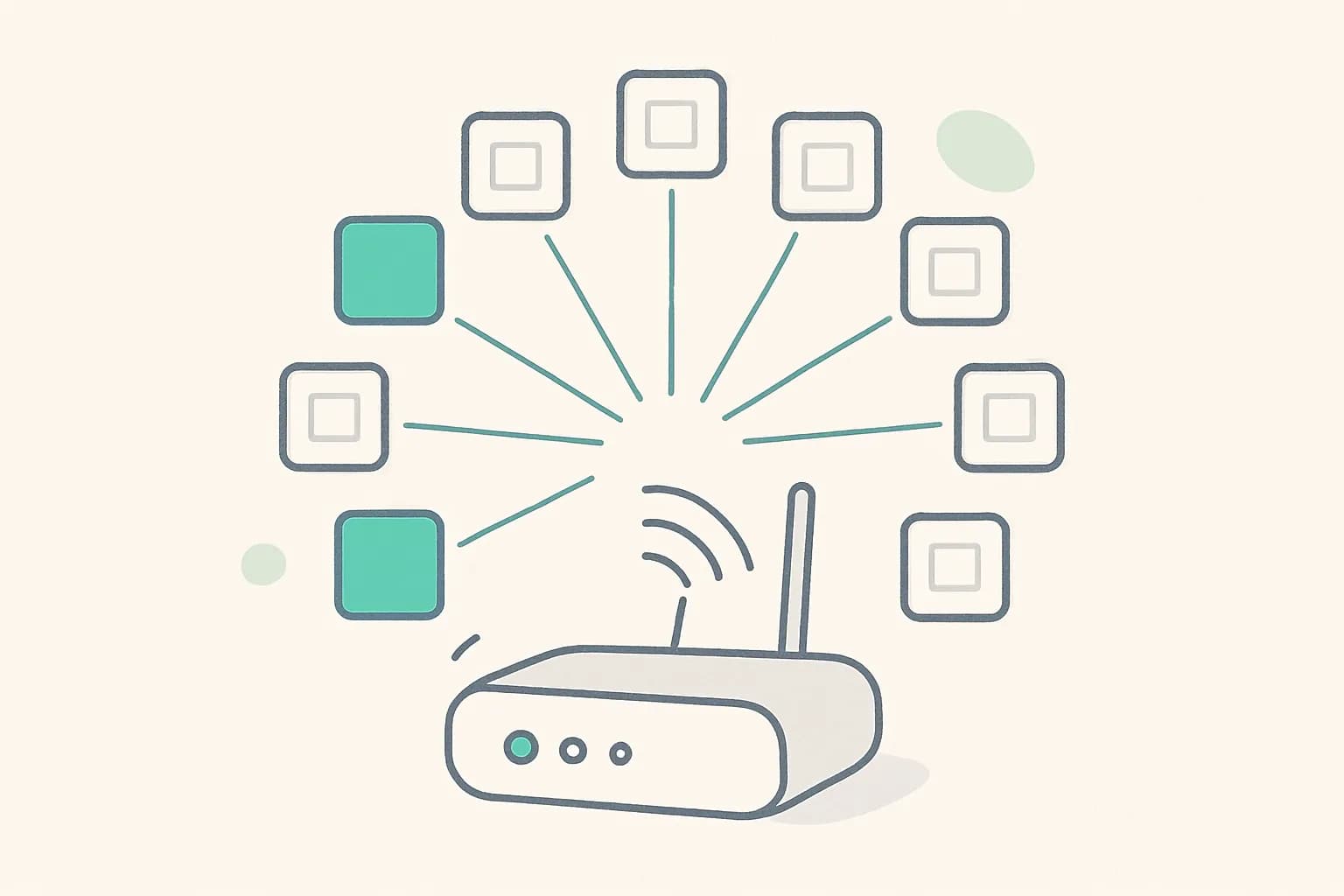
OVHcloud has released Olala mini 7A1B, the first model in its Olala family and its first open-weight language model. It is a mixture-of-experts model with about 7 billion parameters in total and 1 billion active per token, licensed Apache 2.0, and trained on European public supercomputers. CEO Octave Klaba unveiled it on November 17, 2026, and the weights are now on Hugging Face under the OVHaiLLM organization.
The pitch is a small, fast model that runs without a GPU. This post separates what OVHcloud claims from what the model card documents, and lists what to test.
TL;DR: Olala mini 7A1B
| Question | Answer |
|---|---|
| What is it? | Hybrid Mamba and attention mixture-of-experts LLM, 7B total, 1B active |
| License? | Apache 2.0, keep the NOTICE file (credits the Qwen tokenizer) |
| Context? | 32K tokens input plus output; 128K version promised |
| Hardware claim? | 160 tokens/s on an RTX A4500, 50 tokens/s on a CPU, per OVHcloud |
| Variants? | Base, SFT, final model, GGUF, MLX, plus translate and summarise fine-tunes |
| Training? | 12.8T tokens on JUPITER, Jean Zay and MeluXina |
| Benchmarks? | Model card reports a 68.0 average over twelve tests; self-reported |
What is Olala mini 7A1B?
Each layer holds 256 expert sub-networks, and a router activates only a few for each token, so about 1B of the 7B parameters work at a time. ActuIA's report on the launch says the attention is hybrid, combining Differential-TPA with Mamba-3, a state-space layer that keeps a fixed-size summary of the text stream. The architecture was developed by Dragon LLM, formerly Lingua Custodia, which OVHcloud agreed to acquire in March 2026, according to the same report.
The model card lists reasoning and tool calling as features and supports many languages, from English and Chinese to Finnish, Hungarian and Ukrainian. It takes text only. Images and audio are out of scope.
Why a mixture-of-experts model can be fast on weak hardware
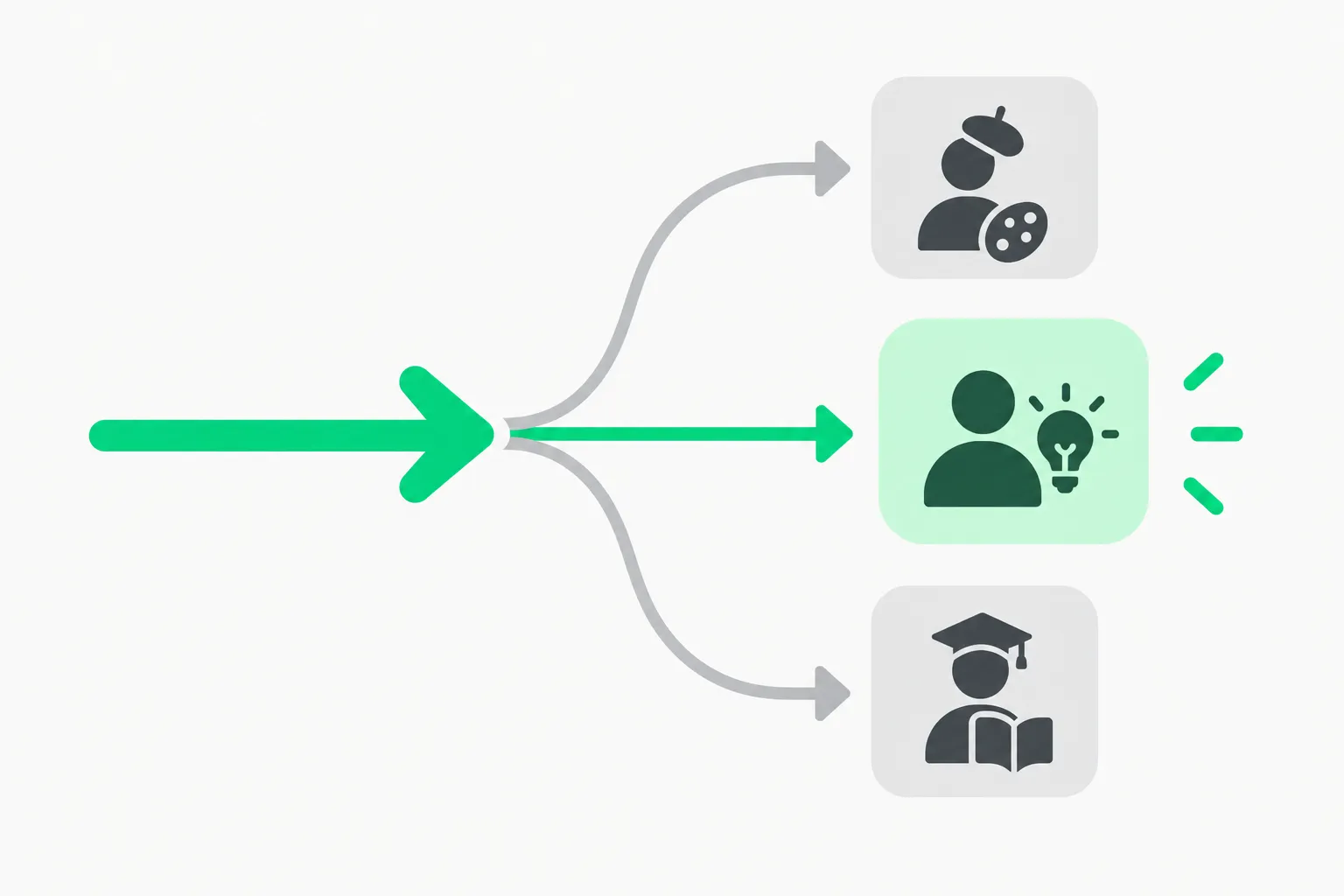 A router hub linked to a ring of small expert blocks, showing how a mixture-of-experts model activates few parameters per token in Olala mini 7A1B
Speed on a CPU depends mostly on how many weights must be read for each generated token. A dense 7B model reads all of them every time. A mixture-of-experts model reads the router plus the chosen experts, roughly the 1B active parameters. That is why OVHcloud can quote CPU speeds that a dense 7B model would not reach.
The trade-off is memory. All 256 experts per layer must be available, so the full weights still take disk and RAM unless you use a compressed build. Active parameters set speed; total parameters set footprint. The Mamba-style layers add a second effect: they keep a fixed-size state instead of a growing cache, which helps long outputs, and also explains the card's warning to serve with float32 cache on vLLM.
What does OVHcloud claim about speed and memory?
IT Pro reports OVHcloud's figures: 50 tokens per second on a standard CPU and 160 tokens per second on an Nvidia RTX A4500. OVHcloud also says a GPU with 8 GB of memory is enough.
ActuIA questions that last number. In bfloat16, 7 billion parameters weigh about 14 GB, nearly double 8 GB, and the RTX A4500 has 20 GB. The launch gave no explanation, so the 8 GB claim likely depends on a compressed build or partial expert loading. The model card does list a row for a PC with 8 GB of RAM and no GPU at an estimated 65 tokens per second for one request at a time. Treat every speed as a vendor figure measured on OVHcloud's setup.
What does the model card say about quality?
The card is more detailed than the launch coverage. It reports that Olala-v1.0-mini-7A1B averages 68.0 over twelve benchmarks, 15.2 points above its SFT checkpoint, strongest on instruction following and weakest on competition mathematics. It compares 19 models grouped by size, including Ling 3.0-tiny, OLMoE 1B-7B, Qwen3.5 in 2B and 4B, Ministral 3, SmolLM3, Apertus 8B and EuroLLM 9B. OVHcloud says every model was run with the same context window and with reasoning enabled where available.
That evaluation is OVHcloud's own. We have not seen an independent leaderboard result, so use the table as a shortlist, not a verdict. Early reports on launch day said the announcement had no scores, and the card has since filled that gap.
Limits OVHcloud lists itself
The card is candid, which helps you plan:
- Knowledge. With about 1B active parameters, it stores less factual knowledge and can state wrong facts with confidence. It was trained to read data through tools.
- Languages. Comprehension outside English and the main European languages is weaker than the training mix suggests.
- Repetition. Long reasoning can loop. Use the recommended sampling, set a token limit, and on vLLM serve it with
--mamba-ssm-cache-dtype float32. - Quantization. Generic quantization recipes produce NaN on realistic inputs, so use the quantizations OVHcloud publishes.
- Context. 32K tokens in total.
Who trained it, and on what?
Training used three public machines: JUPITER in Germany, MeluXina in Luxembourg and Jean Zay in France. ActuIA reports OVHcloud puts the compute at about 7 million euros of hours, without naming the allocation scheme. The model card says pre-training covered 10.4T tokens, then 2.38T tokens of annealing weighted toward mathematics, then supervised fine-tuning on 36.9M samples and reinforcement learning. Public training sets named on the card include FineWeb-2, Nemotron-CC and Wikipedia.
Klaba told IT Pro that "we cannot simply rely on the generosity of certain labs to share their LLMs as open source in the years to come." That is a sovereignty argument as much as a technical one, and it echoes our coverage of open-source AI without Jensen Huang and the open model coalition.
How does it fit among small open models?
Small open models are crowded this month. We covered Haru 4B, an open full-duplex speech model, Nace AI's open-weight decision models and Cloudflare's open-weight Clairic on Workers AI. Olala's distinct angles are the Apache license without usage limits, the European training provenance, EU AI Act documentation and a CPU-first design.
The single customer reference is Qwant, whose Réponse Flash summaries reportedly run 20% faster at one third of the operating cost versus an unnamed earlier model. ActuIA notes Qwant belongs to a group owned 75% by the Klaba family, so it is in-house feedback rather than independent proof.
How to try it
- Read the model card for the recommended sampling settings.
- Pick a build: the main model through Transformers (custom code is required), GGUF for llama.cpp, or MLX for Apple silicon.
- Run your own prompts, not the card's. Check your language, your tool-calling format and long outputs for loops.
- Measure tokens per second and memory on your hardware before you plan capacity.
- Keep the NOTICE file if you redistribute.
Should you pick Olala over an API model or another small model?
Use a short decision rule. Choose Olala when you need a permissive license, data that stays on your machines, low cost per token on modest hardware, or EU-provenance paperwork. Choose a hosted frontier model when answer quality, long context or broad world knowledge matters more than control. Choose another small open model when it already passes your tests and your stack supports it, since Olala needs custom code in Transformers and special flags in vLLM.
A fair pilot takes an afternoon. Take 50 real prompts from your workload, run them through Olala and your current model, and score the answers blind. Record tokens per second, peak memory and the number of runs that loop or return malformed tool calls. If the failure rate is low on your tasks, the license and cost advantages become real. If it is not, the benchmark average on the card will not rescue it.
Two cautions apply to any launch-week model. Community tooling is young: the Hugging Face listing shows only a few hundred downloads per variant so far, so expect rough edges in runtimes and quantizations. And the card's own warning about generic quantization producing NaN means you should not grab a random community GGUF; use the builds OVHcloud publishes.
What is next
OVHcloud says version 1.1 should extend context to 128K tokens by the end of the year and improve mathematical reasoning. A later release is reported to exceed 100 billion parameters, with models for enterprise agents, cloud DevOps and cybersecurity. None of that is dated, so plan around what is published today.
What this means for what you build or pay
For builders, a CPU-capable 1B-active model is useful for summarization, routing and tool-reading steps where a frontier model is overkill, provided your own tests pass. For founders buying in Europe, the Apache license and AI Act documentation lower paperwork, but the model is small, so keep a stronger fallback. For marketers, the story is sovereignty, not benchmark leadership.
Related voice and speech open releases are in Apriel Voice 27B and Liquid AI's D1.2 Ultra.
Related reading
- Open-source AI without Jensen Huang: the open model coalition
- Haru 4B open full-duplex speech model
- Nace AI open-weight decision models
- Cloudflare Clairic open-weight model
- Apriel Voice 27B
- Liquid AI D1.2 Ultra
Details are as published by OVHcloud, its Hugging Face model card and press reports on November 19, 2026, and may change.