



Ant Group's Robbyant lab open-sourced LingBot-Touch, a tactile foundation model that turns magnetic, piezoresistive, and visuotactile streams into shared tokens for dexterous robot hands. The technology site and GitHub repository describe 4,983 hours of pretraining, Apache-2.0 code, and checkpoints on Hugging Face and ModelScope.
For embodied-AI builders, the release is a rare open-weight touch encoder at foundation scale—not another vision-language demo without contact physics.
TL;DR
| Item | Robbyant (Nov 2026) |
|---|---|
| Architecture | JEPA-style latent prediction + shared Transformer (HaT) |
| Modalities | Magnetic, piezoresistive, visuotactile |
| Pretraining scale | 4,983 h · 464k episodes · ~1.33B frames |
| Smallest encoder | HaT-Tiny · 5.46M parameters |
| Weights | Tiny + Small checkpoints (HF / ModelScope) |
| Code license | Apache-2.0 on GitHub |
| Integration | Pairs with LingBot-VLA; tested on Sharpa Wave + XHand |
| Reported real-task lift | Vendor charts on 26 tasks (see tech site + arXiv) |
Why tactile foundation models matter now
Vision-language-action (VLA) models improved grasping from pixels, but precision manipulation still fails when force, slip, and contact timing stay invisible. explainx.ai has tracked that gap in egocentric data debates and LeRobot v0.7 integrations, where LingBot-VLA 2.0 already appears beside other hands.
LingBot-Touch attacks the sensor heterogeneity problem: labs use incompatible tactile hardware, so policies trained on one gloved rig rarely transfer. Robbyant's pitch is one latent space across modalities, then zero-shot transfer to unseen sensors—a claim that must be validated outside Ant's slides.
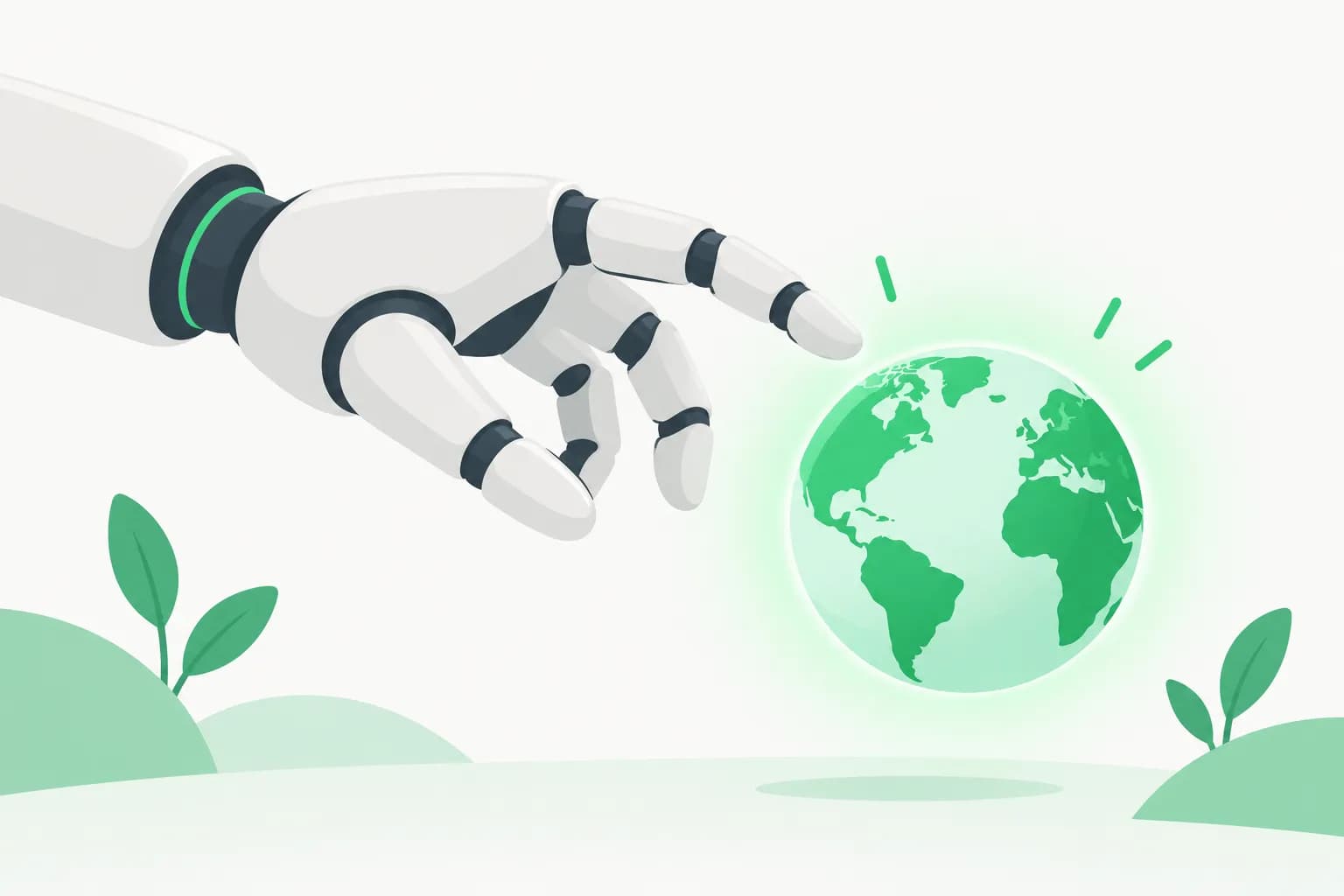
 Robot hand reaching toward a globe, illustrating cross-hardware tactile transfer goals
Architecture in plain language
Per the README:
- Modality-specific tokenizers map raw tactile frames into tokens.
- A shared Transformer (Haptic Transformer / HaT) integrates spatiotemporal context via masked latent prediction (JEPA-style training).
- Inference ships a frozen target encoder that outputs token-level features plus addresses (time, finger, spatial taxel).
Robbyant stresses attention-based querying downstream: VLAs should cross-attend to all tactile tokens instead of mean-pooling, because post-attention tokens already mix information across the contact patch.
That design choice matters for agent builders stitching touch into π0.5-style policies or custom diffusion heads: treat tactile tokens like compressed KV cache entries, not a single pressure scalar.
Pretraining corpus—what Ant says is inside
Robbyant's page breaks down ~4,983 hours across sensor types (piezoresistive, magnetic, visuotactile gloves and hands). The scale rivals vision pretraining corpora in episode count (464k) even though touch data is harder to collect.
| Sensor family | Hours (Robbyant) | Notes |
|---|---|---|
| Piezoresistive | 2,197 h | Largest slice |
| Magnetic | 1,136 h | Includes glove arrays |
| Visuotactile | 1,650 h | GelSight-class sensors cited in demos |
Caveat: Unlike vision datasets with public downloaders, most tactile hours stay inside Ant's cluster. You get encoder weights, not the full 1.33B-frame corpus—fine for inference, limited for from-scratch pretraining.
Reported real-robot evaluations (vendor benchmarks)
Robbyant evaluated 26 dexterous tasks on Sharpa Wave and XHand, comparing policies with:
- No tactile input
- Raw tactile streams
- Frozen LingBot-Touch tokens
Robbyant's technology page publishes interactive charts comparing original model, raw tactile, and frozen LingBot-Touch tokens across LingBot-VLA, π0.5, Diffusion Policy, and T-Rex on 26 real-world tasks (20 trials each on Sharpa Wave and XHand). The companion arXiv preprint describes the same evaluation scope.
Those charts are useful directionally—touch helps contact-heavy tasks like cap twisting listed on the site—but not independent replication. Until another lab posts Sharpa Wave logs, quote gains as Robbyant-reported and read percentages from the official charts, not SEO reposts.
Qualitative demos on the technology page show key insertion, toothpaste pressure control, and bag sealing—tasks where vision alone confuses contact vs proximity.
What people ask about tactile foundation models
| Question | Short answer |
|---|---|
| Is this a VLA? | No—it is a tactile encoder. Pair it with LingBot-VLA or your policy head. |
| Do I need Ant hardware? | Robbyant claims transfer to unseen sensors; you still need some compatible stream at inference. |
| Can I fine-tune the encoder? | Apache-2.0 code ships frozen encoder utilities; full pretraining code is not in-repo. |
| How fast is HaT-Tiny? | Robbyant markets high-frequency inference; profile on your GPU with README scripts. |
| Is visuotactile the same as RGB? | No—GelSight-class contact geometry plus force; tokenizer differs from camera ViTs. |
JEPA vs contrastive tactile baselines
Many labs still train touch with contrastive losses on single-sensor datasets. Robbyant's JEPA / masked latent prediction choice targets long-horizon context across taxels—closer to how contact events unfold during manipulation (slip, stick, release).
Practical difference for integrators:
- Contrastive models often need paired negatives per sensor layout.
- JEPA-style models predict masked spatiotemporal patches, which may tolerate missing taxels when gloves degrade.
We cannot independently verify Ant's ablation tables, but the architecture story matches why they emphasize attention readouts instead of pooling: the representation is explicitly contextual.
Token addresses and why pooling fails
Each output token carries time, finger, and spatial address metadata. Robbyant warns that mean/max pooling throws away which contact patch drove a slip event. For debugging grasp failures, addresses let you align tactile tokens with video frames in logging pipelines—a useful pattern for anyone building robot observability stacks.
If you already log proprioception + RGB for LeRobot datasets, add a third stream for tactile token IDs so offline replay shows where the policy felt contact.
Checkpoints: Tiny vs Small
| Checkpoint | Params (encoder) | Robbyant positioning |
|---|---|---|
| LingBot-Touch-Tiny | 5.46M (HaT-Tiny) | Edge inference, fast loops |
| LingBot-Touch-Small | larger HaT variant | Higher capacity, more VRAM |
Weights live off-repo on Hugging Face and ModelScope with gated downloads—budget time for account approval before CI pipelines fetch artifacts.
How to try LingBot-Touch this week
- Clone
github.com/Robbyant/lingbot-touch(Apache-2.0). - Download
config.json+encoder.ptfor Tiny or Small from Hugging Face / ModelScope intocheckpoints/lingbot-touch-tiny/or...-small/. - Pick modality flag:
magnetic,piezoresistive, orvisuotactileper README. - Run encoder inference to extract token features + addresses.
- Feed tokens into your VLA via cross-attention queries (Robbyant's recommended readout).
Hardware reality: LingBot-Touch does not include a simulator. You still need a robot hand + tactile stream or a recorded dataset in one of the three modalities. For software-only teams, start by replaying published tactile logs if Robbyant releases them; today the repo focuses on encoder inference.
Integration with LingBot stack: Robbyant positions LingBot-Touch beside LingBot-Map streaming 3D and LingBot-VLA releases—spatial perception, contact encoding, and action heads in one vendor stack, similar to how NVIDIA GR00T bundles perception and control narratives.
Comparison anchors on explainx.ai
| Approach | What it optimizes | Open weights? |
|---|---|---|
| LingBot-Touch | Cross-sensor tactile tokens | Yes (encoder + code) |
| Gemini 4 Argon robotics | Sim/real alignment for robot views | Closed API |
| LeRobot ecosystem policies | Imitation + RL on community hardware | Mixed |
| Reward AI OM-1 | Wearable multimodal human demos | Product-specific |
LingBot-Touch is closest to representation learning for touch—the missing layer between Open X-Embodiment vision and contact-aware policies.
Wiring LingBot-Touch into LeRobot or ROS stacks
Most labs will not replace an entire VLA— they will inject tactile tokens into an existing policy:
- Record synchronized tactile + proprioception + video (Robbyant modalities only unless you fine-tune).
- Batch-encode touch windows through HaT-Tiny offline to save on-robot compute.
- Cache tokens per episode in LeRobot dataset columns, similar to how Open X-Embodiment stores multi-camera frames.
- Train a lightweight adapter (cross-attention queries per Robbyant README) rather than unfreezing the encoder.
On ROS2 deployments, publish token tensors on a diagnostic topic so teleoperators can see when the policy attends to slip cues—useful for human-in-the-loop collection aligned with egocentric wearable debates.
 Humanoid balance metaphor for tactile feedback stabilizing dexterous manipulation policies
Safety, sim-to-real, and lab hygiene
Better touch improves beneficial precision (medication packaging, connector insertion) and harmful precision (weaponizable manipulation research). Teams should pair encoder upgrades with task allowlists in sim before real hardware energizes.
Sim-to-real gaps also remain: GelSight-class sims still under-model wear on taxels. Budget weekly recalibration and log when tokenizer outputs drift—JEPA models may be stable, but glue failure on real skins is not.
For human-subject glove collection, treat tactile logs like biometric-adjacent data: strip names at ingestion, separate storage from cloud VLAs, and rotate keys if gloves sync through vendor clouds.
Limitations and open questions
- No public training code for the full JEPA objective—release is inference-first.
- Weight gating on Hugging Face / ModelScope may slow academic mirrors—plan mirror latency.
- Generalization claims (transfer to unseen sensors with no extra training) need third-party ablations.
- Safety: Better touch can also enable finer manipulation of dangerous objects—pair with task-level guardrails, not only better sensing.
Related reading
- LingBot-Map: streaming 3D reconstruction at 20 FPS
- LeRobot v0.7 rollouts and remote policies
- Egocentric data and the sensorimotor void
- Gemini 4 Argon for robotics and ERQA
- Agentic robotics at Berkeley and NVIDIA CoRL
Replication checklist for outside labs
Independent groups can shrink vendor uncertainty without Ant's private corpus:
- Download Tiny weights and run README inference on public visuotactile sets (e.g., community glove logs).
- Report success deltas with identical random seeds across no-touch / raw / LingBot ablations on one dexterous benchmark.
- Publish failure videos where attention maps miss slip—negative results help the field more than headline percentages.
When replication posts appear, we will link them from this page's update banner.
Repository metadata, corpus statistics, and task scores follow Robbyant sources as of November 10, 2026.