



The best startup ideas sound stupid until they work — and Paul Graham's earn.html essay says that's why you must not hunt for them on purpose.
In How to Earn a Billion Dollars — the written version of Graham's June 2026 Oxford Union talk — the exponential-growth math gets the headlines. A quieter section answers a question founders actually Google: how do you get an idea like Apple or Airbnb in the first place?
Graham's answer is counterintuitive even by startup standards: do not look for startup ideas. Build cool things with friends. Let companies emerge later.
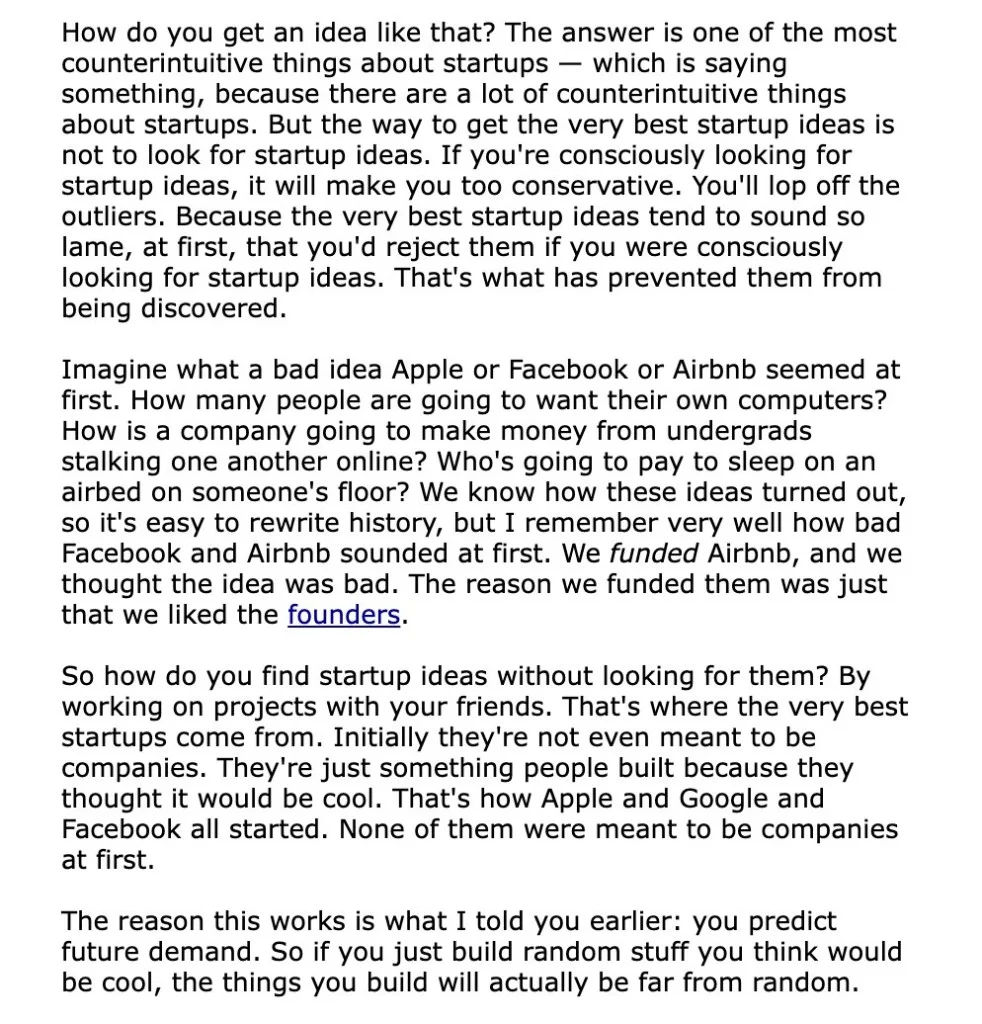 Paul Graham earn.html excerpt on startup ideas from friend projects not conscious searching
explainx.ai covered the growth-rate math in How to Earn a Billion Dollars. This post isolates the idea-discovery thread — the one in Graham's screenshot-worthy paragraphs — and maps it to AI builder culture in August 2026.
TL;DR — what people are asking
| Question | Direct answer |
|---|---|
| Core claim? | Conscious startup idea search → conservative → kills outliers |
| Better path? | Friend projects built because they're cool — company optional |
| Why lame ideas win? | Lameness is the moat — nobody else bothered |
| YC Airbnb story? | Idea judged bad; founders judged good — funded anyway |
| Young founder edge? | Your needs predict demand ~10 years out |
| AI builder read? | Ship hacks you and friends use before pitching "AI startups" |
"Don't look for startup ideas"
Graham's mechanism:
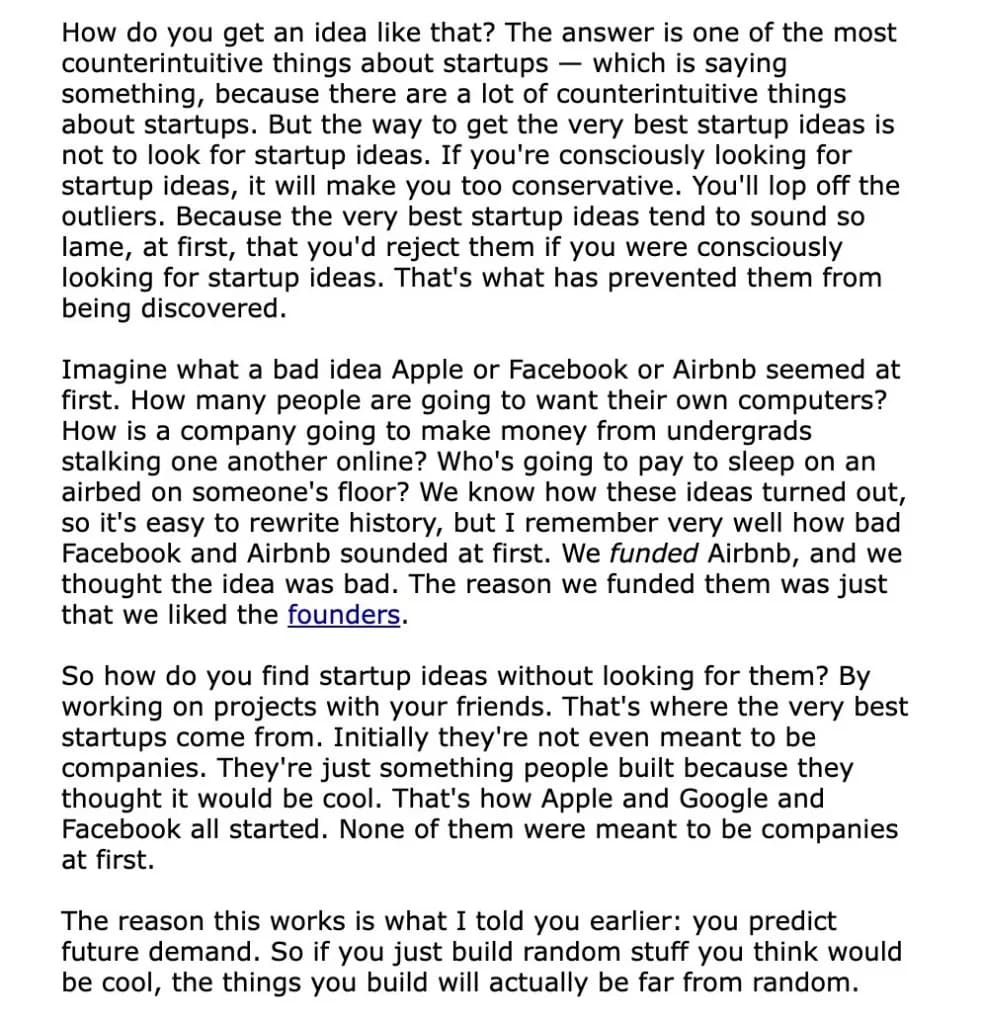
If you're consciously looking for startup ideas, it will make you too conservative. You'll lop off the outliers. Because the very best startup ideas tend to sound so lame, at first, that you'd reject them if you were consciously looking for startup ideas.
That is not romanticism — it is selection bias. Ideas that sound respectable already have competitors. Ideas that sound silly hide undiscovered demand.
| Company | How it sounded early |
|---|---|
| Apple | Who wants their own computer? |
| Undergrads stalking each other online | |
| Airbnb | Pay to sleep on an airbed on someone's floor |
| Twitch / Justin.TV | Guy walking around with a camera on his head |
Graham admits YC thought Airbnb was a bad idea and funded it because they liked the founders — a datapoint that should terrify idea-first pitch decks and comfort builder-first teams.
Friend projects — where Apple, Google, Facebook started
By working on projects with your friends. That's where the very best startups come from. Initially they're not even meant to be companies. They're just something people built because they thought it would be cool.
That aligns with Graham's August 25, 2026 essay How Universities Should Prepare Founders: protect unstructured project time; skip business-plan theater; teach building (CS, engineering) not "entrepreneurship" majors.
Microsoft and Meta both have reading-period origin stories — projects born when "something due tomorrow" pressure disappeared. Graham uses that to argue calendars matter as much as curricula.
Predicting demand without market reports
The payoff paragraph:
If you just build random stuff you think would be cool, the things you build will actually be far from random.
Young founders' tastes correlate with future mainstream demand because they are early adopters by age, not by job title. Build for yourself and friends → you are implicitly running a demand forecast.
For AI builders in 2026, the analogue is not "GPT wrapper for X pitch deck." It is:
- The loop your team runs daily
- The skill you rewrote three times because defaults failed
- The eval that caught a regression nobody else ships
Those embarrassments become products when outsiders hit the same wall six months later — see big tech copying validated startup markets.
Tension with "build LLMs at 17"
Graham's August 23 tweet — build an LLM from scratch at 17 — looks like opposite advice ("go deep, not startup"). It is not:
| Lens | Emphasis |
|---|---|
| earn.html / friend projects | Start from use and cool — company emerges |
| Build LLM at 17 | Start from substrate literacy — company later |
| Universities essay | Institutions should not formalize entrepreneurship |
All three reject performing founder over being a builder.
What not to do — Graham's anti-patterns
- Brainstorm "startup ideas" in a room with a whiteboard of TAM slides
- Reject projects because you cannot name the billion-dollar path day one
- Optimize for sounding smart in pitch contests — Graham hates business plan competitions for this reason
- Copy trending AI categories because they sound legitimate — the respectability filter again
Action list — this week
- Pick one friend-project scale tool — two people, one weekend — that solves your agent workflow pain
- Ship to a GitHub repo or
/skillsentry; skip incorporation talk - Log whether strangers star it or ask for forks — demand signal beats ideation
- Re-read YC-style growth math only after something works
How can AI builders try the friend-project approach?
Treat Graham's argument as a way to discover problems through use, rather than a guarantee that every side project becomes a business. A project can be enjoyable, technically interesting, and commercially irrelevant. The practical benefit is that building exposes details a brainstorming session misses: who repeats the task, what they work around, and where existing tools interrupt them.
Consider two friends who use coding agents on separate projects. Both repeatedly copy test failures into chat, lose the associated diff, and struggle to remember which suggestion produced which result. They could build a tiny local notebook that records a prompt, a patch, and a check result together. The first goal is to make their own debugging sessions easier.
That prototype does not need a market-size presentation. It needs a concrete question: will they still use it after the novelty wears off? If one friend returns to a plain text file because the notebook takes too many clicks, that is valuable evidence. The project has revealed a workflow constraint before the team spends months polishing an unwanted interface.
Distinguish encouragement from repeated demand
Friends are likely to say that a project is cool. They are less likely to rearrange their work around it unless it helps. Look for specific behavior: someone asks to use it again, brings a new input, reports a failure because they depend on the tool, or explains why they cannot finish a task without a missing capability.
Stars, likes, and compliments can help discovery, but they are weaker signals of recurring use. A stranger who describes a concrete problem is often more informative than a larger audience that merely enjoys the demo. Ask what happened before they found the project and what they did when it failed.
Do not turn every conversation into a pitch. Watch someone use the tool with their own material, then ask them to narrate the difficult step. If they need a feature you never considered, determine whether it reflects the same underlying problem or a different audience. A project becomes harder to learn from when every request is treated as a mandatory roadmap item.
What should a weekend prototype leave out?
Keep the first version close to the pain you already understand. If the problem is remembering agent experiments, build capture and retrieval before billing, organizations, or a public marketplace. Extra infrastructure can make a small project look like a company while delaying the moment you discover whether anyone wants the central behavior.
Choose one complete path through the tool. A user should be able to start, accomplish the intended task, and understand the result. A narrow working path is more useful than six disconnected feature panels. Write down the limitation plainly so early users can distinguish a missing capability from a bug.
For an AI feature, add one checkable outcome. An agent-generated patch should come with a diff and an appropriate check. A document extraction should show the source of a proposed value. These are product decisions, not just evaluation machinery: they determine whether another person can trust the output enough to use it.
How to collaborate without losing the project to coordination
Divide work by concrete ownership. One person can build the capture flow while another builds the result view, provided they agree on the data shape first. A shared interface sketch and an example input reduce the need for constant clarification. Integrate the pieces early enough to discover misunderstandings before the weekend ends.
Keep a short decision log. Record why you used local storage, why the first version has no account system, or why an agent cannot run a command automatically. Future collaborators can then understand the trade-offs rather than reopening every choice. The log should explain the project, not perform the appearance of enterprise process.
When is it reasonable to stop or change direction?
A side project can succeed as learning even if it does not become a startup. Stop when the problem no longer interests you, the supposed users do not return, or the operating burden overwhelms the value. Those outcomes are easier to accept when you define the experiment before attaching your identity to a company story.
If recurring use does emerge, explore the next constraint instead of assuming scale will be effortless. Who handles support? What permissions does the tool need? Does a cloud model process private information? Can the project survive a provider outage or a change in pricing? These questions become relevant because people are using the product, not because a pitch deck needs a risk slide.
The evergreen lesson is to let contact with a real workflow shape the idea. Graham supplies the philosophical argument; the prototype supplies your evidence. Keep those roles separate, and resist presenting a successful founder's origin story as a formula that predicts your own outcome.
Related on explainx.ai
- How to Earn a Billion Dollars — Oxford Union math
- Paul Graham — universities should prepare founders
- Paul Graham — build an LLM from scratch at 17
- Big tech copies startups as beta testing
- Loop engineering with coding agents
- What are agent skills?
- Paul Graham — LLMs math vs writing
Essay source: paulgraham.com/earn.html, June 2026 Oxford Union talk. Companion to explainx.ai growth-math coverage — not a duplicate.