



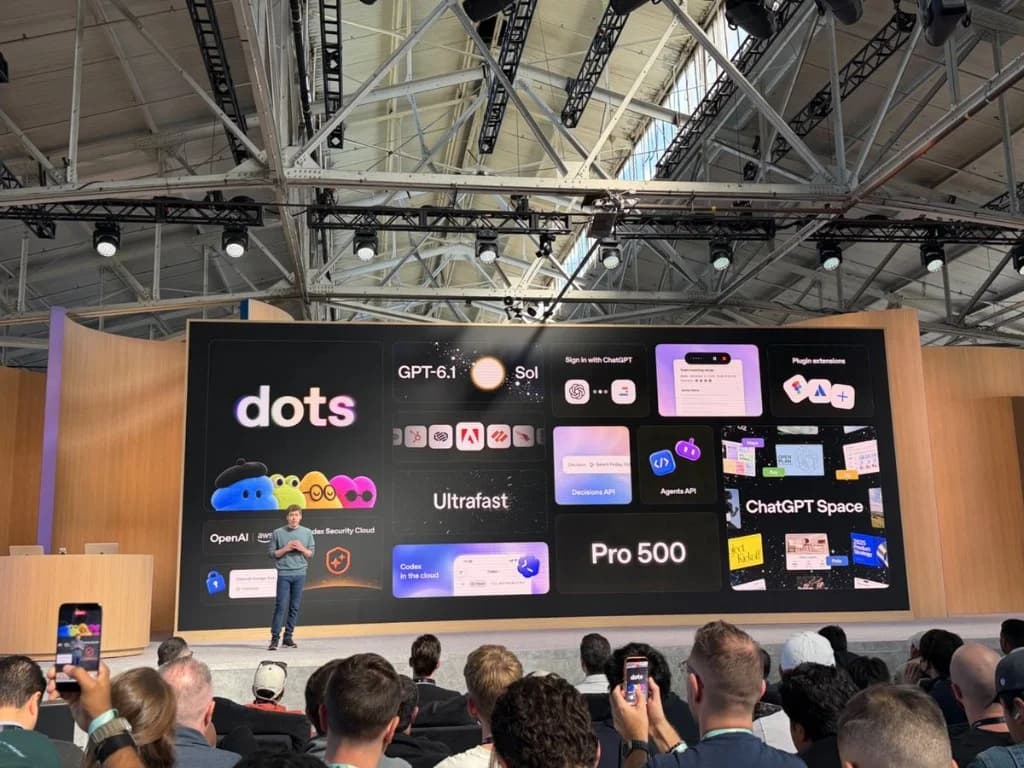
Update — October 2, 2026: OpenAIDevs remade the DevDay Dots demo ("better WiFi") — same product, not a new SKU. Dots post.
OpenAI DevDay 2026 happened on Tuesday, September 29 at Fort Mason in San Francisco. OpenAI's own recap now lists more than 20 announcements across ChatGPT, Codex, models, and a 1.2 billion weekly-user surface. Watch the stream at openai.com/live/ — that is the live/replay URL, not the agenda site at devday.openai.com. Primary write-up: DevDay 2026 Recap.
Update — October 1, 2026: Post-launch, dot.com (xAI) redirect memes ≠ Dots install paths — explainx.ai on the stunt.
The four builder SKUs to remember: Dots (always-on GPT-6 Astra agents), GPT-6.1 Sol at $2 / $10 per million tokens, Ultrafast + Pro 500 (up to 300 tok/s in Codex, 25× Plus usage), and the Decisions API (Luna, limited preview). Sign in with ChatGPT, plugin extensions, Codex in the cloud, and Private Intelligence sit on the same board.
This recap follows our pre-event expectations map. Companion posts go deep; this page is the index.
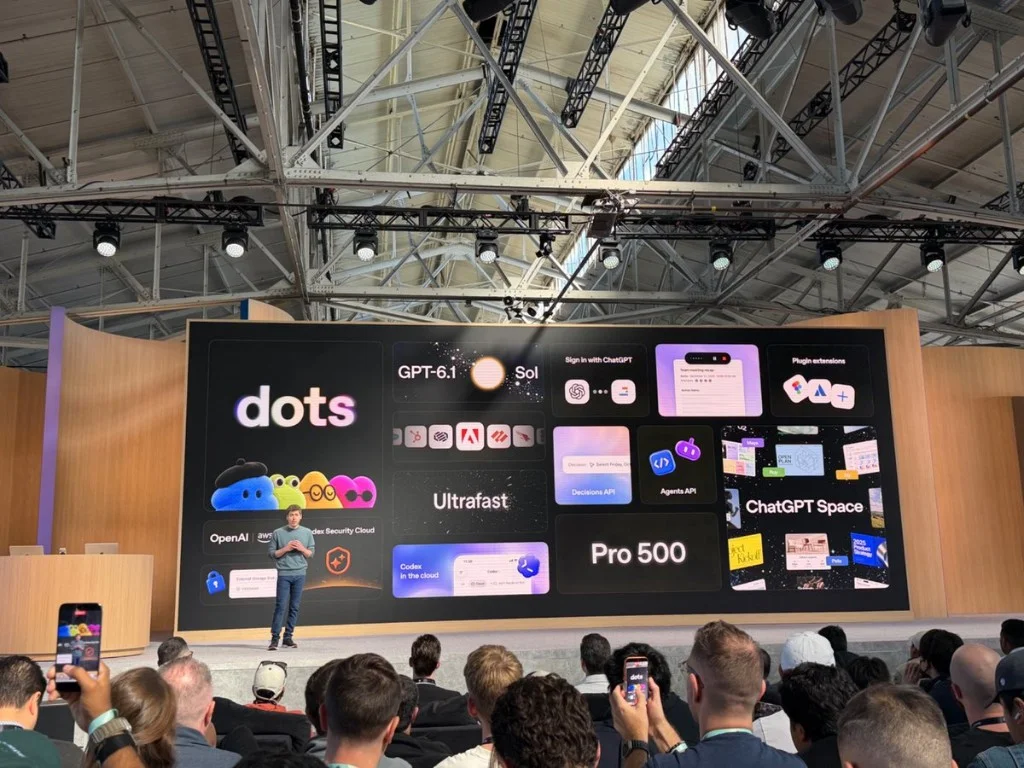 Sam Altman on the DevDay 2026 Fort Mason stage in front of a grid of launches: Dots, GPT-6.1 Sol, Ultrafast, Pro 500, Sign in with ChatGPT, Decisions API, Agents API, ChatGPT Space, plugin extensions, and Codex in the cloud
TL;DR: what was announced
| Announcement | What it is | Deep dive |
|---|---|---|
| Dots | Always-on GPT-6 Astra agents, own cloud computer and browser, 4,000+ plugins | Dots post |
| GPT-6.1 Sol | Near-Astra coding / computer use / professional work at one-fifth of Astra token prices | Sol 6.1 post |
| Astra Ultrafast | Up to 8× faster (~300 tok/s) in Codex, up to 6× in the API | Ultrafast + Pro 500 |
| Pro 500 | Highest usage (25× Plus) plus Ultrafast in Codex and ChatGPT Work | same |
| Pro 200 reopened | Frontier models including Astra and GPT-6.1 Sol | Pro 200 reopen |
| Agents API + computer use | Agents operate software, not just tools; Codex multi-agent pieces in-app | Agents API beta |
| Decisions API | Luna constrained to user-defined questions and finite answers; limited preview | Decisions API |
| Codex in the cloud | Computer, phone, or cloud; reusable environments; voice CLI; /agents view | recap below |
| Codex Security Cloud | Scan GitHub repos, investigate, prepare fixes; Daybreak Blue models included | recap below |
| Plugin extensions | Sidebar homes, file viewers, native-feeling apps in ChatGPT | plugins / Work |
| Sign in with ChatGPT | Spend Plus/Pro allowance in 16 partners (Devin, Notion, Vercel, OpenClaw, …) | Sign in with ChatGPT |
| ChatGPT Space / Pages / slides | Shared workspace; human+agent documents; collaborative slides coming | recap below |
| Private Intelligence | Zero Data Retention with Private Safety Processing; Private Inference preview this fall | recap below |
| Marketplace | Apply part of an enterprise OpenAI commitment to 32 partner products | recap below |
What are Dots, and are they the "o" agent we predicted?
Full write-up: OpenAI Dots at DevDay. Official film: Live-from-the-Lab. Product page: Introducing dots.
Dots are the consumer-and-prosumer centerpiece. Each Dot runs on GPT-6 Astra, gets a dedicated cloud computer and browser, connects to more than 4,000 apps, and works toward the goal you set around the clock. Per the launch coverage, you give a Dot a goal, connect the apps it needs, and define what it can do without asking you.
Our pre-event call, based on a config leak for an always-on assistant called "o", was right on shape and wrong on name. The product shipped as Dots, not a lowercase letter. The behavior matches the leak: proactive, persistent, background work rather than a chat window you have to open.
Availability: Dots are rolling out to Pro and Business Premium users in eligible markets. Enterprise workspaces, including Edu and Healthcare, can turn Dots on once an admin enables them. One Dot is included with these plans, and OpenAI says you will be able to add more later. Free and Plus are not in the first wave.
Two comparisons come up immediately. Coverage framed Dots as OpenAI's answer to Meta's Muse and SpaceXAI's Grok Bot, the other "personal agent" launches this quarter. For the Meta side of that race and its security model, see our Muse personal agent breakdown. For OpenAI's earlier direction, Codex persistent mode was the developer-side precursor.
Honest limitations to watch
- Autonomy is scoped, not open-ended. You define what a Dot may do on its own. Expect approval prompts for anything that spends money or sends messages.
- One Dot per plan. If you planned a fleet of specialized agents per seat, that is a future upsell, not day one.
- Prompt injection is the standing risk for any agent with a browser and app credentials. Treat connector scopes like production IAM.
GPT-6.1 Sol: the announcement that changes your bill
Full write-up: GPT-6.1 Sol pricing and benchmarks.
GPT-6.1 Sol is an upgrade to GPT-6 Sol that, per OpenAI, nearly matches GPT-6 Astra on agentic coding, computer use, and professional work at one-fifth of Astra's standard input and output token prices. It is included on paid ChatGPT plans and in the API as of September 29.
Reported API pricing:
| Token type | GPT-6.1 Sol |
|---|---|
| Input | $2.00 / million |
| Cached input | $0.10 / million |
| Output | $10.00 / million |
The Next Web put the cached-input figure at half of GPT-6 Sol's previous cached price. It builds on the September 22 Sol and Luna price cuts, and it lands one day after OpenAI cancelled the October GPT-6.1 Astra release. Read the pattern: OpenAI's frontier weights are pausing while its price-performance ladder keeps compressing. Our pre-event guess that DevDay would optimize the ladder rather than launch a new flagship was correct.
How GPT-6.1 Sol compares with Claude
This is where Claude builders should pay attention. Anthropic's Claude Sonnet 5.5 shipped on September 28 at $2 input and $10 output per million tokens, the same list price now attached to GPT-6.1 Sol. Claude Opus 5.5, released September 22, sits at $4 and $20.
| Model | Input / M | Output / M | Positioning |
|---|---|---|---|
| GPT-6.1 Sol | $2 | $10 | Near-Astra agentic work, DevDay |
| Claude Sonnet 5.5 | $2 | $10 | Near-Opus performance at about half the price |
| Claude Opus 5.5 | $4 | $20 | Anthropic's flagship coding and agent model |
On one third-party benchmark cited in post-keynote comparisons, Terminal-Bench Science 0.1, GPT-6.1 Sol scored 57% against 58.7% for Claude Opus 5.5. That is a one-point gap at half the sticker price, but a single benchmark is not your workload. Our existing Sonnet 5.5 vs GPT-6 Astra comparison and Opus 5.5 vs Sonnet 5.5 guide show how to build a fair head-to-head; rerun it with Sol 6.1 in the mix.
What this means for what you build or pay: with list prices equal, the differentiators shift to cache economics, tool-call reliability, and latency. Sol's $0.10 cached input is worth modeling if your agent re-reads a large repo context every turn. Anthropic's own caching rules are covered in our Claude Code token efficiency guide.
Astra Ultrafast: speed as a paid tier
Full write-up: Ultrafast and Pro 500. Official clip:
OpenAI introduced Ultrafast, a premium speed tier. For GPT-6 Astra it delivers up to 8x faster generation, roughly 300 tokens per second, in Codex, and up to 6x faster in the API. GPT-6 Astra Ultrafast is available today in the API and in ChatGPT Work and Codex on the Pro 500 and Enterprise plans. GPT-6.1 Sol Ultrafast is coming soon.
Why builders should care: latency is the bottleneck in agent loops, where a 40-step task multiplies every slow token. Ultrafast turns wall-clock time into something you can buy. Expect premium per-token pricing on the API side; check the pricing page before switching a loop over.
The $500 Pro tier and the Pro Max rumor
The long-rumored top plan arrived as a $500-a-month tier with OpenAI's highest usage limits and exclusive access to Astra Ultrafast in ChatGPT Work and Codex. That matches the leak we tracked in the Pro Max $500 rumor post, including the capacity story behind the earlier pause on new $200 sign-ups.
If you are a heavy Codex user hitting caps, this is the plan aimed at you. If you are cost-sensitive, note the contrast with Claude Code's plan structure; our Claude Code limit-reset coverage covers the other side of the same usage-cap fight.
Developer platform: Agents API, Codex, plugins, sign-in
Agents API gets computer use
The Agents API public beta from September 10 now supports computer use, so agents can operate software rather than only calling structured tools. This is the same capability class that Anthropic pioneered with Claude's computer use; our Claude background computer use coverage shows where Claude stands. If you already run computer-use agents on Claude, GPT-6.1 Sol at $2/$10 makes a second-provider fallback cheap to test.
Decisions API (limited preview)
Full write-up: Decisions API, GPT-6 Luna. Official clip:
The Decisions API focuses Luna on user-defined questions with finite answers. You send text or images; it returns a selection for classification, routing, or an agent's next action. OpenAI says it is tuned for a few hundred milliseconds end to end. Limited preview for selected API customers; broader release planned in the coming days. Pricing was not in the recap.
Codex: cloud, phone, voice, security
Codex can now run on your computer, remotely from a phone, or in the cloud from any device. The Codex CLI accepts voice instructions to start and steer tasks. Codex Security Cloud scans repositories for vulnerabilities and prepares fixes automatically. For a Claude-side comparison, see our Codex plugin for Claude Code guide, which shows how teams already combine both harnesses.
Plugin extensions
Plugin extensions let developers ship what OpenAI calls "essentially entire applications that feel native to ChatGPT": a sidebar presence, interactive interfaces, custom file viewers, even an editor, dashboard, or full workspace built into ChatGPT and Codex, distributed through OpenAI. The announcements also mentioned a Marketplace with 32 partners. This extends the pattern we covered in ChatGPT voice, plugins, and Work.
Sign in with ChatGPT
Users can spend Plus and Pro allowance inside 16 partners, including Cognition's Devin, Notion, Vercel, T3, OpenClaw, and Dactyl, with per-app caps. Identity is global; plan usage is Plus/Pro in participating tools. Notion still needs a Business or Enterprise workspace on top of ChatGPT Plus/Pro — do not assume a personal Notion workspace is enough. This is the official version of the subscription-oauth idea we covered in LoginWithChatGPT. Distribution thesis: a16z on OpenAI customers.
ChatGPT Space, Pages, and Private Intelligence
ChatGPT Space is a dedicated team workspace on desktop and web (Pro, Business, Enterprise); finding, reading, and sharing pages also work on mobile. Pages are documents built for human and agent collaboration. Collaborative slides are coming in weeks. @ChatGPT in Slack and Teams (Business/Enterprise) does not require every teammate to hold a ChatGPT license. Meetings plugin is a macOS desktop beta for Pro and Business.
Private Intelligence: Zero Data Retention with Private Safety Processing so automated safety reviews do not give OpenAI personnel the underlying content. Private Inference (confidential computing) is previewed for this fall.
Marketplace: eligible enterprises can apply part of an existing OpenAI commitment to 32 partners (Figma, Adobe, Sierra, Decagon, HubSpot, Salesforce, ServiceNow, Harvey, Legora, Palo Alto Networks, CrowdStrike, Baseten, and others).
What people are asking
Did DevDay match our predictions?
| Prediction from our expectations post | Outcome |
|---|---|
| Always-on consumer agent | Hit, shipped as Dots |
| ~$500 Pro tier | Hit |
| Agents API GA-style news | Partial, computer use added, no confirmed GA label |
| Voice/GPT-Live in ChatGPT | Not a headline item in coverage |
| Hardware teaser | Not reported |
| New frontier flagship | Miss (as predicted unlikely); GPT-6.1 Sol is a price-performance move |
Is this a threat to Claude?
The honest read: Dots compete with Claude's consumer and Cowork surfaces, and Sol 6.1 competes with Sonnet 5.5 on price. But no Claude capability was displaced. Anthropic's counter-programming this month was on models, not a DevDay-timed launch, and the Anthropic counter-Astra analysis still frames the race. Separately, TechRadar ran a live "Claude down" report on September 29, so check Anthropic's status page before assuming any migration signal in your own error logs.
What should I do this week?
- Rerun your eval set on GPT-6.1 Sol and Claude Sonnet 5.5 side by side; record cost per solved task, not just per token.
- Model your cache hit rate. Sol's $0.10 cached input only helps if your prompts are stable.
- Pilot one Dot on a low-risk recurring task before granting broad app connectors.
- Read the plugin extension terms before committing product roadmap to ChatGPT distribution.
Claude-relevant updates we are tracking
This post is updated on each run. As of publication:
- Claude Opus 5.5 (September 22) and Claude Sonnet 5.5 (September 28) set the price comparison Sol 6.1 was launched into.
- Update — September 30, 2026: Anthropic published a GLM-5.3 cyber-capability eval the same week as DevDay — open-weight exploit skill near Mythos Preview, with weak safeguards. Coverage: GLM-5.3 cyber eval.
- Watch for a Sonnet 5.5 price adjustment or Claude Code plan change; if either appears, we will add it here.
The bottom line
DevDay 2026 was a consolidation keynote: agents that persist (Dots), models that cost less (Sol 6.1), speed you can buy (Ultrafast), and distribution you can build on (plugin extensions, Sign in with ChatGPT). For most builders the one number to remember is $2 / $10, because it now applies to both OpenAI's near-frontier model and Anthropic's Sonnet 5.5, which turns the choice into an eval question rather than a price question.
Related reading
- Update — October 1, 2026: The missing plugin-backend piece from this keynote — ChatGPT Sites can host the MCP server.
- Dots: always-on GPT-6 Astra agents
- dot.com → Grok redirect vs Dots naming
- GPT-6.1 Sol pricing and benchmarks
- Ultrafast and ChatGPT Pro 500
- Decisions API (GPT-6 Luna)
- Sign in with ChatGPT
- What to expect at OpenAI DevDay 2026
- OpenAI's "o" always-on assistant leak
- GPT-6 Sol and Luna pricing
- Agents API public beta and sandbox partners
- Codex Security Cloud, Agents API computer use, Bedrock, Codex in the cloud
- Claude Sonnet 5.5 launch and building guide
- ChatGPT Pro Max $500 rumor
Official: DevDay 2026 Recap · Introducing dots · Watch live · Agenda · ChatGPT pricing
Figures and availability are accurate as of September 30, 2026, checked against OpenAI's DevDay recap. Confirm plan names and token prices on openai.com before production config changes.