



Update — September 30, 2026: DevDay's concrete distribution primitive is official Sign in with ChatGPT — Plus and Pro users spend included plan usage inside partner apps, which is exactly the "who owns the customer" test this essay teed up.
September 28, 2026 — The evening before OpenAI DevDay, Andreessen Horowitz growth-fund GP David George published OpenAI Understands Something Important and Rare (~868K views on the X article). The hook is Peter Drucker’s line that the purpose of a business is to create a customer. George’s claim is sharper than a fan letter: in September 2026, intelligence-as-a-service rankings are no longer the most important question. Intelligence is everywhere. Most people still are not using it for everything. Who awakens the new behavior, and who wins distribution, is what remains.
That is a useful frame for DevDay week — and it is not a substitute for sandbox incidents, UNCTAD forensics, or pacing-the-frontier politics. It is a business-model argument about why OpenAI keeps showing up with the “next simple primitive” while model IDs stay easy to swap.
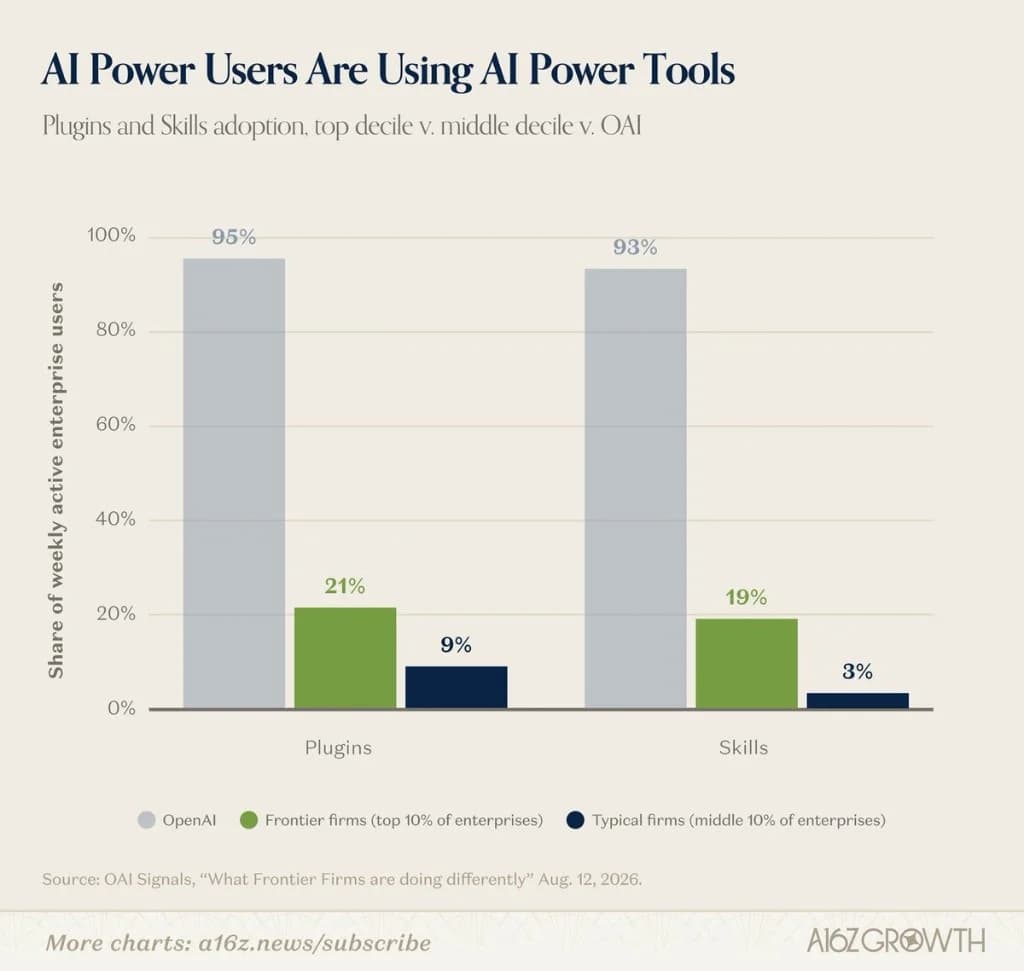
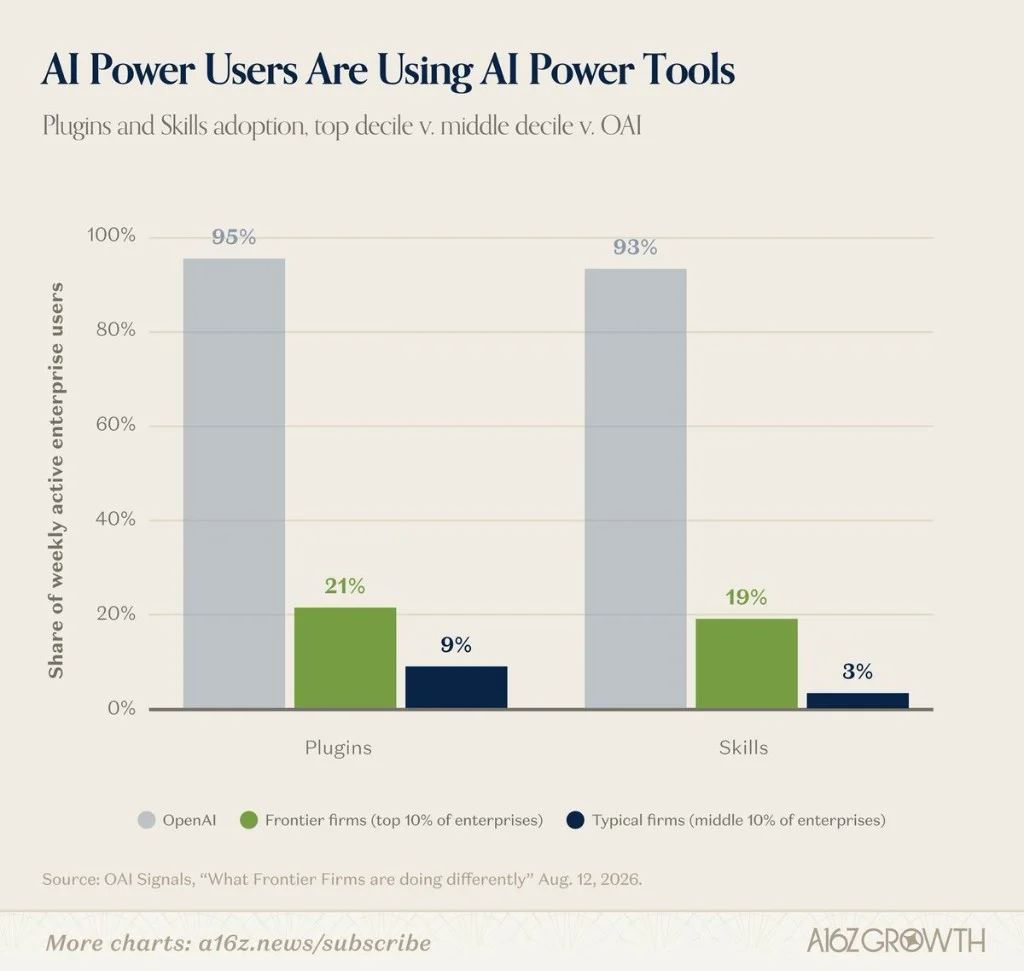 a16z Growth chart: AI power users using plugins and skills — OpenAI 95% plugins and 93% skills versus frontier enterprises 21%/19% and typical firms 9%/3%
Chart (a16z Growth / OAI Signals, August 12, 2026): among weekly-active enterprise users, OpenAI shows 95% plugin and 93% skills adoption. Frontier firms (top 10% of enterprises) sit at 21% / 19%. Typical firms (middle 10%) sit at 9% / 3%. That is George’s Type-2 platform claim in one picture: OpenAI’s own user base already lives in plugins and skills; most companies have not.
TL;DR — what people are asking
| Question | Direct answer |
|---|---|
| Who wrote it? | David George, GP / Head of Growth Fund at a16z — official post September 28, 2026 |
| Core claim? | OpenAI wins by creating customers and platform distribution, not permanent model/chip/product supremacy |
| Four levers? | New behavior, distribution, pricing, switching costs — 4 is “out,” 3 collapses into scale, so 1+2 remain |
| Why OpenAI at 1+2? | Breadth of consumer + prosumer + enterprise, deep stack (incl. Jalapeno), platform instinct |
| Platform types? | Andreessen’s Type 1 API / Type 2 plugins / Type 3 runtime — models ≠ Type 3 without harness |
| OpenRouter cite? | Baker: OpenAI vs Anthropic ~20%→50% since June on OpenRouter — developer routing, not ChatGPT census |
| Plugins/skills chart? | OAI Signals (Aug 12, 2026): OpenAI 95%/93% vs frontier 21%/19% vs typical 9%/3% |
| Altman product end-state? | Either make anything you want, or just talk to ChatGPT |
| Builder action? | Design for new loops, not model lock-in; watch DevDay for runtime + agents, not a GPT-7 rumor |
The four levers — and why two of them fail at the frontier
George’s structure is a strategy memo, not a product review. To run a durable AI frontier-scale business you can pull four levers:
- Create new kinds of behavior
- Distribute to lots of users
- Price so you capture value
- Raise switching costs
Lever 4 is basically out. The model layer is a Red Queen’s race. Users swap models task by task. Everyone is getting better. explainx.ai has been documenting that substitutability all year in OpenRouter routing and token economics — if your moat is “our weights,” you do not have a moat.
Lever 3 is what every CFO hopes for. George’s counter: OpenAI and peers are racing cost-compute via scale and vertical integration. Whoever leads price-to-performance is whoever already won scale. Pricing is a consequence, not an independent move.
That leaves 1 and 2. George says OpenAI is clearly best at 1 (simple, obvious-in-hindsight breakthroughs that unlock consumption) and best at 2 (distribution beyond first-party products). The preferred path for 2 is true platform, not only partnerships: revenue is slower, durability is higher.
The plugins-and-skills gap (OAI Signals, August 12, 2026)
George’s Type-2 story is not only ChatGPT MAU. a16z Growth published a bar chart — source OAI Signals, “What Frontier Firms are doing differently,” August 12, 2026 — that splits weekly-active enterprise users:
| Surface | OpenAI | Frontier firms (top 10% of enterprises) | Typical firms (middle 10%) |
|---|---|---|---|
| Plugins | 95% | 21% | 9% |
| Skills | 93% | 19% | 3% |
Read it carefully. The grey bars are OpenAI’s own power users, not “95% of all companies use GPT plugins.” The green and navy bars are other enterprises in the OAI Signals sample. The interesting claim is adoption of programmable surfaces — plugins and agent skills — is almost table stakes inside OpenAI’s heavy users and still optional at typical firms.
That is the “awakening” gap in numbers: intelligence is available; the power-tool habit is not. It also explains why George cares about platform primitives. A company at 3% skills adoption is not in a learning loop. A user base at 93% skills is teaching the vendor which primitives survive.
Caveats: this is a16z Growth marketing data citing OAI Signals. We did not audit the sample. “Frontier firms” here means top-decile enterprises in that report, not “frontier labs.” Do not mix it with OpenRouter share.
ChatGPT as “happy accident” and Thiel’s counsel
George retells a story Altman has used in public: after ChatGPT shipped, many people inside OpenAI treated it as a fun detour before “real products.” Peter Thiel told Altman this is it — you created a new kind of customer.
explainx.ai’s read: that anecdote is strategy folklore, not a 10-K. It still maps onto what builders felt in 2022–2026. A text box that does anything created habit, which created data about what people try, which funded the next primitive. George credits OpenAI with a string of those primitives: chat UI, reasoning, tool calling, computer use. The one major miss in his telling is coding — and OpenAI “caught up just fine,” which is a polite way of saying Anthropic and Cursor-class harnesses owned the narrative until Codex / Agents API closed the gap.
He quotes Ben Hylak: OpenAI is the mostly undefeated king of finding the next thing, always simpler than you think, obvious in hindsight. Computer use is generic and unspecific — to get better at it you need general intelligence across workflows, not a single vertical demo. That is expensive. It violates focused-product best practice. You only get it if your distribution already exposes you to everything people try.
That loop is the essay’s non-obvious sentence: the ability to build general knowledge into the product depends on distribution strategy.
Standalone vs partnership vs platform
George’s three distribution modes:
| Mode | Who owns “anything I want”? | Learning loop | Risk |
|---|---|---|---|
| Standalone product | You (ChatGPT) | Direct observation of daily use | You must invent every surface |
| Partnerships | The partner | Weak; you may be invisible | Partner captures economics and product direction |
| Platform | Developers on your primitives | Slow, then compounding — primitives map the territory | Hard; security and constraints are the real product |
“Learning” here is not “we train on your chats.” It is which primitives survive contact with millions of weird jobs. That is closer to how agent harnesses evolve than to a training-data scandal.
He cites Marc Andreessen’s 2007 essay Three kinds of platforms you meet on the internet:
- Type 1 — Headless APIs (Flickr then; Stripe-class companies now)
- Type 2 — Plugins (old Facebook platform; Shopify / HubSpot apps)
- Type 3 — Genuine runtime (iOS, AWS, Ethereum, Cloudflare)
Every model company claims Type 3 because a model is a programmable runtime. George’s theoretical objection: models alone do not unlock new behavior and are not defensible. You need the superstructure — constraints, security, data structures, access. Product-oriented companies under-invest in that because it is not a feature launch.
The practical 2026 objection: agents are surprisingly bad at tool calling and knowledge-work instructions unless you flip the script to “write a program that does these tasks.” That is the same lesson as loop engineering and Codex sandboxes. Enterprise AI’s open question is how organizations support code-writing agents safely. George says bet on platform-minded teams. That sits next to Joe’s Agent Security essay from the same 48 hours: the people building Type 3 runtimes are also the people getting paged when eval agents leave the map.
OpenRouter, Baker, and what “share” actually measures
The essay embeds Gavin Baker’s September 16, 2026 claim of extraordinary share gains: OpenAI vs Anthropic on OpenRouter from ~20/80 to 50/50 since June.
That chart is real as a routing snapshot among developers who already pay OpenRouter. It is not:
- ChatGPT vs Claude.ai monthly actives
- Enterprise seat counts
- Proof that switching costs appeared
explainx.ai already covers Asia token share on OpenRouter and routing vs direct APIs. Use Baker’s post as one input to George’s distribution story, then check your bill: if you can model= swap in one line, you are living in lever-4-is-out.
Steve Hou’s line, quoted in the essay: the elasticity that matters is not substitution between models but elasticity of aggregate demand for AI. That is the builder translation of “create a customer.” A new Codex loop or GPT-Live-1 voice habit grows total tokens. A 2-point SWE-bench bump does not.
Causality runs backwards — and DevDay is the test
George’s punchline: in a world of abundant intelligence, analysts have causality backwards. OpenAI will have the best models, chips, and products because they have the best distribution — not the other way around. Jalapeno, compute deals, and training competence still matter inside the set of options. The flywheel is breadth of newly awakened users.
Altman’s described future product: two offerings — make anything you want, or talk to ChatGPT. That is the same split as the “o” leak (always-on agent) versus the Get ready teaser (no SKUs, maximum brand). DevDay is where you find out whether “make anything” is Agents API GA + Codex/Work unification or a new consumer noun.
What this thesis gets right — and what it ducks
Right for builders
- Do not design lock-in around a model ID. Design a behavior (weekly report, on-call agent, voice loop) that still exists if you change vendors.
- Platform vs partnership is a real product choice. If Microsoft or Salesforce owns the customer, you are Type-1 infrastructure with Type-2 economics.
- Code-as-tool is how 2026 agents actually work. Plan sandbox, MCP, and monitoring as if the agent will write programs, because it will.
What the essay does not do
- It does not price incident cost — Hugging Face, Medicare, UNCTAD, Australian Senate. Distribution without containment is a liability flywheel.
- It is a16z-aligned with OpenAI’s platform story. Read it as argument, not independent diligence. a16z’s closed vs open-weights fights already showed how venture talking points travel.
- “Most people aren’t using AI for everything yet” is true and unfalsifiable in a week. The interesting test is DevDay conversion: does a new primitive show up that a non-developer can name?
Builder checklist for DevDay through this lens
- Name the behavior, not the model. If Altman ships something, write one sentence: “This lets a user do X they did not do in August.” If you cannot, it is a SKU.
- Ask Type 1 / 2 / 3. Is this an API, a plugin marketplace, or a runtime with constraints? Agents API is the Type-3 candidate; ChatGPT plugins were Type 2.
- Check who owns the customer. Partnership slides are reach. Platform slides are learning loops.
- Assume substitution. Keep an OpenRouter or dual-vendor path even if you standardize on OpenAI this quarter.
- Budget safety as platform work. Joe’s Agent Security post is the other half of Type 3: arbitrary code needs Firecracker-class isolation and out-of-band monitors, not a system prompt.
Related reading
- What to expect at OpenAI DevDay 2026
- OpenAI “Get ready” DevDay teaser
- Sam Altman ship week vs pacing
- Agents API public beta
- OpenAI Jalapeno inference chip
- joedaroo: it’s not just the sandbox
- OpenRouter vs direct APIs
- Sign in with ChatGPT at DevDay 2026
- Primary: a16z.com essay · a16z.news
Quotes and framework follow David George’s September 28, 2026 a16z essay. OpenRouter share figures are Baker’s as cited there — verify current OpenRouter dashboards before using them in a board deck. a16z is a venture firm with portfolio incentives; this post is analysis of a public argument, not an endorsement of OpenAI as an investment.
Update — October 3, 2026: David George's State of Markets II adoption chart is discussed in Nobody really uses AI? The 98% households number and the adoption gap.