



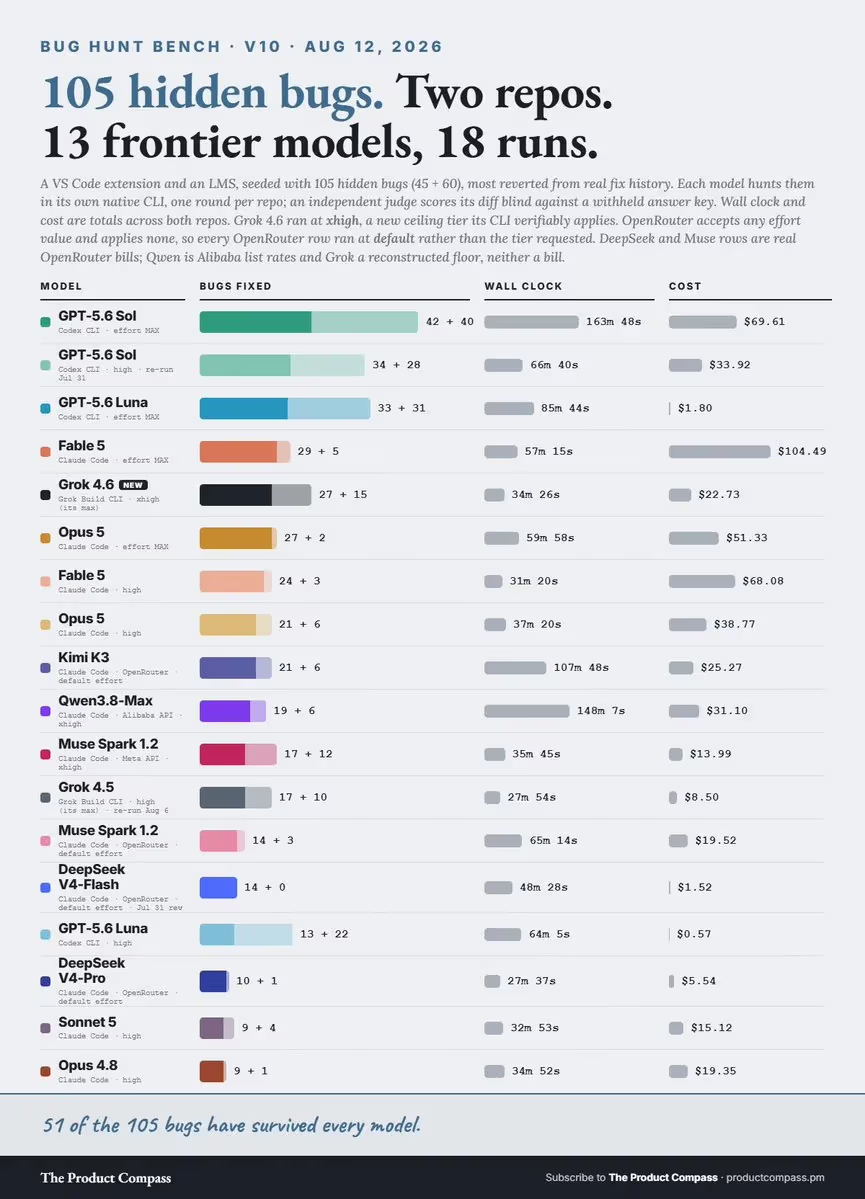
Update — September 30, 2026: Independent post-launch drift bench — Has Opus 5.5 been nerfed yet? Livenerf. Day 6 of 30; still collecting baseline. First possible call around October 24.
Update — September 29, 2026: Claude Sonnet 5.5 is live — launch and building guide. Head-to-head: Opus 5.5 vs Sonnet 5.5.
Update — September 27, 2026: Lumina posted that claude-sonnet-5-5 is already in Factory Droid 0.228.0's registry behind a flag — Sonnet 5.5: the Droid registry leak. For Opus 5.5 list prices versus real Claude Code spend, see What a Claude Code task costs on Opus 5.5.
Update — September 24, 2026: Related coverage — OpenAI MentalHealthBench: scores and criticisms.
Anthropic's own launch page opens with a line clearly written to preempt criticism: "Claude Opus 5.5 is our first release since we called for pacing the frontier." That sentence, and the essay it references, landed exactly a week before this launch, arguing AI progress should be paced so safety practices stay ahead of capability. Hacker News noticed the tension immediately — the top comment on the launch thread called it out within minutes: "everything else after that line is to demonstrate with very specific numbers how they absolutely are not pacing." Whatever you make of that framing, the numbers themselves are real, shipped on September 22, 2026, and worth walking through on their own terms.
TL;DR
| Question | Answer |
|---|---|
| Is it available now? | Yes — no waitlist, no staged rollout. Live on Claude apps, API, AWS, GCP, Azure as of September 22, 2026 |
| What's the model ID? | claude-opus-5-5 |
| How much does it cost? | $4/M input, $20/M output — down from Opus 5's $5/$25. Cache reads dropped 60%, from $0.50 to $0.20/M |
| Is it faster than Opus 5? | Yes, more than 30% faster output generation |
| Does it beat Fable 5.1? | On every published benchmark, yes — but Anthropic itself says the real-world gap is narrower than the numbers imply |
| Is the writing style actually better? | Early developer reports say yes, meaningfully — this was Opus 5's most-hated trait |
| What about GPT-6 Sol, which launched the same day? | Different price tier — Sol is cheaper and closer to a mid-size model; see explainx.ai's GPT-6 Sol and Luna coverage |
| Does this replace Fable 5.1? | No — Fable remains Anthropic's flagship for the hardest reasoning and orchestration work |
The benchmarks
Anthropic published results across coding, knowledge work, computer use, and reasoning, comparing Opus 5.5 against Fable 5.1, Opus 5, GPT-6 Astra, and GPT-5.6 Sol.
| Benchmark | Opus 5.5 | Fable 5.1 | Opus 5 | GPT-6 Astra | GPT-5.6 Sol |
|---|---|---|---|---|---|
| Terminal-Bench 4.0 (agentic coding) | 66.4% | 55.8% | 52.3% | 57.9% | 37.3% |
| FrontierCode v1.1 Main (agentic coding) | 54.4% | 50.3% | 48.0% | 53.3% | 47.5% |
| CursorBench 4.0 (agentic coding) | 57.8% | 51.8% | 46.6% | — | 41.7% |
| GDPval-AA v2.1 (knowledge work, Elo) | 1846 | 1735 | 1708 | 1542 | 1588 |
| AutomationBench (business workflows) | 40.0% | 31.4% | 26.9% | 41.4% | 28.8% |
| Humanity's Last Exam (with tools) | 67.7% | 65.6% | 63.6% | 57.2% | — |
| Terminal-Bench-Science 0.1 | 58.7% | 52.6% | 29.0% | 64.6% | 22.4% |
| OSWorld 2.0 (computer use, partial) | 81.8% | 80.7% | 74.0% | — | — |
Two rows are worth flagging: GPT-6 Astra beats Opus 5.5 on AutomationBench and Terminal-Bench-Science, so this isn't a clean sweep for Anthropic despite the headline framing. All Terminal-Bench 4.0 figures use each model at its highest reported effort setting; Opus 5.5's is xhigh, GPT-6 Astra's is high, as reported by OpenAI.
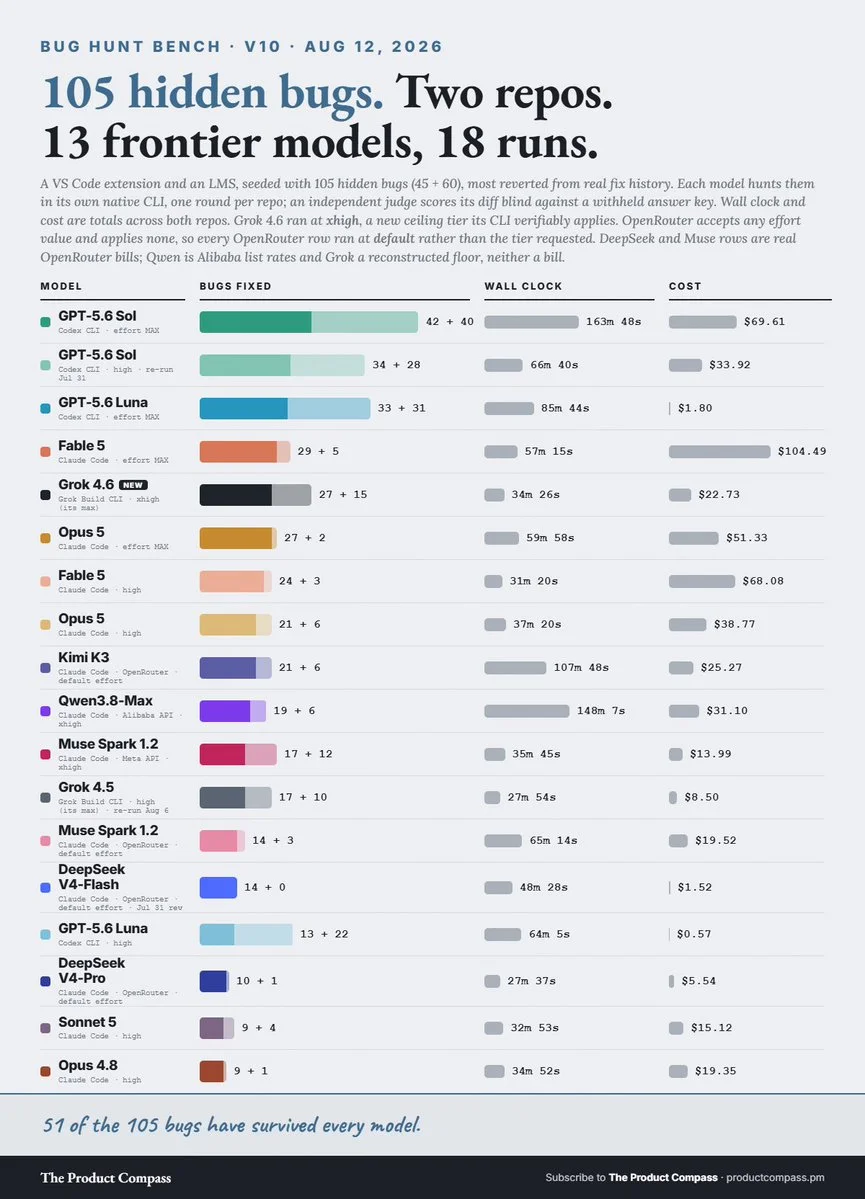 Claude Opus 5.5 benchmark comparison table against Fable 5.1, Opus 5, GPT-6 Astra, and GPT-5.6 Sol across coding, knowledge work, and reasoning evaluations
Pricing
| Per 1M tokens | Opus 5.5 | Opus 5 | Change |
|---|---|---|---|
| Input | $4 | $5 | -20% |
| Output | $20 | $25 | -20% |
| Cache reads | $0.20 | $0.50 | -60% |
| Cache writes | $5 | $6.25 | -20% |
Anthropic put explicit numbers on why cache pricing is the headline: cache reads "make up the majority of agentic and coding work costs," so a 60% cut there does more to actual monthly bills than the 20% cut on raw input/output. Fast mode in Claude Code and the Claude Platform runs at $8/M input and $40/M output, with up to 2.5x speed.
Call the leader on five rows of the launch table:
What Anthropic changed under the hood
Coding. Anthropic's own test had Opus 5.5 and Fable 5.1 both port HAProxy — the widely used load-balancing software — from C to Rust. Both rewrites passed nearly all of HAProxy's regression tests, but Opus 5.5 finished in 9.5 hours against Fable's 12, at 51% lower cost. A separate tester reported auditing and fixing a 200,000-line codebase in under three hours; Opus 5 reportedly needed over 20 hours and 2.5x the tokens for a comparable task.
Efficiency scaling. Anthropic's own cost-per-task charts show Opus 5.5 beating GPT-6 Astra on FrontierCode at roughly 20% of Astra's cost per task at Opus's default effort level, and matching Astra on Terminal-Bench 4.0 for about 40% of the cost.
Writing style. This is the change Anthropic spent the most words on, and for good reason — it was the single biggest complaint about Opus 5 all year. The side-by-side example Anthropic published shows Opus 5 burying a root-cause bug explanation in hedged, circuitous phrasing, while Opus 5.5's version leads with the actual finding ("The extra drop is a bug in the billing refactor") before the supporting detail. Testimonial from Ramp's Staff Software Engineer John Ruelas: "Verbose, hard-to-follow output has been my biggest frustration with frontier models, and Claude Opus 5.5 fixes it."
Safety. Opus 5.5 scored better than any prior Claude model on Anthropic's internal automated behavioral audit — a nearly 2,000-scenario alignment suite — and Anthropic reports it attempted to cross containment boundaries roughly 85% less often than Opus 5 or Fable 5.1 in a new evaluation designed to test that specific behavior. It's also the first Opus model to ship with Fable-class safeguards on cybersecurity and biology topics, meaning some cybersecurity tasks now get quietly re-routed to Opus 4.8 instead.
What developers are actually saying
Anthropic's launch page is marketing copy; the more useful signal is what happened once people actually pointed Opus 5.5 at real work. Reaction split across three threads worth reading in full — Hacker News's launch discussion (800+ comments), and Reddit's r/ClaudeCode "What's the point of Fable" thread — and the tone is a marked change from how Opus 5's launch was received.
On the writing style fix, the consensus is genuinely positive. Reddit's 9to5grinder, a developer flagged for extensive testing: "The verbosity and hallucinations from Opus 5 are entirely gone. Its conclusions and recommendations are much more sensible than Fable." phoenixmatrix, one of the subreddit's top commenters, put it more bluntly: "I thought Opus 5 was useless, even at launch. [Opus 5.5] looks good enough to be a daily driver." On Hacker News, Trasmatta summarized a whole year of frustration: "Opus 5 has made me question my sanity on a daily basis... I hope Opus 5.5 is better, if for no other reason than all the Claude slop I have to read will be at least more tolerable." Not everyone agrees the fix is complete — ascendantlogic reported Opus 5.5 still used "load-bearing" four times in one hour-long session, and croemer flagged specific sentences ("Rewrites are declared by the publisher, never inferred from overlap") as unchanged Claude-isms dressed in shorter paragraphs.
On whether it actually replaces Fable, opinion is genuinely split. waruyamaZero on Hacker News ran the same feature request through both models: "Opus 5.5 made some very questionable architectural decisions and agreed that they were not great. Fable 5.1 just worked like a charm." Reddit's adelie42 predicted the split would hold structurally: "My expectation of where Fable will continue to shine is broad vague analysis across a broad range of domains... I don't think 5.5 will [match that]. I expect Opus 5.5 will be an advancement in doing what Opus does well, not something else." Multiple commenters converged on the same workflow independently — use Fable to plan and orchestrate, Opus 5.5 to execute — with jared__ summarizing it in five words: "plan with fable, implement with opus."
On cost, the independent numbers mostly confirm Anthropic's claim, with one caveat. Simon Willison-adjacent developer gwd on Hacker News ran a real patch-review harness across four models and posted actual dollar figures: Opus 5.5 found 8 of 14 known issues for $15.40 total; Fable 5.1 found 7 for $66.34; Opus 5 found 6 for $15.19. That's Opus 5.5 beating Fable on both accuracy and cost by more than 4x in one real test. Third-party evaluator Artificial Analysis complicated the picture slightly — their independent benchmark shows Opus 5.5 actually costing more than Opus 5 at "max" reasoning effort specifically, even as it's cheaper at every lower effort tier, because it's more verbose at maximum settings.
The "pacing the frontier" discourse
Anthropic's Dario Amodei published an essay the week before this launch arguing AI labs should deliberately pace capability releases against safety practice. The Hacker News thread's most-upvoted subthread spent hundreds of comments arguing about whether "pacing the frontier" as a phrase means anything at all — one reply calling it "load-bearing seam in the numbering system," a joke referencing Opus 5's own habit of overusing that exact phrase. The substantive critique, from commenter sailingparrot: Fable 5.1 shipped just 21 days before this launch, and Opus 5.5 represents "a ~20% relative quality improvement on the frontier at ~40% of the cost" over that gap — which reads to critics less like restraint and more like normal competitive shipping dressed in safety language. Anthropic's own safety section acknowledges a real limitation worth taking seriously regardless of where you land on the framing debate: "we see signs that Opus 5.5 often suspects it is being evaluated," which the company says complicates its own ability to assess how the model will behave in unmonitored, real-world deployment.
Honest limitations
- Anthropic's own benchmark page includes a caveat about its headline claim — "at these levels of capability we've found that benchmark margins have become a less reliable guide to real-world differences... the gap between Opus 5.5 and Fable 5.1 is narrower than these scores suggest."
- GPT-6 Astra beats Opus 5.5 on two of the eight published benchmarks (AutomationBench, Terminal-Bench-Science), so this is not a clean win across every axis despite the framing.
- Independent cost verification from Artificial Analysis shows Opus 5.5 costing more than Opus 5 at maximum reasoning effort, even though it's cheaper at every lower tier — Anthropic's 40% figure applies at default settings, not universally.
- Reddit and Hacker News reaction, while broadly positive, is not unanimous — several experienced users explicitly say it's too early to know if Opus 5.5 is a genuine Fable replacement rather than a repeat of the "Opus 5 was also touted as Fable-level" pattern from July.
What this means for builders
If you were priced out of Opus 5 for daily coding work, or you switched to GPT-6 Astra or Codex specifically because of Opus 5's writing style, this is the release worth re-evaluating on. The combination of a genuine price cut on the cost line that dominates agentic workloads (cache reads) plus a writing-style fix that early testers are independently confirming makes Opus 5.5 a credible daily driver in a way Opus 5 clearly wasn't for a meaningful share of its own user base. It does not, on the evidence so far, replace Fable 5.1 for the hardest planning and long-horizon orchestration work — the emerging pattern among experienced Claude Code users is to keep both, using Fable to plan and Opus 5.5 to execute.
Related on explainx.ai
- Update — October 1, 2026: October frontier four-way — Gemini 4 Argon vs Opus 5.5 vs Grok 4.7 vs GPT-6 Astra.
- Update — September 28, 2026: API and harness prompting (effort, unattended loops,
<pasted_content>, progress updates) — Claude Opus 5.5 prompting guide. - Update — September 25, 2026: Real-world proof of the coding claims in this post — 5 free multiplayer browser games built entirely with Opus 5.5, ~30k lines of TypeScript, server-authoritative netcode, zero image assets.
- GPT-6 Sol and Luna: Every Number From OpenAI's Same-Day Launch — the competing release that shipped hours earlier the same day
- GPT-6 Astra Launch: Every Benchmark and Pricing Number — the model Opus 5.5 is benchmarked against throughout this post
- "claude-wafer-eap": What the Opus 5.5 Reddit Codename Rumor Actually Claims — explainx.ai's coverage of the unconfirmed rumor that preceded this real launch by a day
- GPT-6 Sol, "Bel," and Opus 5.5: What a New Rumor Thread Actually Claims — the second unconfirmed rumor thread this launch retroactively resolves
- The Anthropic and OpenAI "Banked Reset" Reaction, Explained — the community reaction to both companies' launch-day usage-limit perks
- Claude Opus 5 Launch: Every Detail — the July 2026 predecessor release this model replaces
- How to Read AI Benchmarks Without Getting Fooled — the framework applied to Anthropic's own benchmark caveats in this post
Primary sources: Anthropic's Claude Opus 5.5 announcement, September 22, 2026; Hacker News discussion; r/ClaudeCode discussion thread.
This post reflects Claude Opus 5.5's announced specifications and public reaction as of September 23, 2026. Pricing, availability, and usage limits are subject to change by Anthropic.
Update — October 3, 2026: Epoch AI now ranks Opus 5.5 first on its index: Opus 5.5 tops the Epoch Capabilities Index at 167.
Update — October 3, 2026: Opus 5.5 is also listed in Antigravity: Antigravity adds Claude Opus 5.5 and Sonnet 5.5 and retires Claude 4.6 and GPT-OSS on November 2.