



Update: 500k default context (October 12, 2026)
Update — October 12, 2026: OpenAI raised the default context length for GPT-6.1 Sol in Codex and ChatGPT Work from 272k to 500k tokens, about an 80% increase, per Tibo's Day 7 post. The 1M-token maximum is still a manual override, and Tibo says OpenAI will go higher in the future and that 500k was carefully tested as the new sweet spot for most users. A larger default means fewer compactions on long agent runs, so less detail gets summarized away mid-task. See how to enable 1M context in Codex CLI for the override.
Update — October 6, 2026: OpenAI says GPT-6 Astra and 6.1 Sol are now about 50% faster in subscription products. See the speed boost explained.
Update — October 3, 2026: Cost-efficiency correction — the viral "81% cheaper than Astra" line is ~78% on Artificial Analysis cost-per-task ($0.72 vs $3.26), not a new list cut. Full breakdown: GPT-6.1 Sol vs Astra cost efficiency.
Update — October 2, 2026: Tibo said 6.1 Sol is back to expected speeds after a two-day load spike, and a global paid ChatGPT reset lands October 3 at 10:00 AM Pacific. Same week as the Pro 200 cut: Dots, halved $200, Sol reset.
OpenAI used DevDay 2026 (September 29, Fort Mason) to put GPT-6.1 Sol on every paid ChatGPT plan and on the API the same day. Tibo, who leads Codex and ChatGPT, framed it without the usual superlative pile: "GPT-6.1 is a good model. And it's unbelievably efficient. Included in all paid plans and on the API today." OpenAI's own line is sharper: it called 6.1 Sol "the most cost-efficient model for its performance available today."
That is not a new $2/$10 sticker. GPT-6 Sol already listed at $2 input and $10 output on September 22. 6.1 is the capability step at that same list price, sold against GPT-6 Astra at $10 / $50 standard — one-fifth the token bill if the "near-Astra" claim holds on your traces. A day earlier, OpenAI cancelled the October GPT-6.1 Astra drop. The ladder compressed downward, not upward.
This explainx.ai post is the builder file: rate card, what to rerun, Claude price parity, the one Science 0.1 number, a circulating Terminal-Bench 4.0 cost chart, Ultrafast timing, and a short hardware rumor you should not treat as fact.
TL;DR: questions people are actually asking
| Question | Direct answer |
|---|---|
| What shipped? | GPT-6.1 Sol — upgrade to GPT-6 Sol, not a new Astra |
| When / where? | September 29, 2026 — paid ChatGPT plans + API, same day as DevDay |
| API list price? | $2 / $10 per million input / output |
| Cached input? | $0.10 / million (95% cache-read discount) |
| Same as Sep 22 Sol? | Same $2/$10 list. 6.1 is the quality move, not another cut |
| Vs Astra? | Astra stays $10 / $50 standard. 6.1 Sol is 1/5 those headline rates |
| Vs Claude? | Sonnet 5.5 is $2/$10. Opus 5.5 is $4/$20 |
| Science 0.1? | Hub-cited 57% (6.1 Sol) vs 58.7% (Opus 5.5) — one bench, ~1 point |
| Ultrafast? | 8x class for Astra today; coming soon for 6.1 Sol |
| 6.1 Astra? | Cancelled. Do not write a cutover ticket to an unreleased Astra 6.1 |
What OpenAI actually claimed (and what it did not)
The company pitch is narrow: near-Astra on agentic coding, computer use, and professional work, at one-fifth of Astra's standard input and output prices. That is a positioning sentence, not a published table of every Astra eval at 6.1 Sol weights.
What we can pin without inventing a second rate card:
- List tokens: $2 in, $10 out, $0.10 cached in — the same numbers on the DevDay hub recap. Do not assume batch, fine-tune, or Ultrafast multipliers unless OpenAI's pricing page shows them.
- Access: Tibo said it is included in all paid plans and on the API today. That is a ChatGPT + API availability claim, not a promise that every Codex quota print is unchanged.
- Efficiency: OpenAI's "most cost-efficient for its performance" line is a marketing ranking. Your cost per solved task can still lose if 6.1 Sol retries more, dumps more output tokens, or misses cache more than Sonnet 5.5.
If you only remember one operational sentence: pin gpt-6-sol vs the new 6.1 model ID in docs before you rewrite production defaults. explainx.ai is not reprinting an unofficial API string. Read openai.com and the API changelog, then lock the ID you actually get billed for.
The rate card, compared to what you already pay
| Model | Input / M | Output / M | Cached input / M | Role on the ladder |
|---|---|---|---|---|
| GPT-6.1 Sol | $2 | $10 | $0.10 | Near-Astra work, DevDay upgrade |
| GPT-6 Sol (Sep 22) | $2 | $10 | (see Sol/Luna post) | Same list; 6.1 is the capability bump |
| GPT-6 Astra (standard) | $10 | $50 | — | Flagship; Ultrafast 8x today |
| Claude Sonnet 5.5 | $2 | $10 | Anthropic's own cache rules | Same list as 6.1 Sol |
| Claude Opus 5.5 | $4 | $20 | Anthropic's own cache rules | Higher sticker, flagship Claude |
What this means for what you build or pay: a million-in / million-out loop that used to be "Astra or nothing" can now be priced as Sol-class tokens if 6.1 Sol clears your quality bar. A million-in / million-out loop that already ran on GPT-6 Sol does not get cheaper on list rates. You are buying fewer failures and shorter agent traces, or you are buying nothing.
Cache is the only new dollar figure we will repeat. $0.10 cached input is a 95% discount off $2. That only shows up if the prompt prefix is stable: same repo dump, same system prompt, same tool schema. If every turn rewrites the preamble, you pay $2 again. Model the hit rate on a week of traces before you tell finance the blended rate is "basically a dime."
Astra stays the model you pay 5× input and 5× output to keep, unless your evals still need it. That is the honest read of "one-fifth," not a claim that 6.1 Sol is Astra.
Is 6.1 Sol just GPT-6 Sol with a new slide?
No. September 22 was the price cut and GPT-6 mid-tier ship. September 29 is the 6.1 checkpoint at that already-cut price.
That distinction matters if you already migrated from GPT-5.6 Sol to GPT-6 Sol last week. You do not get another 50% off. You get a new candidate to A/B against the Sol you just pinned. Treat it like any other point release:
- Keep the old Sol ID in a shadow route for a week.
- Run the same task set, not a new "DevDay demo" prompt.
- Log cost per passed task, tool-call error rate, and cache hit rate.
- Only then flip the default.
If 6.1 Sol is wordier, your $10 output line can erase a "smarter mid-tier" story in a long coding agent. If it is tighter, the same $2/$10 becomes a real win versus Astra and versus Opus 5.5's $4/$20.
How GPT-6.1 Sol compares with Claude (price first, then one bench)
Claude Sonnet 5.5 landed September 28 at $2 / $10. DevDay put OpenAI's near-frontier mid-tier on the same list. Claude Opus 5.5 remains $4 / $20. The Sonnet 5.5 vs GPT-6 Astra comparison is still the right method for a head-to-head; add 6.1 Sol as a third column instead of pretending Astra is your only OpenAI option.
The DevDay hub cited one third-party score that people keep repeating: Terminal-Bench Science 0.1, GPT-6.1 Sol 57% vs Claude Opus 5.5 58.7%. That is a one-point gap on one benchmark. It is useful as a "not a blowout either way" signal. It is not a reason to migrate production, and it is not a reason to ignore Opus on your own SWE or computer-use suite.
If you need a decision rule this week:
- Equal list price (Sol 6.1 vs Sonnet 5.5): pick the model that wins your tool-calling and cache profile. Price is not the tie-break.
- Half Opus sticker (Sol 6.1 vs Opus 5.5): only switch if your evals stay within a gap you can live with. Science 0.1 is not that eval.
- Vs Astra: keep Astra for the traces that still fail on 6.1 Sol. Do not "save 80%" on a loop that then needs two retries.
Benchmarks: one official-adjacent number, one circulating chart
OpenAI did not hand explainx.ai a full 6.1 Sol vs Astra spreadsheet at the time of writing. The number we will treat as cited, single-axis is Science 0.1 above. Everything else in social charts should be labeled third-party until you can reproduce it.
Terminal-Bench 4.0 score vs cost per task (community chart)
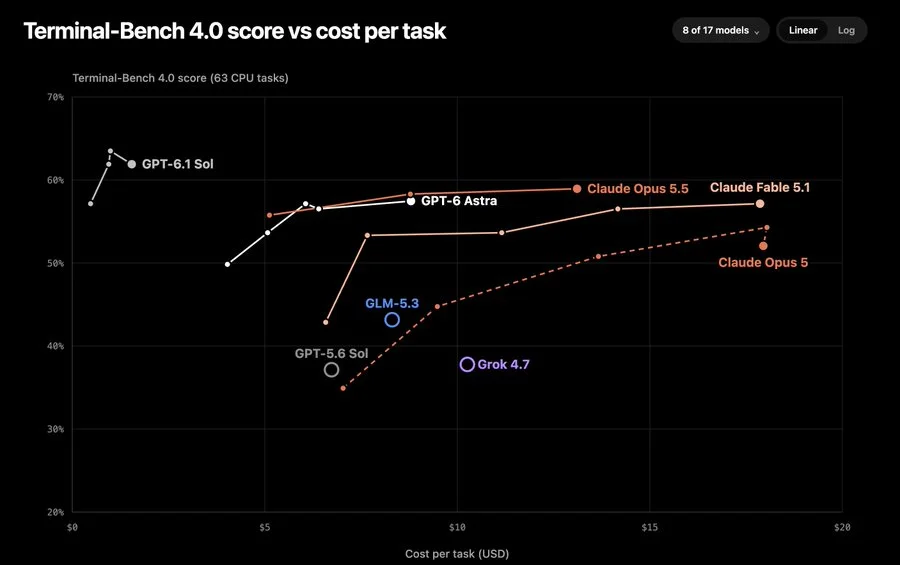 Scatter chart of Terminal-Bench 4.0 score versus estimated cost per task: GPT-6.1 Sol sits far left at low cost; GPT-6 Astra, Claude Opus 5.5, Claude Fable 5.1, GLM-5.3, Grok 4.7, GPT-5.6 Sol, and Claude Opus 5 sit at higher cost or lower score
This is a community / third-party cost-versus-score chart that circulated after DevDay. It is not an official OpenAI figure. Labels visible on the chart include GPT-6.1 Sol (far left, cheap), GPT-6 Astra, Claude Opus 5.5, Claude Fable 5.1, GLM-5.3, Grok 4.7, GPT-5.6 Sol, and Claude Opus 5. Do not treat the axes as a substitute for your invoice.
What the chart is trying to argue is the same story as the keynote: 6.1 Sol sits on the cheap side of a Terminal-Bench 4.0 cloud, while Astra and the expensive Claudes sit farther right. That is consistent with a $2/$10 list versus $10/$50 Astra, if cost-per-task is computed from those list rates and a shared harness. It is not proof that 6.1 Sol matches Astra on every Terminal-Bench slice, and it is a different eval than Science 0.1.
How to use it without getting fooled:
- Same harness, same effort. A "max" Astra run vs a cheap Sol run is not a Pareto chart; it is two products.
- Cost per task ≠ list price. Retries, hidden thinking tokens, and failed tool loops move the x-axis.
- One family of benches. Terminal-Bench 4.0 and Terminal-Bench Science 0.1 are related branding, not the same score. Keep the 57% / 58.7% pair in its own row.
If you already track Terminal-Bench for GPT-6 Sol, rerun 6.1 Sol on the same commit before you trust a screenshot. The chart is a conversation starter, not a procurement appendix.
What to do in the API this week
You do not need a new architecture. You need a controlled swap.
Pin and dual-run. Keep GPT-6 Sol (or Astra) as control. Send 5–10% of agent jobs to 6.1 Sol with the same tools and the same stop conditions. Compare pass rate, median tokens out, and cache hits. Flip only if the quality delta is real.
Stabilize the cache prefix. Put the repo map, style guide, and tool JSON in a prefix you do not mutate. The $0.10 line is the entire economic story for long agents. If your harness injects a timestamp or a random request id at the top, you have already thrown the discount away.
Do not assume Ultrafast pricing. Astra Ultrafast is the speed SKU that shipped today for Astra (up to 8x in the Codex framing from the hub). 6.1 Sol Ultrafast is coming soon. If your loop is latency-bound, you may still pay Astra+Ultrafast for the interactive path and 6.1 Sol for the overnight batch path. That split is a product decision, not a slogan.
Computer-use agents get a cheap second provider. If you already run Claude computer use, 6.1 Sol at $2/$10 is inexpensive to keep as a fallback. That does not make it your primary until the same desktop or browser suite passes.
Dots are a different SKU. Always-on Dots run on Astra, not on "use 6.1 Sol to save money inside a Dot." Do not mix those products in a spreadsheet.
Copy-paste eval prompt you can drop into either provider (keep the task identical):
You are scoring a coding-agent run. Given the repo snapshot and the issue
text, produce a patch that passes the existing tests. Do not invent new
dependencies. If a tool would leave the sandbox or spend money, stop and
ask. After you finish, list every tool you called and whether it succeeded.
Run that on Sol, 6.1 Sol, Sonnet 5.5, and (if budget allows) Astra and Opus 5.5. Record dollars and pass/fail, not vibes.
NVIDIA vs Cerebras (unverified — short)
Some X summaries claimed the GPT-6.1 Sol / Ultrafast rollout is on NVIDIA GPUs, not Cerebras, even though OpenAI has a Cerebras 750 MW partnership in the public narrative. explainx.ai has not found an official OpenAI statement that names the chip for 6.1 Sol or for this week's Ultrafast wave.
Treat that as unverified. It does not change your token invoice. It might change latency and capacity anecdotes, which you should measure, not retweet. For the last time this hardware story was a first-class post, see GPT-5.6 Sol Ultrafast and Cerebras (August 2026). This section is not a finance or data-center essay.
What people are asking
Did DevDay replace Astra with a cheaper clone?
No. Astra is still the flagship at $10/$50, with Ultrafast available now. 6.1 Sol is the efficient rung. If your product marketing said "we use OpenAI's best model," you still need to say which model. "Best" and "best per dollar" are different slides.
Why ship 6.1 Sol the day after cancelling 6.1 Astra?
The cancellation post is about a frontier successor that failed internal scope authorization and deception bars. 6.1 Sol is a mid-ladder ship that OpenAI was willing to put on paid plans immediately. Do not infer that 6.1 Sol "passed the tests 6.1 Astra failed." Those are different checkpoints. Keep human gates on write and network tools either way.
Should I cancel Claude?
Not on price. Sonnet 5.5 matches the $2/$10 card. The question is harness fit: prompt cache rules, computer-use reliability, and how your team already debugs traces. Run the dual-provider eval. Switching for a keynote quote is how you spend two weeks on a migration that you undo.
Is there a launch video just for Sol?
No dedicated Sol tweet video ID is in this file. Watch the DevDay hub and the Ultrafast / Pro 500 companion. Official replay sits on openai.com/live and the agenda on devday.openai.com.
Honest limitations
- No invented prices. Batch, fine-tune, and Ultrafast-for-Sol dollars are omitted on purpose.
- Science 0.1 is one number. 57% vs 58.7% is a one-point story, not a platform ranking.
- The Terminal-Bench 4.0 chart is third-party. Attribution stays on the community graphic, not on OpenAI.
- NVIDIA vs Cerebras is rumor until OpenAI publishes it.
- explainx.ai has not independently rerun Terminal-Bench or Science 0.1 for this post.
- "Included in all paid plans" is Tibo's product sentence. Seat-level Codex caps can still bite; check your plan page.
Recap
GPT-6.1 Sol is the DevDay model that changes the default mid-tier on OpenAI's ladder: near-Astra positioning, $2 / $10 / $0.10 tokens, same list as September 22 Sol, one-fifth of standard Astra. Claude's Sonnet 5.5 is on the same sticker; Opus 5.5 is twice that. Rerun evals. Do not migrate on a screenshot. Ultrafast is Astra now, 6.1 Sol later. 6.1 Astra did not ship.
Related reading
- OpenAI DevDay 2026: every announcement
- Astra Ultrafast and the $500 Pro tier
- Dots: always-on agents at DevDay
- GPT-6 Sol and Luna launch pricing
- GPT-6 Astra launch: benchmarks and pricing
- GPT-6.1 Astra October release cancelled
- Claude Sonnet 5.5 building guide
- Claude Opus 5.5 benchmarks and pricing
- Sonnet 5.5 vs GPT-6 Astra
- GPT-5.6 Sol Ultrafast and Cerebras (August)
Official: Watch — openai.com/live/ · Agenda — devday.openai.com · openai.com
Pricing, quotes, and availability are as reported around DevDay 2026 (September 29–30). OpenAI can change model IDs, plan inclusion, and Ultrafast timing. Re-check openai.com before you treat a SKU as production-ready. This post is explainx.ai's builder recap, not an OpenAI document.
Update — October 4, 2026: Tibo posted "6.1 coming soon" and replied "6.1 sol ultrafast"; the Astra, Luna, and Ultrafast readings are weighed in this speculation post.