



LlamaIndex released OCRia-nano-1 on November 23, 2026: an 8.1-million-parameter document stack that runs on CPU inside LiteParse. The announcement post and Hugging Face model card say it hits 59.2 on ParseBench-2, about 27.8 pages per second with 16 vCPUs, and roughly 2x LiteParse's default Tesseract throughput. It is the lightweight sibling of OCRia-1, distilled from the 4B teacher.
TL;DR
| Question | Answer |
|---|---|
| How big is the model? | 8.1M parameters across seven ONNX models (detector, router, four recognizers, LayoutNet) |
| Quick start | pip install liteparse → lit models pull ocria-nano → lit parse doc.pdf --format markdown |
| Speed | 426 ms mean per page on one core; 27.8 pages/s with 16 workers |
| Accuracy | 59.2 ParseBench-2 overall; 59.5 tables; beats LiteParse+Tesseract 48.7 on same bench |
| License | Weights: Open RAIL-M variant; LiteParse: Apache 2.0 |
| When not to use it | Charts to tables, heavy handwriting, or max accuracy—use OCRia-1 or GPU VLMs |
What LlamaIndex changed on November 23
The blog post frames 100 trillion-plus document pages worldwide and argues Tesseract-class OCR fails on tables while VLMs are overkill for bulk digital PDFs. OCRia-nano-1 targets first-pass ingestion: contracts, invoices, and routine scans where latency and CPU cost dominate.
Pipeline steps on each page:
- Read native PDF text when the text layer exists.
- Run OCR where text is missing (scans, embedded images).
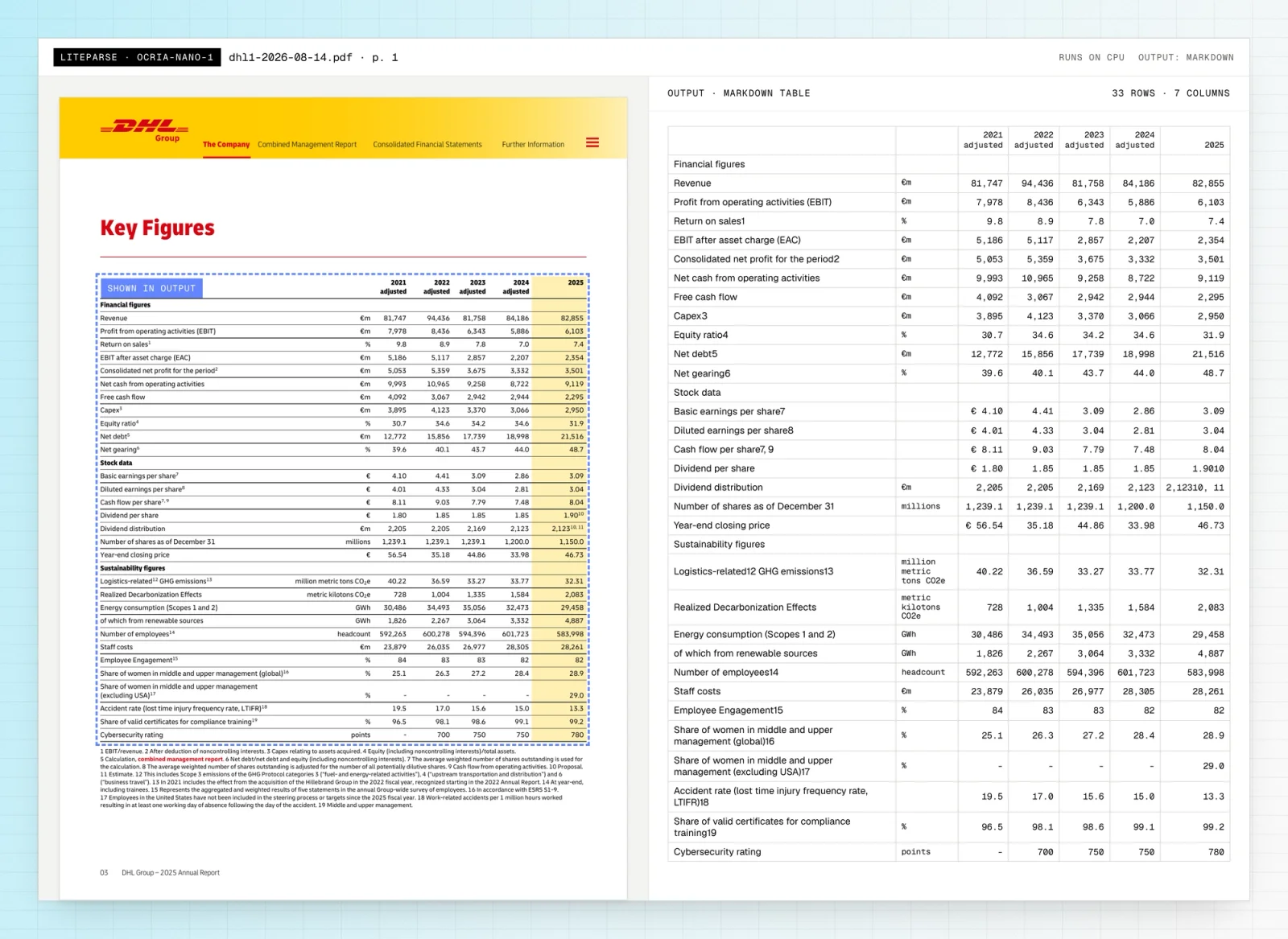
- LayoutNet recovers tables, headings, lists, captions using text positions plus visual features.
Outputs are Markdown, JSON, or plain text via LiteParse. Multilingual coverage uses a script router plus Latin, CJK, RTL, and world-script recognizers.
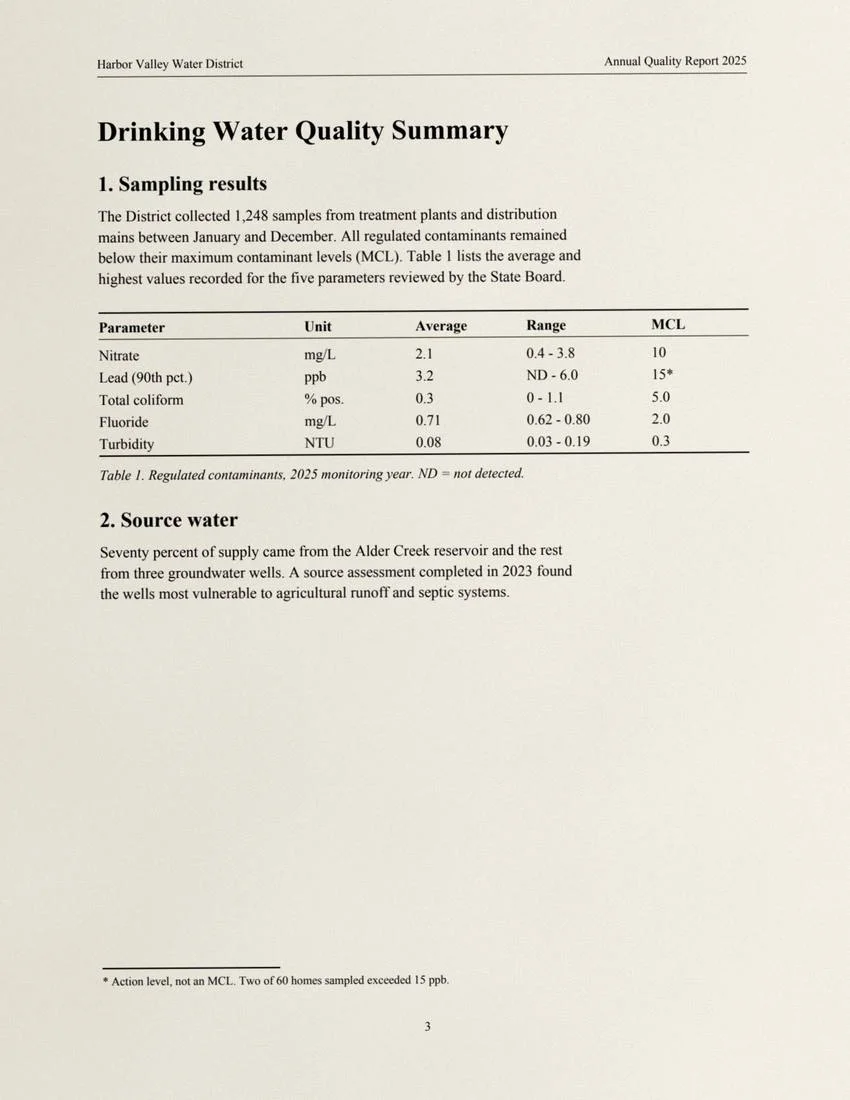 Synthetic scanned water-quality report parsed by OCRia-nano-1 pipeline demo
Image: LlamaIndex
Benchmarks LlamaIndex published
 ParseBench-2 CPU parser comparison for LiteParse OCRia-nano-1 versus Tesseract and Marker
Image: LlamaIndex
From the model card table (16 vCPU host, 300 random ParseBench pages):
| System (CPU) | ParseBench-2 | pages/s |
|---|---|---|
| LiteParse (Tesseract) | 48.7 | 14.2 |
| Marker 2.2.0 (fast) | 52.5 | 24.7 |
| Indra 1.1.2 | 55.1 | 29.6 |
| LiteParse + OCRia-nano-1 | 59.2 | 27.8 |
| OCRia-1 in LlamaParse (teacher, GPU) | 87.0 | — |
ParseBench-2 dimension highlights for nano: 68.5 text, 82.2 formatting, 59.5 tables, 72.4 layout. Charts stay at 3.1 (image-only)—confirming the OCRia-1 upgrade path for figure-heavy decks.
Compared to DocJev and Tencent Youtu-Parsing-Omni, nano is narrower (no audio/video) but orders of magnitude smaller for edge and batch jobs.
How to install LiteParse and run OCRia-nano-1
Official commands from LlamaIndex:
pip install liteparse
lit models pull ocria-nano
lit parse scan.pdf --format markdown
Python:
from liteparse import LiteParse, models

models.pull("ocria-nano")
result = LiteParse(ocr_backend="ocria-nano", output_format="markdown").parse("scan.pdf")
print(result.text)
Node.js uses @llamaindex/liteparse with the same ocrBackend. WASM builds load OcriaNano.fromUrl() for browser demos—useful beside agent skill vetting workshops.
Force legacy OCR for one run: lit parse scan.pdf --ocr-backend tesseract.
OCRia-nano-1 vs OCRia-1: which parser when
| Workload | Pick |
|---|---|
| Bulk digital PDFs, simple tables, agent upload pipelines | OCRia-nano-1 on CPU |
| Complex tables, handwriting, degraded scans, math notation | OCRia-1 (4B post) |
| Charts must become editable tables | OCRia-1 (nano leaves charts as images) |
| Multimodal audio/video packets | Youtu-Parsing-Omni class tools |
Pair nano with RAG pipelines by parsing locally before embedding—see memory architecture posts for how agents consume structured chunks.
License and commercial use
The Hugging Face card states:
- Research and teaching: free.
- Personal use: free.
- Commercial: free if annual revenue and total funding are each under $2M.
- Competing parsers or larger firms: contact LlamaIndex for a commercial license.
LiteParse itself stays Apache 2.0; ONNX Runtime is MIT. Legal teams should read Attachment B on the model download, not only the blog summary.
Model stack: what the 8.1M parameters do
The Hugging Face card lists seven ONNX files that LiteParse orchestrates. Together they replace a monolithic VLM with a specialist chain tuned for CPU inference:
| Component | ONNX file | Role | Params (approx.) |
|---|---|---|---|
| Line detector | det.onnx | Segmentation map of text lines | 0.08M |
| Script router | router.onnx | Picks recognizer per line; upside-down detection | 0.04M |
| Latin recognizer | rec_latin.onnx | CTC, 791 characters | 0.80M |
| World recognizer | rec_world.onnx | ~17 scripts | 0.98M |
| RTL recognizer | rec_rtl.onnx | Arabic, Hebrew | 0.71M |
| CJK recognizer | rec_cjk.onnx | Chinese, Japanese, Korean | 1.27M |
| LayoutNet | tablenet | Tables + 13 layout classes | 4.27M |
OCR-only mode (no LayoutNet) still scores 51.2 on ParseBench-2 at 37.2 pages/s on the benchmark host—useful when you only need plain text from scans before sending snippets to a frontier chat model.
LiteParse renders pages at 250 DPI by default (--dpi overrides). The router assigns a majority script per page but lets confident lines override—important for English contracts with occasional Chinese stamps or mixed Latin numerals in RTL headers.
ParseBench-2 dimensions explained
LlamaIndex's dimension table (same host, official scorer) shows where nano wins and where teachers still dominate:
| Dimension | LiteParse + Tesseract | LiteParse + nano | OCRia-1 teacher (GPU) |
|---|---|---|---|
| Overall | 48.7 | 59.2 | 87.0 |
| Text | 58.8 | 68.5 | 87.0 |
| Formatting | 78.0 | 82.2 | 92.7 |
| Tables | 36.2 | 59.5 | 89.9 |
| Charts | 1.2 | 3.1 | 77.4 |
| Layout | 49.4 | 72.4 | 89.2 |
| Forms | 68.5 | 69.8 | 85.6 |
The jump in tables and layout is the story: nano is not merely a faster OCR; LayoutNet reconstructs Markdown tables with row and column structure, including spanning header cells exported as HTML when colspan is required.
BHL character error rate drops to 0.048 versus 0.275 for Tesseract-backed LiteParse on the biodiversity heritage line in the card—relevant if you ingest scanned archival PDFs for science agents (SciResearch eval context).
Production deployment patterns
Batch ingestion: Run 16 single-core workers on a fat CPU box when you already shard PDFs in a queue (S3 notifications, Airflow, Temporal). At 27.8 pages/s, a 10k-page day finishes in ~6 minutes of parser time excluding I/O—compare to shipping every page to a GPU VLM that may spend seconds per page on easy digital PDFs.
Edge laptop: Single-core 426 ms mean (P90 862 ms) fits human-in-the-loop review: parse on device, push only low-confidence pages (failed table cells, upside-down detections) to cloud.
Browser WASM: @llamaindex/liteparse-wasm can load a 1.5 MB partial pack when you disable layout ({ scripts: ["latin"], layout: false })—good for demos beside datasette SQL agents where users upload one PDF without installing Python.
Hybrid with OCRia-1: LlamaIndex's own guidance is explicit: run nano first, escalate hard pages to OCRia-1 or LlamaParse. That mirrors how Fixer guided localization routes hard coding tasks to stronger models instead of burning flagship tokens on easy files.
Distillation and training story
Nano labels came from OCRia-1 teacher runs on training documents: text transcriptions, table annotations, and layout labels. The blog's interactive pipeline demo uses synthetic degraded scans (rotation, blur, JPEG) to show detector → router → recognizer → LayoutNet outputs.
You cannot fine-tune nano from the released artifacts alone today—the value is inference. For custom domains (medical forms, customs declarations), plan either routing rules post-parse or fine-tune upstream VLMs, not expect nano to learn new layouts without LlamaIndex retraining.
Security and data handling for local parse
CPU parsing keeps bytes on your hardware—critical next to CERT-In agent warnings and Bedrock trusted access patterns. Pair lit parse output with your own chunking before any cloud embedder; nano does not call the network after models are pulled.
Log confidence scores from JSON output when available; low OCR confidence on a line is a cheap gate before downstream RAG answers a compliance question.
Cost comparison snapshot
| Parser | ParseBench-2 | Throughput (16 core) | Typical host |
|---|---|---|---|
| Tesseract via LiteParse | 48.7 | 14.2 pages/s | CPU only |
| PP-OCRv6 tiny | 58.9 | 14.7 pages/s | CPU only |
| Indra 1.1.2 | 55.1 | 29.6 pages/s | CPU only |
| Marker 2.2 fast | 52.5 | 24.7 pages/s | CPU only |
| OCRia-nano-1 | 59.2 | 27.8 pages/s | CPU only |
| OCRia-1 teacher | 87.0 | GPU path | Cloud GPU |
Marker and Indra remain strong; nano's pitch is one LiteParse command, distilled table/layout, and shared JSON schema with the OCRia family so you can swap backends without rewriting agents.
What people ask about LiteParse
Searches cluster on "is LiteParse open source" (yes, Apache 2.0 runtime) versus weight license (RAIL-M variant). "LiteParse vs LlamaParse" maps to self-hosted CPU (nano) versus cloud LlamaParse with bigger VLMs. For GPU document agents, see Greptile accessibility-tree computer use; for eval harnesses, Hugging Face Harbor agent guide.
Migration checklist from Tesseract or Marker
If you already run Marker or Indra in batch jobs, LiteParse lets you A/B backends without rewriting storage paths:
- Pin
lit models pull ocria-nanoon CI workers and hash-verify ONNX shards (model card lists sha256 checks). - Run parallel parse on a 300-page sample with your legacy parser; diff Markdown table hashes and JSON bbox overlap.
- Tag pages where charts dominate—route those URIs to OCRia-1 or keep Marker for chart extraction only.
- Log mean ms/page and P90 separately; nano's advantage is tail latency on digital PDFs as much as mean speed.
- Update retention policy: parsed text may still contain PII; local CPU parse does not remove GDPR duties.
Teams using LlamaParse cloud for everything should estimate egress cost on re-parse; nano is aimed at repeat ingestion where per-page API fees hurt. Keep teacher-model escalation in the runbook so agents do not treat 59.2 overall as OCRia-1 parity on handwriting or chart extraction.
Related reading
- OCRia-1 4B parser and ParseBench claims
- DocJev document classification
- Tencent Youtu-Parsing-Omni
- Beginner local AI with Unsloth
- MCP explainer
- MemOnce scalable memory
- Agent skills workshop
Benchmarks and install commands follow LlamaIndex blog and Hugging Face materials accessed November 24, 2026.