



Six spare MacBook Airs can run a 30-billion-parameter chat model with no cloud API, if you chain them with Thunderbolt, shard weights with EXO, and fix the macOS privacy settings that silently block peer discovery. On November 23, 2026 Quickchat AI published a lab note from engineer Mateusz Jakubczak: six M2 MacBook Airs with 16 GB RAM each, five data-capable cables, Claude Code over SSH, and Qwen3-30B-A3B answering at roughly 20 tokens per second before lunch.
What Quickchat actually built
The Macs were former remote dev boxes running Linux VMs in Docker. After the team moved workloads to Boxes42, the hardware sat idle. Jakubczak treated 96 GB of pooled RAM as enough to try sharded local inference.
| Piece | What the post specifies |
|---|---|
| Hardware | Six M2 MacBook Air, 16 GB each |
| Topology | Daisy chain on Thunderbolt, five cables between six machines |
| Software | EXO splits one model across nodes |
| Model | Qwen3-30B-A3B, about 16 GB at 4-bit — too large for one Air |
| Agent help | Claude Code over SSH for install, debugging, and test prompts |
| Privacy | No prompts left the office — inference stayed on the six laptops |
The walkthrough is not a vendor benchmark. It is operations storytelling: wrong cables, Allow accessory to connect? dialogs on unused laptops, and Wi-Fi model downloads slow enough that copying weights over Thunderbolt once beat waiting on the slowest node.
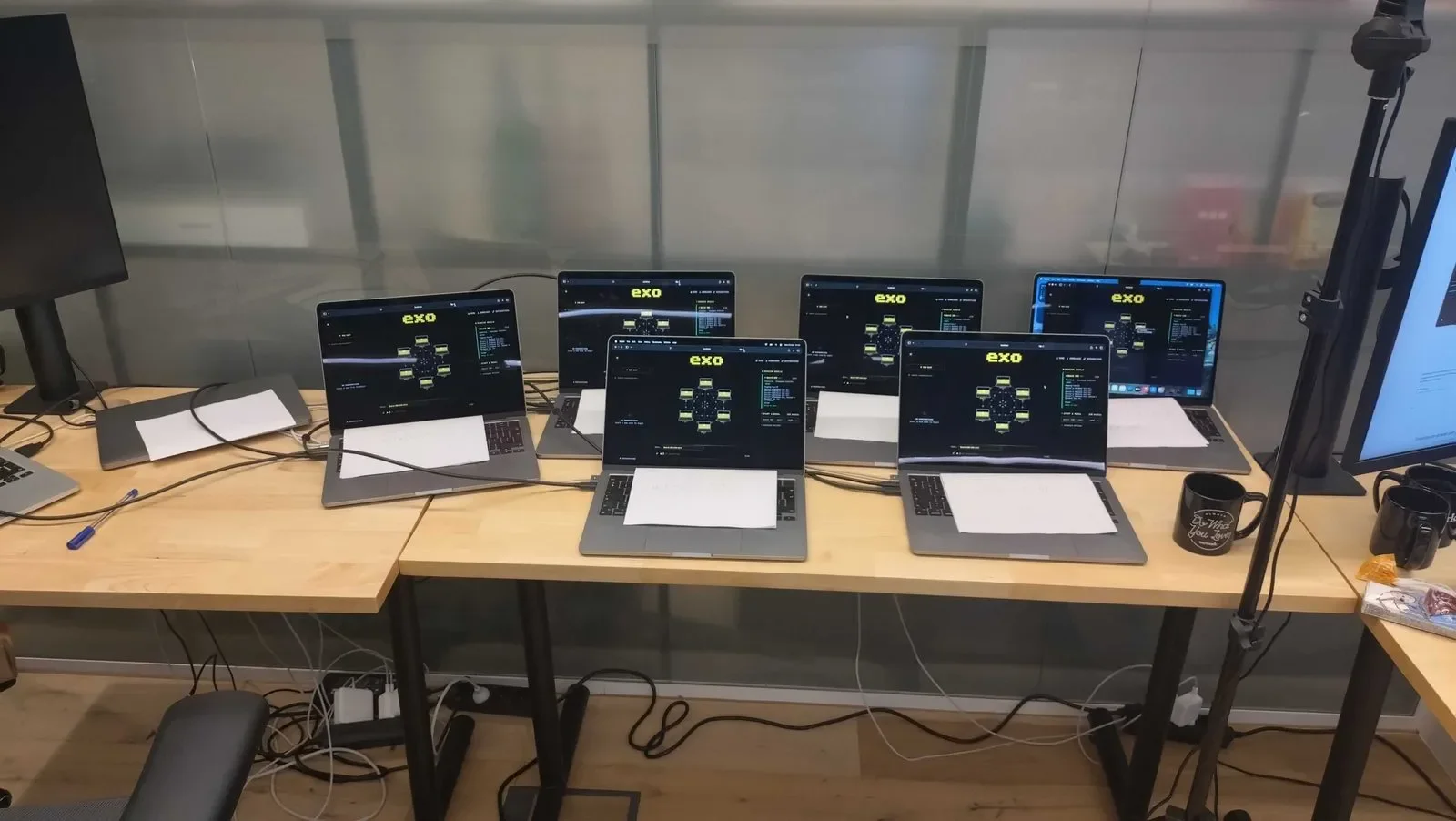 Six MacBook Airs in an EXO private LLM cluster showing connected nodes on each screen
Image: Quickchat AI
How EXO sharding differs from one big Mac
 Open model weights split across trays, echoing EXO sharding one LLM across six MacBook Airs
Single-machine local AI — the pattern in our Unsloth Desktop home guide — needs enough unified memory for weights plus KV cache. Distributed EXO trades cable friction for aggregate RAM: each node stores a slice of weights and participates in every forward pass.
Quickchat's FAQ on the post states practical limits:
- ~50 GB free counted across six Airs → models up to ~45 GB or ~80B at 4-bit.
- Short questions return quickly; long prompts stall before the first token because the stack reads the full context across nodes.
- More Macs ≠ faster tokens — the chain adds per-hop latency even when throughput feels readable at ~20 tok/s.
If you already run MLX-class inference on one Studio or Mac mini, EXO is the path when you have many small Airs instead of one large unified-memory box. NVIDIA's RTX Spark desktops push the same "local frontier" story on x86; Apple shops often already own the spare Airs.
Setup lessons that cost more time than software
Thunderbolt is not USB-C charging
Jakubczak spent most of the morning in a cable drawer. Most USB-C leads were charge-only. The post describes:
- One good Thunderbolt cable proved the first two-Mac cluster.
- Macs 5 and 6 needed someone to click Allow on accessory connect prompts — headless machines nobody touches anymore.
- Mac 4–5 showed link up, zero data until a charge cable was replaced.
For builders, that is a reminder: inventory Thunderbolt 4 rated cables before you promise a cluster demo. Our inference optimisation skill post stresses measuring real hardware paths, not spec sheets — same idea here.
macOS Local Network privacy blocks EXO quietly
With two Macs installed, each node thought it was a cluster of one. Claude Code traced EXO docs to macOS Local Network permissions: blocked apps get no error toast, just failed discovery.
Fix on SSH-only Macs: run EXO as a root system service so discovery works without a GUI click. Fix on a laptop you use: allow EXO under System Settings → Privacy & Security → Local Network.
That failure mode rhymes with Signal screenshot blocking and other macOS silent denies — agent harnesses must log peer discovery, not assume LAN multicast always works.
Claude Code as remote cluster admin
Quickchat used Claude Code with SSH access to:
- Shut down leftover dev-machine Docker stacks to free RAM.
- Install EXO on each node.
- Diagnose Thunderbolt vs charge links from inside the OS.
- Suggest single-download, Thunderbolt copy once Wi-Fi pulls lagged (~30 seconds copy vs 80–90 minutes on the slowest downloader).
The pattern matches how teams already wire Pi or Codex harnesses to remote GPUs — here the "GPU" is six laptops on a desk.
Model choice: Qwen3-30B-A3B
Qwen3-30B-A3B is a mixture-of-experts-scale naming convention from the Qwen line; Quickchat picked it because ~16 GB at 4-bit cannot load on one 16 GB Air but fits sharded. The cluster listed primes correctly and returned haiku test outputs — sanity checks, not Terminal-Bench scores.
Treat 30B on six consumer Airs as private chat and light coding, not agentic multi-hour runs. For office-agent products, Quickchat builds Boxes42 remote dev environments; this post is sibling content in their "how we work with AI" series, not a product launch.
What developers said on Hacker News
The HN thread listed 5 points and a single top-level reply when this post published. woadwarrior01 asked, in their comment, whether the piece was a "submarine" ad for EXO and linked Paul Graham's stealth-marketing essay. No other commenter posted independent throughput numbers or EXO version pins — treat community verification as still open.
When you replicate, publish EXO commit hash, Qwen revision, and cable model if you want credit beyond Quickchat's anecdote.
How to try a similar cluster
- Confirm EXO still matches your Mac OS version on github.com/exo-explore/exo — README positions it as frontier AI locally.
- Label Thunderbolt cables; keep charge-only leads out of the chain.
- Free RAM — quit Docker/VMs left from old dev workflows.
- Fix Local Network or systemd-style root service per Quickchat's workaround.
- Download once, copy shards over Thunderbolt if Wi-Fi is asymmetric.
- Point tools at EXO's OpenAI-compatible API — same client pattern as local LAN Unsloth, different backend.
- Firewall the API — private does not mean secure if the port faces the internet.
For single-GPU readers, start with Unsloth Desktop or NeonClipping's Ollama Shorts pipeline before buying five cables.
Timeline: what happened before lunch
Quickchat's narrative is clock-driven — useful if you are planning a proof-of-concept demo with executives in the afternoon.
| Local time (approx.) | Event |
|---|---|
| Morning | Find one Thunderbolt cable; link two Macs; EXO ignores peers until Local Network fixed |
| 13:12 | Two-node cluster answers; haiku test about two laptops and one cable |
| Mid-morning | Hunt four more data cables; fix Allow accessory on Macs 5–6; swap charge-only link between 4–5 |
| Download phase | Parallel Wi-Fi pulls; slowest node 80–90 minutes behind; single copy over Thunderbolt ~30 s |
| 13:54 | Six-node Qwen3-30B-A3B live; ~20 tok/s; prime list sanity check |
The lesson for IT departments is not romantic: budget cable QA and GUI access to headless Macs, not just brew install.
Security: private inference is not automatic compliance
On-prem tokens help with customer NDAs and air-gapped policies, but EXO still exposes an API on the LAN. Quickchat explicitly warns that most OpenAI-compatible clients can target the cluster once you repoint base URLs.
| Risk | Mitigation |
|---|---|
| LAN leak | Bind listeners to office VLAN; block inbound from guest Wi-Fi |
| No auth by default | Assume zero trust unless EXO docs add tokens — wrap with reverse proxy if needed |
| Stale dev containers | Jakubczak shut down old Docker stacks — hidden services steal RAM and open ports |
| Physical theft | Sharded weights still sit on disk — FileVault and asset tags matter |
This is lighter than Together AI prompt-leak class incidents, but the threat model is the same: local means you operate patching and firewalling.
When a Mac cluster beats one GPU box
| Situation | Prefer |
|---|---|
| Six 16 GB Airs already depreciated | EXO chain for 30B-class private chat |
| One 48–128 GB Mac Studio / Threadripper | Single-node MLX / vLLM — simpler ops |
| Linux fleet with RDMA | Tensor parallel stacks, not Thunderbolt daisy chain |
| Low-latency agents | Cloud API or one fast GPU — chain adds per-hop cost |
Quickchat's team builds hosted dev boxes; this experiment is R&D recycling, not their production inference path.
What this does not prove
Quickchat's post does not publish power draw, dollar cost vs cloud, or side-by-side quality vs Qwen3 API. It does not compare EXO to vLLM tensor parallel on Linux. It does prove a real team can turn e-waste Macs into a closed-network chat endpoint in one morning if someone will click Allow on headless machines.
For workshop teams learning local stacks, our live AI workshop explainer covers when hands-on LAN labs beat async video — EXO is the kind of demo that only works in the room with real cables.