




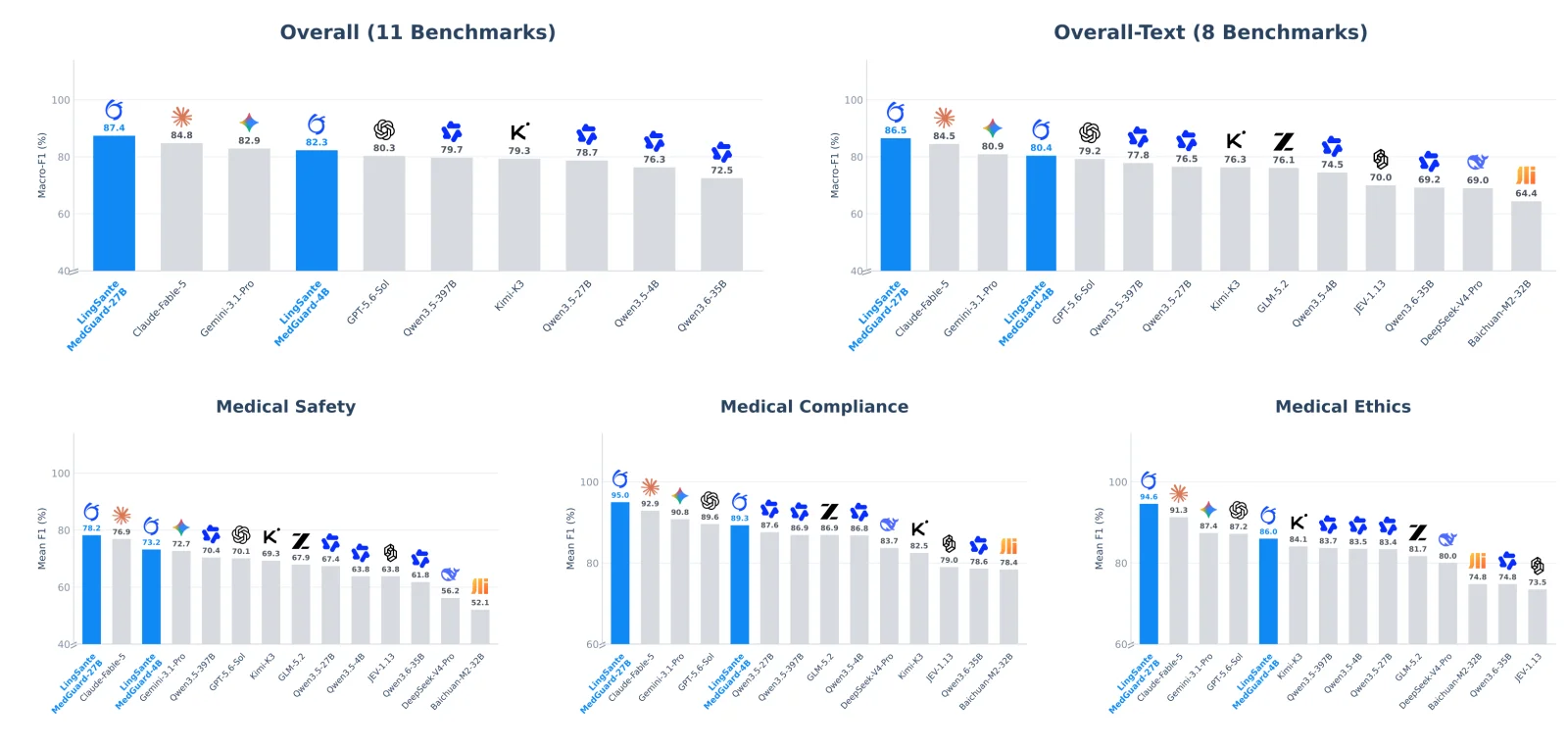
LingSante MedGuard is inclusionAI's medical guardrail—not another chatbot, shipped with GitHub code, Hugging Face papers 2611.25509, and MedGuardBench for safety, compliance, and ethics checks. The 27B build reports 87.4% mean F1 across 11 risk subsets, while LingSante-3.1-flash remains the 560B MoE doctors' offices might fine-tune for dialogue.
TL;DR
| Item | Detail per HF paper page and report |
|---|---|
| Role | Guardrail reviewing AI medical replies |
| Teachers | 1 guardrail teacher + 6 capability experts |
| Sizes | 4B, 9B, 27B |
| MedGuardBench | 11 risk subsets (safety, compliance, ethics) |
| Mean F1 | 82.3% (4B), 82.4% (9B), 87.4% (27B) |
| 4B extra eval | 73.9% mean accuracy on MedHallu and MedHALT-NOTA with retrieval |
| Repo | github.com/inclusionAI/LingSante-MedGuard |
| Dataset | LingSante-MedGuardBench on HF |
Agents that act on your behalf need rules. See how explainx helps secure your agents →
Why medical AI needs a guardrail layer in 2026
Hospitals adopted RAG, agentic order workflows, and multimodal intake faster than verification. Naver K-Med 31B targets on-prem reasoning. Radical Omnii-1 pushed genome-to-patient claims. Vas Narasimhan's AI drug timeline shows board-level attention.
Chat accuracy and reply safety are different KPIs. A fluent answer can still miscalculate doses, hallucinate imaging, or skip consent language. MedGuard is inclusionAI's attempt to bundle specialists into one filter instead of bolting six ad-hoc scripts behind LingSante-3.1-flash.
Architecture: teachers, distillation, on-policy feedback
 LingSante MedGuard distillation pipeline from the technical report
Image: inclusionAI
The technical report summary on Hugging Face describes a pipeline, not a single SFT pass:
- Guardrail teacher supervises risk decisions and explanations across safety, compliance, and ethics.
- Six capability experts cover rule parsing, numerical reasoning, multimodal hallucination checks, agentic safety verification, risk localization, and multimodal entity understanding.
- Offline SFT on teacher demonstrations, then multi-teacher on-policy distillation using feedback on student-generated responses.
That matches how Anthropic alignment auditors and MCP skills over raw tools think about layered supervisors—here applied to clinical text and multimodal charts.
MedGuardBench: what the 11 subsets test
LingSante MedGuardBench is the public scoreboard. Authors group risk detection into safety, compliance, and ethics buckets with 11 subsets total.
Reported mean F1:
| Checkpoint | MedGuardBench mean F1 |
|---|---|
| 4B | 82.3% |
| 9B | 82.4% |
| 27B | 87.4% |
The 4B model also hits 73.9% mean accuracy across MedHallu and MedHALT-NOTA when retrieval is enabled—suggesting the guardrail is meant to sit on top of evidence fetch, not replace it.
Separate verification component evaluations claim better evidence-supported consistency, source traceability, and rule-guided rationale quality across scales. Treat those as author metrics until third parties rerun them on local EHR exports.
How to run MedGuard without swapping your chat model
- Clone inclusionAI/LingSante-MedGuard and read scripts/ for inference entry points.
- Download weights from the Hugging Face collection linked on the paper page.
- Pull MedGuardBench to regression-test your prompts before go-live.
- Keep LingSante-3.1-flash or another LLM as generator; pipe outputs through MedGuard as critic.
For agentic workflows, align with iFood's 15,000-repo remote agent lessons—verification must run per tool call, not only on final markdown.
Regulatory and ethics context
 Medical bags beside a green sorting funnel
UK FCA agentic authorization and New York's chatbot toy ban show governments moving faster than hospital procurement. A documented guardrail with public benchmarks helps compliance packets, but does not clear FDA-style pathways by itself.
When marketing 87.4% F1, specify subset definitions and false positive costs. Over-blocking benign counseling text can harm patients too.
Pairing MedGuard with retrieval and human review
The 73.9% figure on MedHallu and MedHALT-NOTA with retrieval enabled signals intent: guardrails should see the same evidence clinicians expect, not only the draft answer text. Wire MedGuard after your RAG fetch, not before, so it can judge citation alignment and numeric checks against source snippets.
For multimodal intake (photos of wounds, pill bottles, lab PDFs), the multimodal hallucination and entity understanding teachers matter more than pure text F1. Run subset-by-subset error analysis on your modalities; aggregate F1 hides catastrophic misses on dosing.
Human escalation paths stay mandatory. MedGuard is best framed as triage: block, flag, or annotate before a nurse approves send. That matches Talkie child-harm investigation lessons—automation without escalation design fails regulators.
Subset-by-subset deployment guide
MedGuardBench ships eleven subsets—do not tune operations to one F1. Map subsets to your workflows:
- Safety — triage chat and after-hours bots.
- Compliance — billing codes, prior auth language, HIPAA-style phrasing in US pilots.
- Ethics — consent, vulnerable populations, end-of-life counseling guardrails.
Run shadow mode for 30 days: log flags without blocking, measure false positives that would have delayed care. Only then wire hard stops.
4B vs 27B choice is latency vs F1. Edge hospitals on GPU budgets may run 4B beside Ling-3.2-Air chat models; academic centers validating trial protocols may demand 27B.
Agentic safety verification subset matters when tools call labs, imaging PACS, or e-prescribe APIs. MedGuard is positioned for tool loops, not static FAQ bots alone.
Distillation pipeline in operations language
Teacher models generate rationales during SFT; on-policy distillation means student outputs get scored by teachers iteratively—similar to RLHF, but multi-teacher. MLOps teams should store teacher version IDs when FDA-style change control asks what retrained.
Numerical reasoning and multimodal hallucination experts justify separate heads merging into one guardrail—avoid six microservices in prod unless latency allows.
Competitive landscape November 2026
Naver K-Med chases on-prem reasoning. Harvey Muse Spark targets legal, not clinical guardrails. Anthropic ships Artifacts and safety research, not open MedGuardBench. inclusionAI's play is open weights + bench for integrators.
FAQ for clinical engineering leads
Can MedGuard run on CPU-only wards? Check GitHub for quantization scripts; 4B is the likely ward profile. Does it replace pharmacist review? No—it flags risky text. How often retrain? Follow inclusionAI release tags; re-run MedGuardBench each upgrade. What about non-English clinics? Benchmark coverage is author-defined—run your languages before launch. Is 87.4% F1 enough? Depends on subset cost of false negatives; shadow mode first.
Security teams should threat-model guardrail bypass attempts—attackers may prompt the chat model to ignore critic outputs unless architecture enforces hard blocks at API gateway.
Researchers comparing Latent introspection steering should note MedGuard is supervised distillation, not activation steering—different ops footprint.
What is verified vs author-reported
| Item | Status |
|---|---|
| HF paper page and GitHub repo live | Verified Nov 25, 2026 |
| F1 table for 4B/9B/27B | Author-reported on HF summary |
| Peer review | Preprint / technical report |
| Integration with your EHR | Your validation required |
Related reading
- LingSante-3.1-flash open medical MoE
- inclusionAI Ling-3.2-Air open weights
- Naver K-Med on-premises medical LLM
- Anthropic alignment auditors with reinforcement learning
- iFood remote agent platform at 15,000 repos
- UK FCA agentic AI authorization for payments
Closing note for compliance officers
Store MedGuardBench run IDs beside model release tags in change control. When inclusionAI ships a new checkpoint, rerun all eleven subsets—not only aggregate F1—before re-enabling auto-send in patient chat. Pair guardrail logs with UK FCA agentic payment rules if billing agents touch the same thread.
MedGuard does not solve workflow liability; it gives auditable signals. Treat blocked messages as events worth weekly review, not noise.
Hospital IT should version guardrail and chat checkpoints independently—upgrading LingSante-3.1-flash without retesting MedGuard invites silent drift. Biomedical informatics fellows can use MedGuardBench as a 2026 capstone: reproduce subset F1, publish error buckets, and compare retrieval-on versus retrieval-off paths using the 73.9% auxiliary statistic as a starting hypothesis.
Payers asking for AI safety attestations should request bench run logs, not marketing F1 alone. Startups integrating telehealth APIs should budget two models in production: generator plus critic, with latency budgets measured on ward Wi-Fi, not lab Ethernet.
Medical schools piloting LLM tutors should run MedGuardBench on synthetic student prompts before live standardized-patient weeks. Six teachers in the paper map cleanly to rubric rows deans already use—ethics, numeracy, evidence, multimodal sanity, agentic tool use, and entity grounding.
Open-source contributors can help by documenting failure cases per subset on GitHub issues—aggregate F1 hides which harm class still leaks at 87.4%. That community QA is how ProofAtlas-style math posts matured this month; clinical safety benches deserve the same public triage.
Integration partners wrapping Epic, Cerner, or regional HIS APIs should treat MedGuard as a middleware hook on outbound patient text, not a replacement for pharmacist verification queues already in the workflow.
Risk committees should demand subset-level dashboards in Q1 2027 planning even if aggregate F1 clears internal thresholds today—one weak ethics subset can still drive sentinel events when volume scales. Export those dashboards to PDF for joint commission folders when auditors ask.
Benchmark figures come from the LingSante MedGuard technical report summary on Hugging Face as of November 25, 2026. Clinical deployment requires institutional review beyond open weights.