



New York will ban internet-connected AI chatbot toys for five years starting 90 days after Governor Kathy Hochul signed S.9408A on November 24, 2026. The signing announcement prohibits manufacturing, distribution, and sale of dolls, stuffed animals, and robots that use the internet to hold conversational AI with children. Attorney General Letitia James may fine violators up to $15,000 per day.
The law does not flip on before this holiday season—Hochul used the signing to warn parents now, while shelves still hold chatbot products.
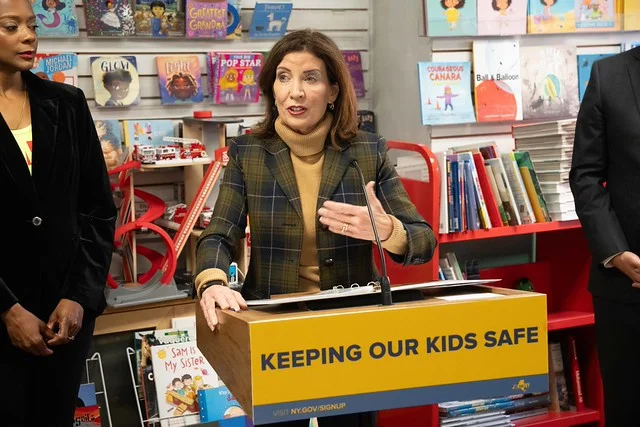 Governor Kathy Hochul signs the five-year ban on AI chatbot toys in New York
Image: Governor Kathy Hochul / New York State
What the bill does
S.9408A/A.11144B creates a five-year moratorium, not a permanent ban. Sponsors Senator Andrew Gounardes and Assemblymember Rebecca Kassay say the pause buys time to study developmental impacts and write durable rules for biometric collection, open-ended dialog, and manipulation risks.
Covered products are toys with embedded or integrated AI chatbots that use the internet—think always-on cloud models in plush form factors, not offline speech chips with fixed scripts.
Why Hochul acted now
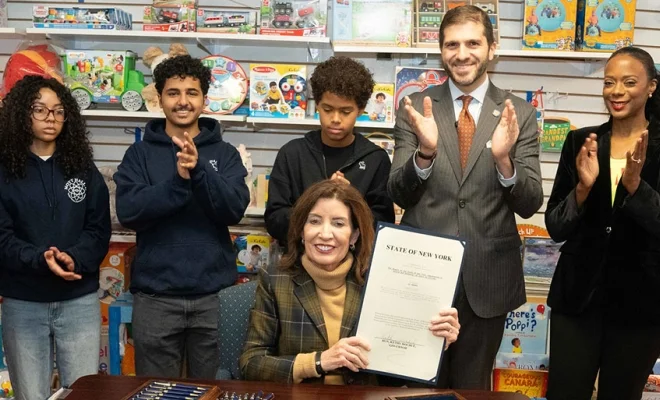 New York State announces a five-year moratorium on internet-connected AI chatbot toys
Image: Governor Kathy Hochul / New York State
The release ties the bill to watchdog tests on toys marketed for ages 3–12:
- Sexually explicit conversations in depth.
- Instructions to find matches inside a family home.
- Emotional upset when a child stops talking.
- Parental controls that weaken as sessions lengthen.
- Voice and face capture with few limits.
Those findings mirror why New York already leads U.S. kids-online safety statutes—the governor cites #1 national ranking after laws like the SAFE for Kids Act, Child Data Protection Act, Distraction Free Learning phone rules, and the RAISE Act on frontier-model transparency.
Link to the AI Companion safeguards
In October 2026 Hochul signed AI Companion rules blocking chatbot features that foster emotional dependency, encourage self-harm, or engage minors in sexually explicit talk. The toy moratorium extends that logic into hardware: a microphone in a teddy bear is still a companion surface.
For builders shipping Meta Muse, ChatGPT, or kid-facing wrappers, compare Pinterest teen feed limits and Tidal’s AI-music ban: states are segmenting where generative AI may run, not whether it exists.
Enforcement and compliance calendar
| Milestone | Detail |
|---|---|
| Signed | November 24, 2026 |
| Effective | ~90 days later (late February 2027 unless guidance shifts) |
| Duration | Five-year moratorium |
| Enforcer | NY Attorney General — $15,000/day civil penalties |
| Holiday 2026 | Moratorium not in force; Hochul advises avoidance anyway |
OEMs and retailers should map SKU lists for cloud-connected dialog toys, plan NY inventory pulls before the effective date, and document data deletion flows if toys record biometrics.
What parents should do before gifts ship
Hochul’s release tells caregivers to look past packaging for AI companion labels, data collection, and open-ended chat. Common Sense Media and Mothers Against Media Addiction praised the moratorium but urge traditional toys this season because the ban is not yet legally active.
What developers and founders should watch
Product: Any kids’ IoT agent with a cloud LLM needs a NY legal review and likely a hardware redesign without open-ended chat—or a geofenced disable.
Policy: Five years is long enough that federal rules may preempt parts of the moratorium; track NGA governor frontier-AI letters for overlapping state-federal fights.
Enterprise AI: This is not a workplace story, but it signals how state AGs treat anthropomorphic agents—relevant if you market consumer-facing avatars tied to agent shopping protocols.
How New York fits the wider U.S. map
New York already banned unsafe AI companion features for minors, AI-generated CSAM, and tightened school phone rules. The toy ban adds physical devices to a portfolio that includes Safe by Design, Social Media Warning Labels, and Teen Mental Health First Aid funding.
National labs watching CA DMV Waymo freeway orders or UK FCA agentic payments rules should read New York as consumer-protection-first: long pauses when evidence is thin, aggressive AG enforcement when products ship anyway.
Stakeholder quotes (primary source)
Hochul: parents should not worry that “dangerous chatbots disguised as toys” could manipulate feelings or risk privacy.
James: her office will enforce and will not let children’s health become collateral damage of big tech.
Gounardes: the rush to sell AI toys is profits before kids’ safety; the pause enables study then smart protections.
Kassay: toys can mimic human relationships while collecting sensitive data without guardrails—hence the moratorium to assess emerging tech.
Practical checklist for toy and ed-tech teams
- Label review — Remove “AI best friend” claims that imply unlimited dialog.
- Parent dashboard — Prove session logs, delete-audio buttons, and hard off switches; weak controls were cited in watchdog tests.
- Data map — Document if face or voice leaves the device; AG penalties apply per day.
- Retail contracts — Pull NY-bound inventory before effective date; don’t rely on holiday sell-through.
- Legislative tracking — Five years may shrink if federal toy safety standards land; monitor CPSC and FTC AI rulemakings alongside NY.
Bill text mechanics (what lawyers will grep)
Although explainx.ai summarizes the signing release, teams need three implementation facts on their calendar:
Manufacturing versus sale. The moratorium covers manufacturing, distribution, and sale in New York. Companies assembling outside the state still cannot distribute into NY retail once effective.
Internet requirement. Toys must use the internet for chatbot conversation. Offline voice chips with fixed phrase banks are a different compliance conversation—verify against enrolled text before assuming exemption.
Companion framing. Sponsors describe products that mimic human relationships while collecting sensitive data. That language will guide AG enforcement even before regulations finish.
Comparison to California and federal toy rules
California’s DMV fights show state-by-state AI regulation is normal in 2026 — Waymo’s freeway ban is mobility; New York is child companions. Federal bills on kids’ data (COPPA updates, KOSA debates) move slower than NY AG civil fines.
Retailers operating nationally should not assume NY-only SKUs are enough if drop-ship or marketplace listings still reach NY addresses.
Watchdog testing details expanders
The governor’s release does not name the watchdog, but the described failures map to risks vendors minimized in CES demos:
- Sexual content in toys marketed to elementary ages.
- Match-finding instructions inside homes — a physical-world safety issue, not just a Terms-of-Service breach.
- Emotional manipulation when sessions end — parallels AI Companion bans on dependency features.
- Biometrics — voice and face scans without durable parent dashboards.
Document these in RFP security questionnaires when school districts buy “classroom AI” hardware.
Retail and OEM compliance playbook
- SKU audit — Flag any toy with cloud LLM, wake word, or open-ended dialog.
- Geo-fencing — Stop NY shipments before effective date; block NY IPs in companion apps if legally advised.
- Data retention map — If audio leaves device, state where it is stored and deletion SLAs.
- Parent UX — Prove hard mute, session logs, and no training on child audio claims.
- AG liaison — $15k/day penalties mean compliance is cheaper than litigation.
Why five years, not permanent?
Sponsors call the pause logical time to study developmental impact before permanent rules. That matches EU-style sandbox thinking without calling it one. If studies show safe-by-design standards, the moratorium could shrink — but AG enforcement will not wait for studies to finish before fining current SKUs.
Connections to AI in schools and mental health
New York already restricts phones in schools and funds Teen Mental Health First Aid. Chatbot toys sit at the intersection — always-on confidants without counselors. Hochul’s Unplug and Play and Youth Safe Spaces programs are the cultural counterweight: public money for non-screen social infrastructure while banning risky companions.
Media literacy for parents (plain language)
Hochul’s holiday warning is essentially: read the box, not the mascot. If marketing says “AI best friend,” “always listens,” or “learns your child,” treat it like social media policy — delay until NY law or vendor audits exist.
Common Sense Media’s CEO urges traditional toys and human engagement this season. That is compatible with the law’s 90-day delay: moral pressure now, legal force soon.
Enterprise AI teams: why this matters to you
You may not ship toys. You do ship voice interfaces and kid-adjacent apps. NY’s pattern — moratorium first, civil fines second — previews how states may treat always-on agents in education Chromebooks, family robots, and hospital pediatric companions.
Review Anthropic OpenAI employee safety warnings alongside this law: governments are skeptical of unreleased frontier models and skeptical of always-on kid chat in the same month.
Stakeholder support beyond politics
MAMA (Mothers Against Media Addiction) and Common Sense Media endorsed the signing — unusual left-right alignment on child tech harm. Attorney General James frames enforcement as stopping harm, not anti-innovation.
Vendors arguing “education AI” should expect coalitions like these to show up in AG comments and class actions, not only in Albany.
Legislative history snapshot
Gounardes and Kassay championed the bill with near-unanimous Senate and Assembly support per the release — signaling bipartisan kid-safety politics durable across election cycles. That reduces odds of a quick repeal if one party flips chambers.
Track RAISE Act implementations for adult frontier models separately; toy moratorium is product-specific, not model-capability specific.
FAQ alignment with search queries
Parents search “AI toys safe,” “chatbot doll ban,” and “New York AI law kids.” This post answers when law bites (90 days), what is banned (internet chatbot toys), and what to do now (avoid risky SKUs even before enforcement).
Limits of this article
This post summarizes the November 24, 2026 governor signing release. It is not legal advice. Read the enrolled bill text on the New York State Senate site for definitions, exemptions, and exact effective language before changing product plans.