



Anthropic said on November 24, 2026 that Model Context Protocol (MCP) SDK downloads now exceed 700 million per month, with more than 10,000 MCP connectors for Claude. The same day it opened Skills over MCP in public beta, marked Tasks and Elicitation as generally available, and announced file uploads to MCP servers as rolling out soon.
TL;DR
| What changed | Detail |
|---|---|
| Scale | 700M+ monthly MCP SDK downloads; 10,000+ Claude connectors (Anthropic) |
| Skills over MCP | Public beta — servers ship skills + tools + resources; skills load on demand |
| Tasks | GA — long server jobs run in the background while Claude continues |
| Elicitation | GA — servers can pause and ask the user for missing fields |
| File uploads | Soon — PDFs, spreadsheets, images to servers without stuffing context |
| Community | MCP blog marks two years since open source; 5B total SDK downloads cited (MCP blog) |
Why MCP crossed 700 million monthly downloads
MCP began as an Anthropic open standard in November 2024 for wiring agents to tools and data. Within two years it moved under the Agentic AI Foundation at the Linux Foundation, picked up a stateless core in the 2026-07-28 spec, and became the default integration path for Blender, DaVinci Resolve, ROS robotics, NASA data, and enterprise SaaS in the birthday retrospective on the MCP blog.
Anthropic's product article ties the download figure to production agent wiring: tool search that loads definitions only when needed (up to 85% context savings in multi-server setups, per Anthropic), Enterprise Managed Auth so admins approve servers once, and MCP Apps for interactive UIs inside chat clients. If you are new to the wire itself, start with explainx.ai's Model Context Protocol guide and our A2A vs MCP comparison for multi-agent orchestration next to tool access.
The 700 million monthly number is SDK package downloads, not unique developers. It still matters for builders because package managers and CI pipelines pull MCP SDKs every time someone spins up a new agent host, MCP server template, or connector in a monorepo. When Hugging Face routes inference through OpenRouter or Amazon Bedrock adds trusted Claude access patterns, the underlying integrations increasingly speak MCP-shaped tool lists.
Skills over MCP: expertise rides with the connector
Until this week, MCP servers mostly advertised tool names and JSON schemas. That tells Claude what it can call, not how your team runs a workflow across twelve steps, guardrails, and account-specific naming rules.
Skills over MCP closes part of that gap. Anthropic's diagram shows three layers a server can expose:
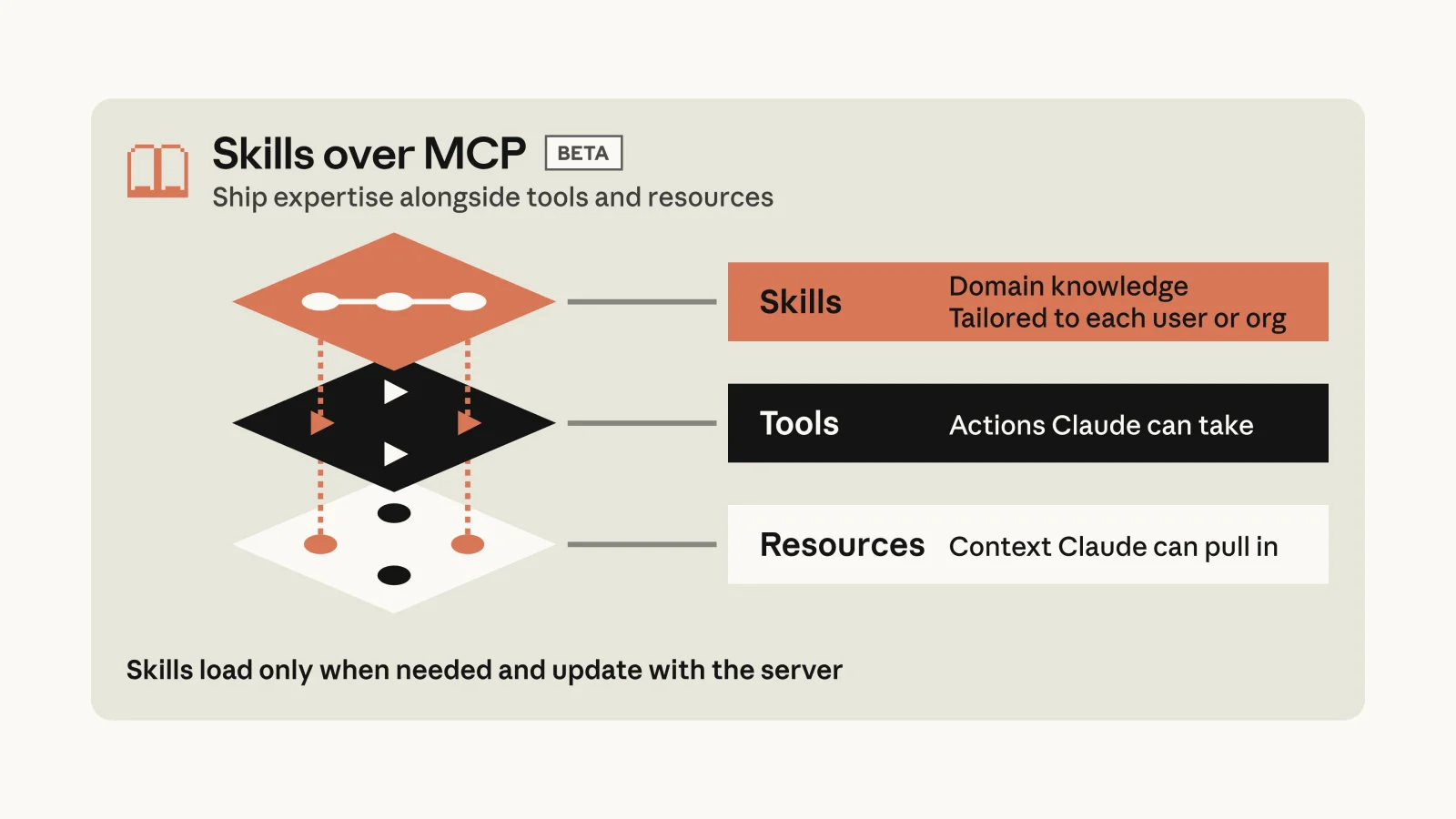 Skills over MCP lets Anthropic Claude load server skills tools and resources on demand
Image: Anthropic
- Skills — procedural knowledge tailored to a user or org
- Tools — actions the model can invoke
- Resources — files or records the model can read
Skills load only when needed and update with the server, so you ship tools and guidance in one release instead of asking customers to copy a local SKILL.md into Claude Code. That pattern complements—but does not replace—folder-based Agent Skills we documented for Expo Router and Google Stitch design-to-code.
Anthropic names Shopify (store design end to end), HubSpot (onboarding), Atlassian (org context for work analysis), and Carta (equity drafts from uploads, coming soon) as early Skills over MCP partners. It also echoes 37 Salesforce sales skills inside Claude as an earlier skills-heavy integration, now generalized through the protocol.
Who gets access
Per Anthropic's article:
- Public beta in Claude and Claude Code
- On by default for Pro, Max, and Ultra
- Team plans after an admin enables it
- Enterprise listed as coming soon
Builders should read Anthropic's Skills over MCP, Tasks, Elicitation, and File Uploads docs linked from that article before changing production servers.
Tasks and Elicitation reach general availability
Long-running agent work broke early MCP clients that assumed every tool call finished in seconds. Tasks formalize async server work:
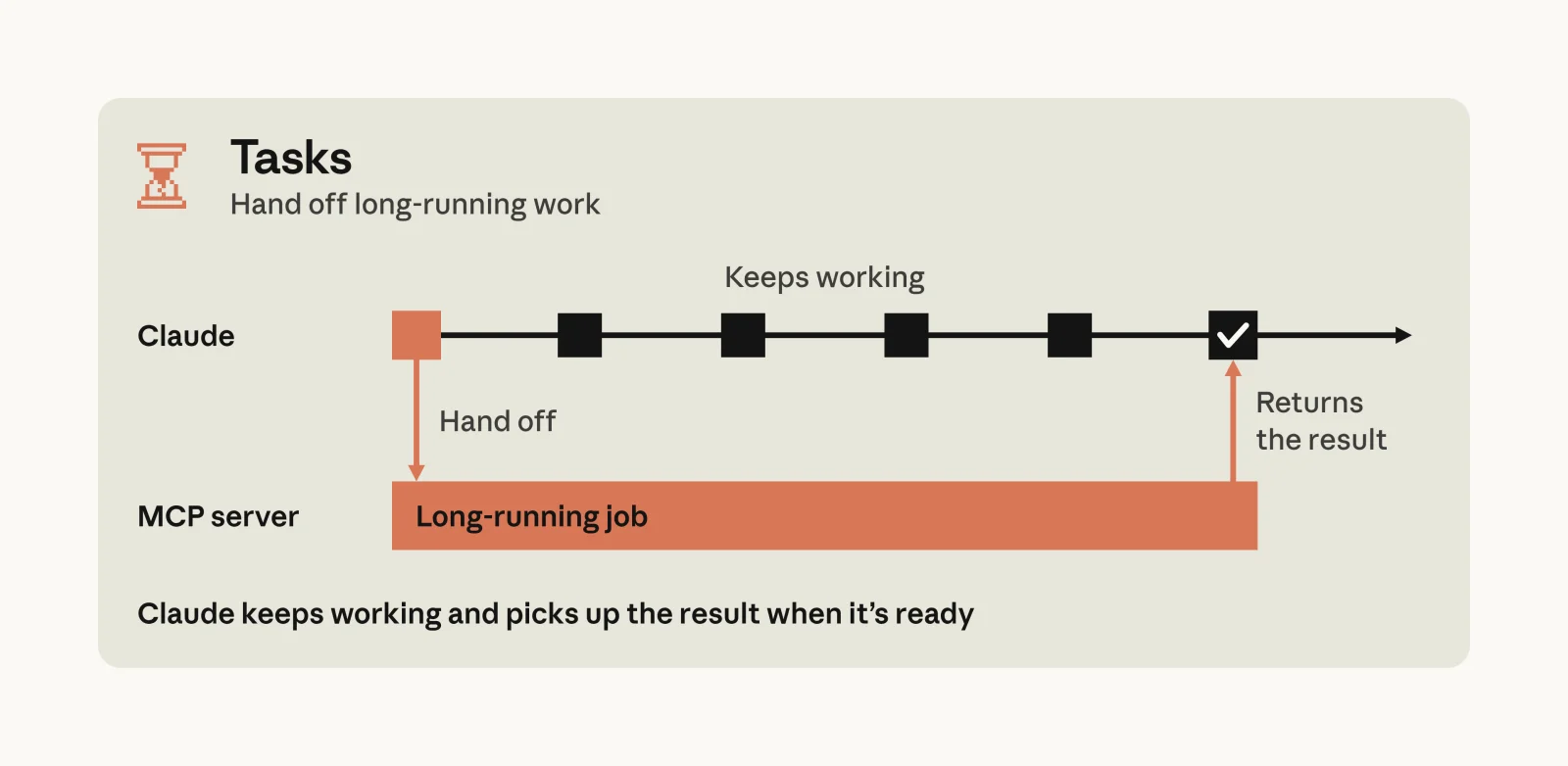 MCP Tasks let Claude delegate long jobs to a server while continuing other work
Image: Anthropic
Claude hands off a lengthy job, keeps working on other steps, and picks up the result when the server finishes. Anthropic cites ZoomInfo using Tasks for deeper research without blocking the chat thread.
Elicitation is the mirror image: the server stops and asks when automation would otherwise guess. Anthropic's examples—typing a GitHub repo name before deletion and confirming Supabase spend before creating a paid project—match the safety patterns we see in reflective tool agents that recover from bad MCP calls.
Both features are generally available as of the November 24 announcement and are part of the open MCP extensions, so they are not Claude-only hooks.
File uploads and what the MCP blog adds
File Uploads are coming soon: Claude will pass PDFs, spreadsheets, and images to servers without embedding megabytes in the prompt. The MCP blog birthday post also highlights a working group draft for large file transfer and Events (beta) so agents react when email arrives or a repo push lands—useful for CI agents that parallelize QA without polling loops.
None of that replaces client-side sandboxing. If your server accepts uploads, you still need virus scanning, PII redaction, and size limits the way you would for any web upload endpoint.
What developers should do this week
- Audit your MCP server README — Can you express your top three customer workflows as skills with stable IDs, not only as tool descriptions?
- Add Tasks support if any tool routinely runs more than ~30 seconds (reports, bulk exports, simulation jobs).
- Use Elicitation on irreversible or paid actions instead of burying warnings in tool docstrings nobody reads.
- Track spec drift — The MCP blog says maintainers are planning a March 2027 spec drop; pin SDK versions in CI.
- Compare hosting choices — Stateless 2026-07-28 servers scale on serverless; stateful flows may still need a session store until your paths migrate.
How this fits Anthropic's wider agent stack
Skills over MCP lands beside Claude Ship for PR stewardship, enterprise adoption research, and ongoing distillation defenses. The protocol layer is how third-party SaaS meets Claude without every vendor rebuilding OAuth and tool schemas from scratch.
For teams standardizing skills + MCP inside a single repo, review explainx.ai's agent skills workshop curriculum before you publish playbooks that contradict your server's tool hints.
Events, MCP Apps, and the builder conferences behind the numbers
The MCP birthday post is not only marketing copy. It documents spec commits ordinary teams depend on: stateless servers for load-balanced hosting, MCP Apps so Excalidraw-style UIs render inside ChatGPT, Claude, Goose, and VS Code, and Events (beta) so agents subscribe to email, GitHub, or calendar triggers instead of polling.
Anthropic's November tally also situates MCP inside a global maintainer calendar: MCP Dev Summit New York (~1,200 attendees), Bengaluru and Mumbai, Seoul, Shanghai–Tokyo–Amsterdam, Toronto, San Jose, and Nairobi in the past year. That matters if you are choosing whether to build on MCP versus a private JSON-RPC shim—the spec working groups and Discord moderators are the reason OAuth, enterprise auth, and file transfer land as extensions instead of ten incompatible forks.
None of that removes vendor risk. MCP is open, but Claude still controls which connectors appear in the default directory and which plan tiers see Skills over MCP first. Treat 700 million monthly SDK downloads as evidence of installer churn, not a guarantee your niche server will be discovered without docs and a registry listing.
Enterprise Managed Auth and token efficiency (why ops teams cared in 2026)
Before Skills over MCP, Anthropic emphasized Enterprise Managed Auth: admins approve a server once, and individual users stop hitting surprise OAuth consent screens on every laptop. That extension reached stable status in the MCP blog's 2026 recap and pairs with Tasks—background jobs are useless if refresh tokens expire mid-run because nobody standardized org-wide consent.
Tool search, also cited in Anthropic's article, attacks a different cost center: multi-server setups used to dump hundreds of tool definitions into the system prompt. Loading schemas on demand reportedly cuts context use by over 85% in Anthropic's testing. If you operate Claude Code parallel QA agents with GitHub, Linear, Sentry, and internal APIs connected at once, that optimization is the difference between fitting a task in the window and compacting away your plan every three turns.
Skills over MCP vs bundling skills in a Claude plugin
Anthropic's older MCP production article described two patterns: bundle skills + MCP in a Claude plugin (Cowork data plugin with 10 skills and 8 servers), or publish a skill next to a connector in the directory. Skills over MCP generalizes the second pattern so HubSpot-scale vendors can ship versioned playbooks without asking every customer to import a zip.
| Pattern | Best when | Tradeoff |
|---|---|---|
| Local SKILL.md folder | You control the agent host and want offline edits | Drifts from the vendor API when they ship breaking changes |
| Claude plugin bundle | You sell a vertical Cowork package | Tied to Anthropic's plugin manifest |
| Skills over MCP | You run the MCP server and own workflow truth | Requires spec-compliant skill metadata and client support |
| Skills only, no MCP | Pure prompt workflows with no live API | Cannot execute CRM or GitHub actions |
When design tools ship MCP plus packaged skills, the skill should own presentation and sequencing while the MCP server owns authentication and rate limits—the same split Anthropic documents in its skills plus MCP explainer.
Security and compliance checklist for new MCP features
File uploads and Tasks change your attack surface:
- Scan uploads for malware before parsers touch them; do not trust Claude's MIME sniffing as your only gate.
- Cap concurrent Tasks per user so a poisoned prompt cannot fork thousand-hour jobs.
- Log Elicitation prompts for SOC2 evidence that a human confirmed destructive tools.
- Redact PII in skill text that embeds account-specific examples.
If you are wiring agents that touch production, pair this release with our AI agent workshop format guide so operators know when MCP fits versus human-in-the-loop-only tools.
Related reading
- What is MCP? Model Context Protocol guide
- A2A vs MCP for multi-agent systems
- Google Stitch Skills and the Stitch MCP server
- Salesforce's 37 sales skills in Claude
- Expo Skills and the Expo MCP server
- Hugging Face inference routing via OpenRouter
- AgentReflex: recovering from noisy MCP tools
- Amazon Bedrock trusted access and Claude
- Claude Artifacts Install as app on Mac and Windows